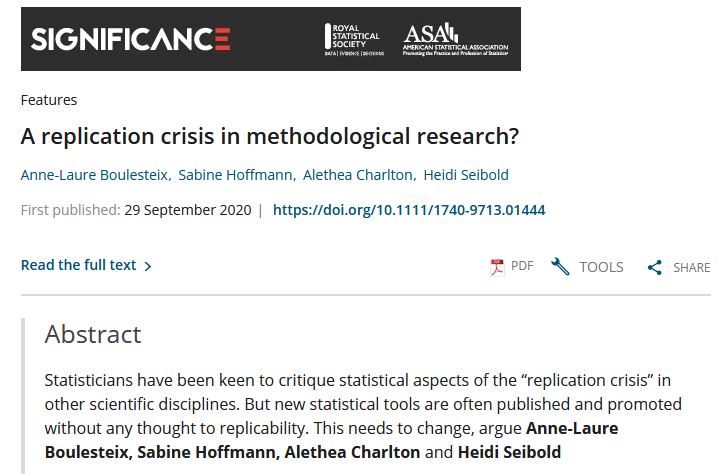
Happy to talk about the replication crisis in methodological statistical research at @METRICStanford international forum, Thursday March 18th 2021, CET 18.00-19.00.
https://t.co/tUKuaYtFvh
@stephensenn@melb4886@MaartenvSmeden It was a good discussion. I'm curious how this perspective considers risk prediction (Q-risk/Framingham), in which it seems representativeness is needed. On the genetics side, it seems we need it some cases (SNP association),but don't in others (conserved expression across cells)
@tangming2005 There are 2 areas to balance. 1st, one can't have
expertise in everything bioinformatics (although collaborators may assume this is possible), so we have to decide where to invest time. 2nd, we have to balance scientific interests and making efforts so that funding is stable.
@JeremySussman "GWAS loci often implicate genes of unknown function or of previously unsuspected relevance, and experimental follow-up of such loci can lead to the discovery of novel biological mechanisms underlying disease"
https://t.co/2DeECDBUS2
@JeremySussman "The primary goal of these studies is to better understand the biology of disease, under the assumption that a better understanding will lead to prevention or better treatment. The path from GWAS to biology is not straightforward"
https://t.co/GnPYmXmrVQ
@VickersBiostats Because there have always been flaws in papers, there is a reflexive tendency to criticize almost any analysis. There is not a unified message from statisticians so more thought has to be given to what is reasonable (even if one disagrees) and what is truly unacceptable.
Throwing this on the main thread in case of interest- great treatment of the subject both on the stats and the quick takeaways, from my favorite stats prof Rich Williams (whose notes I still reference or point students to!) https://t.co/T4qzvqzL8p
@MyKo101AB In many cases there multiple methods available for a given question. How do we select one, and how to do we decide others are incorrect? We cannot base this on expert opinion alone because thoughtful experts disagree. This doesn't get enough discussion in early courses.
@tangming2005 I am sure the developers appreciate the citation although it is hard convince collaborators why it is important to cite graphical packages. The main challenge comes from limitations on the number of references (<50), which makes it hard to cite every package you used.
@PhDemetri Consider SAS. The reputation for reliability is deserved from my experience. However, many analysis require user-developed "macros". So you are back to the same concerns with open source. But when presenting methods, the concern is hidden behind the brand.
@dinga92 I find most stat texts hard to read. Nice exceptions include Agresti (Categorical Data), Kruschke (Doing Bayesian), and parts of Fitzmaurice (Longitudinal). Andrew Vickers also has many clearly-written papers.
@AbbyCScience Vickers, 2006 provided a way to reconcile confusing ways in which risk models are compared, and also helped me understand why solutions are challenging.
https://t.co/sD8Ywo6gpz
@MaartenvSmeden ...and this doesn't make it less important. I am more afraid of research that claims to be causal or predictive but is not (eg wrong methodology https://t.co/fjRMHnp8pg or predictors from the future https://t.co/A7GieDHj9C)
Next time you get negative peer review comments, be like @MuinJKhoury.
Early in my career, he set the example on how to respond to critical comments.
Here's the story
1/