There are largely two types of academics: A and B. Their worlds are so different, so insular they don't even know the other type exists.
Type A:
> Comes from a middle, upper-middle class family
> Well-educated parents (with advanced degrees including PhDs)
> Parents map out their kid's career trajectory
> Parents teach academia's hidden curriculum: applications, admission essays, extracurriculars, and so on.
> Send the kid to a "good" school (private or private tutoring)
> Kid gets good grades
> Goes to Ivy League or Oxbridge or a similar top school for undergrad
> Decides to do a PhD
> Gets into another top program in a top school because of top undergrad school, duh
> Gets a well-connected supervisor during PhD
> Gets a tenure-track job offer from another top university in the final year of PhD even before graduation because of the supervisor, duh
> Fully understands the tenure clock
> Publishes papers, monographs on time
> Gets tenure
> Thinks PhD is easy, tenure is easy, academia is easy
> Marries a colleague in the same university
> Has kids
> The cycle repeats
Type B:
> Comes from a dysfunctional, working-class family
> Parents who barely graduate high school
> Parents with no idea what kind of education their kids need
> Goes to a no-name shit school with underqualified teachers
> Then goes to a community college or some such institution if lucky, joins the military if unlucky (KIA.exe)
> Reads a lot, become autodidact, becomes a half-decent writer
> Someone suggests, do a PhD, become a professor
> Likes the idea of academic life, starts applying to PhD programs
> Gets rejected from top programs because don't have good recommendation letters or connections
> Goes to a third tier PhD program in a university located in the middle of nowhere
> PhD stipend is not enough, has to work part-time to make ends meet
> Lives in a shitty apartment, sometimes eats at the soup kitchen
> Still works hard and publishes a bunch of papers
> Thinks I'll write my way out of poverty
> Sees a bunch of Type A PhDs in conferences, tries to "network" with them, Type A folks recognize Type B PhDs and stay away from them.
> Defends PhD where the committee says this is excellent work and imminently publishable
> Applies to tenure-track jobs left, right, and center. Gets rejected from everywhere
> Idea of being unemployed with a PhD causes desperation
> Gets a temporary teaching job, gets paid per course basis with no health benefits
> Spends a few years as adjunct with semester to semester renewal of job contract
> Barely survives, has to take up part-time jobs
> Get a one-year postdoc, decides to turn PhD dissertation into a monograph in the hopes it will get tenure-track job
> Postdoc ends, back to temporary adjunct jobs
> Monograph stays incompelete, no time to work on it
> Tries moving out of academia, is considered over-qualified
> Reads social media posts by Type A academics saying PhD is easy, academia is easy
> Thinks, what could I have done better?
Fei-Fei Li ( @drfeifei ) beautifully explains Robotics.
She defines robotics not by form, like humanoids or cars, but by function: they are any "embodied machines" that must perceive, understand, and act within a physical, 3D space.
This core requirement is "spatial intelligence," the unifying principle of all robotics, allowing them to perform tasks and even collaborate with humans.
Throughout all of human history, we have been confined to a single, shared reality: the "physical Earth 3D world."
This singularity has been our only playground.
However, new technologies that combine 3D generation and reconstruction are shattering this limitation.
We can now create "infinite universes"—a multiverse of digital worlds for countless purposes, from training robots to enabling creativity, travel, and storytelling.
This leap from one physical world to an infinite multiverse unlocks boundless possibilities for human imagination and interaction.
Video from @a16z
I see every week on X an announcement or demo which implies that robotic manipulation has been solved. The only reason I don't believe it is because manipulation had already been solved last week by somebody else! So may I propose the "5 year old paired comparison test" ? At the next conference let's set up a number of tables to which you can bring your robot hardware. Next to it we will have another table where there will be a 5 year old child. In parallel we will try 100 different manipulation tasks that a neutral person has chosen- we could start with "pick up anything" - only household objects (e.g. as might be found in a typical American home) will be used, and we compare the performance of your robot with that of the 5 year old. Can you pick up a coin? Or a book? Or untwist a bottle top? Or insert any plug into a matching socket? Rotate one face of a Rubik's cube? Until your robot can do all the "open world manipulation" that a 5 year old kid can, some humility is in order.
Fine-Tuning: Success can be found by training a robot to do one specialized task exceptionally well (e.g., folding a specific hospital towel) and then fine-tuning that model for adjacent tasks
Quasi-Static Manipulation: Many current manipulation successes are "short-horizon" and "quasi-static" (relying on position rather than dynamic forces), which may not scale to the full range of human dexterity.
Don't Be a Purist: Avoid the dogma of "data only." The most effective current systems (like those from Boston Dynamics) hybridize learned keypoints with traditional Model Predictive Control (MPC).
✨ New in LeRobot ✨
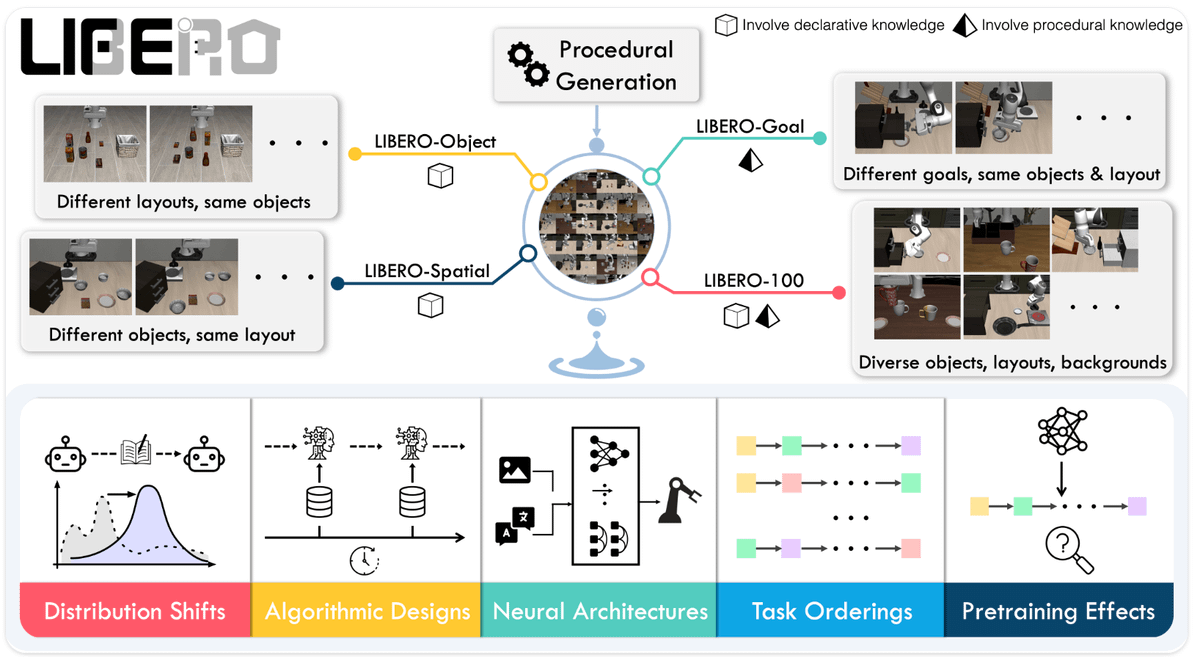
We now officially support LIBERO, one of the largest open benchmark for Vision-Language-Action (VLA) policies with 130+ tasks 🤯
Why this matters:
🧩 Unified benchmark: evaluate any VLA policy under a common setup.
🛠️ Easy integration: just install lerobot, and you’re ready to run LIBERO tasks.
📊 Baseline condition: LIBERO is now the default benchmark for adding new VLAs to LeRobot.
🔗 Dataset: https://t.co/ekUHOP2SKs
📚 Docs: https://t.co/n2WxEQCTYo
This is a huge step toward building the go-to evaluation hub for VLAs.
Let’s make robot learning as open and reproducible as NLP & CV. 💪
👉 Try it out today, share your runs, and let’s push forward the frontier of embodied AI together!
Many people think LLMs are non-deterministic. This is often not true!
You just need 3 lines of code to make your LLM deterministic
LLMs (as any PyTorch model) are non-deterministic only when they include certain operations or when using multiple GPUs
Try the code yourself
“LET MEN SUFFER” These are the words of Renuka Choudhary the woman behind India's regressive Domestic Violence Law. When confronted about its one-sidedness, that was her reply. #JusiceForAtulSubhash#JusticeIsDue#NikitaSinghania
Hey everyone!
I've been getting a lot of DMs for guidance, so decided to take action on it.
I'm excited to help folks out and give back to the community via Topmate. Don't hesitate to reach out if you have any questions or just want to say hi!
I'm at https://t.co/U6T3aBBOSA
Persistence and Patience: The Path to Opportunity In the pursuit of opportunities, putting in maximum effort doesn't always guarantee success. However, it's essential to maintain unwavering hope. #persistence#opportunity#successmindset
Remember: "Maintain your belief even as others seem to have their wishes fulfilled. If your own blessings are yet to arrive, stay resolute."
#persistence#opportunity#successmindset