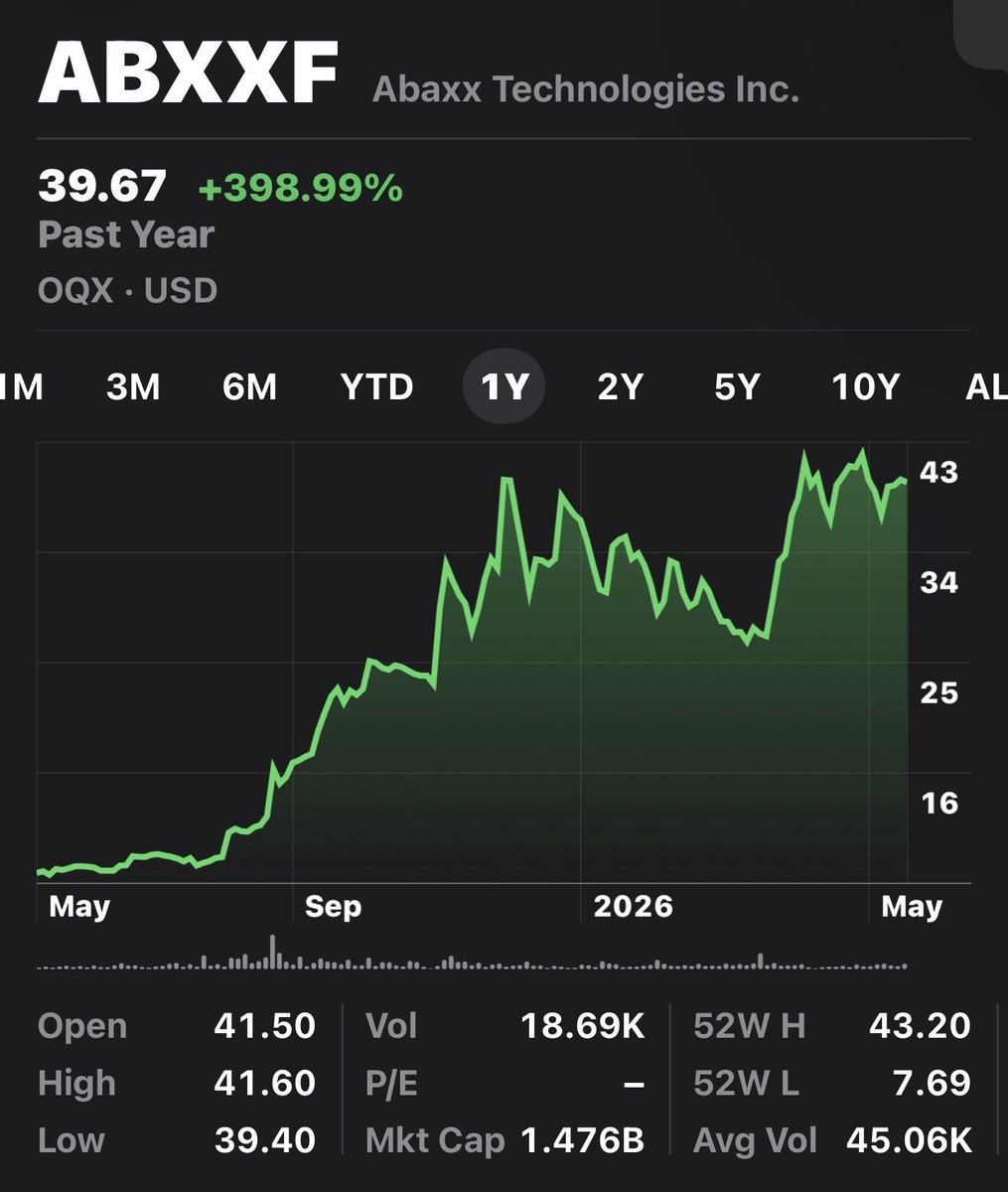
You can’t print molecules (or atoms or joules). $Abaxx is a physically settled commodities exchange that will drive true price discovery and the flow of commodities globally.
As the picks and shovels play of the most asymmetric trade in financial history, $ABXX has exponential volume growth and a game-changing technology that can enable tokenization of real world assets.
The Abaxx Exchange has been setting new trading volume records, highlighted by its first 50k contract day. The 50k volume level positions ABAXX as an emerging global benchmark exchange while signalling that operating breakeven economics are within reach.
Additionally, $ABXX will be uplisted to the Toronto Stock Exchange this Thursday, opening up potential index inclusion in the weeks or months ahead driving more liquidity and lower cost of capital.
Volumes were primarily driven by the Singapore #Gold Kilobar (SGK) & our emerging flagship #LNG (GOM, NPA) benchmarks.
CEO Josh Crumb and I will be on an ATB client call this Thursday at 11am ET. Please contact your ATB representative for details.
Catching up on the Abaxx Technologies investor call.
They’ve been telling us about their vision for a long time, and people are slowly waking up to it now. 6 years in the making.
What a masterclass in execution! @JoshCrumb@abaxx_exchange $ABXX 👏🏽
@calvinfroedge I tried to buy some B3SA3 today but they don’t let you convert USD to BRL. IKBR lets you buy in USD but then you have a weird negative BRL balance. Haven’t figured this out yet
The company is signaling that they are ready to go. This press release increases my confidence that the federal environmental permit is coming soon
https://t.co/JZCefOONa5
Denison $DNN has been quiet on their federal environmental licensing approval after two recent events:
1/ PBCN filed for a judicial review, challenging the Sask. govt over the environmental assessment
2/ Part 2 of the public hearing with the Canadian Nuclear Safety Commission (CNSC)
Luckily, all of the documents from the hearing are publicly available! https://t.co/wzBpysXSvu
The Headlines:
"Based on the licensing regulatory review and technical assessments, CNSC staff have determined that Denison’s license application to prepare site and construct the Wheeler River Project complies with all applicable regulatory requirements and that the proposed Wheeler River Project is protective of people and the environment."
"CNSC staff do not predict any direct impacts to PBCN’s Indigenous and treaty rights as a direct result of the Project if approved, based on the information shared to
date"
The Staff Submission also highlights ongoing engagement between CNSC and PBCN throughout the year, even mentioning "CNSC staff reached out to PBCN regarding setting up technical meetings with PBCN’s consultants however, CNSC have not received a request from PBCN for these meetings to date"
Based on the official stance from the CNSC, I'm expecting $DNN to receive their federal environmental permits ~soon. They are nearly fully funded for a 2 year construction timeline and very likely to get into production this decade, well ahead of NexGen.
Let the second upswing of the Lassonde Curve begin 📈
2025 was a transformational year for Abaxx, marked by the ramp of trading volumes and new markets on @Abaxx_Exchange, FBOT designation from @CFTC, the launch of @Abaxx_Spot & Adaptive Infrastructure, and the first commercial applications of our ID++ protocol to unlock the collateral value of commodities & bring real-time collateral to regulated markets.
Many thanks to our partners, team, shareholders, and network as we continue to build smarter markets; we look forward to 2026.
@gave_vincent For someone from NYC that has never been China, which cities do you recommend visiting to see their culture and development on full display?
The most interesting part of the $ASPI $QLE earnings call has to be the new LEU+ concept
Higher enrichment grades of 5-10% compared to 3-5% for normal LEU
This allows reactors to run longer between refueling, extending life and producing more power per fuel bundle
Great stuff here on Brazil $EWZ
I love how Louis describes the US <> LATAM <> China situation as "heads I win, tails I don’t lose" for major Latin American economies
Cheap valuations + strategically positioned to benefit from any outcome of US/China tensions. Love this trade
One of Gavekal’s key themes this year has been the rebuild of “Fort Monroe”; a US that refocuses its foreign and economic policies towards Latam. This, we argued, would be very bullish Latam debt and equity markets.
But, after an impressive performance in 2025 for the region’s debt markets, is the trade done? Last week, I caught up with my friend Alexandre Larrain of @larrainvial to discuss this very issue. As we both see it, momentum in the trade is strong, valuations of both bonds and currencies remain attractive and 2026 could witness a number of positive political catalysts. Our conversation is below:
https://t.co/QwdbI3t4X4
Perhaps the most notable observation of today’s selloff is that neither the U.S. dollar nor Treasuries rallied as they typically would.
Frankly, that’s the kind of behavior we would expect from an emerging market economy.
Instead, US stocks led the decline, while EM — the overlooked and underowned segment — actually outperformed.
My two cents:
Pay attention to these signals.
We’re likely to see more of this dynamic, not less.
Highly recommend $ASPI $QLE $SKBL investors start using the https://t.co/EfjBdxKRRj community board under the ASPI ticker.
This is a great place to discuss research and what’s coming next for this stock. The site automatically posts all press releases into the chat in real time
A mortgage approval should not be a 30-year fixed process 🏡
We’re speeding it up with new updates to our tools to help lenders modernize with real-time, single-source data.
With our mortgage tools, lenders will now see:
✅ Upgraded Verification of Assets (VOA) reports with more insights and employment refreshes
🔗 Simplified, secure account linking experiences resulting in conversion as high as 80%
🔁 Direct LOS and POS integrations enabling easier workflows
With 45M+ verifications powered to date, Plaid is continuing to help mortgage lenders move towards a faster, smarter process built on real-time financial data.
Pair this with the recent post from @leomironov about his travels in the suburbs of Beijing.
Combined together, it makes you realize the future is taking place in China right now. Maybe, just maybe, it’s not as bad as western leaders want you to believe
https://t.co/y8SFbhluvo
Listening to @gave_vincent takes me back to my East Asian Studies lectures in school - incredibly dense information wonderfully stitched together in a free flowing story and narrative. Must listen.
MacroVoices @ErikSTownsend & @PatrickCeresna welcome, Louis-Vincent Gave @gave_vincent. They'll discuss his long-term perspective on China’s role in the global economy, highlighting both its extraordinary infrastructure ambitions and the challenges of securing foreign capital amid shifting geopolitical realities. https://t.co/vu4OJ8c3TS
$QFIN
Seen a lot of information out there regarding the new banking regulations in China. Thought I’d summarize what I found and how it relates specifically to Qfin Holdings.
1. Timeline Enforced 24% Cap:
December 1, 2024:
NFRA Announcement No. 112.
Immediate cap on all new loans, cannot exceed 24% APR. Previously there was a band-range, 24-36%, still technically accepted but legally unenforcebale through the courts.
» No new loans over 24%
June 1, 2025:
A six-month grace-period was extended for existing loans, but by June 1, 2025 all loans must comply with 24%.
Since their on-balance-sheet loans have an average APR around 22%, this should have mostly affected light-capital issuance.
While Q1 was seemingly unaffected (perhaps lagged reaction from partnered-banks), Q2 issuance was down 20% compared to 25Q1 and 24 Q2,3 and 4 (4,8B compared to 5,8-6,6B)
2. PBOC CRC Credit-Scoring
September 23, 2024: PBOC Circular No. 189
January 1, 2025:
All loans must be registered with the PBOC CRC (People’s Bank of China, Credit Reference Center)
Mars 1, 2025:
FinTechs are forced to ”shut-down” independent credit-scoring models.
October 1, 2025:
The PBOC CRC acts as ‘Primary Score’ for all new loans, while additional data serves as supplement.
PBOC’s reasoning (intention with regulation)
While the 24% rate-cap at first glance seems the most impactful change in regulation, the change to a centralized Credit-Scoring system is something much more impactful. A centralized credit-rating for all customers forms a hard-cap for rates, using three metrics:
1. Debt-to-Income
a. No more than 50%
2. Repayment history.
a. Late payments etc. damages scores.
3. Credit-utilization.
Explicit intentions:
» Eliminate the possibility of customers to hide current loans from banks while taking out new loans. All loans visible, no more than 3.
» Hard cap 24%.
» Remove subprime-lenders. Those ruled delinquent are not allowed loans even though a companies own propretiary model judge differently.
Consequences for QFIN
The new regulation establishes a firm interest-band for interest rates. Before, QFIN’s used their proprietary data to identify borrowers that fell outside the scope of regular banks.
Qfin’s own model, TRIDENT MLLM, used:
· Usage of apps and phone.
o Frequency of logins.
o Budget tools.
o Long-term usage of same phone/IP-adress.
o Speed of loan-application.
o Battery-charge/ book about machine-learning
· Social Patterns
o Default rates among social group.
o Purchase behavior.
o Social Media
A few of these data-points are no longer allowed with the new rules, mainly social patterns and tracking behaviour.
However, the CRC is still inflexible. While the regulation completely eliminates those deemed ‘credit-unworthy’, removing those from the customer pool, all other customers have simply fallen into a spectrum.
Qfin’s advantage has and continues to be identifying customers midjudged by a general credit-score. This suggests identifying customers placed around APR 22-24% that, with a more dynamic model, deserved a lower rate (for example, 15-20%).
The change might have an immediate effect on new issuance, but when things settle, Qfin’s position might very well have strengthened. Banks are still inflexible. Qfin utilize proprietary models for fraud-detection and evaluation. And a change like this, higher compliance and narrowed customer-base, eliminates every actor that barely survived solely on the upper-band.
In summary, I think the reaction is overblown.