Unfortunately, it is hard to trust *claims* in 2025.
What’s easier to trust is *incentives*.
So here’s an incentive: I’ll pay a $3,000 bounty to the first person who uses this method to improve either the NanoGPT or CIFAR-10 speedruns
https://t.co/smolXytR6u
We are living in a timeline where a non-US company is keeping the original mission of OpenAI alive - truly open, frontier research that empowers all. It makes no sense. The most entertaining outcome is the most likely.
DeepSeek-R1 not only open-sources a barrage of models but also spills all the training secrets. They are perhaps the first OSS project that shows major, sustained growth of an RL flywheel.
Impact can be done by "ASI achieved internally" or mythical names like "Project Strawberry".
Impact can also be done by simply dumping the raw algorithms and matplotlib learning curves.
I'm reading the paper:
> Purely driven by RL, no SFT at all ("cold start"). Reminiscent of AlphaZero - master Go, Shogi, and Chess from scratch, without imitating human grandmaster moves first. This is the most significant takeaway from the paper.
> Use groundtruth rewards computed by hardcoded rules. Avoid any learned reward models that RL can easily hack against.
> Thinking time of the model steadily increases as training proceeds - this is not pre-programmed, but an emergent property!
> Emergence of self-reflection and exploration behaviors.
> GRPO instead of PPO: it removes the critic net from PPO and uses the average reward of multiple samples instead. Simple method to reduce memory use. Note that GRPO was also invented by DeepSeek in Feb 2024 ... what a cracked team.
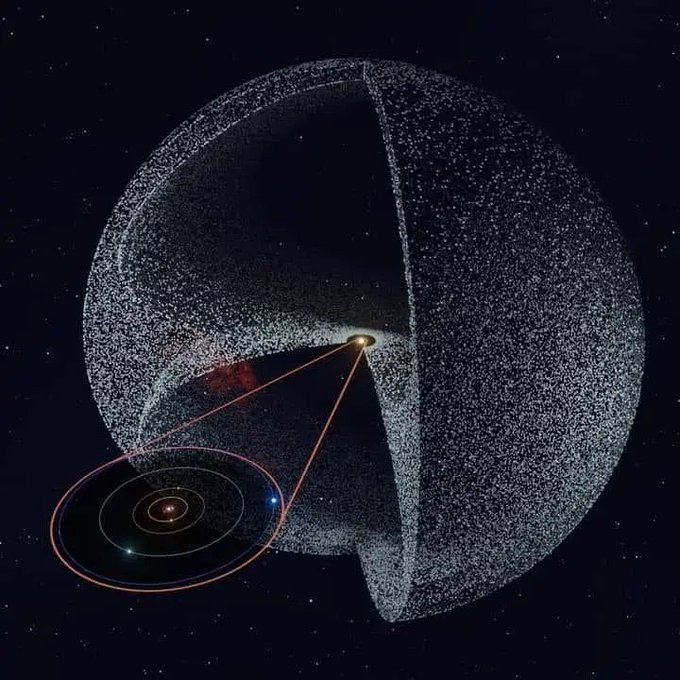
Imagine a massive celestial bubble made of ice and dust surrounding our Solar System. That’s the Oort cloud and this is its scale.
The Oort Cloud lies at the very edges of the Solar system. Even the farthest ones which are still working, like Voyager 1, Voyager 2 and New Horizons didn't go beyond the cloud.
Long-period comets, taking centuries to orbit the Sun, provide evidence for the existence of the Oort Cloud. Scientists believe this vast region is the birthplace of these cosmic travelers.
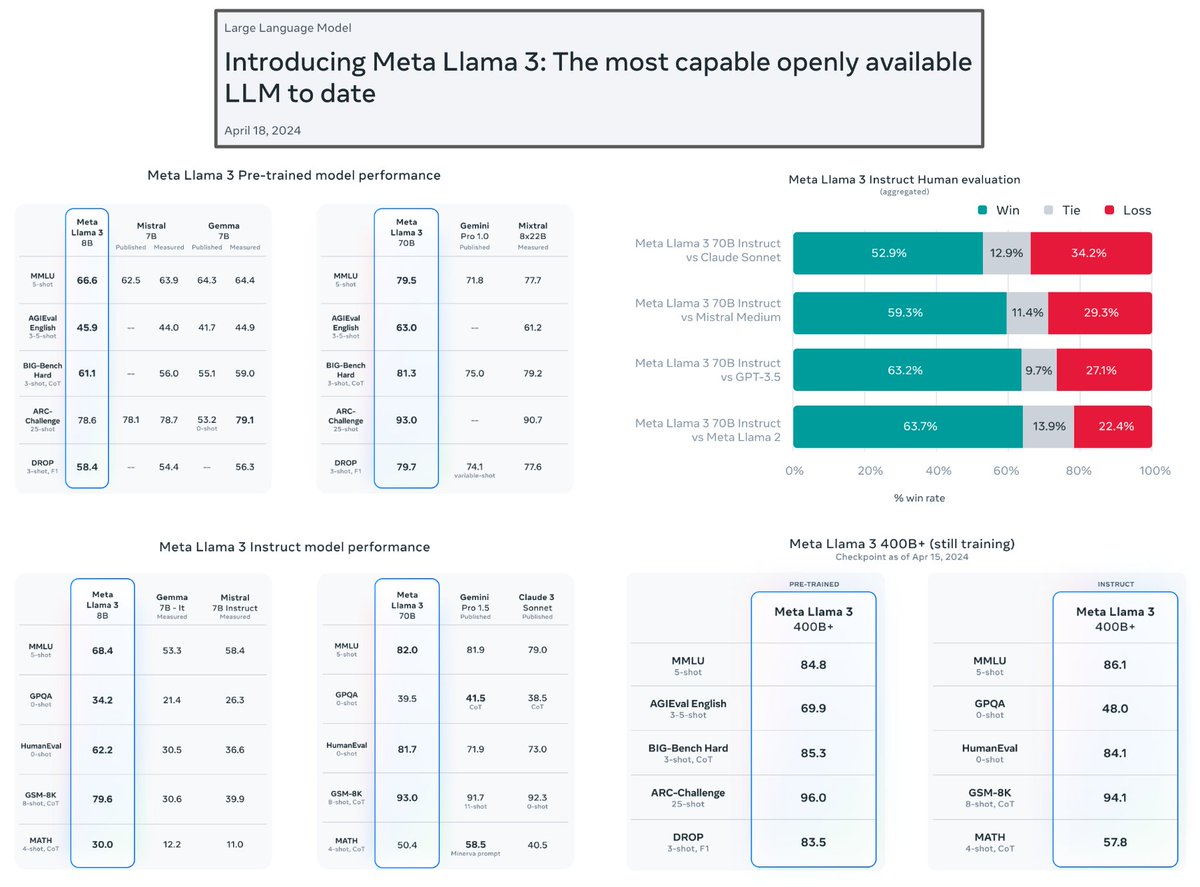
LLaMA-3 is a prime example of why training a good LLM is almost entirely about data quality…
TL;DR. Meta released LLaMA-3-8B/70B today and 95% of the technical info we have so far is related to data quality:
- 15T tokens of pretraining data
- More code during pretraining (leads to better reasoning capabilities)
- More efficient tokenizer with larger vocabulary
- Super sophisticated (including LLM components) data quality filtering
- Extensive empirical analysis of data mixture
- Focus on quality filtering of post training data (for SFT/RLHF/DPO)
All of the cool stuff in this report is related to how to curate data effectively for pre/post-training! This really shows that data curation/filtering is the most difficult and impactful aspect of training foundation models.
(1) Model architecture: Only 5 sentences are provided about the model architecture, which simply state that LLaMa-3 uses a standard decoder-only architecture with grouped query attention to improve inference efficiency (and a longer 8K context). It’s pretty clear that model architectures are becoming standardized, and most of the research focus is going into constructing datasets. In fact, the main architecture modification made by LLaMA-3 is a more efficient tokenizer!
“Llama 3 uses a tokenizer with a vocabulary of 128K tokens that encodes language much more efficiently, which leads to substantially improved model performance.” - from LLaMA-3 blog
(2) Better tokenizer: LLaMA-3 comes with a custom tokenizer with a vocabulary of 128K tokens (LLaMA-2 had a vocabulary of 32K tokens). This tokenizer is more token efficient (i.e., fewer tokens are necessary to encode the same piece of text relative to LLaMA-2), which makes inference more efficient. Authors also note that the new tokenizer improves performance! In other words, making sure that we are encoding the model’s input data correctly is super important.
(3) Massive pretraining corpus: LLaMa-3 is pretrained over 15T tokens of text (5% non-English), which is a 7X improvement over LLaMA-2 and even larger than the 12T pretraining corpus of DBRX. The pretraining corpus also has 4X more code relative to LLaMA-2 (this was a big criticism of LLaMA-2). With this in mind, it’s not a surprise that LLaMA-3 has strong reasoning/code capabilities—several papers have correlated pretraining on code to better downstream reasoning in LLMs.
“We found that previous generations of Llama are surprisingly good at identifying high-quality data, hence we used Llama 2 to generate the training data for the text-quality classifiers that are powering Llama 3.” - from LLaMA-3 blog
(4) FIltering pretraining data: Few concrete details are provided on the filtering process for the pretraining corpus of LLaMA-3, but it’s clear that a lot of filtering is done. These filters include heuristic filters, NSFW filters, semantic deduplication, and text classifiers to predict data quality. Plus, authors note that LLaMA-2 is very good at detecting text quality, so they use these models in the filtering process (see above). Authors also mention that they do extensive empirical analysis to figure out the correct data mixture (DBRX also mentions this is hugely important).
(5) Overtraining: Chinchilla proposed the compute optimal training regime for LLMs, but recent work indicates that pretty much everyone overtrains their LLMs relative to the compute-optimal ratio. LLaMA-3 is pretrained on two orders of magnitude more data (for the 8B model) beyond the compute-optimal ratio, and we still see log-linear improvements. Sure, we could train a larger model on fewer tokens and achieve similar performance while spending less on training compute. But, this doesn’t consider inference costs! We almost always will pay for more training compute if it means we can deploy a smaller model with the same performance.
“The quality of the prompts that are used in SFT and the preference rankings that are used in PPO and DPO has an outsized influence on the performance of aligned models.” - from LLaMA-3 blog
(6) Post training data quality: Even beyond pretraining, data quality is pivotal for LLaMA-3! The model is aligned with a combination of SFT, rejection sampling, PPO, and DPO. During alignment, authors claim that the quality of supervised/preference data is super important. In fact, the biggest quality improvements in LLaMA-3 came from curating this data and performing multiple rounds of quality assurance on humans annotations!
# scheduling workloads to run on humans
Some computational workloads in human organizations are best "run on a CPU": take one single, highly competent person and assign them a task to complete in a single-threaded fashion, without synchronization. Usually the best fit when starting something new. Comparable to "building the skeleton" of a thing.
Other workloads are best run on a GPU: take a larger number of (possibly more junior) people and assign tasks in parallel: massively multi-threaded, requiring synchronization overhead. Usually a good fit for later stages of a project, or parts that naturally afford parallelism, comparable to "fleshing out" a thing when the skeleton is there.
There's some middle ground here - sometimes you can imagine a multi-threaded CPU execution of a small team collaborating.
A good manager will understand the computational geometry of the project at hand and know when to delegate parts of it on the CPU or on the GPU. One notable place where the analogy breaks down a bit is that the worst thing that can happen when you misallocate computer resources is that your program will run slower. But in human organizations it can be much worse - not just slower, but the result can be of lower quality overall, more brittle, more disorganized, less consistent, uglier.
The most common stumbling point here is trying to parallelize something that was supposed to run on the CPU. In the common tongue, this comes from the misunderstanding that something can go faster if you put more people on it, usually leading to outcomes where something is "designed by a committee" - not only is the thing actually slower, but the philosophy is inconsistent, the entropy is high, and the long-term outcomes much worse.
The opposite problem is more rare and usually looks like someone doing something repetitive, uninteresting or tedious, where they could really benefit from more help.
I think this is one accidental advantage of startups - they lack resources of large companies and run compute on powerful CPUs, winning in cases where that is the right thing to do. Larger companies, especially in cases where something is deemed of high strategic importance, will almost always reach for too much parallelism.
TLDR: Think about your project, its computational geometry, its inherent parallelism, and which parts are a best fit for a CPU or a GPU.
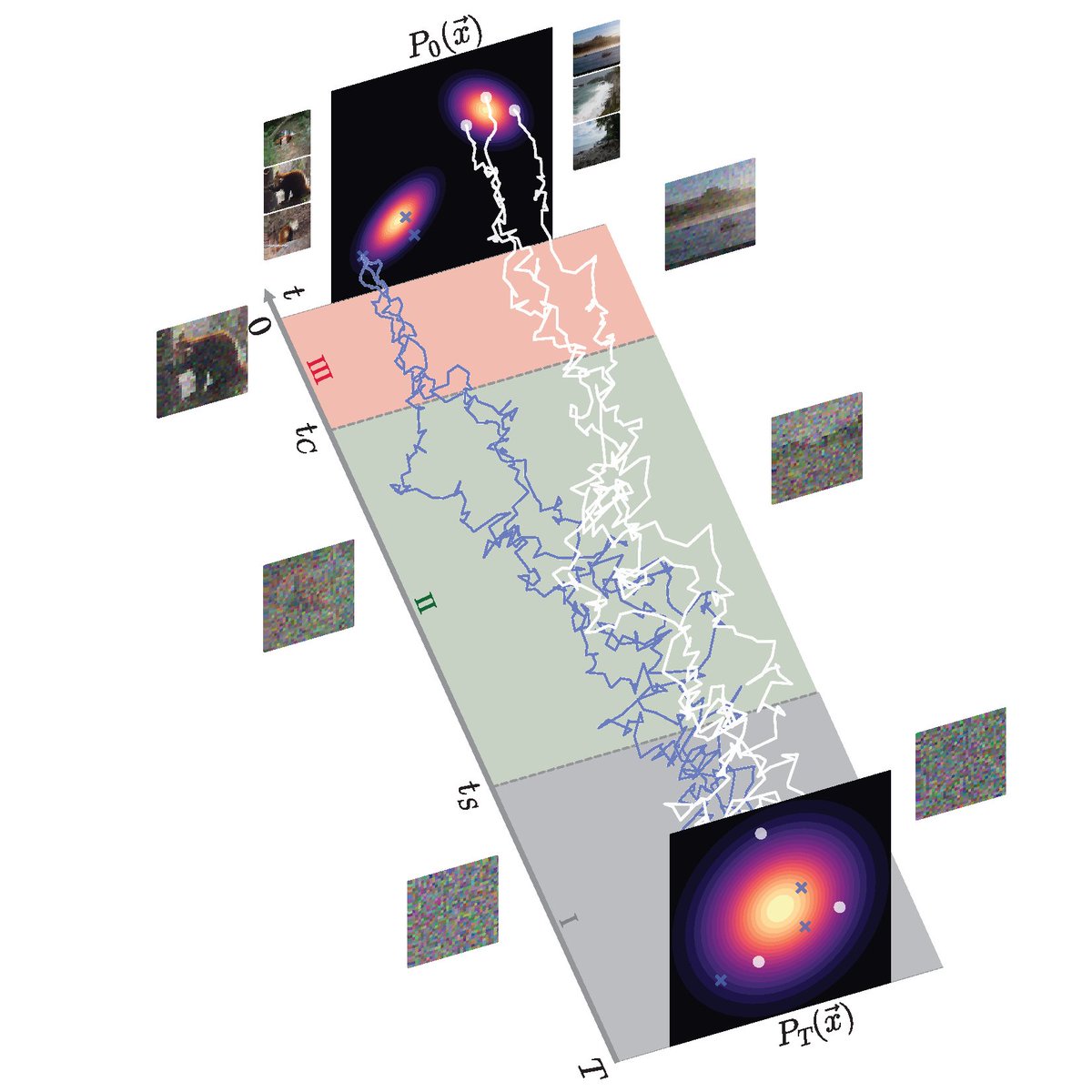
The statistical physics of generative diffusion models is getting hot!
As shown in our paper and analyzed here, class separations is a symmetry breaking phase transition.
On the other hand, memorization is the result of a transition similar to condensation in glassy systems!
Our paper on dynamical regimes of diffusion models is out https://t.co/INbgpEcUoc ! A great collaboration with @MarcMezard T. Bonnaire @ValentinDeBort1 analysing generative AI using statistical physics concepts and methods, in particular symmetry breaking & glass transitions.
I am really excited to reveal what @GoogleDeepMind's Open Endedness Team has been up to 🚀. We introduce Genie 🧞, a foundation world model trained exclusively from Internet videos that can generate an endless variety of action-controllable 2D worlds given image prompts.
Tim is one of the most imaginative researchers I know, and Genie is one of his most imaginative works. Unlike Sora, Genie is actually a proper action-driven world model with inferred actions.
2024 will also be the Year of Foundation World Models!
Congrats 👏👏
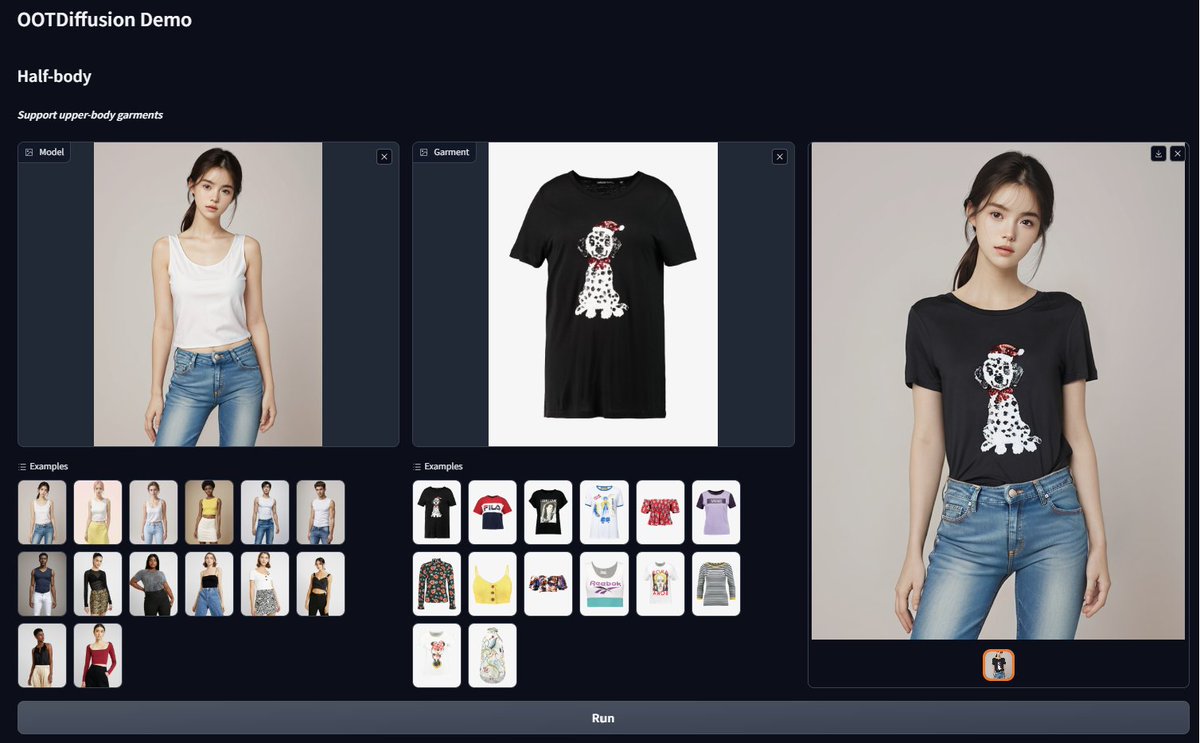
📢Fascinating research alert: 𝐎𝐎𝐓𝐃𝐢𝐟𝐟𝐮𝐬𝐢𝐨𝐧: 𝐎𝐮𝐭𝐟𝐢𝐭𝐭𝐢𝐧𝐠 𝐅𝐮𝐬𝐢𝐨𝐧 𝐛𝐚𝐬𝐞𝐝 𝐋𝐚𝐭𝐞𝐧𝐭 𝐃𝐢𝐟𝐟𝐮𝐬𝐢𝐨𝐧 𝐟𝐨𝐫 𝐂𝐨𝐧𝐭𝐫𝐨𝐥𝐥𝐚𝐛𝐥𝐞 𝐕𝐢𝐫𝐭𝐮𝐚𝐥 𝐓𝐫𝐲-𝐨𝐧
🔥How cool is that: A model and a gradio demo that can assist with Virtual Try-on!
You *need* to try @SupermavenAI.
It's a huge improvement over Github Copilot.
INSTANT code suggestions.
Massive (300k) context length.
Watch me use it to build a Flask API in seconds.
Career update: I am co-founding a new research group called "GEAR" at NVIDIA, with my long-time friend and collaborator Prof. @yukez. GEAR stands for Generalist Embodied Agent Research.
We believe in a future where every machine that moves will be autonomous, and robots and simulated agents will be as ubiquitous as iPhones. We are building the Foundation Agent — a generally capable AI that learns to act skillfully in many worlds, virtual and real.
2024 is the Year of Robotics, the Year of Gaming AI, and the Year of Simulation. We are setting out on a moon-landing mission, and getting there will spin off mountains of learnings and breakthroughs.
Join us on the journey: https://t.co/uco72rPngl
Love letter to @obsdmd to which I very happily switched to for my personal notes. My primary interest in Obsidian is not even for note taking specifically, it is that Obsidian is around the state of the art of a philosophy of software and what it could be.
- Your notes are simple plain-text markdown files stored locally on your computer. Obsidian is just UI/UX sugar of pretty rendering and editing files.
- Extensive plugins ecosystem and very high composability with any other tools you wish to use because again it's all just plain-text files on your disk.
- For a fee to cover server costs, you can also Sync (with end-to-end encryption) and/or Publish your files. Or you can use anything else e.g. GitHub, it's just files go nuts.
- There are no attempts to "lock you in", actually as far as I can tell Obsidian is completely free of any user-hostile dark patterns.
For some more depth, I recommend the following writing from CEO @kepano:
- "File over app" https://t.co/SigWj8uCrf . If you want to create digital artifacts that last, they must be files you can control, in formats that are easy to retrieve and read. Accept that all software is ephemeral, and give people ownership over their data.
- "100% user-supported" https://t.co/2qDJXub7cs . On incentives alignment.
- "Quality software deserves your hard‑earned cash" https://t.co/qfNjSEwbLf
TLDR: This is what software could be: private, secure, delightful, free of dark patterns, fully aligned with the user, where you retain full control and ownership of your data in simple, universal formats, and where tools can be extended and composed.
The Top ML Papers of the Week (Feb 19 - Feb 25):
- LoRA+
- Gemma
- Stable Diffusion 3
- OpenCodeInterpreter
- Revisiting REINFORCE in RLHF
- CoT Reasoning without Prompting
...
Over the last two days after my claim "long context will replace RAG", I have received quite a few criticisms (thanks and really appreciated!) and many of them stand a reasonable point. Here I have gathered the major counterargument, and try to address then one-by-one (feels like a paper rebuttal):
- RAG is cheap, long context is expensive. True, but remember, compared to LLM, BERT-small is also cheap, and n-gram is even cheaper, but they are not used today, because we want the model to be smart first, then makes smart models cheaper -- history of AI tells it is much easier to make smart models cheaper than making cheap model smart -- when it is cheap, it's never smart.
- Long context can mix retrieval and reasoning during the whole decoding processing. RAG only does the retrieval at the very beginning. Typically, given a question, RAG retrieves the paragraphs that is related to the question, then generate. Long-context does the retrieval for every layer and every token. In many cases the model needs to do on-the-fly per-token interleaved retrieval and reasoning, and only knows what to retrieve after getting the results of the first reasoning step. Only long-context can do such cases.
- RAG supports trillion level tokens, long-context is 1M. True, but there is a natural distribution of the input document, and I tend to believe most of the cases that requires retrieval is under million level. For example, imagine a layer working on a case whose input is related legal documents, or a student learning machine learning whose input are three ML books -- does not feel as long as 1B right?
- RAG can be cached, long-context needs to re-enter the whole document. This is a common misunderstanding of long-context: there is something called KV cache, and you can also design sophisticated caching and memory hierarchy ML system working with kv cache. This is to say, you only read the input once, then all subsequent queries will reuse the kv cache. One may argue that kv cache is large -- ture, but don't worry, we LLM researchers will give you crazy kv cache compression algorithms just in time.
- You also want to call a search engine, which is also retrieval. True, and in the short term, it will continue to be true. Yet there are crazy researchers whose imagination can be wild -- for example, why not letting the language model directly attend to the entire google search index, i.e., let the model absorb the whole google. I mean, since you guys believe in AGI, why not?
- Today's Gemini 1.5 1M context is slow. True, and definitely it needs to be faster. I'm optimistic on this -- it will definitely be much faster, and eventually as fast as RAG
Let's see how things go, shall we?
YOLOv9
Learning What You Want to Learn Using Programmable Gradient Information
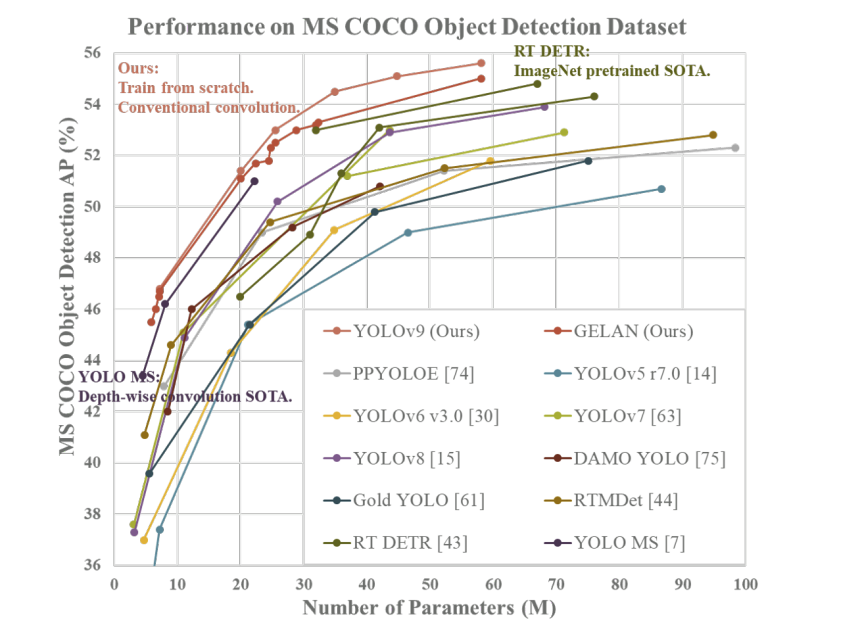
Today's deep learning methods focus on how to design the most appropriate objective functions so that the prediction results of the model can be closest to the ground truth. Meanwhile, an appropriate architecture that can facilitate acquisition of enough information for prediction has to be designed. Existing methods ignore a fact that when input data undergoes layer-by-layer feature extraction and spatial transformation, large amount of information will be lost. This paper will delve into the important issues of data loss when data is transmitted through deep networks, namely information bottleneck and reversible functions. We proposed the concept of programmable gradient information (PGI) to cope with the various changes required by deep networks to achieve multiple objectives. PGI can provide complete input information for the target task to calculate objective function, so that reliable gradient information can be obtained to update network weights. In addition, a new lightweight network architecture -- Generalized Efficient Layer Aggregation Network (GELAN), based on gradient path planning is designed. GELAN's architecture confirms that PGI has gained superior results on lightweight models. We verified the proposed GELAN and PGI on MS COCO dataset based object detection. The results show that GELAN only uses conventional convolution operators to achieve better parameter utilization than the state-of-the-art methods developed based on depth-wise convolution. PGI can be used for variety of models from lightweight to large. It can be used to obtain complete information, so that train-from-scratch models can achieve better results than state-of-the-art models pre-trained using large datasets, the comparison results are shown in Figure 1.
[1/2] "Generation of realistic images doesn't indicate physical understanding"
We've found generative models do capture interpretable physical concepts & we can extract them without fine-tuning their backbone. Our evidence:
1) https://t.co/Op4wFUMN22
2) https://t.co/dCPwXotbzh
Let me clear a *huge* misunderstanding here.
The generation of mostly realistic-looking videos from prompts *does not* indicate that a system understands the physical world.
Generation is very different from causal prediction from a world model.
The space of plausible videos is very large, and a video generation system merely needs to produce *one* sample to succeed.
The space of plausible continuations of a real video is *much* smaller, and generating a representative chunk of those is a much harder task, particularly when conditioned on an action.
Furthermore, generating those continuations would be not only expensive but totally pointless.
It's much more desirable to generate *abstract representations* of those continuations that eliminate details in the scene that are irrelevant to any action we might want to take.
That is the whole point behind the JEPA (Joint Embedding Predictive Architecture), which is *not generative* and makes predictions in representation space.
Our work on VICReg, I-JEPA, V-JEPA, and the works of others show that Joint Embedding architectures produce much better representations of visual inputs than generative architectures that reconstruct pixels (such as Variational AE, Masked AE, Denoising AE, etc).
When using the learned representations as inputs to a supervised head trained on downstream tasks (without fine tuning the backbone), Joint Embedding beats generative.
See the results table from the V-JEPA blog post or paper:
https://t.co/mfLvtvk8jj


![anand_bhattad's tweet photo. [1/2] "Generation of realistic images doesn't indicate physical understanding"
We've found generative models do capture interpretable physical concepts & we can extract them without fine-tuning their backbone. Our evidence:
1) https://t.co/Op4wFUMN22
2) https://t.co/dCPwXotbzh https://t.co/r0VPCc41SD](https://pbs.twimg.com/media/GGltBiOXQAEVYvc.jpg)






![anand_bhattad's tweet photo. [1/2] "Generation of realistic images doesn't indicate physical understanding"
We've found generative models do capture interpretable physical concepts & we can extract them without fine-tuning their backbone. Our evidence:
1) https://t.co/Op4wFUMN22
2) https://t.co/dCPwXotbzh https://t.co/r0VPCc41SD](https://pbs.twimg.com/media/GGltckDXgAAwjtV.jpg)


