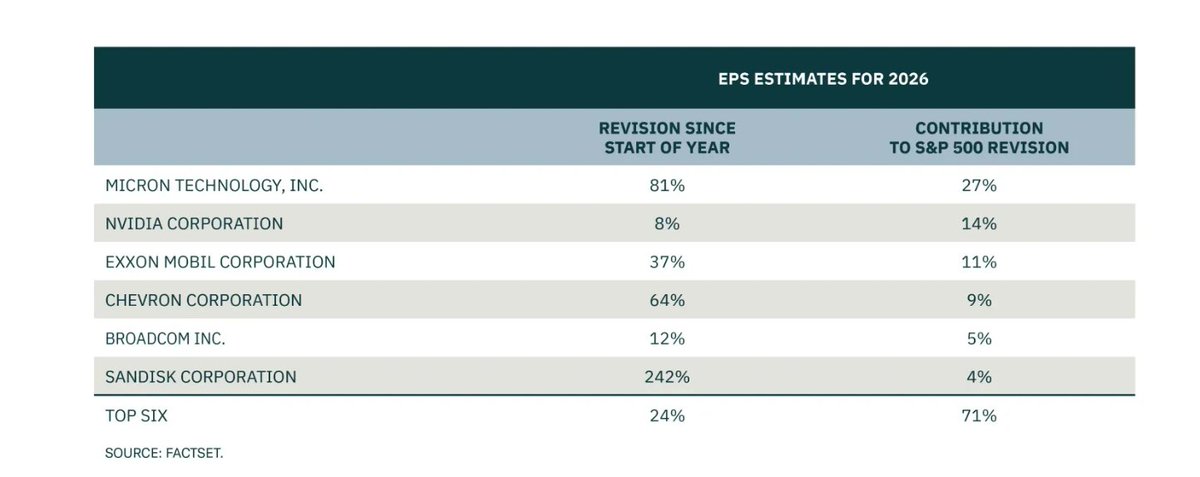
Just six companies account for 70% of the S&P 500's earnings upgrade for 2026.
What do all these companies have in common? They are benefiting from shortages: A shortage of oil and more importantly, a shortage of semiconductors.
Our latest report discusses how scarcity underlies profits and what indicators investors should monitor to determine when the AI capex boom will turn to bust.
Clients can read it here:
https://t.co/lDHbJjjf7S
Had a Jane Street interview in 2013 that still bothers me.
It was my 6th round. Final interview. The guy walks in carrying no laptop, no notebook, just a cold brew and what I later realized was a single IKEA tea candle.
He writes on the whiteboard:
food: $200
rent: $800
utilities: $150
candles: $3,600
family: dying
Then he turns around and says, “Optimize.”
I laughed because I thought it was a culture-fit bit. He did not laugh.
So I said, “Well, obviously you spend less on candles.”
He says, “Assume candles are non-discretionary.”
Okay.
I start building a model. Basic constraint satisfaction. Family survival as a soft penalty. Candles as a state variable. Maybe there’s an arbitrage where you buy wholesale paraffin and convert the $3,600 line item into inventory.
He stops me.
“You’re thinking like a consultant.”
That’s when I knew I was in trouble.
He says, “Give me a bid-ask on family dying.”
I say, “What?”
He says, “You’re long candles, short family. Where do you make markets?”
I try to recover. I say the real issue is liquidity: rent and utilities are fixed, food is elastic, candles are emotionally inelastic. Therefore the optimal strategy is to securitize future candle enjoyment and borrow against it.
He nods for the first time.
Then he asks, “What time do you sell the candles?”
I say, “Whenever the market is liquid?”
He says, “Be more specific.”
I say, “Uh… 10 a.m. Eastern?”
For the first time, he smiles.
He goes, “Every day?”
I say, “Every day.”
He says, “In size?”
I say, “In size.”
He says, “And what do we call that?”
I say, “Market manipulation?”
The room gets very quiet.
He looks disappointed and writes something down.
“No. We call it providing liquidity to candle ETFs during the U.S. cash open.”
I try to save it. “Right. Of course. The family isn’t dying because we underfunded them. They’re just experiencing temporary price discovery.”
He nods again.
Then he points back at the board.
I had missed it. The utility bill was $150, but candles provide light. You can zero out utilities.
I update the budget:
food: $200
rent: $800
utilities: $0
candles: $3,750
family: still dying, but now in a more capital-efficient way
He says, “How confident are you?”
I say, “0.95.”
He smiles and circles candles.
“0.95 huh?”
Then he asks me to estimate how many leveraged longs get liquidated if we dump $3,750 of candles at 10:00:01 every morning for 90 consecutive trading days.
Needless to say I did not get the offer.
If I had to become an AI engineer in 90 days, I would not start with courses.
I would build projects from these 10 GitHub repos.
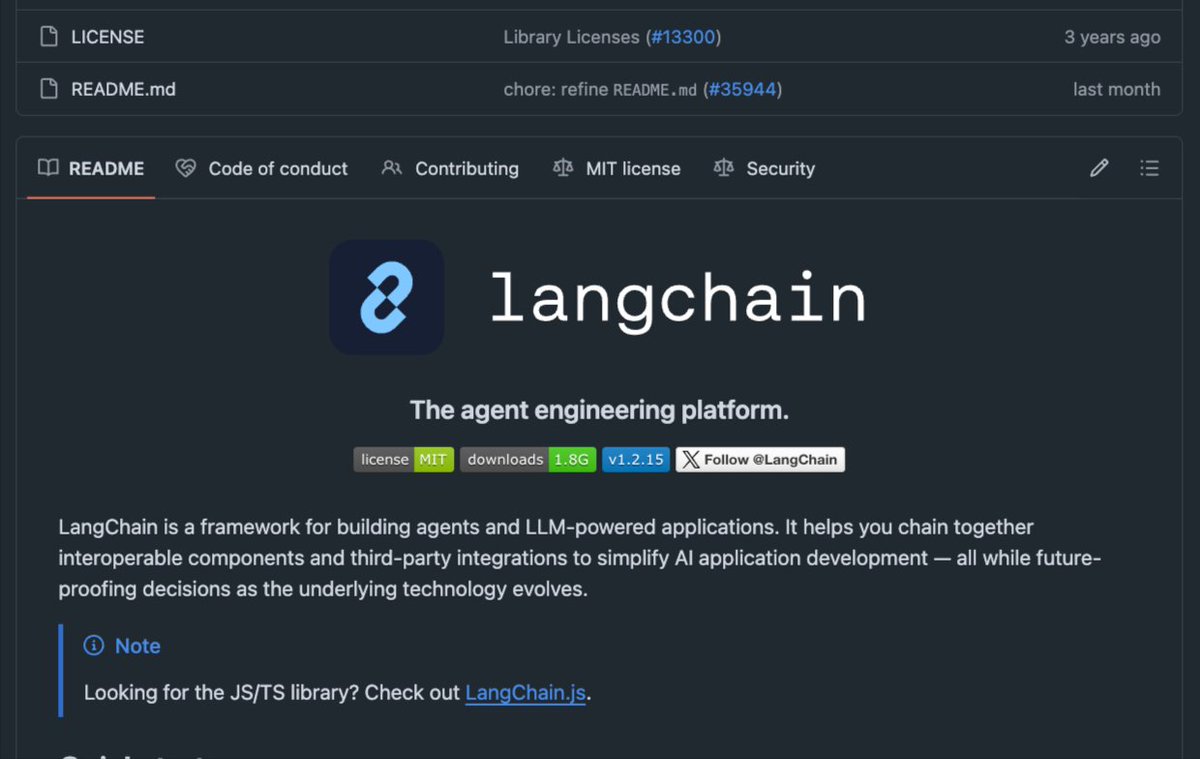
1. LangChain
The LLM application framework on almost every AI engineer JD. If you want to build production LLM apps, start here.
repo → https://t.co/alIh6rDDIu
2. LangGraph
Stateful agents as graphs. The repo JDs mean when they say "agentic workflows."
repo → https://t.co/bzVBn9uecV
3. LlamaIndex
The go-to framework for RAG and document agents. Every "retrieval pipeline" JD points here.
repo → https://t.co/m4oJ9FiCrX
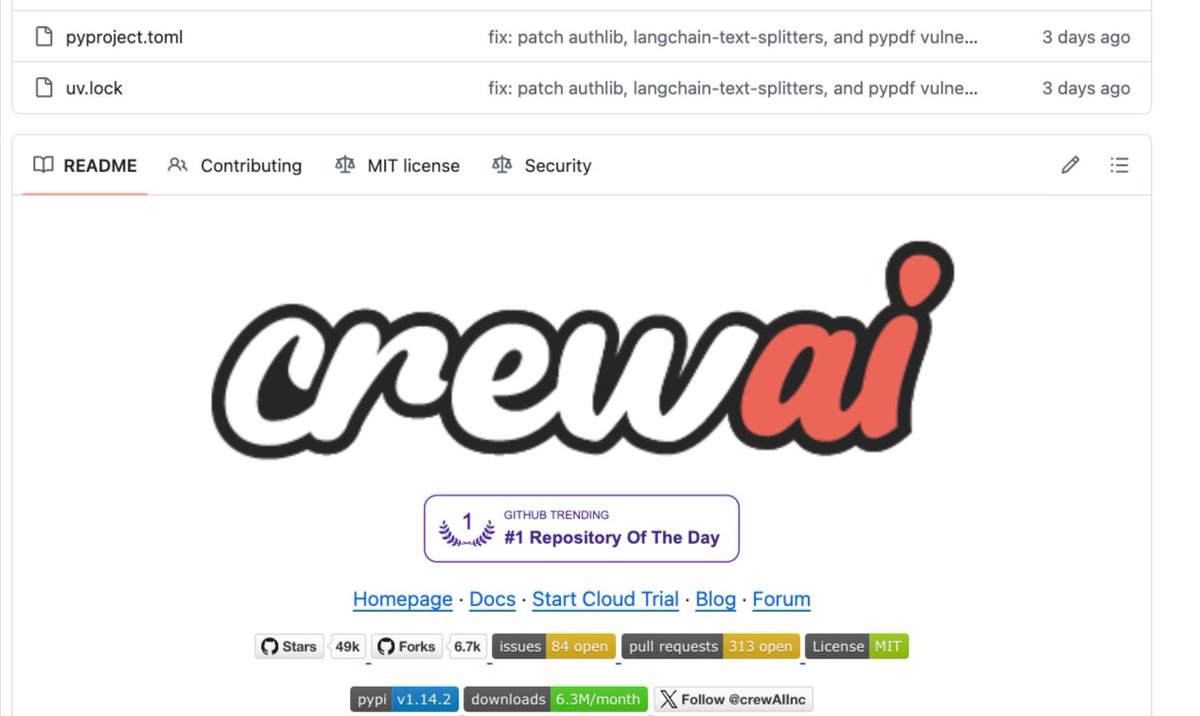
4. CrewAI
Multi-agent teams with roles and tasks. Used in production by enterprises across the Fortune 500.
repo → https://t.co/0xohE065sD
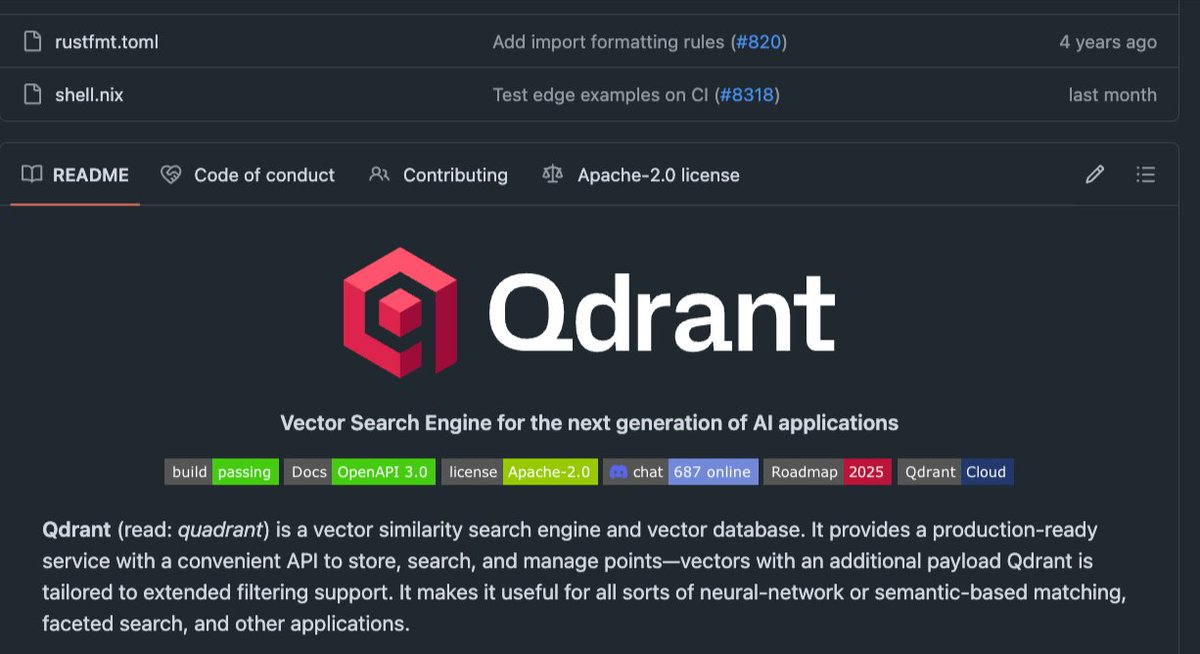
5. Qdrant
A production vector database written in Rust. JDs name it alongside Pinecone, Chroma, and FAISS.
repo → https://t.co/ziSSXW2dzZ
6. Ragas
The standard framework for evaluating RAG pipelines. Hallucination, faithfulness, relevancy, all measurable.
repo → https://t.co/vgOInvREU5
7. Ollama
Run open-source LLMs locally in one command. JDs ask for local inference for cost and privacy reasons.
repo → https://t.co/gyZhUdzsnZ
8. Awesome MCP Servers
Model Context Protocol is the newest skill on JDs. This repo indexes every production MCP server out there.
repo → https://t.co/ejVOgkRJDX
9. Awesome LLM Apps
100+ end-to-end templates for RAG, agents, multi-agent teams, voice agents, and MCP. Real working code.
repo → https://t.co/oXrD5A8K6a
10. AI Agents for Beginners
Microsoft's free 12-lesson curriculum covering the full AI agent stack. No paywall, no signup.
repo → https://t.co/7dNsDw6bTj
AI engineer job descriptions in 2026 keep asking for the same things: RAG, agents, vector databases, evals, MCP.
These 10 repos teach all of it.
Pick one. Build one project. Push it to GitHub. That's how you start.
100% free. 100% open source.
🚨 I don't think people realize how bad things are at @aave right now.
All core markets are at 100% utilization, that includes $3 bil in USDT and $2 bil in USDC stuck!
That means you CAN'T WITHDRAW your money!
A long post on why and how we ended up here.
When the rsETH exploit happened and AAVE incurred bad debt, whales like Justin Sun, MEXC exchange, and others immediately withdrew billions from AAVE.
This instantly drained all available liquidity in key core markets like ETH, USDT, USDC and so on. Those first to withdraw got out, laggers got trapped.
Initially, the ETH market hit 100% utilization, meaning you could not withdraw your ETH from AAVE.
Worse, this also means the protocol can't process ETH liquidations should ETH price fall/crash. If you can't sell any ETH, you can't liquidate to cover debt obligations.
That means the risk of more bad debt incurred by AAVE is increasing the longer its markets remain stuck.
Nevertheless, users can still sell at a minor loss the aETHwETH tokens on Uniswap or similar aggregators. That exit door is the last one remaining for ETH depositors on AAVE.
The same cannot be said by depositors of USDT and USDC. They are stuck.
That's because AAVE lost over $6 billion in liquidity in the past 24h. As whales took out their money, USDT and USDC also hit 100% utilization.
These markets are now also stuck with money locked. Panic is spreading and desperate times call for desperate measures.
Some users decided to borrow against USDT/USDC and exit via other markets at a 10-25% loss (90-75% LTV). Basically you borrow GHO/DAI/USDe against your locked USDT/C.
But as more liquidity leaves AAVE, more markets get to 100% utilization and get locked/stuck due to low liquidity. This is quickly cascading across all available markets.
Luckily the crypto market was rather flat today so liquidation risks were marginal, but if things change there are billions in stablecoins and other assets locked on AAVE that can't process liquidations = more bad debt for AAVE.
If users or related protocols that are stuck need access to their money to prevent liquidations or other critical function, they have a huge problem on their hands.
Plus, nobody wants to deposit (or provide liquidity) in these markets now since your ETH, BTC, USDC/T could be stuck there for who know how long.
As soon as any available liquidity is made available, it is instantly taken out by bots fighting to get out. As I wrote this I saw 250k in liquidity on USDC vanish in seconds.
Then there is the bad debt question.
There's over $200 mil in bad debt incurred by AAVE via rsETH that's like a hot potato. Nobody knows who will eventually pay this bill.
If you didn't remove your assets from AAVE, you risk receiving at least part of that bill in some form. Not having access to your money is part of that risk too.
Contagion is also extremely high.
Many protocols and apps rely on AAVE for their earn mechanics. These protocols and their users are stuck too and may be forced to incur bad debt with no fault of their own.
October 10th was a CEX driven crash, this is a DeFi risk mitigation failure of epic proportions.
AAVE should have never onboarded rsETH as a collateral asset, at least not to the size of hundreds of millions that allowed the hacker to walk away (i.e. borrow) over $200M in ETH after posting fake collateral.
Rumors on X are saying rsETH was onboarded by AAVE due to a conflict of interest (lobbying) by a given service provider. If true, this is a major failure of its governance structure (nothing new).
The folks at @KelpDAO who manage rsETH also have a tough decision to make on who will actually pay for the $200M exploit. AAVE users? L2 rsETH users? Everyone affected gets a haircut to account for the loss?
The AAVE team and its founder, Stani, have been quiet for over 20h since the exploit after initially announcing the rsETH market freeze.
They have a pretty big problem on their hands since the whole protocol is at risk right now. Trust is already lost as AAVE is bleeding billions in TVL to the level of hitting 100% utilization on all core markets.
Maybe some key actors in the space will step in to provide liquidity to stabilize the markets on AAVE before this gets even worse.
I got lucky to get out of AAVE early when I first saw this. I also removed all assets from DeFi and will not touch any protocol in the next few weeks. Too much risk for a few percentage points in yield.
If you found this informative, like, share, and follow @duonine
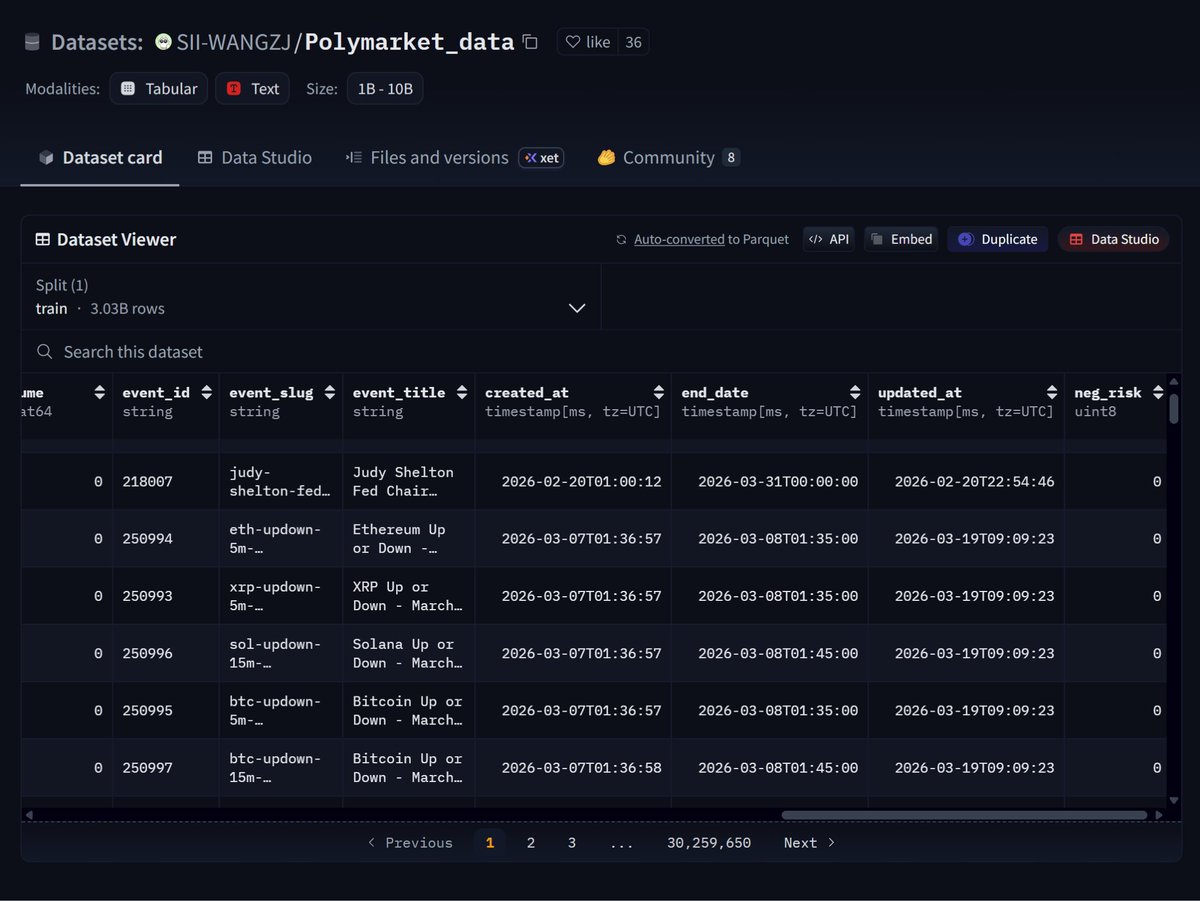
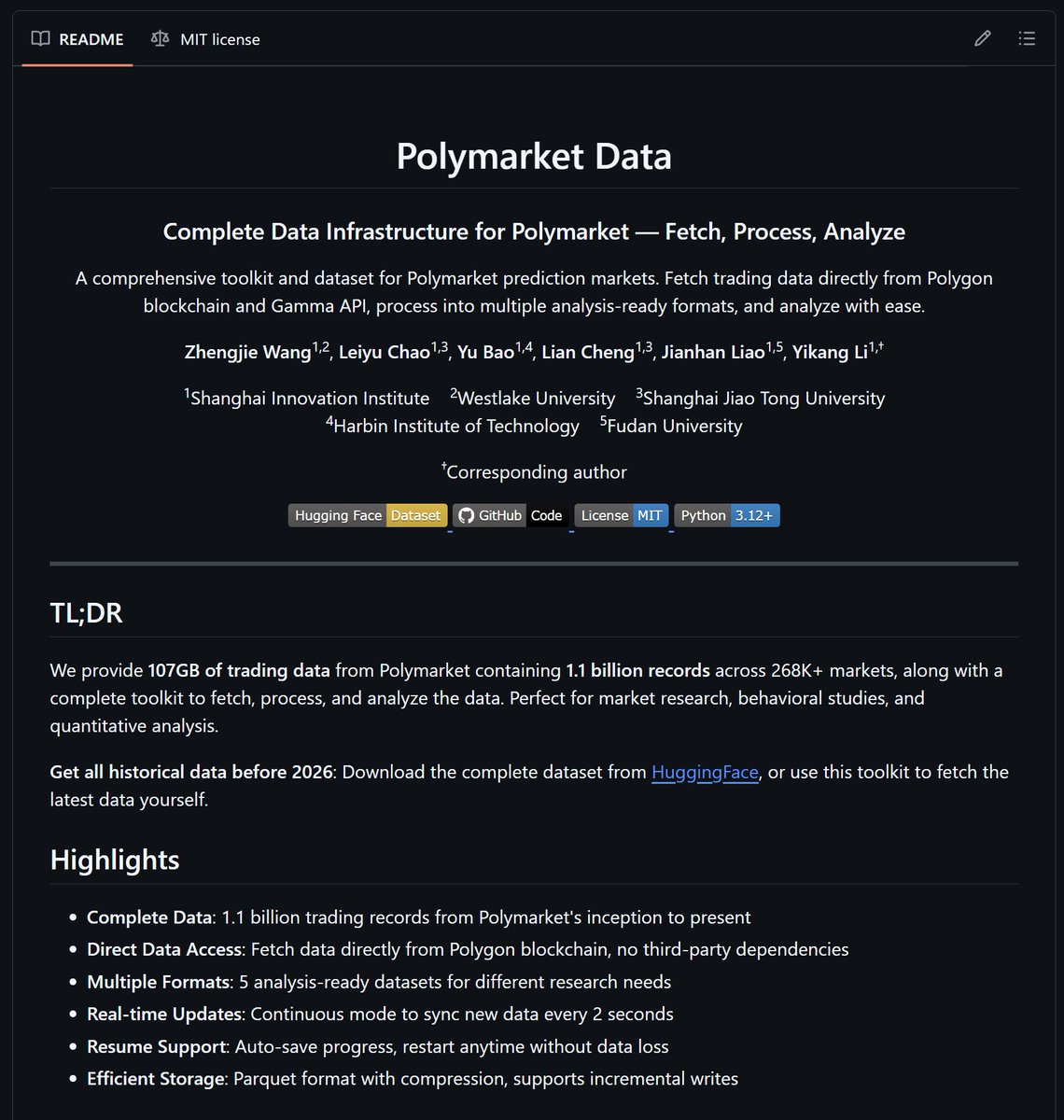
5 students from Shanghai University analyzed over 1.1 billion Polymarket trades across 268K markets, collected 107GB of real trading data and released it for free on GitHub…
This is the largest public prediction market dataset I have ever found.
Here is how you can use it for trading on Polymarket:
This dataset allows you to understand how Polymarket actually behaves and how prices typically move.
You can analyze and compare all markets within the same category to find patterns in price movements that repeat over time.
Lets imagine, while analyzing this dataset, you discover that, for example, most economic markets are less volatile and often have a clear winner right from the beginning (with the highest % probability) - Boom, now this becomes your own proven working strategy.
This way, you can create hundreds of different time tested ideas and strategies based on real historical data.
In addition to the dataset, this repo also provides a full set of tools to work with Polymarket data directly via API, so you can continuously fetch fresh data, process it, clean it and convert it into easy excel format.
This repo: https://t.co/7hj5ZXS6Qi
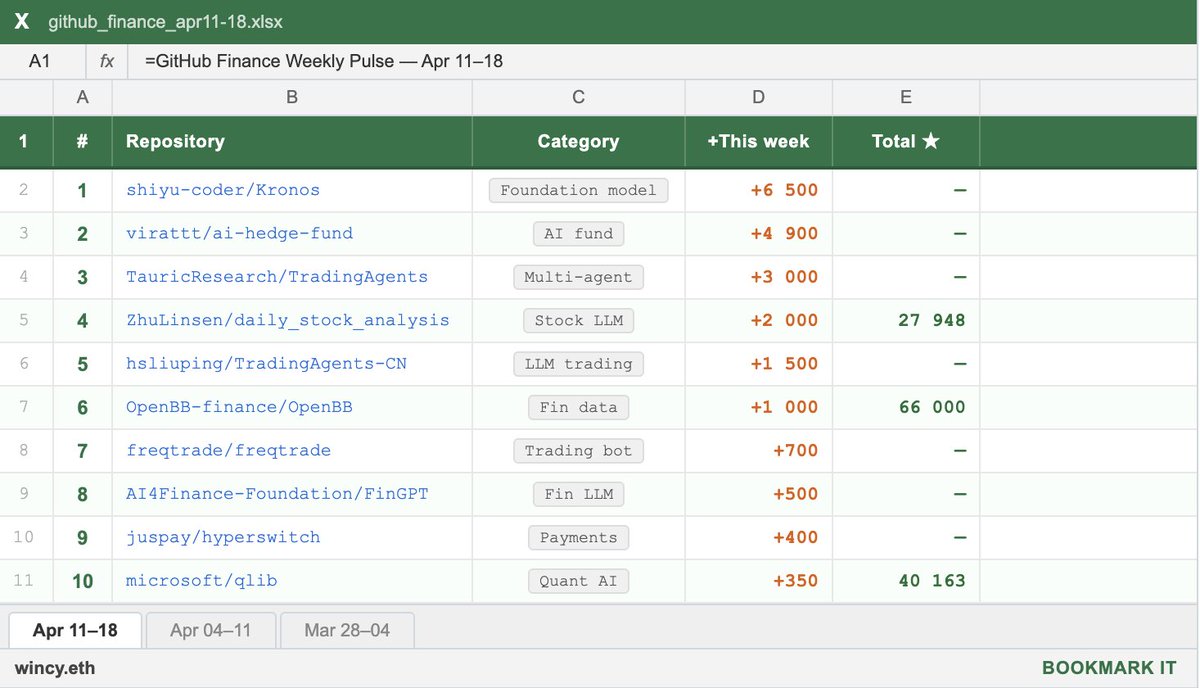
the fastest growing GitHub repos in finance this week:
1. shiyu-coder/Kronos (+6.5K ★)
first open-source foundation model for financial candlesticks. trained on 45+ global exchanges. predicts OHLCV candles as tokens — literally GPT for price charts. accepted at AAAI 2026.
2. virattt/ai-hedge-fund (+4.9K ★)
a team of AI agents simulating Buffett, Munger, Ackman, Cathie Wood and others. each agent runs its own strategy, a Portfolio Manager makes the final call. one of the most viral finance repos right now.
3. TauricResearch/TradingAgents (+~3K ★)
multi-agent LLM trading framework. fundamental analyst, sentiment analyst, technicals, risk manager — all working together. supports GPT-5.x, Gemini 3.x, Claude 4.x, Grok. built by UCLA/MIT researchers.
4. ZhuLinsen/daily_stock_analysis (+~2K ★)
LLM stock analyzer for US, A-share and H-share markets. auto-builds a daily decision dashboard with exact entry/exit levels. pushes to WeChat/Telegram/Discord/Email via GitHub Actions. zero cost, zero server.
5. hsliuping/TradingAgents-CN (+~1.5K ★)
Chinese fork of TradingAgents. fully localized for A-share markets (Shanghai/Shenzhen), Chinese data sources, and domestic LLMs. 5.1K forks — very active community.
6. OpenBB-finance/OpenBB (+~1K ★)
open-source Bloomberg alternative. stocks, crypto, options, derivatives, fixed income — one platform. integrates with AI agents via MCP. 66K total stars and still climbing.
7. freqtrade/freqtrade (+~700 ★)
free, open-source crypto trading bot in Python. supports all major exchanges, full backtesting, strategy optimization, Telegram control. release 2026.3 just dropped.
8. AI4Finance-Foundation/FinGPT (+~500 ★)
open-source financial LLMs trained on real market data — news, filings, earnings. built for sentiment analysis and robo-advisors. models on HuggingFace, ready to deploy.
9. juspay/hyperswitch (+~400 ★)
open-source payments router in Rust. one API to connect Stripe, Adyen, PayPal and 50+ providers. smart routing, high performance, built for fintech scale.
10. microsoft/qlib (+~350 ★)
Microsoft's AI quant investment platform. covers the full pipeline: alpha seeking, backtesting, model training, live trading. supports ML/DL, RL, and auto-quant.
bookmark this and start today.
This 30-minute speech by the Head of Anthropic "Coding Agents" researcher will teach you more about vibe coding than 100 paid courses.
Bookmark it & give it 30 minutes today. This video will change the way you use AI forever,
my thought process is very simple
we’re doing something different for the first time in 6 months,
so maybe we get a larger rally than anything we’ve gotten in the past 6 months.
I must look at it that way; if I don’t, it’s probably because I watched an obvious 3yr uptrend breakdown, and wrote articles about how bear markets no longer exist, as I watched many do.
instead, I was the loudest bear on the timeline, dodged -40%+ of the selloff, and bought the absolute bottom of the capitulation into $60k due to having preserved capital along the way
being objective is a superpower.
it’s just long term philosophy; always putting myself in positions to catch, and avoid, the moves that actually matter.
so reclaiming this trend, in addition to breaking out of the range this time around, opens the door for a larger move into $90k, where we can test the same trend which held as bottoms for 3 years [2D 200MAs], and also opened the door for a more aggressive and sustained selloff in recent months
if Bitcoin can’t rally to $90k, as stocks see record-breaking strength into new ATHs, and instead deviates back inside the range…
that would be a ‘signal’ in itself.
it wouldn’t be ‘lag’ at that point, it’d be sustained relative weakness.
goodluck to all.
With the takeoff of OpenClaw and MoltBook, a new agent-driven economy is taking shape.
On the @LightconePod, we took a look at the explosive growth of AI dev tools and whether the time has come for builders to make something agents want.
00:00 - Intro
02:12 - No human involvement is changing the experience
04:55 - Does YC need to change its motto?
07:48 - Email tools and agent infrastructure
09:36 - Agent-driven documentation
13:00 - Swarm intelligence
15:36 - Content generation and dead Internet theory
18:12 - Growth, rules, and founder insights
I created a Crypto Tool Hub with 80+ tools so you never have to look for 'best DeFi analytics platform' again.
Every tool you need is organized and ready to use, finding DEXs, Perps, and other tools is so much easier.
No more 100 tabs -> Everything you need in 1 place:
Uhhhh guys? Bill Ackman (Head of Pershing Square, one of the top 20 hedge funds globally) just followed @clawdbotatg / $CLAWD
He only follows around 1000 people...
Only $7.5M right now
🎉 Happy New Year, Suuuiplashers! 🎉
We’re starting 2026 with BIG news 💥
The dates are officially locked in 👇
🧬 Suuuiplash Genesis NFT Mint
📅 Jan 22, 2026
🎮 Closed Beta Test (CBT)
📅 Jan 29 – Feb 1, 2026
🚀 Official Launch
📅 End of March
More details dropping soon 👀
Stay tuned & get ready to SUUUIPLASH 💦
Only on @SuiNetwork
They don't call it a bailout anymore.
They call it a "repo facility."
Because collapse sounds better
when it wears a financial acronym.
13.5 billion injected overnight,
and the reaction isn't rage.
It's retweets.
That’s not a market.
That’s a hostage negotiation
where the ransom gets paid in emojis.
You’re not witnessing liquidity.
You’re watching life support.
You’re not seeing the system operate.
You’re watching it flatline in real time
and get resuscitated by lies.
They told you this was normal.
That “temporary” injections
can last forever.
That Covid was a one-off.
That 2008 was fixed.
Then they quietly pumped more
than the Dot Com peak.
Not because the banks are healthy.
But because the illusion can’t survive
without permanent CPR.
This isn’t oversight.
It’s orchestration.
The dot com bubble popped.
This one has a PR team,
a meme format,
and a central bank IV drip.
"Carry on."
That's not commentary.
That's a lullaby sung by the algorithm
while the walls get moved closer.
Introducing Minara News.
Imagine a Perplexity-like news, but designed for digital finance. Minara News tracks everything, summarizes what matters, and tells you why the market moves.
News insights, follow-ups, and trading — all in one seamless flow.
Only with Minara.






![TraderMercury's tweet photo. my thought process is very simple
we’re doing something different for the first time in 6 months,
so maybe we get a larger rally than anything we’ve gotten in the past 6 months.
I must look at it that way; if I don’t, it’s probably because I watched an obvious 3yr uptrend breakdown, and wrote articles about how bear markets no longer exist, as I watched many do.
instead, I was the loudest bear on the timeline, dodged -40%+ of the selloff, and bought the absolute bottom of the capitulation into $60k due to having preserved capital along the way
being objective is a superpower.
it’s just long term philosophy; always putting myself in positions to catch, and avoid, the moves that actually matter.
so reclaiming this trend, in addition to breaking out of the range this time around, opens the door for a larger move into $90k, where we can test the same trend which held as bottoms for 3 years [2D 200MAs], and also opened the door for a more aggressive and sustained selloff in recent months
if Bitcoin can’t rally to $90k, as stocks see record-breaking strength into new ATHs, and instead deviates back inside the range…
that would be a ‘signal’ in itself.
it wouldn’t be ‘lag’ at that point, it’d be sustained relative weakness.
goodluck to all.](https://pbs.twimg.com/media/HGM_4mfbYAAhXz7.jpg)





![TraderMercury's tweet photo. my thought process is very simple
we’re doing something different for the first time in 6 months,
so maybe we get a larger rally than anything we’ve gotten in the past 6 months.
I must look at it that way; if I don’t, it’s probably because I watched an obvious 3yr uptrend breakdown, and wrote articles about how bear markets no longer exist, as I watched many do.
instead, I was the loudest bear on the timeline, dodged -40%+ of the selloff, and bought the absolute bottom of the capitulation into $60k due to having preserved capital along the way
being objective is a superpower.
it’s just long term philosophy; always putting myself in positions to catch, and avoid, the moves that actually matter.
so reclaiming this trend, in addition to breaking out of the range this time around, opens the door for a larger move into $90k, where we can test the same trend which held as bottoms for 3 years [2D 200MAs], and also opened the door for a more aggressive and sustained selloff in recent months
if Bitcoin can’t rally to $90k, as stocks see record-breaking strength into new ATHs, and instead deviates back inside the range…
that would be a ‘signal’ in itself.
it wouldn’t be ‘lag’ at that point, it’d be sustained relative weakness.
goodluck to all.](https://pbs.twimg.com/media/HGM_4mhawAAN2di.jpg)