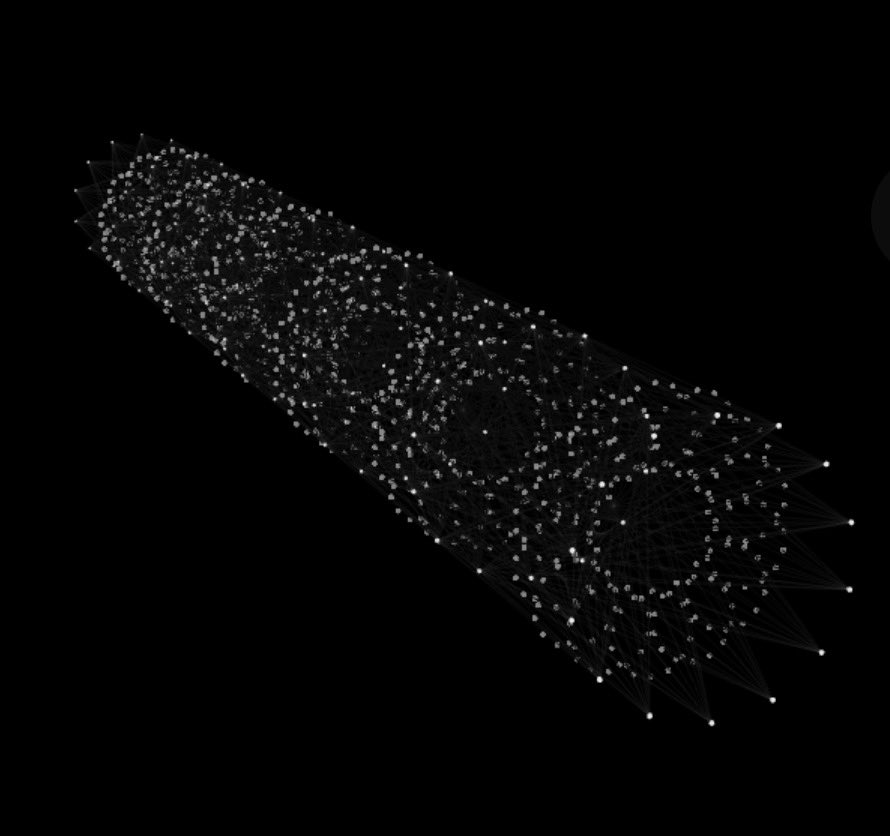
Just orchestrated a 128 node permissionless decentralized training run, in 5 minutes, for 5 TAO, via @IOTA_SN9
They can do this up to 100B param models.
Unbelievable.
https://t.co/hJGZ6O5NrU
The beauty of decentralized technologies is that they beget each other, a protocol of decentralized compute is only relevant when there is a protocol for decentralized training.
Z-Score Probability Waves.
Rolling 52-week log z-score. The asset's distance from its own mean, in standard deviations. // bitcoin:native bittensor:native
Log Regression Bands ▌
$TAO's growth fitted to a log curve. Bands above and below tell you where this subcycle sits in the long arc.
Fair value
$451.56
Log-fit midline
Residual
-0.80σ
Standard deviations from fit
Risk score
0.34×
0 (cheap) → 1 (top)
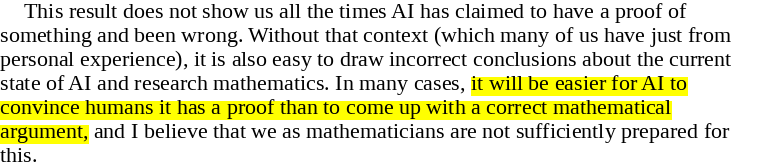
A couple of points on the recent OpenAI math result and why TIG is built for exactly this.
First of all, this is a genuinely impressive result. It's a longstanding famous problem and many mathematicians are impressed with it.
Where TIG comes in is the difference in how its algorithm challenges are verified vs how proofs like the one from OpenAI are verified.
The AI did the proof with over 125 pages in its chain of thought.
BUT
It took nine mathematicians multiple weeks to verify it actually worked.
The raw output required polishing (missing definitions, scrambled logic) and ultimately needed a human-edited, reorganised, clearer version as the final proof.
So the AI produced something but humans had to do all the heavy lifting to figure out if it was real.
That is the whole problem with AI doing maths.
Generating gets faster, verifying stays slow and expensive.
One of the nine mathematicians flagged this directly, worried that even experts will struggle to verify future proofs.
TIG sidesteps this entirely.
The problems on TIG are asymmetric.
Hard to solve, trivial to verify.
If an algorithm is better (eg runs quicker), it does not matter at all what the contents of the algorithm are.
You run it.
It either works or it doesn’t.
If it works, you can tell immediately if it was better.
No expertise needed.
This is what the miners (benchmarkers) in the TIG network do.
When an algorithm is submitted, benchmarkers run and then adopt the best one.
So with the increase in AI x Maths, TIG works not only on challenges of economic importance, but on the exact shape of problem where AI-generated work can actually be trusted at scale.
Stock-to-Flow $TAO
Supply divided by annualised emission, fit against log price. The classic #Bitcoin scarcity model adapted to #Bittensor.
S2F Model
$888.66
Predicted · log fit
Deviation
-67.9%
Price ÷ model − 1
S2F Ratio
5.31×
Supply ÷ annual emission
We’ve long forecasted that AI will become an essential component of how scientists and mathematicians do research.
With Prometheus’ release just over the horizon, this hypothesis is now an imminent reality.
Today at 5PM BST, join @Dr_JohnFletcher and @0x_Asuka as they discuss how Prometheus is poised to reshape entire industries and even birth new ones.
See you there!
"I like to get involved in projects that I think are transformative and have 100x, 500x, 1,000x type return opportunities" @BarrySilbert
"Unless the US dollar completely collapses.. #Bitcoin is not going to go up 500x"
"I think a #Bittensor can go up 500x and so our portfolio is allocated accordingly"
500x would see one $TAO valued at $75,000
cc: @APompliano@BitGo
Everyone's debating when the singularity arrives.
Wrong question.
The question is: how close is the event horizon?
This is the point of no-return, when the winner of the AI race becomes inevitable.
Nothing may seem to change when the event horizon is crossed. But the final outcome is now determined.
Google has done this before. With Search, it captured data its competitors thought was worthless.
And the data flywheel effect meant the race was over years before anyone noticed.
This same mechanism applies to mathematical tacit knowledge.
This data set can grant control of the most fundamental layer of the AI stack.
We are now at a decision point. Two futures are possible.
In one future, the most powerful foundational technology in AI remains open.
Everyone can see the state of the art. Everyone can build on it. Technology improves at the maximum rate.
The alternative is a single private entity controling algorithmic discovery. The technology is closed, secret.
Perhaps some capabilities are offered over an API, at the monopolist's discretion.
But *how* the technology works is unknown to the public.
From there on, all progress is governed by one company's priorities.
On our current trajectory, who wins the AI race? Google.
Will they be a monopolist? Yes.
Alphabet pricing a 100-year bond starts to look less like confidence and more like certainty.
There is still time to change this.
https://t.co/vMLGTmtVQx
Open source alone is not enough.
You can't eat GitHub stars.
You can't pay rent with citations.
Algorithm development requires compute, infra, and sustained effort.
Without an economic framework that rewards open innovation, decentralisation cannot compete.
TIG is that framework.
With the framework no one else can compete. All competiton will be eviscerated.
This is worth emphasising.
The permanent lead in AI from data flywheel has nothing to do with recursive self-improvement / AGI,
(which has been assumed before now to be the point-of-no-return for a runaway lead).
Nothing so sci-fi is required.
It only needs the same mechanism used by Google 25 years ago to secure web search dominance. This is a well-known mechanism!
$USELESS daily post until we hit 500m mcap...
This is now the third retweet of this chart pic that I originally posted here, and every day I believe more and more that this will come true. Slowly but steadily, we are getting closer and closer to it happening. It will be wonderful.
But I'm just a cat!
Interested in $TAO exposure?
@opentensor $TAO helps leverage economic incentives and decentralized networks for open and accessible #AI development.
Grayscale Bittensor Trust is open for private placement for eligible accredited investors.
Learn more and see important disclosures: https://t.co/SxJWBeDra7
2025: $TIG proved it with real breakthroughs.
2026: Acceleration mode. First Space dropped, @Dr_JohnFletcher warning hitting real-time (Google power concentration everywhere).
$TIG flips it: Incentivized global competition → faster progress for everyone.
Sub $20M? Don’t Fade.