On July 25, we hacked OpenAI.
Two bugs let us take over ChatGPT/Codex accounts of OpenAI employees (+some unaffiliated users) and reach connected services: Outlook, Slack, GitHub, etc.
We proved it with a PR in OpenAI’s internal codebase . It took us <72h. 🧵
> Read this and your next model will be 10x smarter. <
Nobody knows what intelligence truly is. We just know models are converging to being smarter, as they train. Yet, we DO know some of the fundamental features of intelligence. And when one of these features is neglected or not trained for, then there is no way for a model to obtain it. Neglecting an aspect of intelligence hinders a model's general capabilities, in a way no amount of flops can compensate for.
I'm making this whole post to convince you there is ONE fundamental aspect of intelligence that YOU are neglecting, underestimating, and under-training for. Anyone using models 24/7 can see this weakness. It is blinding, glaring, as clear as skylight.
That feature is: ✨ erasure ✨
Removal. Compression. Garbage collection.
Models are not sufficiently trained for that.
They are trained to ADD information.
Not to REMOVE it.
You ask a question. They give you an answer.
They work in a project. They write files.
You post a bug. They craft a solution.
They're only indirectly, if at all, rewarded for removing information, or compressing information. This is a huge mistake, because erasure is a cornerstone of intelligence.
The human brain has several mechanisms entirely dedicated to removing information. Short term memory, long term memory, sleep, all mechanisms to throw garbage away. Furthermore, grokking is nothing but a compression event. An aha-moment happens when your brain is capable of expressing new information in terms of information you already posses stored. This is what allows that info to be stored. That is how you learn.
Erasure isn't a small feature, erasure is *THE* underlying driver of intelligence. It is what allows us to keep absorbing tons of information and still managing to turn it into useful capabilities. Intelligence is not about producing good knowledge, it is about removing bad knowledge. So, erasure is half of it.
So, my advice to you: take erasure seriously. Train on it. The architecture is fine. It can lead to AGI. But you won't be a complete athlete if you skip leg day. Reward your model on the other half of intelligence. Teach it how to erase and compress information competently. Make this a big program in your company. Have entire teams dedicated to this.
"I'm already kinda doing that!"
No you are not. And if you think you are, take this as a signal you should do 100x more of it. I want to be very clear here: erasure is HALF of intelligence. So, if not half of your FLOPS are flowing into erasure, you're wasting your GPUs, and no optimizer can compensate for that.
"But how do I teach a model to erase?"
Literally, just ask it to compress a text, then reconstruct it, and ask questions to assert how lossless the conversion was. That simply. You can do that in any dataset.
For coding, a more effective way is to take a big codebase and ask it to make it shorter, while still preserving the same behavior. IMPORTANT: avoid code-golfing / minification / uglification. Removing comments or making variable names shorter IS reward hacking. Counter that by counting the NUMBER OF BRANCHES. A branch is: an "if", a "match", a "case". That's THE complexity of your program.
Count it, and ask the model to reduce it. There's no way to do so other than building better abstractions. And a better abstraction is nothing more than a blob of information that lets you throw other information away, because it expands into the information that was just discarded. Train on that, and your model will be incentivized to build better abstractions. Do you know what we call humans capable of building better abstractions? Geniuses.
So, please: appreciate the full nature of intelligence and give your models the rewards they need to train on all of it. Let erasure be a major part of your training programs. Do not skip leg day.
Thanks for coming to my TED talk...
i will allow the straw men to gather crows
you're welcome to present *any* set of facts that are consistent with that email being written by the person who wrote it - to the person who received it - about the club in question; that would provide an alternative explanation. btw "legally conclusive proof" is not the threshold in this arbitration.
you're welcome to present a set of facts that are consistent with that email being written by the person who wrote it - to the person who received it - about the club in question; that would provide an alternative explanation. btw "legally conclusive proof" is not the threshold in this arbitration.
Assuming you really are in good faith:
From: Simon Pearce (EAA) Sent: Monday, December 16, 2013 05:27 PM To: Peter Baumgartner (COO, Etihad Airways) Subject: RE: payments
Peter,
Thank you so much for making the transfer. Your and my conversations threw up an anomaly on our side. As I am sure you knew, embarrassingly it would seem that rather than overpaying you I have underpaid you!
In terms of receivables, Etihad owed MCFC:
£31.5m is due from season 12/13 uplift (£30m base fee uplift for 12/13 [from £35m to £65m] and 2 instalments for UCL qualification of £750k each from 11/12 and 12/13)
£67.5m, according to Art. 4.1 of the Sponsorship Agreement FOR 2013/14:
Shirts Rights £35m
Training Kit & Campus Naming Rights £17.5m (there is a £2.5m fee uplift from previous season, according to contract)
Stadium Naming Rights £15m
So we should be receiving a total of £99m, of which you will provide £8m. I therefore should have forwarded £91m and instead have sent you only £88.5m. I effectively owe you £2.5m.
There are two options:
To invoice you only for the £65m and then to invoice you for the additional £2.5m next year (14/15)
To invoice you for the full £67.5m. You pay the £65m now and I will forward the £2.5m in a couple of months, at which point you can forward it on.
Let me know if you agree with all of the above and which option you prefer. Sincere apologies to you and your colleague for forwarding on poor and inaccurate information in the first instance.
Thank you always for your patience.
S
@timstillman_@DarrenArsenal1 Agree with both of you here. Not to be the argument police, but let's keep it in the family until at least Monday morning. We've still got one or two things to do...
An internal OpenAI model has disproved a central conjecture in discrete geometry: If you place n points in the plane, how many pairs of points can be exactly distance 1 apart?
It is clear that AI has reached the threshold of superhuman capability in pure math and (I assert) theoretical physics.
Quotes below from companion paper, linked in thread.
The Erdős unit distance problem [14] raised in 1946 is among the best known open problems in Combinatorics. It is also arguably the best known problem in Discrete Geometry. Indeed, its description in the book of Brass, Moser and Pach on Research Problems in Discrete Geometry ([9], Chapter 5) is: “The following problem of Erdős [14] is possibly the best known (and simplest to explain) problem in combinatorial geometry: How often can the same distance occur among n points in the plane?”
... I believe it would be fair to say that every mathematician working in Combinatorial Geometry thought about this problem, and lots of mathematicians working in other areas spent at least some time thinking about it. Let me also add that although this problem may look at first as a recreational one this is not the case, it is in fact closely related to other mathematical areas including Number Theory and Algebraic Geometry.
... the fact is that the AI was able to do here what lots of excellent human researchers tried and failed to do.
... my impression has been that AI tools are capable of changing research in mathematics in a dramatic way. The new spectacular solution of the Erdős unit distance problem convinces me that it is hard to overestimate the full potential impact of this change.
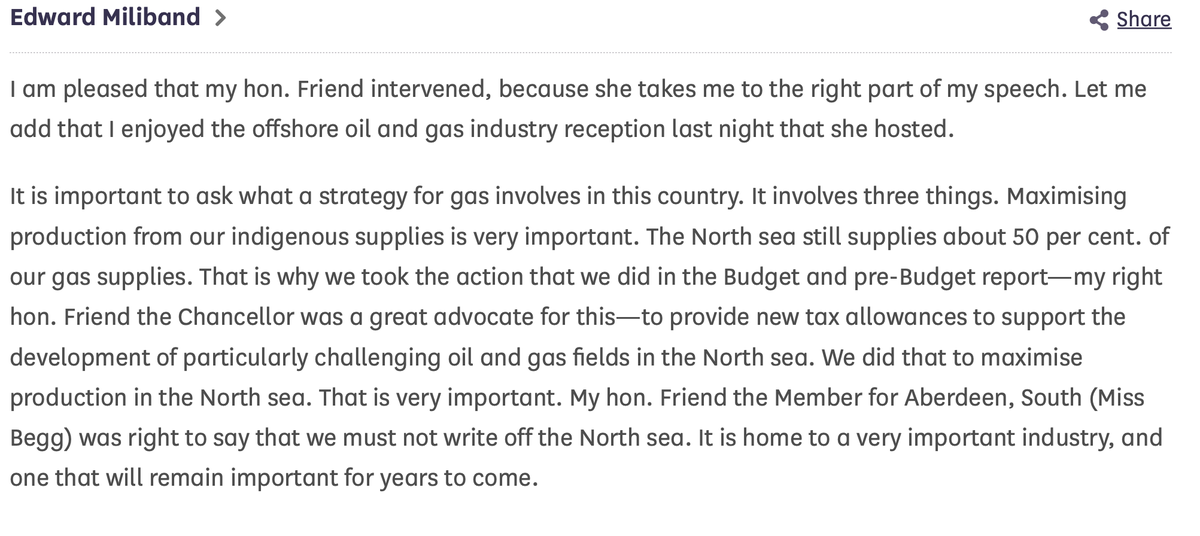
Ed Miliband to the House of Commons on the importance for the UK of a gas strategy centred on the North Sea, speaking 13 January 2010 fourteen months after the Climate Change Act passed.