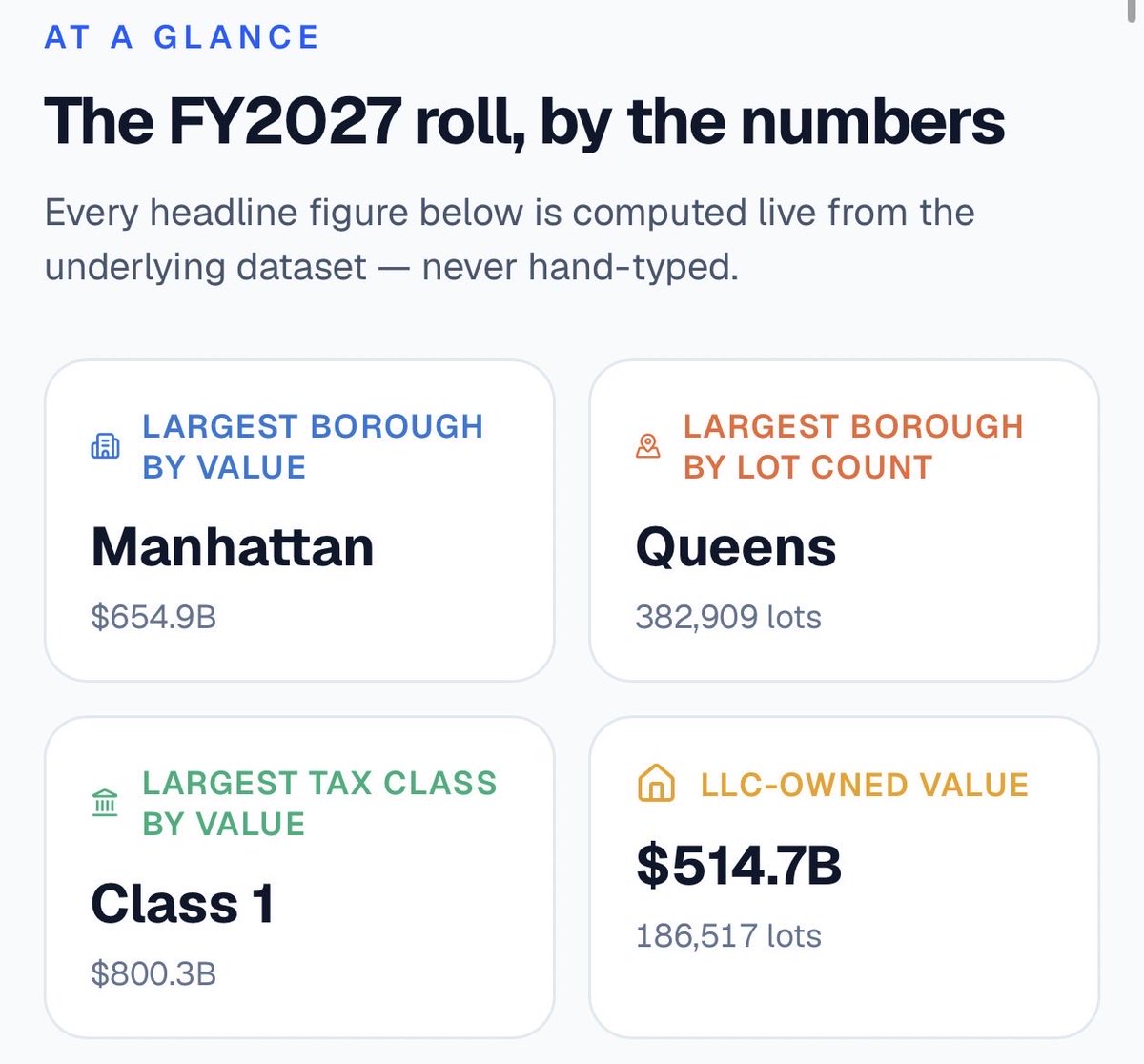
NYC publishes the assessed value of every single property in the city — all 1,167,962 of them. But it ships as 2GB of raw mainframe text files: 139 columns per row, tab-delimited, zero-padded, with a separate Excel doc just to explain the layout. Basically nobody ever reads them.
So I pointed Claude at it and had AI build the whole thing.
How it worked:
🤖 I ran Claude as an orchestrator managing a fleet of AI agents — one audited the raw files and tracked down the city’s official record layout, one wrote the parser/ETL pipeline, one built the ownership classification system, others built the pages, charts, tests, and deploys. All in about a day.
📄 The parser streams both Department of Finance files (1.5M+ raw rows), decodes all 139 fields per property, and loads a searchable database — every query returns in milliseconds across 1.17M records.
🧠 The AI classified all 935,559 distinct owner names into LLCs, corps, trusts, government agencies, nonprofits, co-ops, and individuals — then consolidated the aliases (NYC PARKS vs DEPT OF PARKS & RECREATION vs NYC PARKS DEPT = one owner). Individual homeowners’ names are automatically masked for privacy. Entities are fair game.
📑 It even parsed the Rent Guidelines Board’s 5 borough PDFs and matched 47,277 rent-stabilized buildings to the tax roll — a 99.998% match rate.
What’s inside is wild:
🏙️ NYC’s tax roll values the city at $1.9 TRILLION across 1.17M lots and 3.9M housing units.
✈️ The single most valuable “property” in NYC? Not a supertall on Billionaires’ Row. It’s JFK Airport — one Queens tax lot assessed at $18.88B.
📊 Just 5.3% of properties hold 50% of the city’s entire value. 2,821 lots worth $50M+ hold nearly a quarter of it.
🏠 The famous NYC tax quirk, visualized: 1-3 family homes are assessed at ~6% of market value. Apartment buildings, condos, offices? ~45%. Same city, wildly different math — it’s in state law.
🌳 The biggest property owner in NYC isn’t a developer. It’s the Parks Department: $39.4B across 5,053 lots. $177B of the city’s assessed value pays no property tax at all.
🏢 Manhattan is 43% LLC-owned by value. Staten Island: 8%. Individual people own 67% of NYC’s lots — but only 41% of its value.
🧱 The biggest construction decade still standing? The 1920s — 192,358 buildings, a century old and still housing the city.
🔑 47,277 buildings citywide have registered rent-stabilized apartments. In Queens, 83.5% of the pre-1974 multifamily stock is on that list.
Every property is searchable — address, owner, BBL. Every borough, ZIP, building class, and owner portfolio has its own page. All official DOF FY2027 data, methodology published.
Explore it 👉
https://t.co/FmRFCpy6id
FYI that America’s moronic visa policy is almost certainly a factor in why Kimi/Moonshot is a Chinese startup and not an American one.
The fact that we don’t staple a green card to every AI PhD completed in America is stupid.
would be more logical to seize their passports and force them to stay
Great idea.
I’d attribute much of wage stagnation to this. I also think healthcare costs would move up a slot or two in terms of priorities of Americans at the ballot box
Americans don’t know the insane sums their employers spend on healthcare unless they leave and see COBRA prices.
We should disclose healthcare costs attributed to employees on each paystub.
People could see costs very directly, see how they grow over time, and understand just how much potential wage income gets shipped off to United Healthcare or a local BCBS plan.
It is very difficult to get excited about invisible taxes. There’s no reason invisible taxes need to stay that way.
If you ever doubt how magical this world is, one day you will decide to go to a World Cup watch party in Oakland that you found online to root for a country where you spent two years trying to coax English out of the mouths of Cape Verdean teenagers. 1/7
These are the types of announcements that blow my mind - and I really applaud companies that dedicate R&D to true moonshot AI applications that target hard problems (like this in healthcare!)
"This requires a new architectural approach where every business is able to build agentic systems that improve over time, while still retaining control over their IP."
Every AI company will read this and convince themselves this is their approach while still selling expensive SaaS
🥁 Drumroll please...
Congratulations to Coralum and founders Kevin Cyr and Julian Salazar, winners of the @2048vc Healthcare Pitch Competition at New York @Techweek_!
Thank you to everyone who made it happen: founders, judges, and audience alike 👏
Special thank you to @BrownRudnickLLP for hosting us, and to our amazing judges @t_olkowski, @JajaLiao, @evajsteinman, and @OliviaCapra!
1/ We’ve raised over $1B at a $26B valuation, led by @Lux_Capital, @generalcatalyst, and @8vc.
Our enterprise usage has grown >10x since the start of this year, and our run-rate revenue grew to $492 M.
We launched Devin two years ago as the first AI software engineer. Since then, cloud agents have gone from niche to mainstream, and today they are the fastest growing way to create software.
.@htaneja and @jcfurstenberg have been named to the @Forbes Midas List this year, Hemant for the 10th consecutive year. We exist to back founders working on the big, right problems and to build a company worthy of their ambition. From @AnthropicAI, @AppliedInt, and @deel to @HelsingAI, @WeAreLegora, @stripe, and @ZeptoNow, they have shown up, from seed to scale.
Congratulations to both.