Great talk between @davidtuller1 & George Monbiot - George mentions an interaction with Oxford Professor M Sharpe of PACE trial, this same Prof phoned up my Head of Centre to complain about me writing about ME/CFS and critiquing his model - This was bullying and I also asked for the evidence, because my papers were factual and reviewed the science. https://t.co/yMUJToYHaS
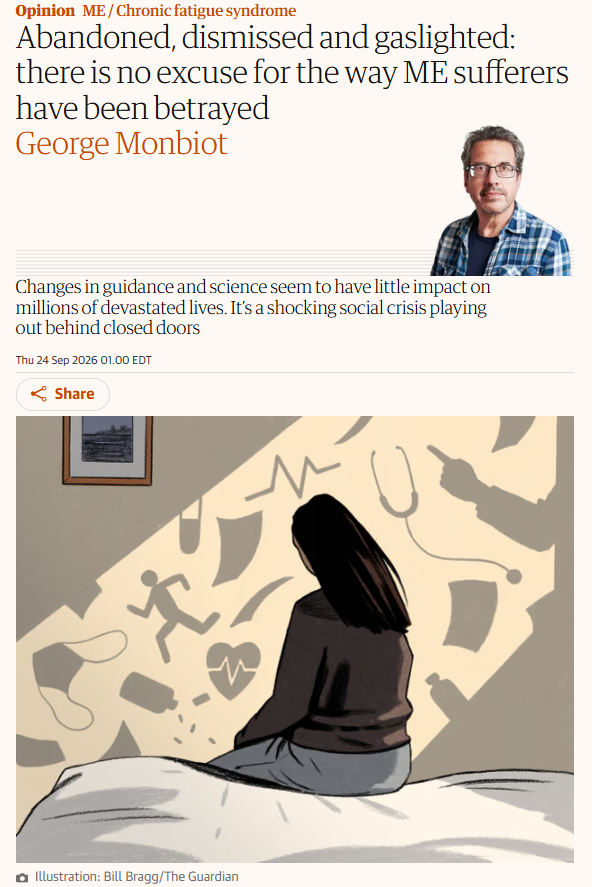
Here's my interview with Guardian columnist George Monbiot about his recent column on the awful treatment of people with ME/CFS: https://t.co/85EeFpOFeb
Surprise, surprise
The Journal or Psychosomatic Research has rejected our response entitled:
CBT is not an effective treatment for long Covid and postexertional malaise. Response to Sauer et al.
https://t.co/01tWYDYxlI
@DavidTuller1, @mecfsskeptic#MEcfs#LongCovid
As many of you already know, George Monbiot has published another hard-hitting article on ME in the Guardian today.
Great to see such coverage, especially as the Guardian published some rubbish by others before
https://t.co/8BGRHY1DqO
#MEcfs#PwME
If everything is FND, then nothing is FND. Time to follow the DSM-V-TR criteria and make any FND diagnosis the result of an active process of ruling out more likely causes that should not stop with the diagnosis because FND is often a placeholder diagnosis for another pathology.
The same people extolling self-help in one breath will agree with a weird long-form missive about “sickfluencers” in the next one, conveniently failing to acknowledge online venues are the only places chronically ill people who are shut out of society find community and support.
Australian #mecfs sufferer Alem Mathees became significantly more unwell because he fought to uncover the truth about the highly flawed 'PACE' trial of graded exercise therapy & cognitive behavioural therapy. Today, misinformed practitioners worldwide continue to exhort ME/CFS patients to exercise - even though exercise is contraindicated for the disease. The @nhmrc clincial guidelines can't come soon enough @Mark_Butler_MP@normanswan@teegstar@steph_dalzell@henriettacook@racgp
#pwME are forever indebted to those who took on this battle against those who were willing to inflict such catastrophic harm on #ME patients.
It should never have been left to these heroes to take on this work & their remarkable achievement won't be forgotten.
Another angle on the truly insane research funding neglect of ME/CFS - looking at clinical trials 💊
How do we get the pipeline of clinical trials truly flowing, in a way that 1) gets the most accurate results, and 2) allows us to maximise learnings on the underlying biology?
Rowland Manthorpe on how his #LongCovid looks almost identical to Dr Charles Shepherd's ME, & how in 2022, 40 years apart, we knew almost nothing about these diseases. Shepherd argues that if #MECFS had been funded similar to rheumatoid arthritis, treatments could already exist.
So, I got royally knighted today. Woot!? Yes, I did. Adopted from Sri Lanka, knighted in the Netherlands. Who would've thought!
The most important thing is that this award belongs to the whole community. Everything we do is teamwork.
I'll write more after I recovered.
#pwme
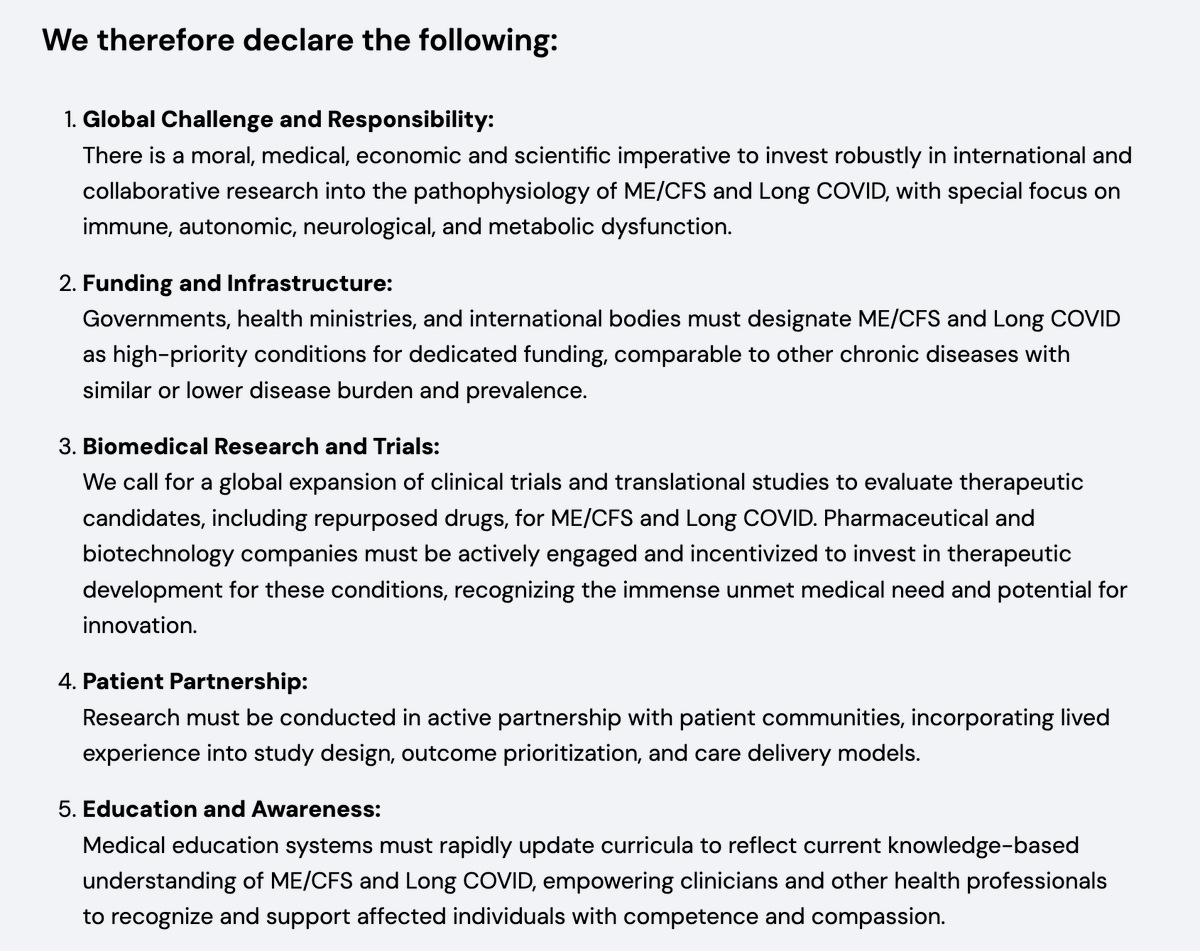
1) On May 12 2025, a group of researchers signed an International Declaration stating that "there is a moral, medical, economic and scientific imperative to invest robustly in international and collaborative research into the pathophysiology of ME/CFS and Long COVID."
For those interested in PEM, see our perspective with lead author @fcowester.
https://t.co/P3YRE1MJhf
PEM has traditionally been viewed as symptom exacerbation and/or emergence of new symptoms following exertion. This perspective proposes that PEM may instead reflect disrupted coordination across interconnected physiological systems operating over distinct post-exertional timescales.
Key questions
•Does PEM reflect disrupted coordination across physiological systems and timescales?
•Can distinct post-exertional physiological trajectories define patient subgroups?
•Does recurrent post-exertional physiological dysregulation contribute to cumulative cardiometabolic burden?
•How do the timing of assessment and disease heterogeneity influence the identification of post-exertional physiological trajectories?
•Can longitudinal cardiometabolic profiling identify biomarkers associated with distinct post-exertional trajectories?
Together, addressing these questions may help determine whether PEM represents disruption of the coordinated physiological responses that shape post-exertional physiological trajectories, and how these alterations contribute to the multisystem and cardiometabolic manifestations of ME/CFS and Long COVID.
Ultimately, advancing our understanding of PEM may require moving beyond symptom characterization toward the longitudinal investigation of post-exertional physiological trajectories across interconnected physiological systems and timescales, while integrating cardiometabolic health as an important source of biological heterogeneity, particularly in individuals with obesity and T2D, in future mechanistic and interventional studies.
1) Update from Dutch researcher Anouk Slaghekke in the AMS 9th annual research meeting abstract book (p. 12). This small study suggests that in #pwME and #LongCovid the tiny blood vessels in muscle do not deliver oxygen efficiently, even though heart and lung function are normal.
ISLC-PAIS Conference Program now available: https://t.co/DXHqSGQnud
International Society for Long COVID and Post-Acute Infection Syndromes Conference takes place 26 – 29 August, 2026, Amsterdam (the Netherlands) https://t.co/LXo7Doyk2d
#MECFS#MEresearch
8 ) Proponents of CBT will likely use this study as confirmation that the treatment works (another positive RCT!), but it really doesn't. This looks more like a promo-article that doesn't contribute to the scientific discussion, but helps to push a narrative in the literature.