What if we could explore the Moon with AI?
Meet the @NASA–@IBM Lunar Foundation Model, a new open‑source AI trained on 17 years of lunar data to map craters, identify geologic features, and even help predict where ice may hide in the Moon’s darkest regions. 🌙
Honored to be recognized as an Outstanding Reviewer at ICCV 2025! Always a privilege to give back to the Computer Vision Community! 🌍🔍 #ICCV2025#ComputerVision#AI
🌞 We’re thrilled to announce Surya, the first heliophysics foundation model, trained at native 4K resolution on NASA’s Solar Dynamics Observatory (SDO) data.
300+ TB of multi-channel, multi-modal solar data → one foundation model.
And this was never a solo effort.
It was possible only because of collaboration across heliophysicists, engineers & AI researchers.
Thank you to all contributors & co-authors 🙏
Your work shaped every stage of SuryaFM.
@NASA@IBMResearch@nvidia@huggingface
> The first ever Foundation weather model: Prithvi WxC enables life-saving weather predictions! 🌍
Hurricane Katrina killed hundreds of people as it made landfall on New Orleans in 2005 - many of these deaths could have been avoided if alerts had been given one day earlier. Accurate weather forecasts are really life-saving.
🔥 Now, @NASA and @IBM just dropped a game-changing new model: the first ever foundation model for weather! This means, it's the first time we have a generalist model not restricted to one task, but able to predict 160 weather variables!
Prithvi WxC (Prithvi, “पृथ्वी”, is the Sanskrit name for Earth) - is a 2.3 billion parameter model, with an architecture close to previous vision transformers like Hiera.
💡 But it comes with some important tweaks: under the hood, Prithvi WxC uses a clever transformer-based architecture with 25 encoder and 5 decoder blocks. It alternates between "local" and "global" attention to capture both regional and global weather patterns.
And boy, does it deliver.
𝗞𝗲𝘆 𝗶𝗻𝘀𝗶𝗴𝗵𝘁𝘀:
🔮 Nails short-term forecasts - Prithvi WxC crushed it on 6-12 hour predictions, even outperforming some traditional numerical weather models
🌀 Tracks hurricanes like a champ - For Hurricane Ida, it predicted the landfall location within 5 km (vs 20+ km errors from other AI models), which is a huge progress!
🔍 6x downscaling power - Can zoom in on weather data to 6x higher resolution with 4x lower error than basic methods
🌊 Models elusive gravity waves - Accurately simulates these crucial but hard-to-capture atmospheric oscillations
😎 The coolest part? Prithvi WxC isn't a one-trick pony. Its flexible design lets researchers fine-tune it for all kinds of specialized tasks. They've already adapted it for things like detailed regional climate projections, modeling tiny atmospheric gravity waves, and hurricane tracking.
This opens up tons of possibilities for improving climate models, severe weather prediction, and more. As climate change intensifies, tools like Prithvi WxC will become more and more crucial to avoid disasters!
Thank you @ClementDelangue for highlighting this release!
As much as I love seeing the progress in AI, I never thought I’d see an AI model with my name 🌎 Thanks NASA for putting Prithvi’s on the map 🙏
https://t.co/x1x4iWcA3Y
Excited to see @ClementDelangue highlighting our work! 🌍 Weather and climate AI like Prithvi WxC open up new frontiers for science, and it’s amazing to be part of this shift beyond just LLMs! Thanks for the shoutout!
Am I the only one tired of LLM releases to gain 5% of accuracy? Time for audio, video, time-series, medical, biology, chemistry AI releases to get more of the spotlight please!
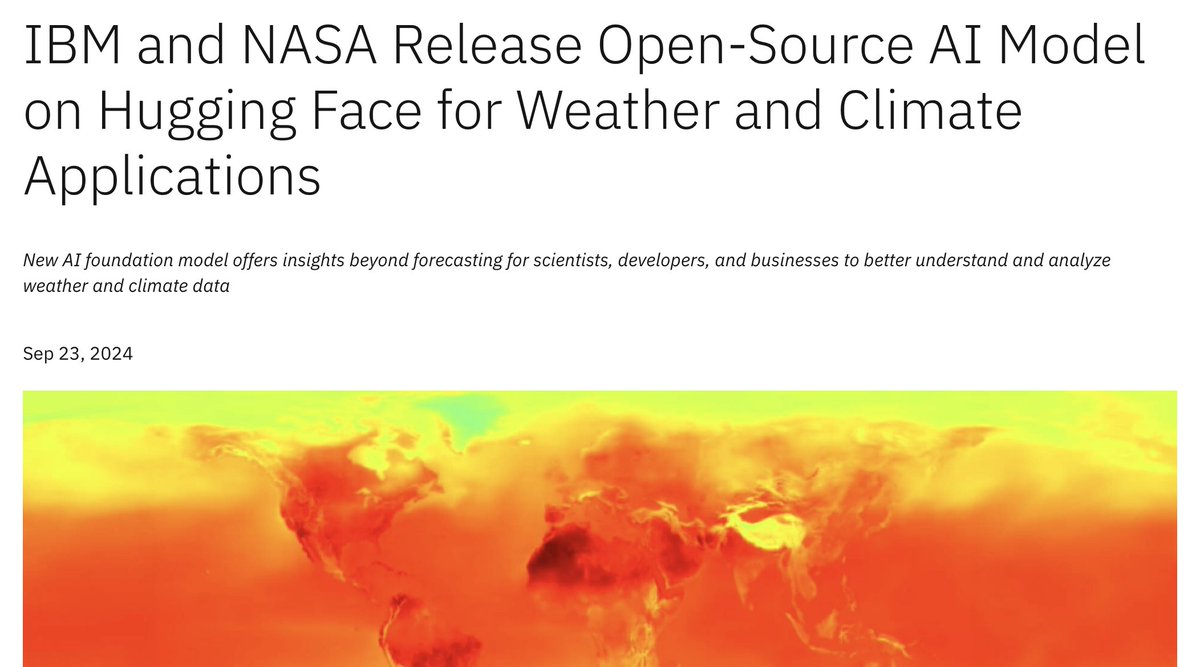
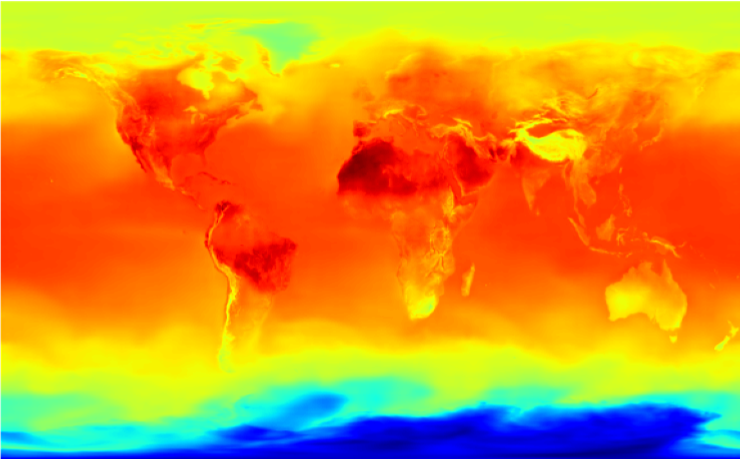
Today, @NASA and @IBMResearch released a new weather climate model powered by AI to help us better predict severe weather patterns and the long-term effects of climate change.
With AI, we're accelerating our work to protect communities and understand our changing world.
Big news! @IBMResearch and @NASAEarth just released a foundation model for weather and climate, Prithvi WxC, on @huggingface to help scientists and devs gain new insights about short-term weather and long-term climate conditions. https://t.co/XeyGnlaVKr
NASA and IBM present Prithvi WxC
Foundation Model for Weather and Climate
discuss: https://t.co/LVOVGo3L3g
Triggered by the realization that AI emulators can rival the performance of traditional numerical weather prediction models running on HPC systems, there is now an increasing number of large AI models that address use cases such as forecasting, downscaling, or nowcasting. While the parallel developments in the AI literature focus on foundation models -- models that can be effectively tuned to address multiple, different use cases -- the developments on the weather and climate side largely focus on single-use cases with particular emphasis on mid-range forecasting. We close this gap by introducing Prithvi WxC, a 2.3 billion parameter foundation model developed using 160 variables from the Modern-Era Retrospective Analysis for Research and Applications, Version 2 (MERRA-2). Prithvi WxC employs an encoder-decoder-based architecture, incorporating concepts from various recent transformer models to effectively capture both regional and global dependencies in the input data. The model has been designed to accommodate large token counts to model weather phenomena in different topologies at fine resolutions. Furthermore, it is trained with a mixed objective that combines the paradigms of masked reconstruction with forecasting. We test the model on a set of challenging downstream tasks namely: Autoregressive rollout forecasting, Downscaling, Gravity wave flux parameterization, and Extreme events estimation. The pretrained model with 2.3 billion parameters, along with the associated fine-tuning workflows, has been publicly released as an open-source contribution via Hugging Face.
The @NASA and IBM open-source Prithvi Weather-Climate AI foundation model has been released! The new model can be used to detect and predict severe weather patterns, create targeted forecasts, and improve spatial resolution on global climate simulations.
https://t.co/ZG2BRV50p4
Dive into more details in our WACV'24 paper 📃
Paper: https://t.co/9mmMOtq3rB
Code (to be released): https://t.co/nvVh6z97LM
Congrats to all the co-authors Arindam Dutta, @dripta_rayc, Calvin-Khang Ta, and Prof. Amit Roy for this work. Special Thanks to @yashgarg10226. (5/5)