Excited to share the final version of ProteinDPO is out today in @naturemethods! New in the paper is application of the model to stabilization of the pre-fusion state of hemagglutinin, the primary component of flu vaccines. 1/8
🔗https://t.co/Hp3m3FJFdF
📑https://t.co/mVggm42WEI
Aside from the very clever advancements in being able to "fingerprint" protein/gene interaction, have gotten a great biology lesson from @_David_Li and @garykbrixi seeing this story unfold, check out the paper!
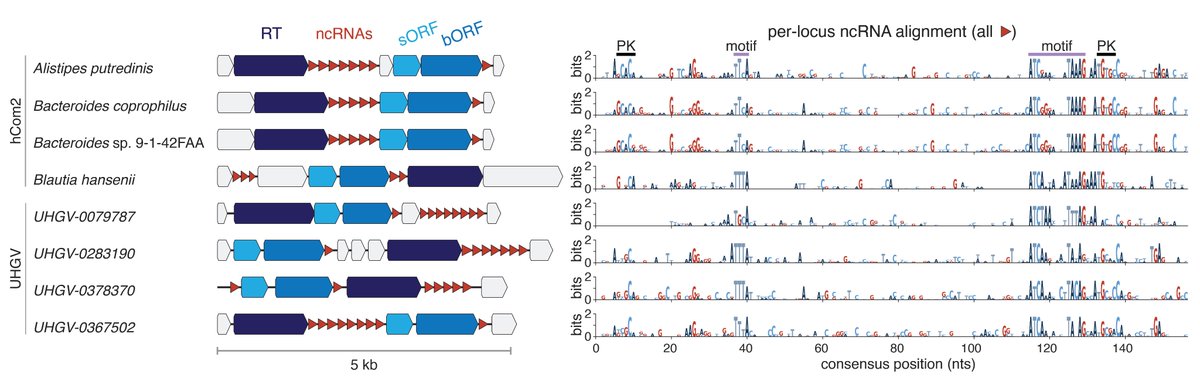
Excited to share Minerva, our approach using genome language models for biological discovery! Using Minerva, we find that UG27 reverse transcriptase systems encode variable arrays of diverse ncRNAs with a shared structure, each templating a short DNA hairpin. With @garykbrixi.
New work out today: we simulated enzymatic reactions in full atomic detail (~30-60k atoms) using a machine learned potential!
Enzymes are remarkable little molecular machines but notoriously difficult to model. High accuracy methods are too expensive for these large systems and approximate methods struggle to accurately describe reactivity. MLIPs offer a path to both speed and accuracy.
Still early days, but this work gives a glimpse of where things are headed. Excited to see how far we can push it.
@DdelAlamo Thats definitely apart of it, and what motivated us adding in the helix/beta sheet loss. But also, during training iirc BoltzGen and RFA receive "templates" as crops of the ground truth (like motifs), whereas for AF2 the templates are homologs, so its much softer conditioning.
@tsuboyama Grateful to be able to tell this story, from model training to learning how to test these designs in the lab, thanks to support from my amazing co-authors Ashir @samuelhking@driscoll_cl@rm_rafailov and PI @BrianHie. Check out the code below! 8/8
Code: https://t.co/X2x7k25VkJ
Excited to share the final version of ProteinDPO is out today in @naturemethods! New in the paper is application of the model to stabilization of the pre-fusion state of hemagglutinin, the primary component of flu vaccines. 1/8
🔗https://t.co/Hp3m3FJFdF
📑https://t.co/mVggm42WEI
@tsuboyama After testing our designs on the 2004 Vietnam strain, we applied them to recently emerged H5N1 variants isolated from cattle and a human (!) in 2024, and found our 9-mutation design was also highly stabilizing on these strains despite 20 years of viral evolution. 7/8
Our work led by @talaldotpdb on aligning protein generative models to experimental fitness with ProteinDPO is now published in @naturemethods!
New in the published paper includes stabilizing mutations to H5 hemagglutinin, a component of flu vaccines.
https://t.co/KnGu6xAtVm
The same method that teaches an LLM which answers people prefer can teach a protein model which sequences are more stable.
This is the basis for ProteinDPO, developed by Innovation Investigator @brianhie, @talaldotpdb, and team.
Today in @Nature we are excited to share the final version of Dyna-1 and *all* of the datasets we curated! New to the manuscript is prospective experimental validation. Congrats to @HWaymentSteele@DorotheeKern@sokrypton and team!!!
🔗https://t.co/HWDjalcx8G
📑https://t.co/PDVYajjRzr
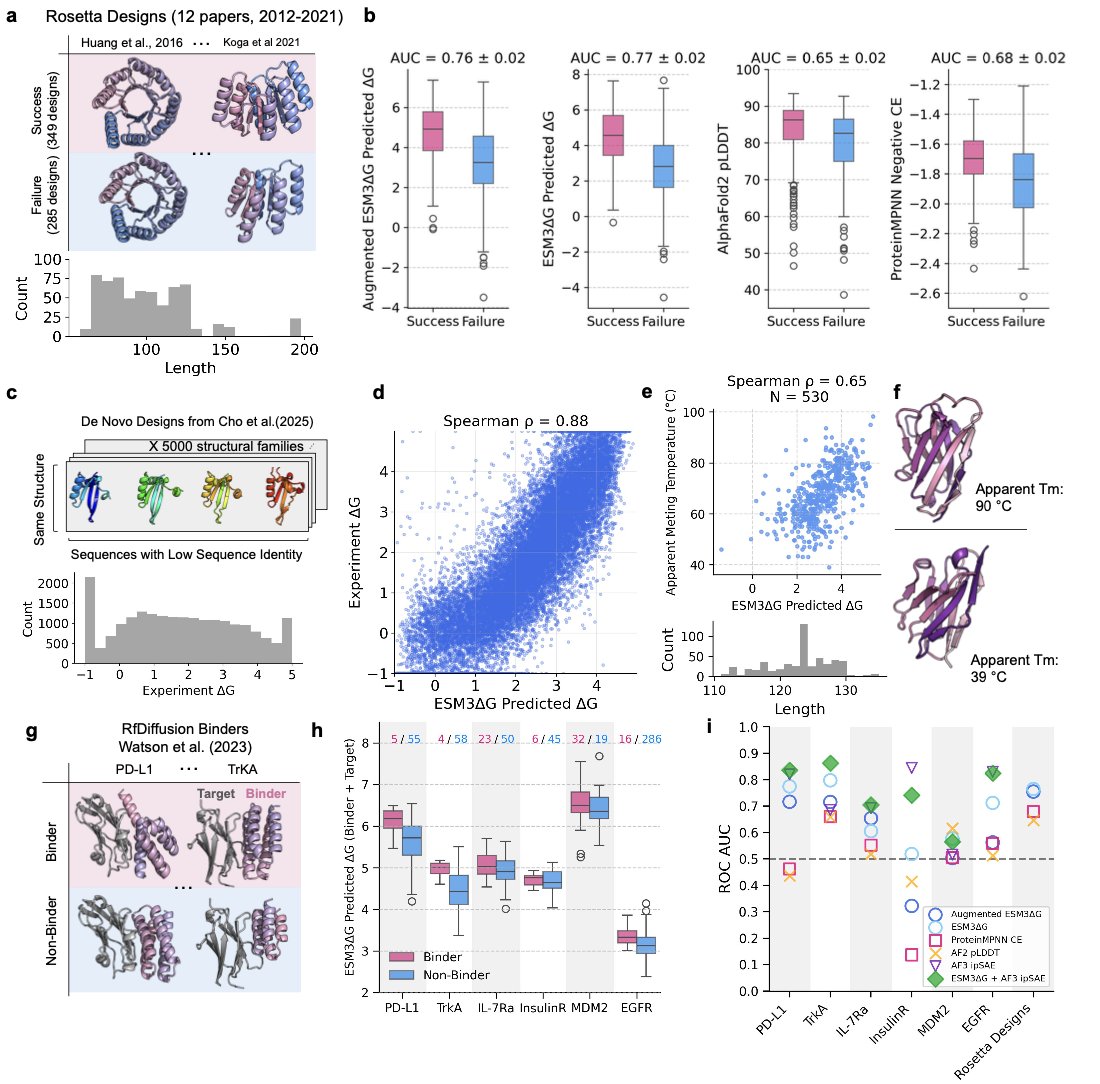
We evaluated our models on de novo designs, nanobodies, and binder ranking tasks, and found they consistently improved discrimination of stable, well-folded proteins.
Introducing Flux Matching, a generative modeling paradigm that generalizes diffusion models to vector fields that need not be the score function.
Enables structural priors in the dynamics, faster sampling, interpretable generation, and more!
w/ @StefanoErmon@Xiaojie_Qiu 🧵⤵️
9 of 322 designs bound in the GEM × Adaptyv RBX1 Binder Design Competition (ICLR 2026). 8 of those 9 engaged the disordered N-terminus, not the structured RING domain where most groups appeared to be aiming. The IDR was the productive epitope. The RING was where the field was looking.
Excited to report the first de novo enzyme catalyzing two of the most energetically demanding reactions in biology—phosphomonoester and phosphodiester hydrolysis—with catalytic efficiencies comparable to natural enzymes! 🚀
desB was designed zero-shot with dEVA. No structure prediction, no pre-defined motif, no reaction-intermediates. 🧵
@StanfordBiosci@bioe_stanford@SLAClab@EPFL@hes_so@simonduerr
🧵 We ran the largest head-to-head benchmark of protein binder design methods in the wet lab.
Project page: https://t.co/eSG5qcCPQB
1 million designs. 127 targets. RFdiffusion, BindCraft, BoltzGen, and Proteina-Complexa — all tested side by side.👇