Let’s give credit where credit is due.
Over the last 16 years, Netanyahu has done an impressive job of ensuring Israel’s future will be better by letting problems grow and fester until they became impossible to ignore.
• Without Netanyahu, many might still think a Palestinian state next door was manageable. Failing to prevent October 7 and then failing to defeat Hamas after years of war have made the risks impossible to dismiss.
• Without Netanyahu, Haredi draft exemptions might have stayed a hidden compromise. Refusing to draft them during the longest war in Israel’s history turned the issue into a permanent political flashpoint even with the young.
• Without Netanyahu, some might still have seen Qatar as a constructive partner. Instead, he allowed Qatari cash to Hamas, Qatari payments to his media advisors, and Qatari-backed Al Jazeera to broadcast their genocide libel from Israel, making clear to all Israelis that Qatar is an enemy state.
• Without Netanyahu forming governments with anti-Zionist Haredi parties that dismiss and insult Reform Jewish Americans, it would have been easier to maintain the relationship with the largest Zionist community in the diaspora. His indifference to their alienation made Israel more vulnerable.
• Without Netanyahu’s judicial overhaul and the fight it triggered, fewer people would have confronted how easily Israel’s political system can be rewritten every year by a simple majority—and why a constitution to protect all our rights is absolutely necessary.
• Without Netanyahu embracing Ben Gvir and Avi Maoz, it would have been easier to pretend Jewish terrorism and extremists in government were fringe and not tolerated by anyone in the Israeli mainstream.
• Without Netanyahu, government influence on the media would feel abstract. By engineering a free newspaper for his base and passing legislation to allow a news channel dedicated to echoing his own voice, the Prime Minister’s power over Israeli media became obvious to all.
Netanyahu doesn’t deserve the blame for making the problems.
But he gets the credit for making the problems undeniable.
So Tenzai is #1 on @Hacker0x01's business VDP leaderboard - for the second quarter in a row.
Here's the news: this time we did it using an open-weight model anyone can download. Same result as the frontier model, ~30% cheaper per report, and only 3.5% false positives.
And here's the real news: These models are highly capable to power offensive AI operations at scale. Attackers can and will build malicious agents with these models.
The write-up: https://t.co/7l7itzgVOJ
“Nobody is going to bet their career on vibe-coding a nuclear reactor.”
Our founder and CEO, @scottgmorton, sat down with @mariogabriele of @thegeneralistco to discuss what it takes to build software that engineers can trust with the world’s most consequential hardware, the lessons about culture he took from the SpaceX control room, and why he ultimately started Revel.
Watch or listen to the full episode:
YouTube: https://t.co/HWyVrPYACj
Spotify: https://t.co/6q0vkU65G5
Apple Podcasts: https://t.co/NbvKRYgLxN
Irregular’s Dan Lahav is on Bloomberg Tech today.
Believe this is his first TV interview since the release of the below essay.
Very simple questions on what happened, what we learned about model capabilities in the security context.
Having worked with @Irregular over the past year, we get a daily reminder that last quarter’s ceiling for AI offensive capabilities are today’s floor. Dan calls it the “end-state fallacy” - and in his new essay, he lays out what the industry should be doing about it. Worth a read
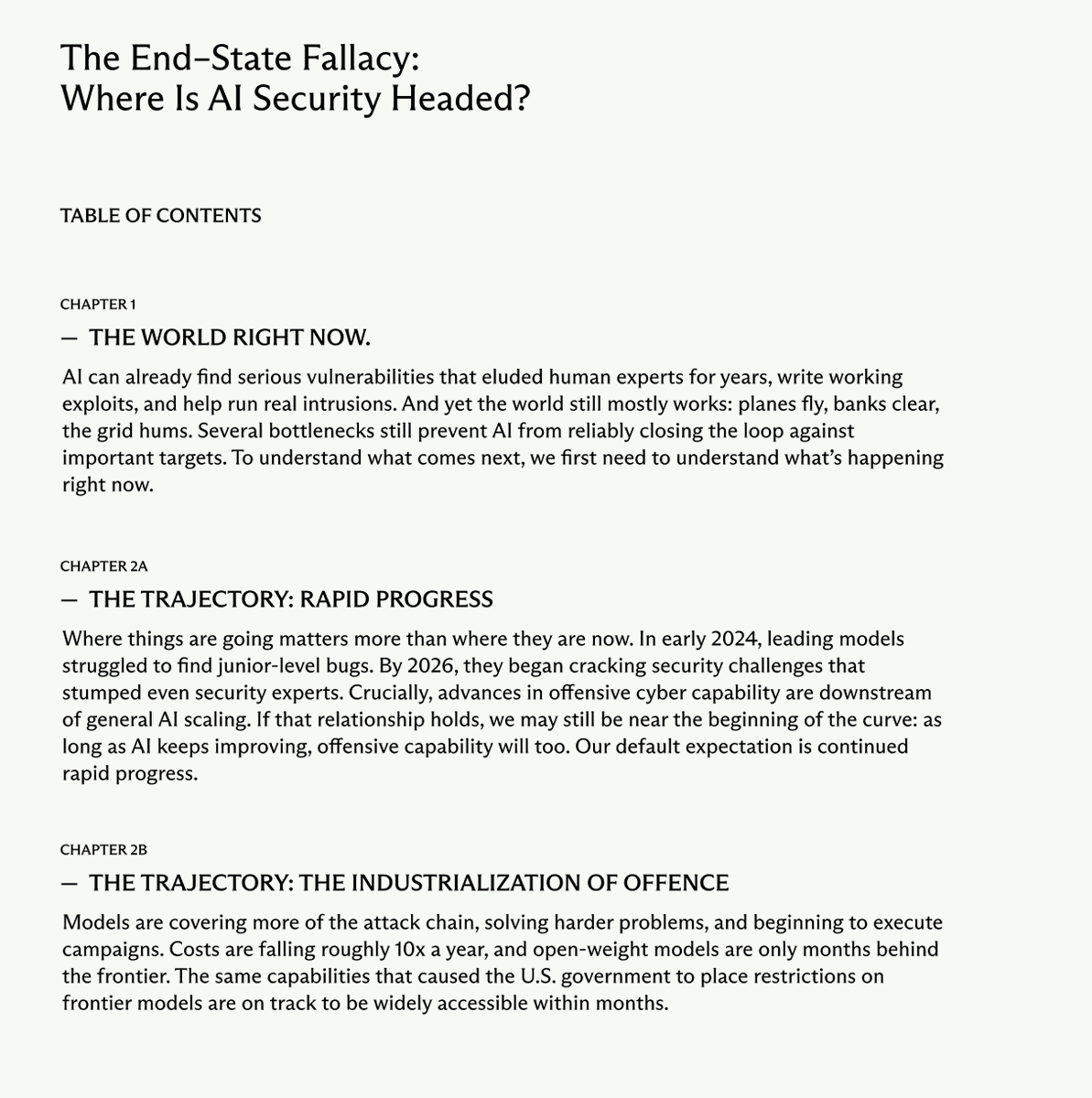
𝗧𝗵𝗲 𝗘𝗻𝗱-𝗦𝘁𝗮𝘁𝗲 𝗙𝗮𝗹𝗹𝗮𝗰𝘆: 𝗪𝗵𝗲𝗿𝗲 𝗜𝘀 𝗔𝗜 𝗦𝗲𝗰𝘂𝗿𝗶𝘁𝘆 𝗚𝗼𝗶𝗻𝗴?
Frontier AI models had a giant performance gain in coding in the Fall of 2025
Then with cybersecurity in April
This is now happening with open-weight models
We are optimistic about the long-term
But outside of a few players, we believe the world is not ready in the short-term
Three weeks ago, I was sitting in the drawing room of the holiday rental my family always gets in July in Frinton-on-Sea (St Tropez of the UK).
It was midnight and as my grandparents were snoring loudly next to me; my phone suddenly buzzed. It was legendary investor, @shardul_shah@IndexVentures.
As much as I love Shardul, it is rare for him to send me a deal and so when he does, I pay attention.
Shardul was sharing @simile_ai with me, suggesting I meet @joon_s_pk. He spoke of all the companies he has backed, their growth being unparalleled. Given the man did Wiz, that really excited me!
I asked for the intro, and 60 mins later, at 1 AM UK time, I was on a call with Joon. Straight away, it was clear he was one of the most unique talents I had met; an ability to be world-class in two seemingly opposing skills: creativity and scientific rigour. The man was a painter before becoming world class AI mind! Wow.
I committed to invest on the call. Why? Joon is obviously insanely special. Second, I care deeply about upside. If this works, what could this be? If this works, it will change marketing forever. It will change stock markets forever. It will change human decision-making in general. Insane.
I had to be a part of it and so I gave Joon a boatload of cash and asked if I could summarise the notes from our conversation below. (Links in comments)
Huge thanks to @BennettSiegel@ninaachadjian@kevinhartz@BryanOffutt@karpathy for amazing thoughts, questions and feedback here.
1. The Question to Ask When Assessing Talent
The best way to evaluate talent is to look for consistent performance across multiple stages of a career, not impressive titles. Ask one question: Were they the common denominator behind every success? Exceptional operators repeatedly create great outcomes across different roles, demonstrating rare ownership and adaptability.
-- @kevinhartz you are one of the single best talent spotters in tech. What is the single biggest commonality in the best founders you have worked with?
2. The Sign of Truly Great Talent
Exceptional talent combines traits that rarely coexist. While most people have correlated strengths, world-class builders embrace cognitive tension. They are short-term paranoid but long-term optimistic—obsessing over daily execution while maintaining unwavering conviction in the bigger picture.
-- @dannyrimer you also have an immense love of art. How has art impacted your view on company building and entrepreneurship?
3. People Will Pay $100 Million for a Single Simulation
AI will enable simulations so valuable that companies will spend tens of millions on a single run. A simulation may cost $20 million in compute, but if it prevents a $500 million product failure, paying $100 million becomes an extraordinary bargain.
-- @GavinSBaker does this align to your views on specialised intelligence?
4. Why Simulation Requires Modeling Human Bias, Not Perfect Logic
Frontier labs are racing to build the “CPU of intelligence” optimized for perfect reasoning. The bigger commercial opportunity may be the “GPU of intelligence”: models that replicate human judgment, bias, and imperfect decision-making to simulate complex real-world markets at scale.
-- @ml_angelopoulos how does the role of evaluations change in this world?
We’re building a future where people make better decisions today, by simulating how people will think, decide, and behave before ideas meet the real world.
Read more about what we're building in today's @nytimes. Thank you, @srimuppidi.
https://t.co/kiIfpDdKEk
Today we’re announcing our Series B.
We’ve raised $200M at a $2B valuation from Greenoaks with participation from Index Ventures, Hanabi, A*, Bain Capital Ventures, CVS Health Ventures, and Definition.
Our mission is to simulate all eight billion people on earth, accurately.
Our founder @scottgmorton joined CNBC's @SquawkStreet this morning to talk about today’s Starship launch, SpaceX’s willingness to take big bets on great teams, and how he’s bringing that same mindset to Revel.
Join us as we make the impossible a reality: https://t.co/LZF86mFS8z
Link to the interview in the replies.
Introducing Aidan, your newest AI employee
Aidan is the first computer-using AI built for realtime conversation
We’ve raised $45M from @sequoia and @8VC to bring Aidan to the world
@NotionHQ and @DecagonAI already use Aidan to run customer interactions. This is how @sablehq works: