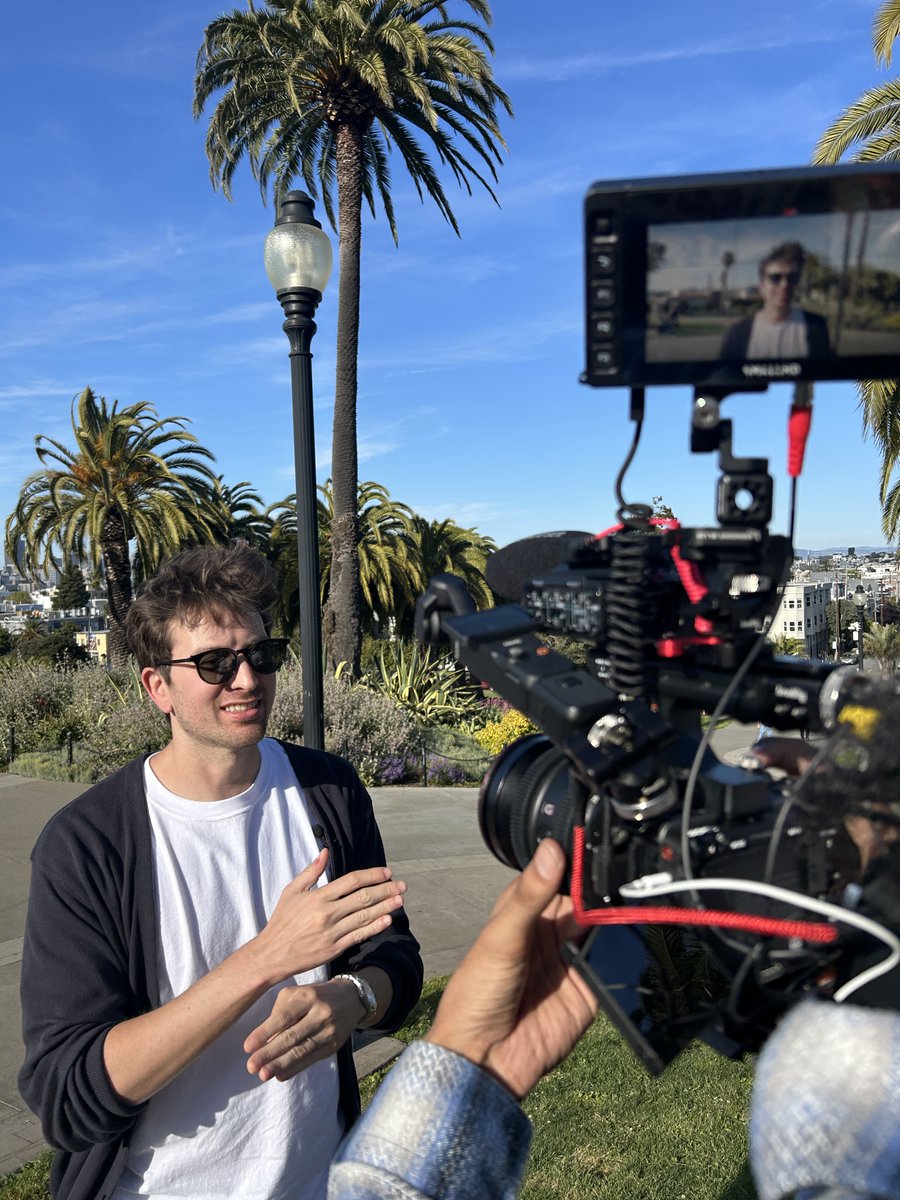
Midjourney is opening a health spa in downtown San Francisco with hot tubs, saunas, cold plunges and a new form of medical imaging that they have created, the full body ultrasound.
They can do a scan in 60 seconds. They want to deploy 50,000 of them over the next 6 years.
AMD CEO LISA SU HELD A MINI PC ON STAGE THAT RUNS A 235B MODEL AND REPLACES YOUR $440/MONTH AI STACK
amd's ryzen ai max+ 395 is the first x86 chip that runs a 200 billion parameter model on one piece of silicon. cpu and gpu share 128gb of unified memory, no separate graphics card needed
the gmktec evo-x2 runs qwen3 235b fully, deepseek v3 comfortably and llama 3.3 70b with headroom. on linux you get 110gb of usable vram out of 128gb
amd claimed the chip beat an nvidia rtx 5080 by more than 3x on deepseek r1 inference. a lunchbox sized pc outrunning a $1,000 discrete gpu on a real ai workload
a heavy ai user pays $200 for claude code max, $200 for chatgpt pro, $20 for cursor and $20 for gemini. that's $5,280 a year and the box pays itself off in 9 to 10 months
install ollama, pull the model, point claude code at localhost. same interface, nothing leaves the machine, nothing costs per request
bookmark this and read the article below
In twelve months, EVERY company will be running a Company Brain.
The teams who build it this year will spend the next year compounding. Everyone else is going to play catch up.
Here's what it actually is. You connect your Slack, your GitHub, HubSpot, all your tools into one intelligence layer, then build the org chart around it: a main brain up top, a fleet commander running the agent fleet, specialist sub-agents handling execution.
The reason it works is change management basically disappears. Your team already lives in Slack. You're just adding agents to the room they're already in.
You NEED to start building yours now. In a year this will stop being an advantage and will become table stakes.
Google hid a fully working flight simulator inside Google Earth back in 2007 and never told anyone.
You unlocked it with a secret keystroke: Ctrl+Alt+A. No menu, no announcement. One user stumbled onto it, the combo spread, and it got popular enough that Google made it official the next year. Two planes, an F-16 and a Cirrus SR22, flying over real satellite imagery of the entire planet.
Then it stayed locked inside the downloadable desktop app for 18 years. The browser version was a stripped-down viewer that couldn't run it. Today that changed.
Here is the part that makes it impressive. A flight simulator is the single hardest thing you can ask a 3D map to do. Panning is easy, the software has all the time it wants to load the terrain ahead of you. Flying low and fast strips that away, forcing it to fetch, decompress, and render the world faster than you are crossing it. The hardest possible job for every part of the system at once.
So "just for fun" is carrying a lot of weight in that sentence. Getting this to run in a browser tab is the cleanest proof that the web version finally matches what used to need a desktop app.
The toy is the benchmark.
I just got back from SF and I FEEL INSPIRED.
I spent 5 days with frontier AI model teams, AI startup founders, and 3 billionaires.
My takeaways:
1. I had lunch with 3 billionaires. All of them are buying SaaS companies and rebuilding them agent-first. They were deeply inspired by Bending Spoons and Ryan Cohen's eBay deal. Buy the company, cut the headcount, rebuild the tech, add agents, add features, make more valuable experience, raise prices.
2. The frontier model companies are hungry for usage data from the field. They can see API calls and token counts. They can't see the actual workflows. If you're deep in a niche using these models in ways the model companies haven't seen, that understanding is incredibly valuable. Usage intelligence is the new alpha.
3. Consumer AI is massively underbuilt. Every billboard in SF is either B2B inference infrastructure or vertical agent companies. The entire city is optimized for enterprise. Meanwhile you have companies like Cal AI doing $50M ARR in 18 months as a consumer app. I met with a cool few teams doing consumer AI (@paulscherer / @ekuyda)
4. MCP came up in literally every conversation. The companies exposing their product as MCP endpoints are getting pulled into deals they never pitched for. The ones that aren't are becoming invisible to agents. This is the new SEO. If agents can't find you, you don't exist. Building products for agents is the new zeitgeist in general.
5. Not uncommon for hot seed rounds to be $25-50 million valuations. I saw a Series A at $450 million
6. If I had a dollar every time someone mentioned "forward-deployed engineer" this trip I could have funded a seed round. It's the hottest role in SF right now. The person who sits between the agent and the customer, making sure everything actually works.
7. The mood around open source shifted. A year ago it felt like open source was chasing the frontier models. Now founders are telling me Gemma and DeepSeek are good enough for 80% of what they need at a fraction of the cost. The "which model do you use" conversation is being replaced by "which model for which task." Model loyalty kinda feels dead.
8. Voice agents came up more than I expected. Multiple founders told me voice is the interface for the next billion users. The billion people who will never type a prompt will absolutely talk to one.
9. The Obsidian community in SF is weirdly intense. Multiple founders showed me their vaults unprompted. Like showing someone your home gym. It's a flex now. The quality of your knowledge base (second brain?) is becoming a status symbol among builders.
10. Maybe it was just the people I met but the age of the founders is shifting. I met more founders over 40 this trip than any trip before and more founders under age 21 than ever before. Founders getting older and younger at the same time.
11. I spoke to a lot of fast-growing startups, VCs and frontier models who are hiring content creators right now.
12. The restaurant scene in SF is actually better than it's been in years. Founders are going out more. Alcohol is out, not surprisingly.
13. SF doesn't feel like the only place anymore. We all have access to the same frontier models. We all read the same X feed. A founder in NYC or Lagos is calling the same APIs as a founder in SoMa. So in the past it felt like SF was always lightyears ahead, doesn't feel that way anymore. It's okay not to live in SF and have BIG DREAMS.
14. The coworking spaces in SF are half empty but the coffee shops are packed. People want to be around people. I had a few startup ideas here....
15. Walking around the Mission I noticed something: the street-level businesses, the taquerias, the barbershops, the laundromats, none of them use any AI at all.
16. I heard the phrase "agent debt" for the first time. Like technical debt but for agents. When you hack together an agent workflow fast and never clean it up, the system prompts conflict, the memory gets polluted, the tools overlap. 6 months later the agent is doing weird things and nobody knows why lol.
17. Met a few people who carry two phones now. One for personal. One that's basically an agent terminal running Telegram or iMessage connections to their agent fleet.
It's always amazing to get that dose of inspiration in SF. I FEEL INSPIRED.
But I'm so happy to be back home, locked in and building.
We're 12-18 months into a shift that will take 15 years to play out. The urgency in every conversation was real.
What an incredible time to be building.
This works really well btw, at the end of your query ask your LLM to "structure your response as HTML", then view the generated file in your browser. I've also had some success asking the LLM to present its output as slideshows, etc.
More generally, imo audio is the human-preferred input to AIs but vision (images/animations/video) is the preferred output from them. Around a ~third of our brains are a massively parallel processor dedicated to vision, it is the 10-lane superhighway of information into brain. As AI improves, I think we'll see a progression that takes advantage:
1) raw text (hard/effortful to read)
2) markdown (bold, italic, headings, tables, a bit easier on the eyes) <-- current default
3) HTML (still procedural with underlying code, but a lot more flexibility on the graphics, layout, even interactivity) <-- early but forming new good default
...4,5,6,...
n) interactive neural videos/simulations
Imo the extrapolation (though the technology doesn't exist just yet) ends in some kind of interactive videos generated directly by a diffusion neural net. Many open questions as to how exact/procedural "Software 1.0" artifacts (e.g. interactive simulations) may be woven together with neural artifacts (diffusion grids), but generally something in the direction of the recently viral https://t.co/z21CP5iQfu
There are also improvements necessary and pending at the input. Audio nor text nor video alone are not enough, e.g. I feel a need to point/gesture to things on the screen, similar to all the things you would do with a person physically next to you and your computer screen.
TLDR The input/output mind meld between humans and AIs is ongoing and there is a lot of work to do and significant progress to be made, way before jumping all the way into neuralink-esque BCIs and all that. For what's worth exploring at the current stage, hot tip try ask for HTML.
The most female-led product org in tech right now:
Chief Product Officer: Ami Vora
Claude Code/Cowork Head of Product: Cat Wu
Claude Code/Cowork Head of Eng: Fiona Fung
Claude Platform Head of Product: Angela Jiang
Claude Platform Head of Eng: Katelyn Lesse
Research Head of Product: Dianne Penn
President: Daniela Amodei
(Also, the fastest-growing company in history)
Just dropped a 2 hour Claude Design masterclass where I go from nothing, to a brand with guidelines, a pitch deck, landing page, mobile app prototype, and a launch video.
All built in Claude Design.
My biggest takeaways from Claude Code's Head of Product @_catwu:
1. Anthropic’s product development timelines have gone from six months to one month, sometimes one week, sometimes one day. Part of this acceleration is access to the latest models (i.e. Mythos). Another is shipping new products into “research preview,” making clear it's early, experimental, and might not be supported forever. Another is an evergreen "launch room "where engineers post ready features and marketing turns around announcements the next day.
2. The PM role is shifting from coordinating multi-month roadmaps to enabling teams to ship daily. As Cat puts it, “There should be less emphasis on making sure you are aligning your multi-quarter roadmaps with your partner teams and more emphasis on, OK, how can we figure out the fastest way to get something out the door?”
3. The most efficient shipping unit is an engineer with great product taste. On Cat’s team, many engineers go end-to-end—from seeing user feedback on Twitter to shipping a product by the end of the week—without a PM involved. Also, almost all the PMs on the Claude Code team have either been engineers or ship code themselves, and the designers have been front-end engineers. The roles are merging, and the most valuable skill is product taste, not job title.
4. Build products that are on the edge of working. Claude Code’s code review product failed multiple times because earlier models weren’t accurate enough. But because the prototype was already built, they could swap in Opus 4.5 and 4.6 and immediately test whether the gap was closed. Teams that wait for the model to be ready will always be a cycle behind.
5. The most underrated skill for building AI products is asking the model to introspect on its own mistakes. Cat regularly asks the model why it made an unexpected decision. The model will explain that something in the system prompt was confusing, or that it delegated verification to a subagent that didn’t check its work. This reveals what misled the model so the team can fix the harness.
6. Every model release forces their team to revisit existing products and audit their system prompt to remove features the model no longer needs. Claude Code’s to-do list was a crutch for earlier models that couldn’t track their own work. With Opus 4, the model handles it natively. Features built as scaffolding for weaker models become debt when the model catches up—so the team actively strips them.
7. Anthropic employees build custom internal tools instead of buying SaaS products. A sales team member built a web app that pulls from Salesforce, Gong, and call notes to auto-customize pitch decks—work that used to take 20 to 30 minutes now takes seconds. Their core stack is Claude Code, Cowork, and Slack. No Notion, no Linear, no Figma.
8. People underestimate how much Claude’s personality contributes to its success. As Cat describes it, “When you reflect on everyone you’ve worked with, there’s just some people where you’re like, I really like their energy, their vibe.” Claude is designed to be low-ego, positive, competent, and earnest—qualities that make it feel like a great coworker, not just a tool. This isn’t cosmetic; it’s what makes people want to use Claude for hours every day. The team has a dedicated person, Amanda, who “molds Claude’s character,” and it’s one of the hardest roles at the company because success is so subjective.
9. The future of work is managing fleets of AI agents, not doing the work yourself. Cat sees a clear progression: first, individual tasks become successful. Then people start running multiple tasks at the same time (multi-Clauding). Next, people will run 50 or 100 tasks simultaneously, which will require new infrastructure—remote execution, better interfaces for managing tasks, agents that fully verify their work, and self-improving systems that incorporate feedback. The human role shifts from doing the work to knowing which tasks to look into, verifying outputs, and giving feedback that makes the system better over time.
10. Hire people who lean into chaos and face every challenge with a smile. At Anthropic, there are weeks when a P0 on Sunday becomes a P00 by Monday and a P000 by Monday afternoon. If you get too stressed about any one thing, you’ll burn out. Their team looks for people who can look at a hard challenge and say, “Wow, that’s gonna be hard. But I’m excited to tackle it and I’m gonna do the best that I possibly can.” This mindset—optimism, resilience, and comfort with constant change—is increasingly essential as the pace of AI development accelerates.
Don't miss the full conversation: https://t.co/1wOUHcdYQN
Tiger Global just valued a bagel shop at $300 million. And the math actually makes sense if you stare at it long enough.
PopUp Bagels started in 2020 out of a kitchen in Westport, Connecticut. Adam Goldberg was baking bagels for neighbors during the pandemic. Five years later, Tiger Global closed a deal in late March that values the company at 5x what it was worth five months ago.
The unit economics are what caught Tiger's attention. Average transaction over $24. Five bagel varieties. Three schmears. 55 total SKUs while competitors run 200-300. Stores are 1,000-1,200 square feet. Each location hires 10-15 employees instead of the 50-60 a typical QSR needs. No ice machines. No soda fountains. No fryers.
They don't sell individual bagels. You buy packs of three, six, or twelve. You grip, rip, and dip. That constraint does two things simultaneously: it raises average order value above the threshold where a small-format store prints money, and it creates a ritual that photographs well. Every customer becomes a content creator.
The franchise math: $330K-$810K to open, $35K franchise fee, 6% royalty. They've signed 300 franchise units with fewer than 15 operators. That's roughly 20 stores per operator. Experienced multi-unit franchisees running large territories, not first-timers buying a single shop. About 30 locations open now, targeting 100 by end of 2027.
Celebrity investors include Paul Rudd, JJ Watt, Michael Phelps, Michael Strahan. Stripes bought a majority stake in 2023 and brought in a real CEO, Tory Bartlett, in late 2024. Adam Sandler has a dedicated phone at one of the New York shops to call in orders. They literally call it "the Sandler Phone."
Here's what Tiger Global sees. The same firm that backed Meta, invested in OpenAI and Waymo, has been exiting 85+ companies from its most recent fund to concentrate on fewer, higher-conviction bets. They looked at a bagel company and decided it belonged in that concentrated portfolio.
The $300 million number only works if you believe 300 franchise locations actually open and hit the projected unit economics. At an estimated $6M revenue per location and 18% margins, 100 operating stores would generate roughly $108M in systemwide profit. At 300, you're approaching the kind of numbers that make $300M look cheap.
The real question is whether the hype survives national scale. PopUp Bagels built its brand on scarcity, long lines, and social media energy. Every franchise system in history has faced the tension between exclusivity and expansion. Levain Bakery, funded by the same firm Stripes, is the closest comparable, and it stayed small.
Tiger's betting the ritual travels. That the 1,100 square foot format, the five-SKU simplicity, and the $24 average ticket create something that works in Tampa the same way it works in Greenwich Village.
If they're right, this is the most capital-efficient restaurant concept of the decade. If they're wrong, it's a $300 million lesson in the difference between a brand and a business.
There's a physicist at Stanford named Safi Bahcall who modeled this exact principle and the math is wild.
He calls it "phase transitions in human networks." When you're stationary, your probability of a lucky event is limited to your existing surface area: the people you already know, the places you already go, the ideas you've already been exposed to. Your opportunity window is fixed.
When you move, your collision rate with new nodes in a network increases nonlinearly. Double your movement (new conversations, new cities, new projects) and your probability of a serendipitous encounter doesn't double. It roughly quadruples. Because each new node connects you to their entire network, not just to them.
Richard Wiseman ran a 10-year study at the University of Hertfordshire tracking self-described "lucky" and "unlucky" people. The single biggest differentiator wasn't IQ, education, or family money. Lucky people scored significantly higher on one trait: openness to experience. They talked to strangers more, varied their routines more, and said yes to invitations at nearly twice the rate.
The "unlucky" group followed the same routes, ate at the same restaurants, and talked to the same 5 people. Their networks were closed loops. No new inputs, no new collisions.
Luck isn't random. Luck is surface area. And surface area is a function of movement.
The lobster emoji is doing more work than most people realize. Lobsters grow by shedding their shell when it gets too tight. The growth requires a period of total vulnerability. No protection, no armor, soft body exposed to the ocean.
That's the cost of movement nobody posts about. You have to be uncomfortable first. The new shell only hardens after you've already moved.
Astronaut Victor Glover delivers beautiful Easter message from space, praises God’s creation.
“When I read the Bible and I look at all of the amazing things that were done for us…”
“You're on a spaceship called Earth that was created to give us a place to live in the universe, in the cosmos.”
“In all of this emptiness, this is a whole bunch of nothing, this thing we call the universe, you have this oasis, this beautiful place that we get to exist together…”
It's a M&A party! Anthropic is buying AI biotech startup Coefficient Bio for ~$400m. The team will join Anthropic's healthcare life sciences group, which develops tools for biotech workflows.
w/ @srimuppidi
https://t.co/JEQXwayvzp
> Anthropic pushed a software update at 4AM
> a debugging file was accidentally bundled inside
> 512,000 lines of proprietary source code. all of it
> researcher Chaofan Shou spotted it within minutes
> 23 million people saw the thread
> entire codebase mirrored across GitHub
> Anthropic fired DMCA takedowns at every repo
> Korean developer Sigrid Jin woke up at 4AM
> most active Claude Code user in the world
> 25 billion tokens last year. WSJ reported it
> rewrote the entire codebase in Python before sunrise
> called it claw-code. pushed it to GitHub
> Python rewrite is a new creative work
> DMCA can't touch it
> 49,000 stars. 56,000 forks
> faster than any repo in GitHub history
> someone mirrored the original to a decentralised platform
> one message. "will never be taken down"
the full breakdown of how Anthropic beat the Pentagon, leaked their own secrets, and built the most dangerous AI in history. 8 min read below.
My dear front-end developers (and anyone who’s interested in the future of interfaces):
I have crawled through depths of hell to bring you, for the foreseeable years, one of the more important foundational pieces of UI engineering (if not in implementation then certainly at least in concept):
Fast, accurate and comprehensive userland text measurement algorithm in pure TypeScript, usable for laying out entire web pages without CSS, bypassing DOM measurements and reflow
Your codebase is about to get worked on at 3am by an engineer that costs $200/month and never sleeps.
Anthropic’s shipping speed right now is genuinely absurd. Four features in 24 days, each one solving the previous release’s constraint. Remote Control (Feb 25) freed you from your desk but kept the machine running. Scheduled tasks (Feb 25) freed you from remembering to start work but required the machine to be awake. Dispatch (March 17) freed you from being near the machine but still needed it plugged in. Cloud scheduling removes the machine entirely.
Repo, prompt, cadence. Claude runs it on Anthropic’s infra. Your laptop can be off.
That last step is the one that matters because it changes WHO is doing the work. When scheduling was local, every automated task competed with the developer’s hardware, uptime, electricity. Cloud scheduling makes the mental model “Anthropic’s infrastructure works my codebase on a schedule I set.” A managed engineering service billed as a subscription.
Look at the session history in the screenshot. “Fix checkout race condition.” “Review auth migration PR.” “Refactor payment retry logic.” Those are tasks you’d assign to a junior engineer. Running autonomously, on cloud infra, against production repos, on a recurring schedule.
If you’re a PM, founder, or engineering leader, here’s how to think about deploying this:
Start with the tasks nobody wants to own. Nightly dependency audits that run npm audit, triage results, and open a PR before your team wakes up. Weekly refactoring passes on deprecated API calls pushed to a review branch. Automated code reviews on every PR open longer than 48 hours. Error log analysis that files a ticket when anomaly patterns spike.
Then move to the tasks that are important but keep slipping. Security scans across multiple repos on rotation. Test coverage gap analysis on new PRs. Documentation drift detection where the code has changed but the docs haven’t.
The compounding effect is what separates this from a better linter. Each scheduled task generates artifacts (PRs, tickets, reports) that your team reviews in the morning. Over weeks, the codebase gets cleaner in the background. Tech debt stops accumulating because something is actually working on it every night. For PMs, that means fewer “we need to pause features for a cleanup sprint” conversations. For founders, that means your 3-person eng team operates like a 5-person team without the burn rate.
The $2.5B ARR number makes more sense in this context. Claude Code’s real competition is headcount. A Max subscription costs $200/month. A junior engineer running nightly reviews and refactoring passes costs $8,000/month minimum. If cloud scheduling works at even 60% reliability, every PM planning next quarter’s roadmap and every founder deciding whether to make hire #4 re-runs that calculation.
Four dependency eliminations in 24 days. The Claude Code team is shipping at a pace that would make most YC startups jealous, and they’re doing it inside a $380B company. The endpoint writes itself.
Former Dropbox CTO says rise of AI code has completely changed software engineer recruiting (vastly increases value of side projects, reduces value of CVs):
“One of our members recently ran about 20 work trials for engineering hires—essentially, extended, weeklong job interviews—and found zero correlation between years of experience and adaptability to AI tools. Another member told me that what predicted success in hiring people who possess that adaptability was evidence of a builder’s disposition: cool personal websites, side projects, an obvious love of making things. FAANG on the résumé and a name-brand university, meanwhile, predicted almost nothing.”
What does it mean for software engineering when we no longer write the code? Here's the take from Boris Cherny (@bcherny), the creator of Claude Code. Timestamps:
00:00 Intro
11:15 Lessons from Meta
19:46 Joining Anthropic
23:08 The origins of Claude Code
32:55 Boris's Claude Code workflow
36:27 Parallel agents
40:25 Code reviews
47:18 Claude Code's architecture
52:38 Permissions and sandboxing
55:05 Engineering culture at Anthropic
1:05:15 Claude Cowork
1:12:48 Observability and privacy
1:14:45 Agent swarms
1:21:16 LLMs and the printing press analogy
1:30:16 Standout engineer archetypes
1:32:12 What skills still matter for engineers
1:35:24 Book recommendations
Brought to you by:
• @statsig — The unified platform for flags, analytics, experiments, and more. https://t.co/ZCSOIcWv31
• @SonarSource – The makers of SonarQube, the industry standard for automated code review. Proactively find and fix issues in real-time with the SonarQube MCP Server: https://t.co/RkEeF7gDc3
• @WorkOS – Everything you need to make your app enterprise ready. https://t.co/aiAee0oF5h
Three interesting things from this conversation:
1. Boris automated himself out of code review well before AI.
Boris was one of the most prolific code reviewers at Meta company. And he worked hard to minimize time spent on code review. His system::every time he left the same kind of review comment, he logged it in a spreadsheet. Once a pattern hit 3-4 occurrences, he’d write a lint rule to automate it away!
2. PRDs are dead on the Claude Code team: prototypes replaced them.
Instead of writing Product Requirement Documents (specs), they build hundreds of working prototypes before shipping a feature. Boris: “There’s just no way we could have shipped this if we started with static mocks and Figma or if we started with a PRD.”
3. This is the year of the generalist (and maybe the year of those with ADHD)
Boris’s work has shifted from deep-focus single-threaded coding to managing multiple parallel agents and context-switching rapidly. As Boris put it: “It’s not so much about deep work, it’s about how good I am at context switching and jumping across multiple different contexts very quickly.”