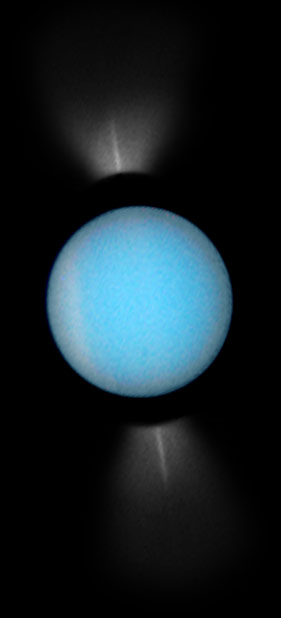
#OTD 15 years ago, Hubble snapped this shot of Uranus.
This rare view shows the planet’s faint rings edge-on, seen as two spikes above and below the planet.
Uranus’s rings can only be seen edge-on every 42 years, since its orbit takes 84 years: https://t.co/9NqybCDQpQ
Saturn is currently in a great spot for skywatchers: close to Earth (relatively speaking) while directly opposite the Sun in our night sky.
Though the full Moon may get in the way, a good telescope should still be enough to zoom in on the gas giant: https://t.co/gILDMBRpvX
On this day in 1966, Lunar Orbiter 1 arrived at the Moon, becoming the first U.S. spacecraft to orbit the Moon. During its mission, it photographed potential Apollo landing sites.
A view from space of the aurora australis over Antarctica on July 18. The image was acquired using the day-night band on the Visible Infrared Imaging Radiometer Suite (VIIRS) on the NASA-NOAA Suomi NPP satellite. https://t.co/N88Ik0gYox
After years of trying, countless cycles of IVF and 3 miscarriages, our rainbow babies finally arrived. One a few minutes before midnight on the 22nd and another five minutes after midnight on the 23rd.
Welcome to the world Jared and Maisie 🌈
#rainbowbabies#IVFbabies
Thanks for being so kind and so brave @KTRTRS ! You came to @MahindraUni after your accident and blessed the students.. You are a true karamyogi 🙏
The entire university (and the universe) wishes you a speedy recovery.