La reganancia de peso es impulsada por la termogénesis adaptativa que reduce el gasto energético🔥
Alteraciones neuroendocrinas que aumentan el hambre (⬇️de leptina y ⬆️de grelina), y una memoria epigenética que vuelve al tejido adiposo eficiente almacenando energía📦
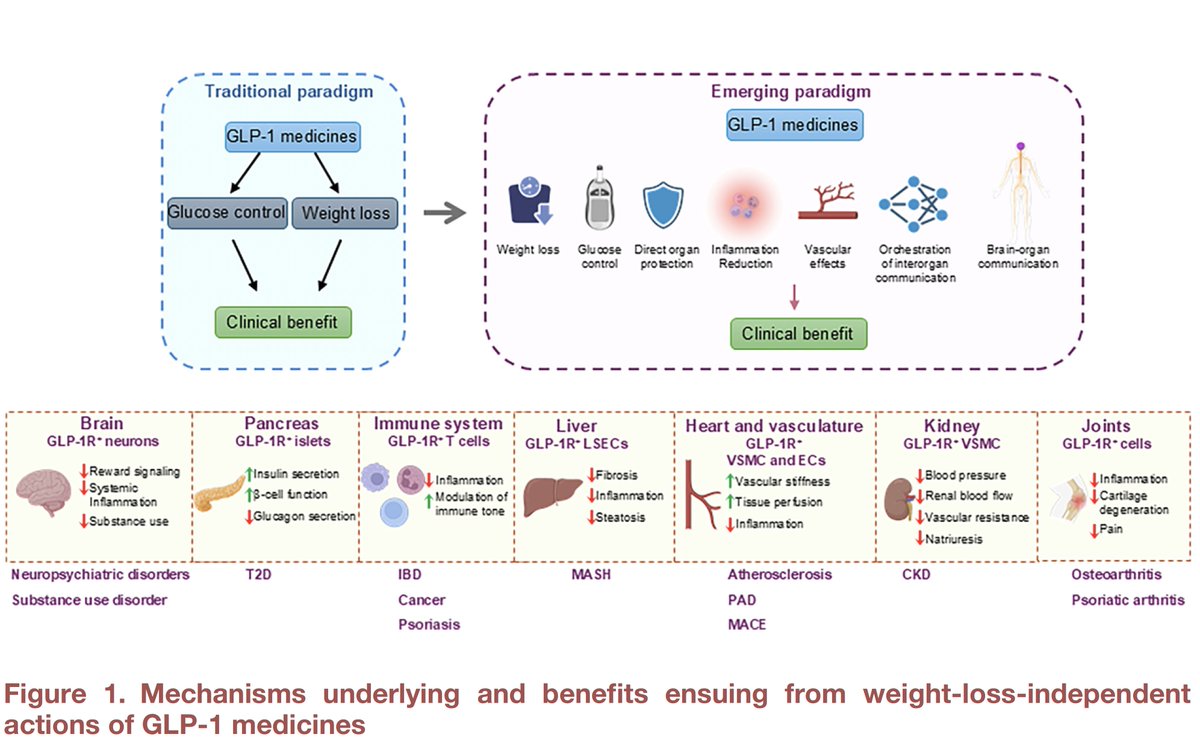
The GLP-1 drugs have evidence for beneficial impact— heart, kidney, liver, joints, immune system, and brain—that are independent of weight loss
@Cell_Metabolism@DanielJDrucker
https://t.co/ApB9ptjDL2
À la espera de la publicación de las guías europeas de Sd cardio_reno_metabólico de @escardio,
Resumen de las guías americanas 2026:
El síndrome CKM no es «diabetes + riñón + corazón por separado» — es un continuo fisiopatológico con estadios, riesgo calculable y tratamiento preventivo antes de la ECV:
🧵 1ª GUÍA UNIVERSAL DEL SÍNDROME CKM
AHA/ACC/ADA/ASN · JACC/Circulation 2026
🚫 FIN DEL ENFOQUE DE SOLO UN ÓRGANO:
🫀 Cardiopatía | 🫘 ERC | 🍬 DM2 | ⚖️ Obesidad
→ Un solo síndrome, un solo marco de acción
⚖️ CAMBIO DE PARADIGMA:
La ADIPOSIDAD disfuncional deja de ser un simple factor de riesgo
→ Es el motor biológico inicial del síndrome CKM
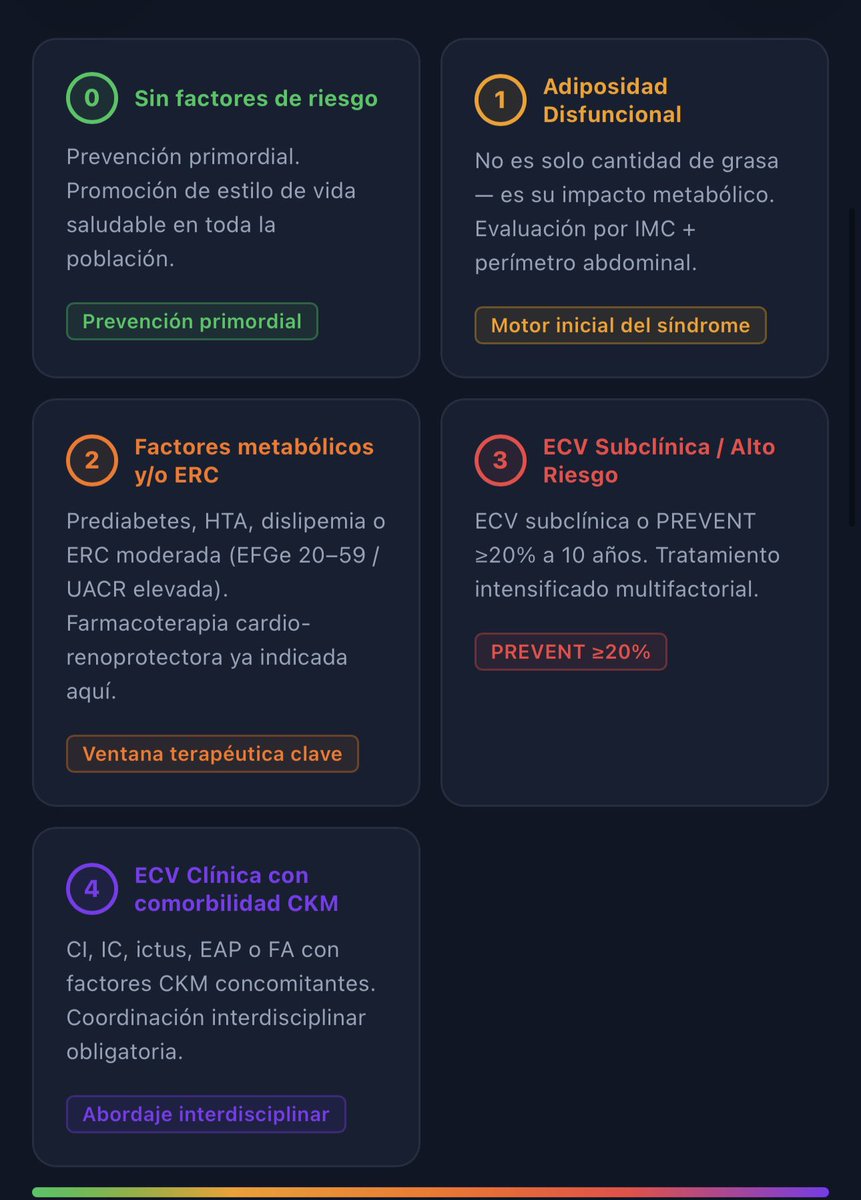
ESTADIOS — la gran novedad estructural:
🟢 ESTADIO 0: Sin factores de riesgo
→ Prevención primordial y estilo de vida
🟡 ESTADIO 1: Adiposidad disfuncional
→ Medición de grasa visceral no IMC
→ No es solo cantidad de grasa — es su impacto metabólico
→ Objetivo: evitar progresión
🟠 ESTADIO 2: Factores metabólicos y/o ERC
→ Prediabetes, HTA, dislipemia, EFGe 20–59 o UACR elevada
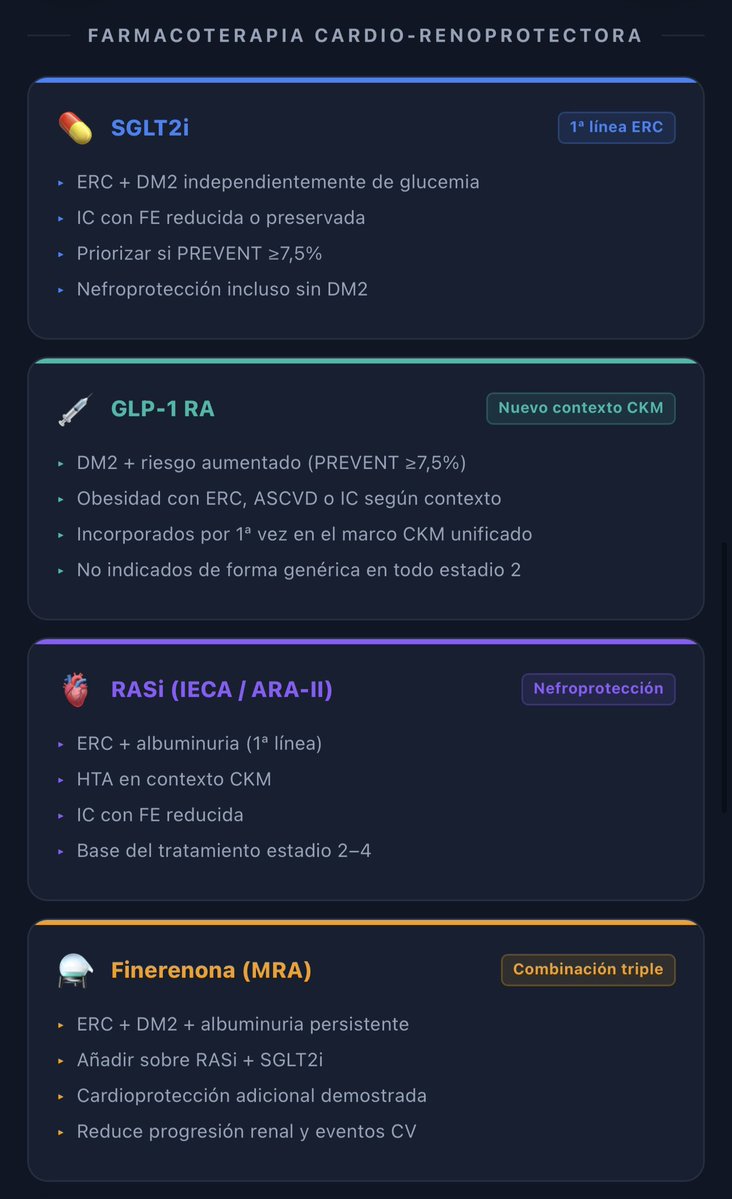
💊 Fármacos cardio-renoprotectores ya recomendados:
→ SGLT2i
→ GLP-1 RA en DM2 + riesgo aumentado (PREVENT ≥7,5%) u obesidad, ERC, ASCVD o IC según contexto
→ RASi (ERC + albuminuria)
🔴 ESTADIO 3: ECV subclínica / Alto riesgo
→ PREVENT ≥20% a 10 años = criterio de estadio
→ Tratamiento intensificado multifactorial
🟣 ESTADIO 4: ECV clínica con comorbilidad CKM
→ CI, IC, ictus, EAP o FA con factores CKM concomitantes
→ Coordinación interdisciplinar obligatoria
📐 ECUACIONES PREVENT — nueva herramienta central:
📊 ≥7,5% a 10 años → priorizar SGLT2i o GLP-1 RA
📊 ≥20% a 10 años → define estadio 3
📅 Horizonte a 30 años para intervención en jóvenes
🔬 ERC — dos marcadores, no uno:
🧪 eGFR + UACR ambos obligatorios
→ Guían SGLT2i, RASi y Finerenona
→ ERC + DM2 + albuminuria persistente → añadir MRA no esteroideo
🔄 NOVEDAD CLAVE: REGRESIÓN DEL SÍNDROME CKM
La guía habla explícitamente de regresión, no solo de frenar la progresión
✔️ El objetivo es revertir el síndrome cuando sea posible
🏥 CUIDADO INTERDISCIPLINAR:
→ Cardiología + Nefrología + Endocrinología + APS coordinados
→ Determinantes sociales de la salud: parte explícita de la evaluación
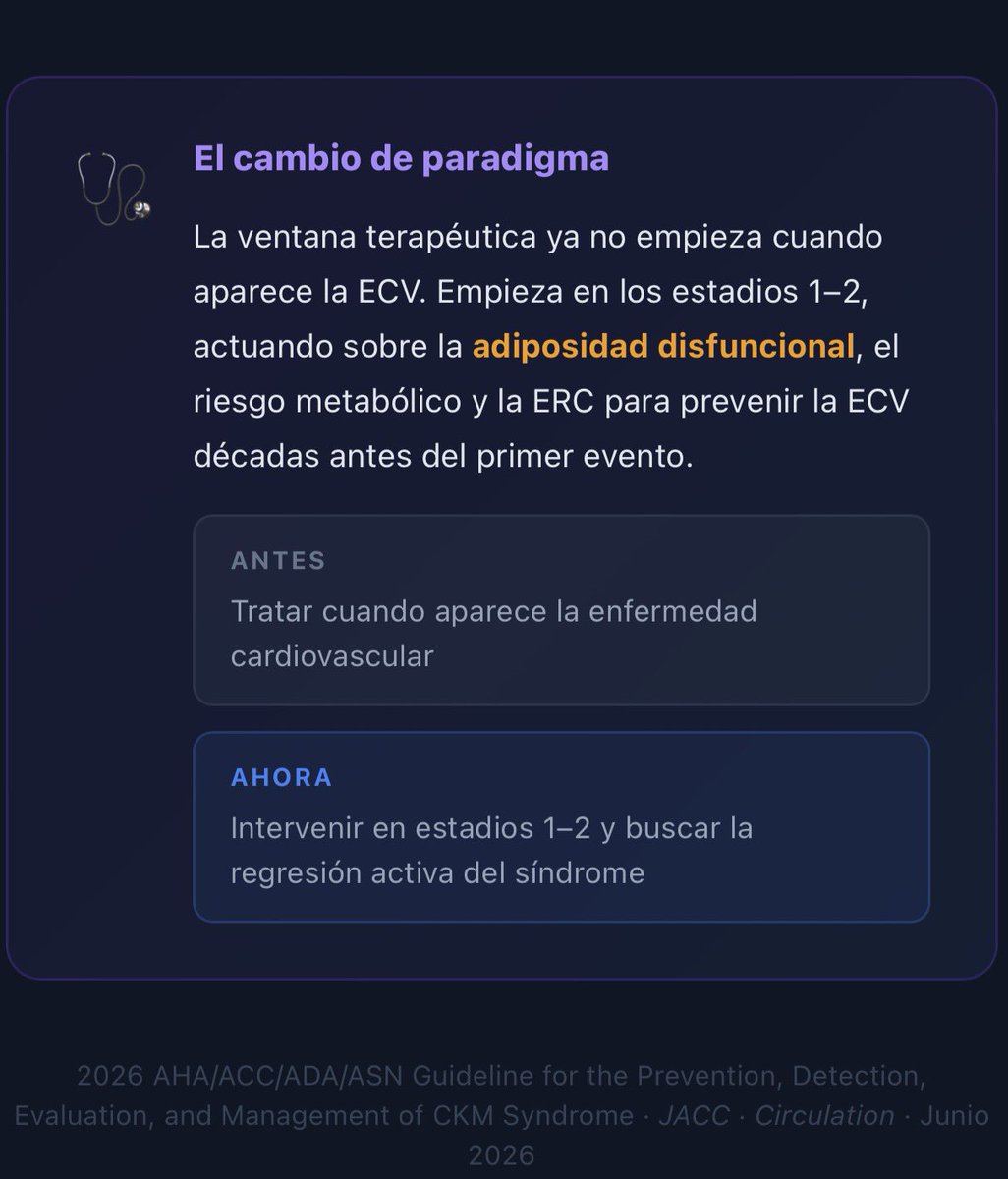
🩺 EL CAMBIO DE PARADIGMA:
La ventana terapéutica ya no empieza cuando aparece la ECV.
Empieza en los estadios 1–2, actuando sobre la adiposidad disfuncional, el riesgo metabólico y la ERC para prevenir la ECV décadas antes del primer evento.
✅ El objetivo ya no es solo frenar la progresión del síndrome CKM, sino favorecer su regresión cuando sea posible.
https://t.co/oz8j0IS129
https://t.co/JBD28PTcI4
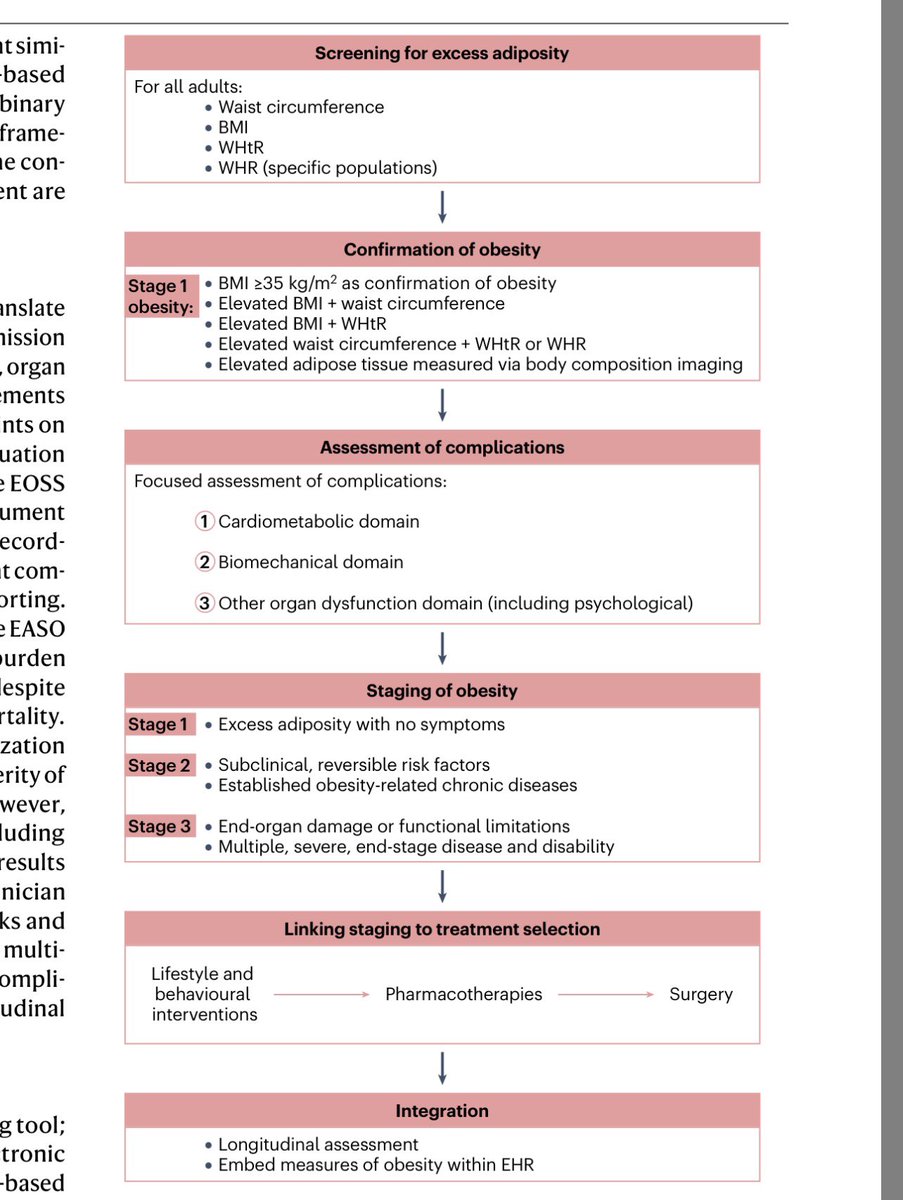
Este paper es probablemente la mejor síntesis hasta ahora en obesidad. No es una nueva guía. Compara las más recientes EASO (2024), (2025), ACC (2025) y AACE (2025) en un paper.
Obesidad deja de ser definida por IMC y se define ahora por exceso de adiposidad que genera daño.
New consensus statement from EASO, @efad_org and @ECPObesity on the use of incretin-based therapies (IBTs): Nutritional, Functional and Psychological Considerations for Obesity Management Medications in Adults
Read more: https://t.co/341DHrF5xL
Activar el GIPR (tirzepatida) y bloquearlo (MariTide) mejoran la composición corporal. Paradoja resuelta en @NatMetabolism : son circuitos distintos.
🔹 Área postrema → agonismo
🔹 Hipotálamo → antagonismo
Y el efecto también potencia a la cagrilintida.
No manda el receptor, manda el circuito 🧠
🔗 https://t.co/bnepdUm1Wa
Two-thirds of MASLD patients who qualify for a statin don't get one — mostly over a hepatotoxicity fear with no current evidential basis.
New review: why the liver may do more with statins than merely tolerate them.
@IDIVALdecilla@sepdigestiva
🔗 https://t.co/RAsG47x9yd
🦴 Do GLP1s increase or decrease fracture risk?
Two new studies. Same question. Opposite conclusions.
📊 Just published yesterday in JAMA:
133,606 adults with T2D. Those on GLP-1 RA had ⬇️ 21% lower fracture rate vs. DPP-4 comparator via the TriNetX database. doi:10.1001/jamanetworkopen.2026.25141
📊 Compare this to 46,177 adults with T2D. Those on GLP-1 RA had ⬆️ 11% increased fracture risk vs. DPP-4. doi: 10.1210/clinem/dgag056.
⚖️ Why the discrepancy? Both are retrospective, both used propensity score matching, yet the conclusions are diametrically opposed. But they have different populations, follow-up interval, potential for residual confounding, other anti-hyperglycemic use.
🔑 We need a prospective randomized trial examining skeletal outcomes with GLP-1 RAs.
📈 «Guía Práctica de ECG para Médicos»
Un manual claro y sistemático para leer el electrocardiograma paso a paso.
Pensada para residentes, médicos de familia y urgencias. 🫀
✍️ Autora: Laura Acosta
👉 Disponible en CardioTeca https://t.co/xkqY8A98wj
📄 La #SEEN, junto con @SEMERGENap, @semfyc y @SEMG_ES, presenta el documento "Continuidad asistencial en la atención clínica de la obesidad", un marco común para mejorar la coordinación entre Atención Primaria y Endocrinología y Nutrición.
🔗 https://t.co/gzsv9hXea9
#Obesidad #Endocrinología
🤰 Are GLP-1 receptor agonists a danger if taken around the time of conception?
A new systematic review and meta-analysis pools the largest reproductive-safety dataset to date: 6 studies, 286,599 women, 43,577 exposed to GLP-1 RAs.
📊 Major congenital malformations: RR 1.02 (95% CI 0.96–1.08). No signal.
Other outcomes were also non-significant:
⬇️ Small for Gestational Age: RR 0.71 (0.39–1.27)
➡️ Preterm birth: RR 1.09 (0.80–1.49)
➡️ Large for Gestational Age: RR 2.31 (0.56–9.44)
➡️ Stillbirth: RR 1.16 (0.24–5.69)
⚠️ The LGA and stillbirth confidence intervals are extremely wide. This is a limitation of the available data, not a reassurance.
🔑 This is reassuring but still limited data we have for inadvertent periconceptional GLP-1 RA exposure. It is not a green light for intentional use during pregnancy. The recommendation remains to discontinue GLP-1 RAs at least 2 months before planned conception. But for the patient who discovers their pregnant while on semaglutide or tirzepatide, this data should ease anxiety.
https://t.co/iHEbFpmToM
Medical #nutrition therapy delivered by a registered #dietitian is central to #obesity care and complements #incretin-based therapies https://t.co/8Cv1jebXky
#GLP-1 receptor agonists
dual GLP-1–GIP receptor agonists
#FREE to read with registration (also FREE)
🫀En ERC un NT-proBNP alto no siempre significa IC; no existe un punto de corte ideal
<300 pg/mL ayuda a excluir IC aguda
>1200 pg/mL con TFG <60 eleva la sospecha
📈En G4–G5 o diálisis, manda la tendencia + eco/POCUS
El riñón modifica la cifra; la clínica le da sentido
#CKD
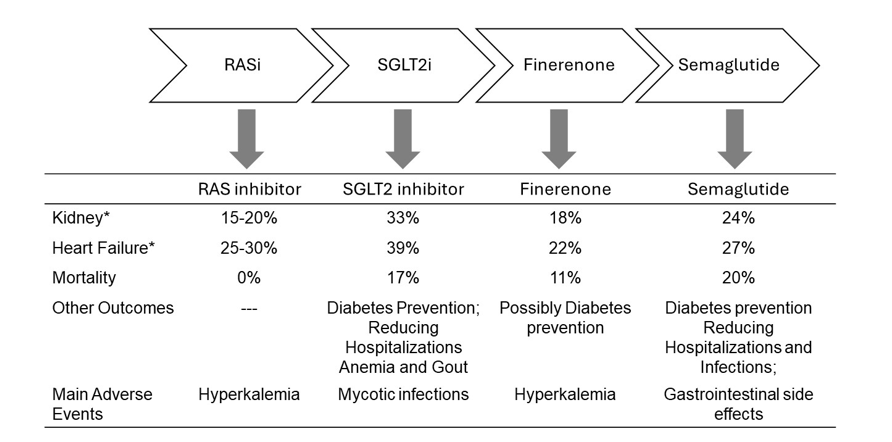
#ASNJASN: As CKD treatment options rapidly expand, a key question emerges- not just which therapies to use, but when and in what sequence. #Perspective explains that future research should focus on delivering the right therapy to the right patient at the right time. https://t.co/Fn0DlOBaTF