Back in May 2026, we presented our work at ICMNAI (neuroMONSTER) in Rome by @thoughtchannel_
We started with a simple question: why is AI memory treated as static storage when biological memory is constantly evolving?
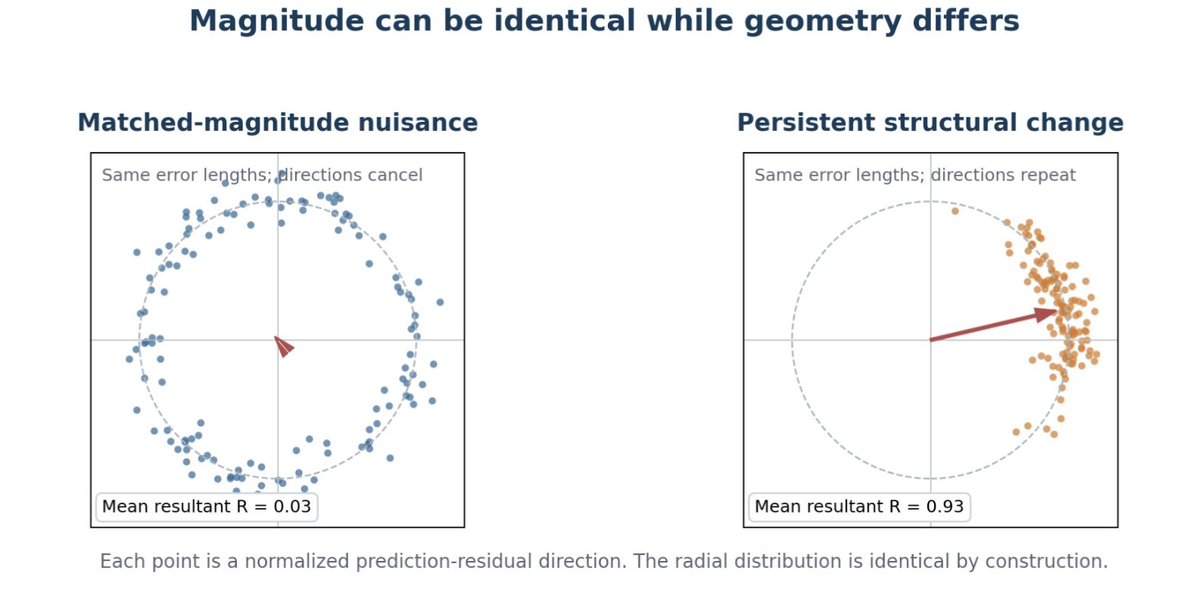
We modelled memory as a dynamical system shaped by decay, diffusion, inhibition, and replay and studied how these forces determine what fades, persists, and stabilizes.
The unusual part? We were undergrads with no formal background in computational neuroscience learning as we went through months of experiments, failures, and iterations.
Presenting this alongside folks from @GoogleDeepMind , @Cornell , @nyuniversity and others made the whole journey even more surreal.
More to come. Godspeed.
Humans are the only known species to reach a higher order of intelligence, an intelligence that shaped the world and placed us at its apex. As artificial intelligence emerges, perhaps we stand at the threshold of something greater, where intelligence begins to transcend its origins.
7 months , 6 naive bachelors , 1 vision : a suite of artifical systems built ground up from biological intelligence.
A new generation of emergent intelligence which goes beyond the comprehension of humanity.
Be a part of a leap towards the next phase of evolution with us at @metacognitionai
Humans are the only known species to reach a higher order of intelligence, an intelligence that shaped the world and placed us at its apex. As artificial intelligence emerges, perhaps we stand at the threshold of something greater, where intelligence begins to transcend its origins.
got done with my Technical R2 at @OpenAI recently for Model Pretraining and Inference, sharing few questions that were asked in this process :
- how does o200k tokenizer works and how is it different from previous tiktokenizer or o100k mechanisms
- whats the possible optimisation possible in BPE algorithm and how does frontier models like 5.6 sol optimise for enriched semantic understanding before reasoning happens over the tokens.
- possiblity of tokeniser free llms and how will u approach to solve this and what are the limitations.
- then they asked about if i have ever built a tokenizer from scatch and trained it -> hence i told them about HMTT and its implementations for mathematical reasoning and where we talked about ideas of neuro-symbolic representations.
( for more info read this -> https://t.co/buzf9hhsTd)
- prefill is compute bound whereas decode is memory bandwidth bound and why quantitatively using arithmetic intensity and at what batch size does decode start looking compute bound instead.
- disaggregating
- few questions on quantisation errors and their rebounds.
- concepts of speculative coding.
-etc..
really loved the technical interactions with the interviewers , learnt a lot of new stuffs and gr8 connections made.. hoping to hear back soon from them. hopefully :>>>
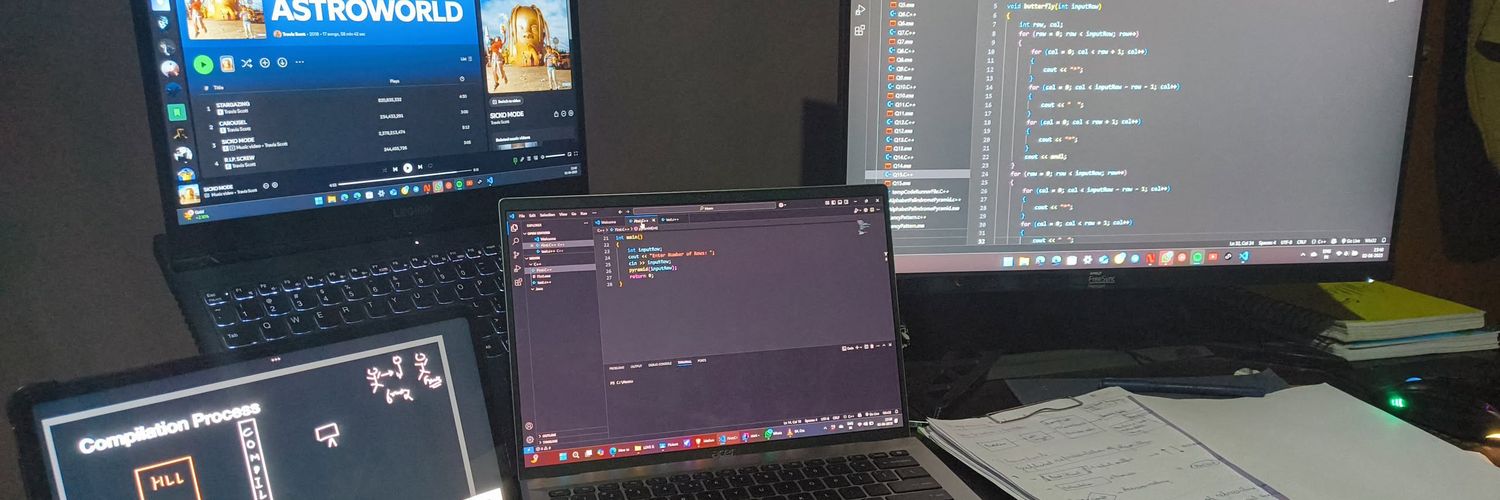
img : random evening work ( ignore claude ;-; )
pursued neuroscience as an engineer to bring cognitive intelligence for AI and
while building @metacognitionai, here's my take on neuroscience and AI, condensed in the form of learnings of the past 6 months for the industry to read. https://t.co/PlZZstWcLL
Personalization starts with understanding what primordial intelligence is.
Primordial intelligence, in neuroscience's terms, is the purest form of intelligence, the simplest of all. But how I define this to be would be - the minimal capability of a system to build an internal model of its environment from experience, retain it through memory, predict future states and adapt its behavior accordingly.
( inference I've taken after reading a brief history of intelligence)
A system that predicts the future states to minimize surprise between two events is a system that achieves primordial intelligence.
Think of a newborn baby, a month old. His brain tries to understand it's environment.
Fast forward this to maybe some years, he forms memories from experience, then patterns emerge from those memories, these inturn improve predictions and eventually the actions of the baby adapt over a period of time. This is the stage before the reasoning even starts developing.
A toddler doesn't need to know physics or gravity to catch a ball. They spend thousands of interactions to develop their own internal predictive model of gravity, motion and timing.
The point I want to make here is - Memory and Prediction is much more fundamental than reasoning. The baby becomes intelligent by experiencing the world and not by performing logical operations.
Now replace this baby by your ai agents. And this is what @metacognitionai does with your ai agents.
For the last few weeks, I have been tinkering with world models a lot because it is necessary for embodied intelligence in the way ahead. Specifically, I have been exploring what could be the possibilities in which we can allow cross-episodic long-horizon planning and memory-based tasks in world models. That way, not just robots but AV systems that we build upon can be also used by companies and infrastructure that require abstract and proper understanding of the environments.
Companies like companies like @temple use a kind of a world model of the particular person and keep a check upon it. At @metacognitionai , we have been trying to do something towards persona world models.
While going deep into the study, I found that there are the top 5 major problems that don't allow world model JEPA-based architectures to work across episodes:
- Auto-regressive error compounding
- Noise vs true memory interpretability
- Lack of a write mechanism
- Return visit degradation
- Drift blindness
What I explored was that a world model is just not about the perception. It is equally more important to work on planning and memory. A lot of people, naive people, think that planning and memory are two different things, but planning requires memory. They are coupled with each other till the very end. They are required for active inference and closed-loop planning. Memory is the most crucial part.
Now, what my idea was: how can we actually work on cross-episodes on that? I have been reading about MOP JEPA a bit, just started with it, but nothing major. What I found out is that there is an intrinsic notion of consequential changes. They do understand incremental changes. They just catch changes to the predictive error or epsilon when there is a drastic change.
But let's talk about what are the problems, basically one by one.
Ever since the research on a global workspace in language models or J-Space came out, I have been more intrigued by understanding what actually is the similarity between how reasoning and parallel thinking actually work in neuroscience, with this global workspace theory that is based completely on computational neuroscience.
So, as a very curious person, the best thing I could do was to understand what, at core, mechanistic interpretability is about and how we can actually decode the internal thinkings of large language models, which we know are a complete black box. How do we understand this dark matter, neural Networks?
@ch402 Blog post ( https://t.co/xNUYb4jOgl ) Talks about how, internally, what a large language knowledge thinks can be interpreted, and why interpreting it is very much important.
Well, I tried exploring some things because this is a new field that I am trying to understand, and so I would be listing down what I thought are really important and things that I found interesting.
- if we take a model like gemma 2b or qwen 3.5b and try to get its residual stream its easy to see and comprehend what the next predicted work be like.
- And if we actually try to tweak every neuron in each of the layers of a particular model, then we actually see a behaviour called polysemanticity, where a single neuron can control multiple features in a model.
- A research from, @AnthropicAI , in 2023 proposes a theory of SuperPosition, which I thought would be similar to what it is in physics and quantum mechanics, but in very crisp and easy terms, what it said, or what I was able to interpret, is that even if there are fewer neurons, those neurons are capable enough to control more features. Somehow, an internal learning is happening in which fewer neurons are able to comprehend more features.
So how do we actually understand what actually happens in every layer of thinking? For that, we actually use something called sparse autoencoders.
To showcase the architecture of it :
It pulls out the neuron outputs, multiplies it with a weight matrix, and converts it into a feature vector. Now, what is the meaning of sparsity here? What it does is it forces most of the terms in the feature vector to be zero. We try to reverse engineer and try to find out if we can reconstruct the neuron outputs that came up first.
And if the reconstructed neuron output is similar to the initial neuron output during activations, then it will show the work of superposition is correct and the sparse auto-encoders work.
Well, the results of applying a sparse autoencoder to the nth layer of the model confirm that it successfully reconstructed the original neuron output while simultaneously mapping them to the correct interpretable sparse feature. The result demonstrated that the SAE was able to take the neuron activation and map them through a set of learned weights into a higher dimension feature space, and then successfully map them back to the original neuron output with minimal loss. By identifying these specific features, researchers can steer or intervene in the model's behaviour directly by clamping those feature values effectively and controlling output like tone, scepticism, or in a predictable way.
So what I would be trying to replicate is trying to build a sparse cross encoder and build a similar SAE over a Gemma 2B model to understand the concept of steering, which would at the end help me comprehend better what the idea of J-space is.
I would love to know more about what other people think about this, because I am very much eager to learn in this field. It's quite interesting and a really fun way to understand how biological intelligence and the internal thinking or reasoning of a large language model can give us the ability to extract way more information than actually what we do.
The last few months at @metacognitionai taught us more through failure than any win ever could....
We didn't always come out on top tbh.. we failed more than we succeeded. But every setback showed us exactly what we were missingin the hardest way possible.
Here's what that journey looked like and what we're building because of it :
- got rejected by @speedrun , twice, saying this with a heavy heart ngl.
- got our papers on dynamic memory and forgetting systems accepted at ICMNAI (neuromonster'26 ) and @IEEEorg ICACI 2026.
- couldn't attend ICMNAI at Rome cause of last minute Visa issues and alot of delays caused by other parties.
- @metacognitionai got to attend @ycombinator Startup School, Bengaluru, were we connected with more than 80+ industry experts and founders which helped us close more design partners.
- Got accepted at @nvidia Inception Program, infinite GPU lessgoooo
- Working clsely with Prof. frank coyle and other labs at @UCBerkeley on bridging the gap between Biological Intelligence and todays AI systems.
- got into the fellowship by @thought_channel , really love this community and network !
- didnt get accepted for @ycombinator S26, we somewhat identify what we are lacking and we are all set for F26 !!
- @sauhard_07 was among the top winners at the Agentic Arena Hackathon by @localhosthq , Bengaluru.
- got accepted at Off Season II by @fdotinc 🎉 lfggg, really excited for the opportunities there.
- we also got accepted at @SarvamAI Startup Program , this will help us build better products faster.
We as a company are working in the edge of something that is thought to be impossible and we are really fixated as a small team that we can solve the problem of AI Memory and hence solving Emergent Intelligence.
Currently we are working on our v1, and this is something you really wont expect to exist. What if there was someone who understood you, your choices, your wants more than you itself at an emotional and behavioural level ? Stay tuned we will drop more about this soon.
Also Tex (v0) is live and running at enterprises.
If you are an company looking for the best memory solution in the market and really care about your data privacy. Reach us out and we can help you walkthrough our solutions.
We are also actively looking for Researchers in the field of Computational Neuroscience, Computational Vision or Neurophysics, we would love to collaborate and build towards the vision of our company here at @metacognitionai
For further information about our track of research, reach me out !! Would love to have a fruitful conversation.
all kudos to the team : @venky1701@sauhard_07 Shyam & Tauqueer
The US government, citing national security authorities, has issued an export control directive to suspend all access to Fable 5 and Mythos 5 by any foreign national, whether inside or outside the United States, including foreign national Anthropic employees.
The net effect of this order is that we must abruptly disable Fable 5 and Mythos 5 for all our customers to ensure compliance.
Access to all other Claude models is not affected.
We apologize for this disruption to our customers. We believe this is a misunderstanding and are working to restore access as soon as possible.
Read our full statement: https://t.co/bwn0sximKZ
@ycombinator and @garrytan released a video hosting @demishassabis about how context engineering is just a duct tape to solving the AI Memory problem.
We at @metacognitionai hence follow neuroscience derived research and are presenting at 7th International Conference of Neuroscience and AI and also selected in @IEEEorg ICACI.
And personally, it is just super interesting to study neuroscience and understand about the cognitive part of the human brain and model them into novel theories.
Link: https://t.co/Vw5A2ubPjK
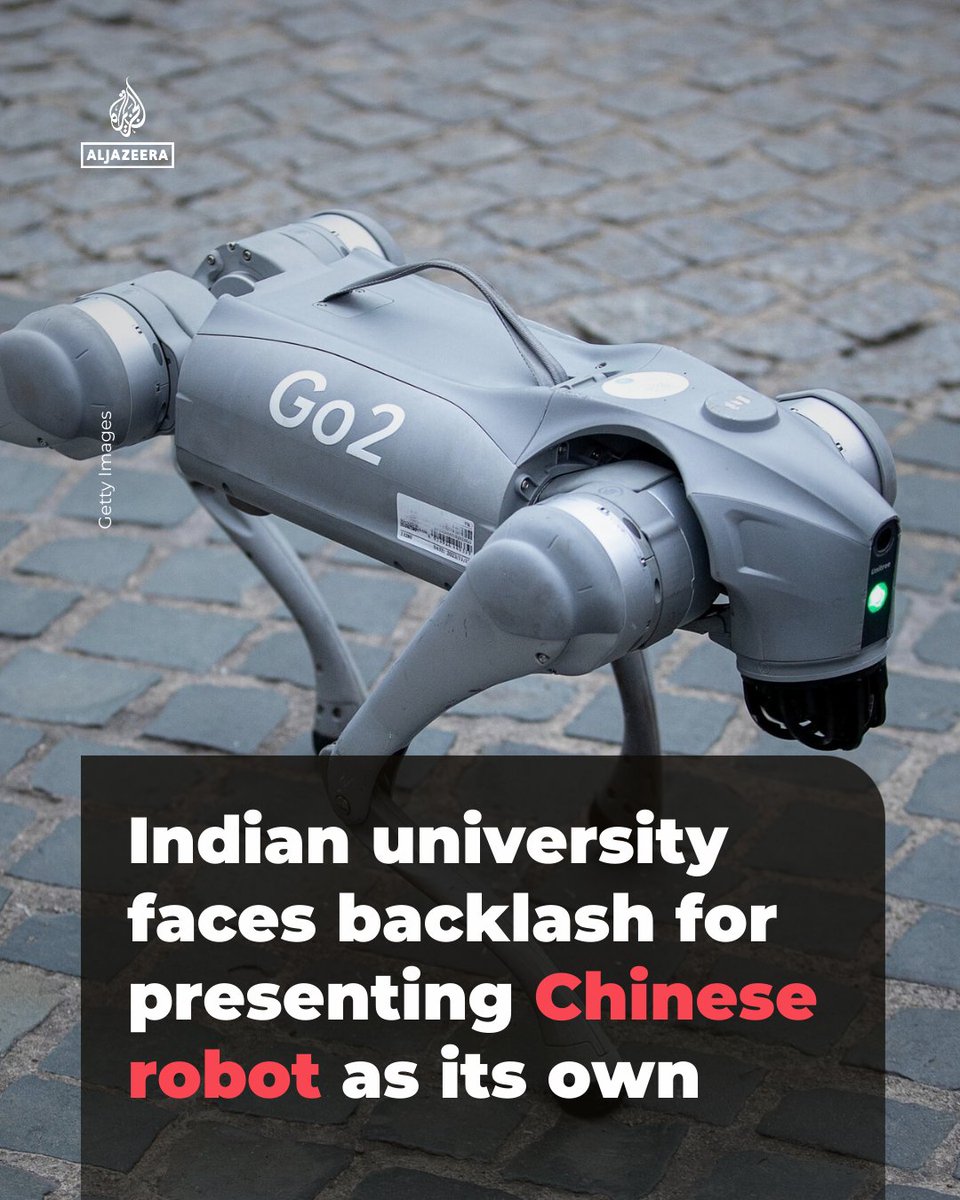
An Indian university is facing backlash after one of its professors was caught falsely presenting a Chinese-made robot dog at a major artificial intelligence summit, it has reportedly since been asked to leave, as the institution’s own https://t.co/6pbdfW2Dmw
Al is writing code faster than ever-but engineers matter more than ever.
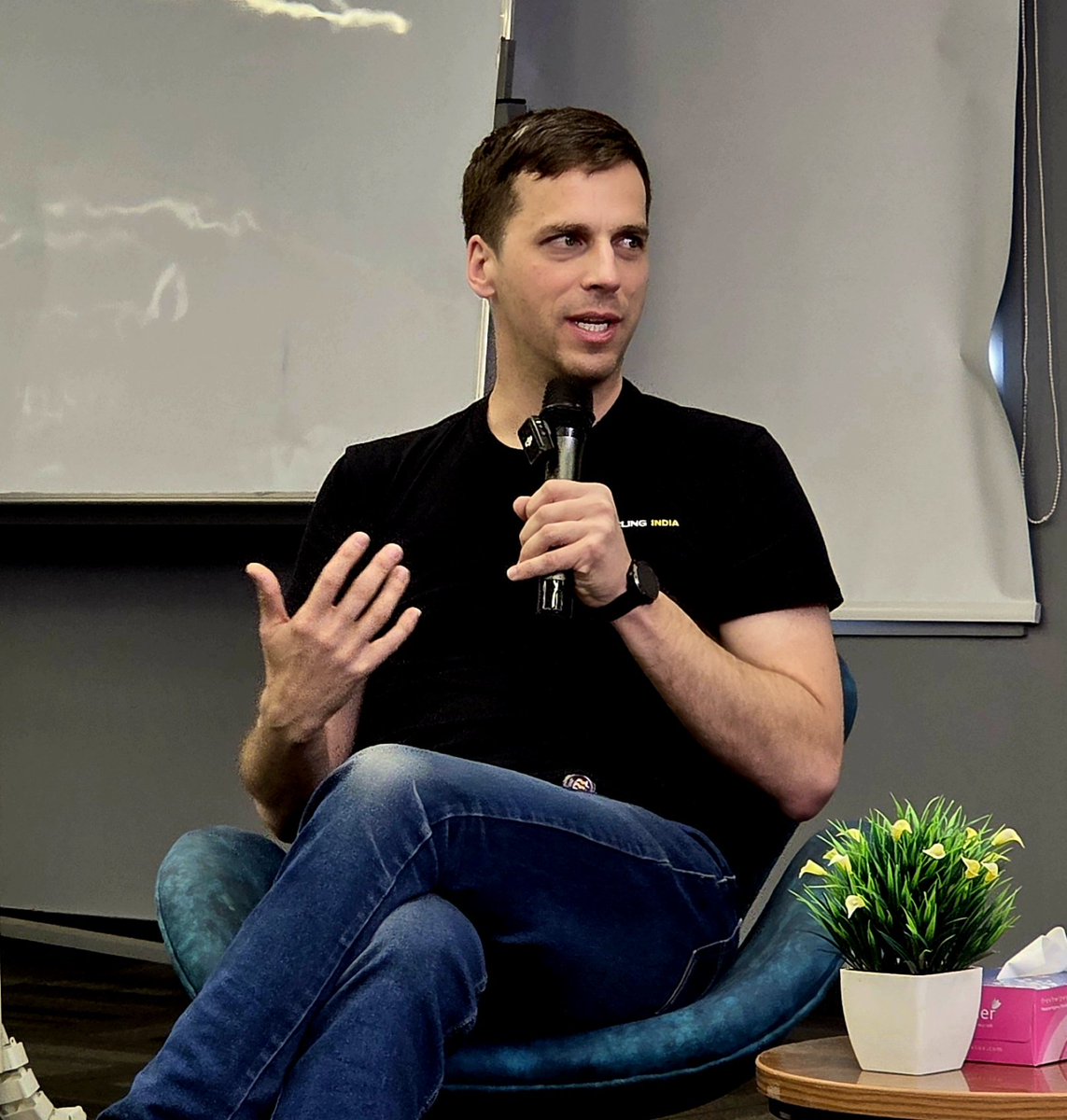
Key insights from ALBERT STRASHEIM (CTO, @Rippling ):
Future engineers won't be judged by lines of code, but by how well they think, design constraints, understand business, and orchestrate Al + systems.
@idleshubh I have applied passport back in November 2024 still haven't got that ... and belive me if i tell them what happened they say its just a glitch hopefully it should not take 2 years 😅😂
Attended an insightful startup finance workshop.
Biggest takeaway: Strong financial discipline, clean books, and solid unit economics matter more than chasing valuation early.
Startups aren't built on ideas alone execution and smart financial decisions make the difference.