Chart number 4,875 that tells you we’re not in an AI bubble
This doesn’t happen if companies are spending less on AI or aren’t seeing ROI (or a path to ROI) on their AI spend
The demand for compute (aka intelligence) is infinite, the market just doesn’t know it yet
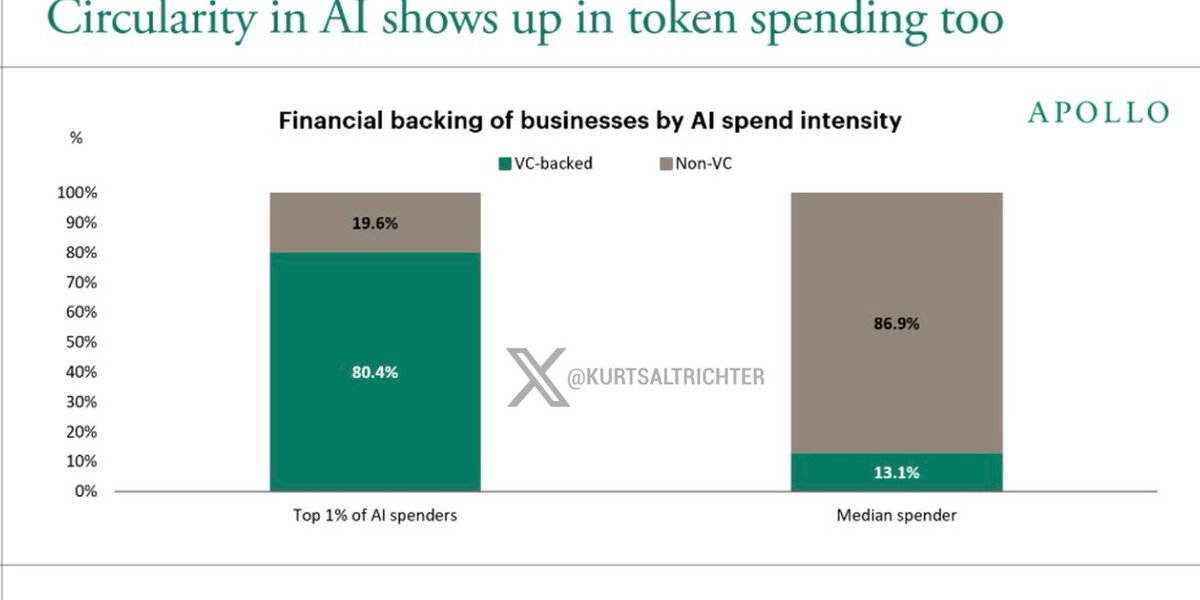
The viral Apollo charts claiming "AI spending is just circular VC money" are a masterclass in financial data misdirection. Here is why the narrative collapses the moment you look under the hood:
1. The Ultimate Selection Bias (The Ramp Dataset)
Apollo’s data comes from Ramp corporate card swipes. Who charges compute on a corporate credit card? Seed and Series A/B tech startups. Who does NOT? JPMorgan, Walmart, Apple, or the DoD. Real Fortune 500 enterprise spend flows through multi-million-dollar negotiated master service agreements via AWS Bedrock, Azure, or Google Cloud Marketplace—not an expense card. Running corporate card data to measure global enterprise AI adoption is like surveying a Y Combinator cafeteria to track global dietary habits.
2. A Basic Math Trick: Power Laws Exist Everywhere
Apollo highlights that the top 10% of firms account for 95.6% of OpenAI and Anthropic spend. Sounds terrifying until you glance two lines down on their own table: the top 10% of firms also account for 95.7% of standard cloud computing and 91.9% of paid ads. Corporate spend is logarithmic. A 5,000-person company naturally spends 500x more on infrastructure and CRM than a 10-person shop. Framing standard enterprise power-law distributions as an "AI-specific bubble" is intellectually dishonest.
3. Intentional Wordplay
"80.4% of the top 1% of AI spenders are VC-backed" does NOT mean 80% of total industry revenue comes from VC startups. It means within a startup card dataset, the heaviest spenders are venture-backed labs training models. Meanwhile, Apollo casually ignores the bar directly beside it: the median AI spender is 86.9% non-VC—proving broad, organic adoption across traditional businesses.
4. Follow the Incentives
Apollo is a massive private credit and alternative debt titan. Their house macro view thrives on convincing institutional allocators that tech equity multiples and venture ecosystems are unstable, steering dry powder directly into senior secured private credit and high-yield asset-backed lending.
FUD gets clicks, but using corporate card data from startups to argue that the entire AI economy is fake isn't serious macro analysis—it’s narrative engineering
@altcap@GavinSBaker@chamath@friedberg@Jason@DavidSacks@elonmusk@BillAckman
The lower token prices are due to two things: cheap open-weight models competing and new capacity with more efficient chips coming online. Sometimes we get 3x to 4x the tokens in a single generation. Actually, as token costs are going down, it's stimulating adoption, as in Jevohn's paradox, and overall spend is increasing with new capacity coming online. GPU prices are appreciating over time, not depreciating over 6 years, but actually much longer, improving hyperscaler ROIs, showing no signs of shortages easing. The hyperscalers and China will buy the chips the neoclouds can't get credit for.
@lisaabramowicz1 With the returns they are getting currently, GPU prices appreciating with time, everything that can be bought and built by the neoclouds will be bought and built by the hyperscalers and China.
@chamath AI service spend and software spend go towards paying for the infrastructure spend; they are at different levels of the value chain. The infrastructure spend is what needs to be paid off. The good news is that capex isn't exceeding it by that much.
@SpecialSitsNews I think the hyperscalers and the Chinese will buy all the chips the neoclouds can no longer buy. Since GPU prices are appreciating over time, you're making money by simply buying and hoarding them; selling the compute is gravy.
@edzitron@arakharazian Start-ups and VCs are adopting AI first; some old companies will get caught off guard by this. I don't think this more than early adopters skew before more traditional companies start to deploy adoption.
Probably NVDA is also great right now; however, they can only repurchase 1 share in 10 over the next 2 years from combined FCF, roughly 550 B. Micron could potentially buy back one-third of its market cap over two years, 300B from combined FCF in two years. But even if it does only half of that because it spends it elsewhere, that's still 1 share in 6 that can be bought back from FCF in the next two years. If that doesn't affect the price immediately, it will, in the longer run affect the number of shares in the P/E ratio. Plus, Micron is priced at peak multiples at sub-5X forward PE, priced for a bust cycle in 2027. The historical PE is between 10-12X forward earnings; those clearly are peak-cycle valuations priced in, limiting the downside risk.
@randgroup If AI is coming for your job, put your 401K in AI stocks to be safe. You either keep your job because AI is a bubble, or you will get an early retirement from the AI stocks. It's a win-win.
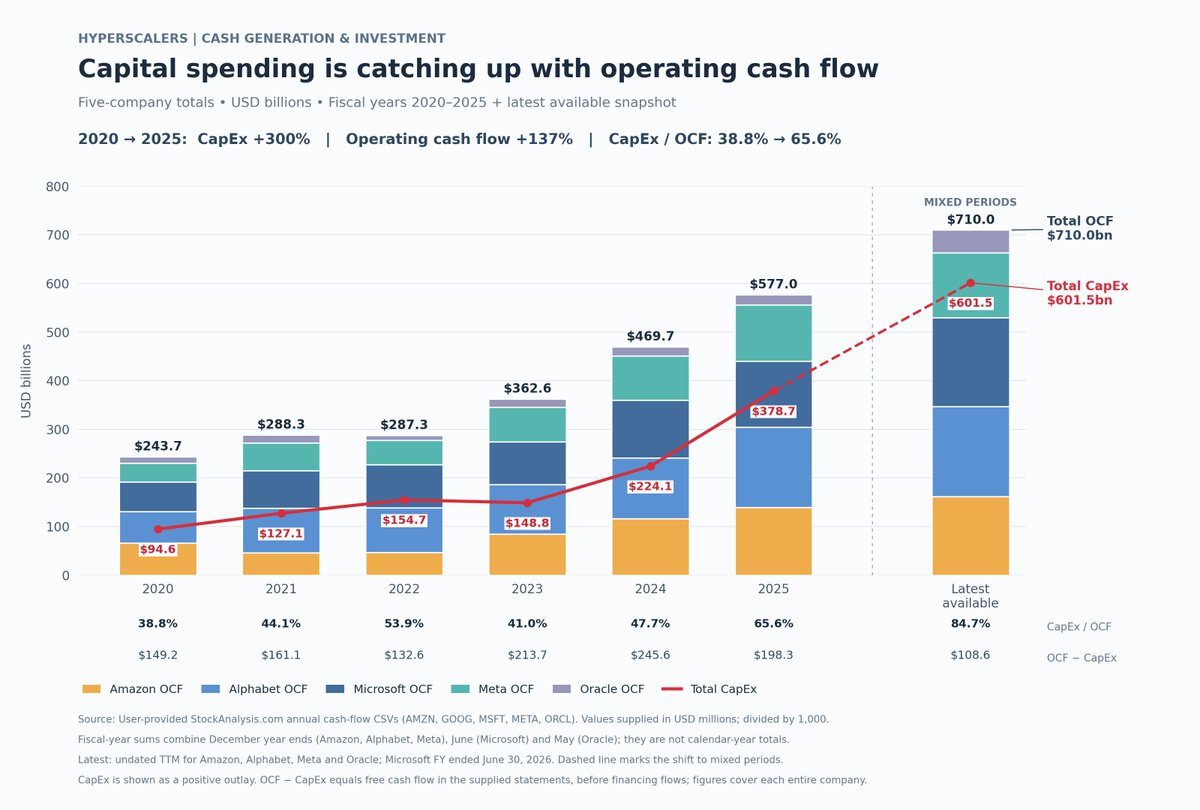
From 2020 to 2025, combined CapEx grew 300%, versus 137% for operating cash flow. CapEx absorbed 65.6% of operating cash flow in 2025, up from 38.8% in 2020.
The latest available snapshot shows $710.0 billion of operating cash flow against $601.5 billion of CapEx, leaving $108.6 billion. That column combines different reporting periods, as noted on the chart.
@RealNickMugalli He thinks capacity can catch up by Oct. 2027. I'm sure he's dead wrong because it's not physically possible to build enough fabs. Even if all the fabs are built on time, the additional capacity increase will not do the job by 2028.
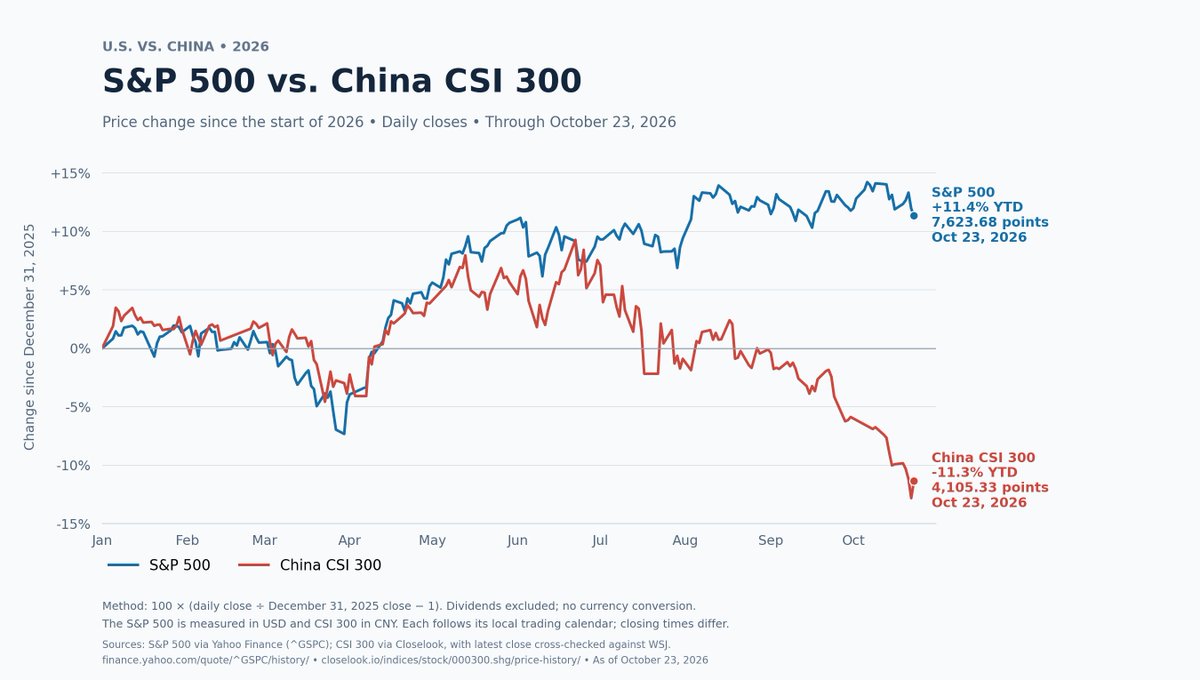
@Amanda_Goodall China is in a 20% market drawdown from the top in July of the CSI 300; it's not the end of the world. I'm more concerned with another hot war starting in a place like Taiwan and cutting off semiconductor supplies for AI.
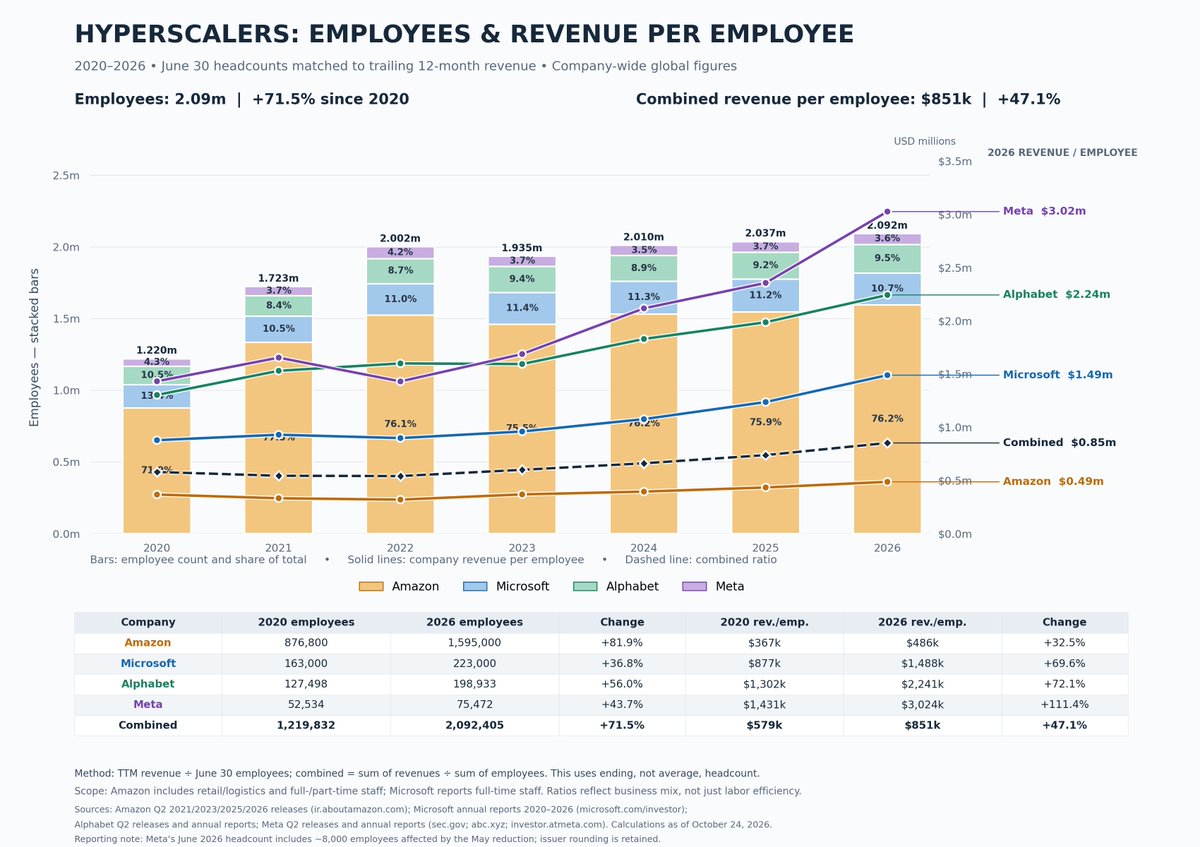
@sarthakgh@DKThomp What happened is that companies started using tokens at work, and instead of growing employee headcounts, they grew revenues by using more tokens. The hyperscalers were the first adopters of AI