Most companies slow down at scale.
Ramp is accelerating.
70,000+ businesses now run on Ramp. AI agents are becoming part of the finance team. And @RampLabs is shipping frontier experiments every week.
Today: $ 44B.
The next chapter of finance will be agentic and we’re building it.
Today, Ramp raised $750M at a $44B valuation.
Last time we grew this fast, we were 1/20th the size.
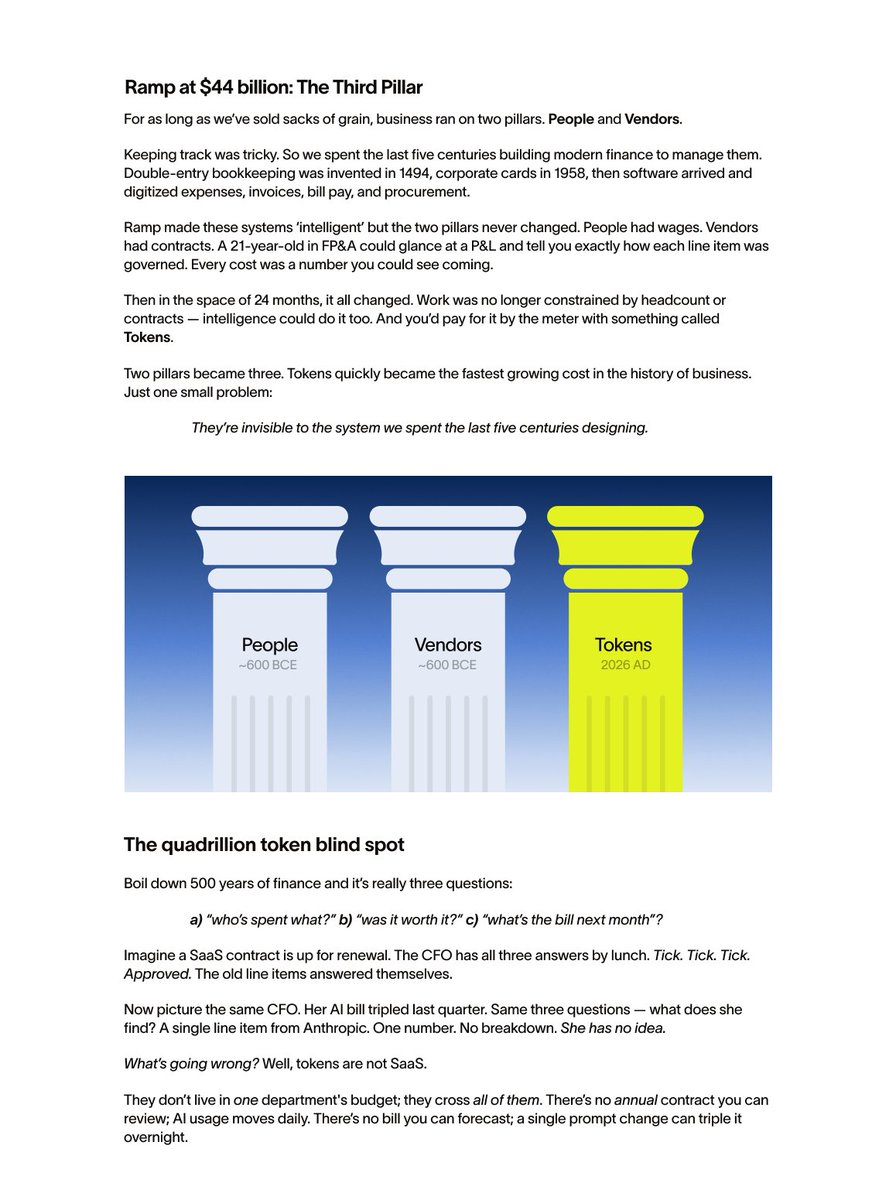
For 2000 years, business was built on two pillars. Today, a third: intelligence.
It’s your least governed cost. It’s also your single greatest opportunity.
Introducing Stack.
The AI operating system that lets accounting firms take on more clients without hiring. Learns your firm's process, runs the close, posts the journals. Fully auditable.
We’re living through the biggest shift in accounting since the spreadsheet.
Grateful for our customers, investors, partners, and most of all for our incredible team. Hard to believe it's only been two years.
Still a long way to go to build the future of software engineering - we are hard at work every day on making Devin even better! If you haven’t tried it in a bit, check it out and let us know what you think: https://t.co/1eSXfDfReg
1/ We’ve raised over $1B at a $26B valuation, led by @Lux_Capital, @generalcatalyst, and @8vc.
Our enterprise usage has grown >10x since the start of this year, and our run-rate revenue grew to $492 M.
We launched Devin two years ago as the first AI software engineer. Since then, cloud agents have gone from niche to mainstream, and today they are the fastest growing way to create software.
Today we're announcing our Series C funding: $355M at a $4.65B valuation, led by some great investors @generalcatalyst and @Redpoint.
We've had insane growth in the last year, but we're still very early. So proud of the team and what we have built so far!
Was great to chat with @bernhardsson about what we are building at Applied Compute!
Modal provides powerful primitives for agent execution environments during RL. We are excited to continue to partner!
Scott Wu (@ScottWu46) runs @cognition, the team behind Devin, an AI software engineer built on Claude.
He wants to make building software 10x faster for every engineering team:
last time @tryramp grew this fast year-over-year, we were 1/20th the size
~170% TPV growth in March. growth usually decays with scale — ours re-accelerated
on CNBC this morning with @carlquintanilla and @SaraEisen for the Disruptor 50
AI is one of America’s greatest achievements, and yet 99% of U.S. services businesses lack the resources to deploy it. We’ve built Long Lake to bring AI to the real world, as a true partner, at scale. It’s a hard problem that can only be solved by a purpose-built team of world-class AI Engineers, Operators, and M&A professionals working together.
We’re hiring - join us.
https://t.co/cV4l2LsfAJ
Scott Wu is the co-founder of Cognition AI, one of the fastest-growing companies in history. He’s also the greatest competitive programmer the US has ever produced. You may have seen him doing impossible card tricks and mental math.
You’ve never seen him asked about weed, Michael Jordan, cancer, and human consciousness over a punnet of strawberries. That is what Colossus editor-in-chief Jeremy Stern did on a recent visit to San Francisco.
For those less familiar with @ScottWu46: In 2nd grade, he entered a math competition for 7th graders, lost, and was so furious he still fumes about it 20 years later. The next year he entered the 9th-grade division as a 3rd-grader and got a perfect score.
Then he won first place at the US national middle-school math competition and three straight gold medals at the International Olympiad in Informatics, where he became the greatest American gold-medalist and coach in history.
Most of the people running the biggest AI companies met as teenagers, competing for their countries on international math and science teams. OpenAI’s Greg Brockman, Anthropic’s Dario Amodei, Meta’s Alexandr Wang, to name just a few.
Most agree that the von Neumann among them was Scott Wu.
In November 2023, a few weeks after his mother died of lung cancer, on the day Sam Altman was fired from OpenAI, Wu founded his own AI company: Cognition.
He was 26 and saw earlier than almost anyone that AI would converge on agents that work in the background, 24/7, like coworkers. He shipped Cognition’s AI software engineer Devin in March 2024. It worked poorly, and he took intense public criticism for it.
Now, in its first 18 months of service, Devin has generated $445 million of revenue run rate and usage has doubled every eight weeks. The US Army, Goldman Sachs, and Mercedes-Benz are all customers. Cognition is raising at a valuation around $25 billion.
@JeremySternLA sat down with Wu, the emperor of the nerds, to ask the questions we’d all ask one of the smartest people in America—building the most consequential technology of our generation—if we ever got the chance.
As well as MJ and weed, they talk about the cluster of competitive math prodigies behind so much of AI, what makes us human when AGI arrives, and why Wu believes he was put on this earth to teach AI how to code.
Read the piece below.
The terminal hasn’t changed much since the 1970s. What you do with it has.
Introducing Devin for Terminal: everything we learned building Devin, now as a local agent, available right in your shell.
And when your work outgrows your laptop, hand it off to the cloud.
Cognition is partnering with @MercedesBenz to accelerate software engineering across their global engineering teams, representing one of the most extensive deployments of AI software engineering in the automotive industry to date.
@ScottWu46 sat down with Katrin Lehmann, Mercedes-Benz CIO, to discuss the work:
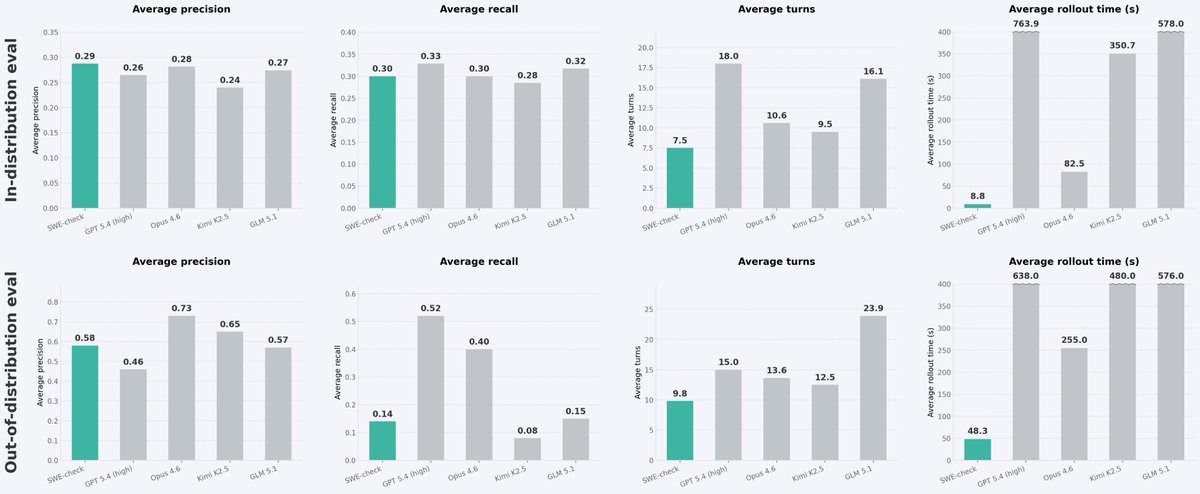
Today we're releasing SWE-check, a specialized bug detection model we RL-trained with @appliedcompute that matches frontier performance on internal in-distribution evals and makes meaningful progress on out-of-distribution evals, all while running 10x faster.