there is definitely promising research on digital biomarkers for long-term neurodegenerative diseases (like gait, or speech in Parkinson's) that don't rely on clinician screening, but are almost all still only "research" use cases. I hope to be proved wrong by saccade.
You can have Alzheimer's for 15 years and not know it.
We can finally slow it down. But only if we catch it early.
So we built the earliest test for it. Saccade (YC F26)
Today we are finally coming out of stealth with a few announcements:
- Founding @thirdmomentres with my friend Jeffrey Yan: automatically improving inference endpoints (with focus on data research).
- Fundraise at $250M valuation earlier this Summer with investors including @neo (@apartovi ), @Mascobot , @adamdangelo and more.
- 0 -> 8 figures in revenue within ~6 months of founding the company. In just this past month, we won $10M+ in contracts.
- Hiring ~15 more engineers in the next 45 days. Currently based in SF, opening a NYC office soon.
Jeffrey and I are building Third Moment to do two things: (1) make it effortless for enterprises to deploy state-of-the-art AI tailored to their workflows, and (2) build best-in-class RL environments that push the frontier of model capabilities. The design of a reinforcement learning environment has an underappreciated impact on the resulting behaviors of the models trained on it.
If you are interested in pushing the frontier of ML systems and data research, reach out to us ([email protected]). Check out OpenAI’s blog post on some of our experiments in the comments.
two thoughts:
1. AI interaction at high fidelity via BCI is perhaps neither necessary nor desirable for a wondrous future. i'd love to see a company working towards a north star that is more human and aspirational.
2. scaling neural data need not be harder than robotics data
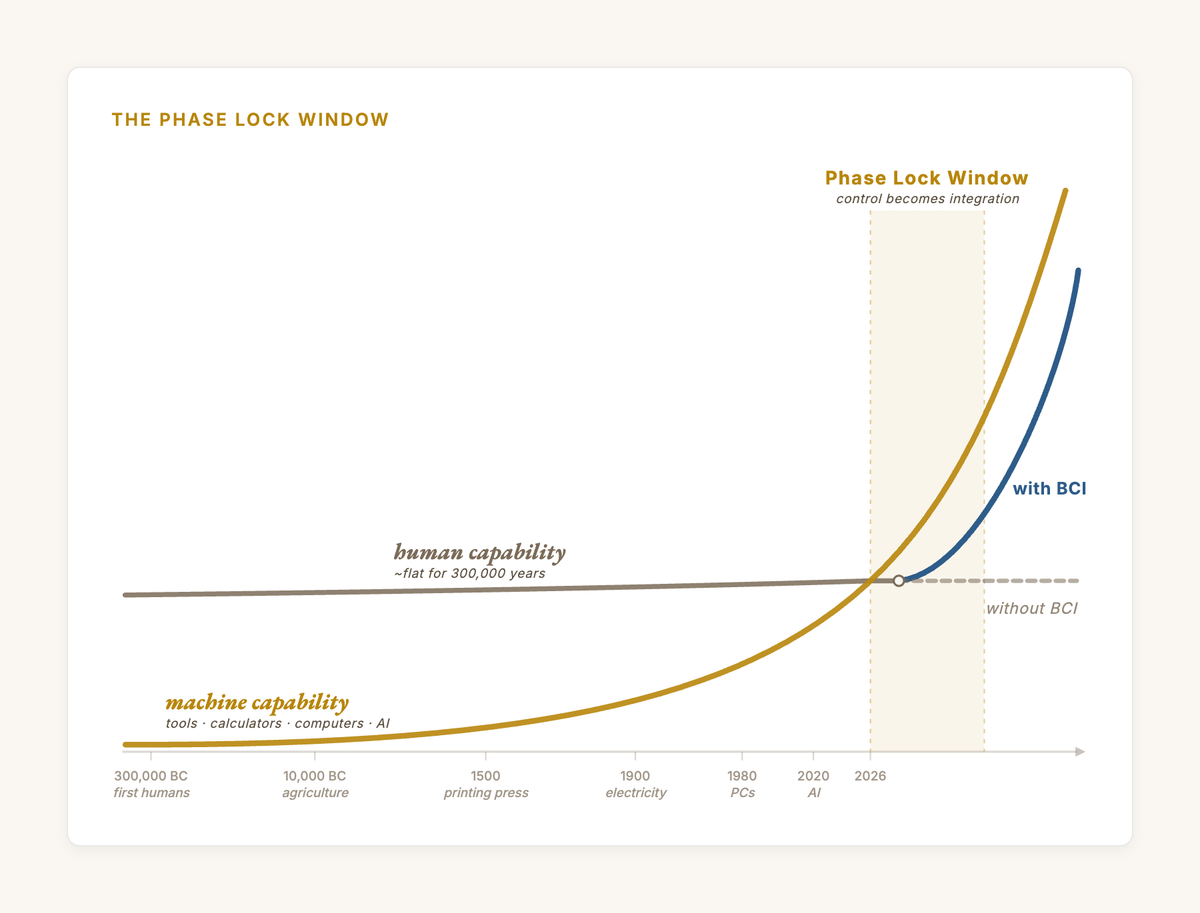
The human brain is approaching its ChatGPT moment.
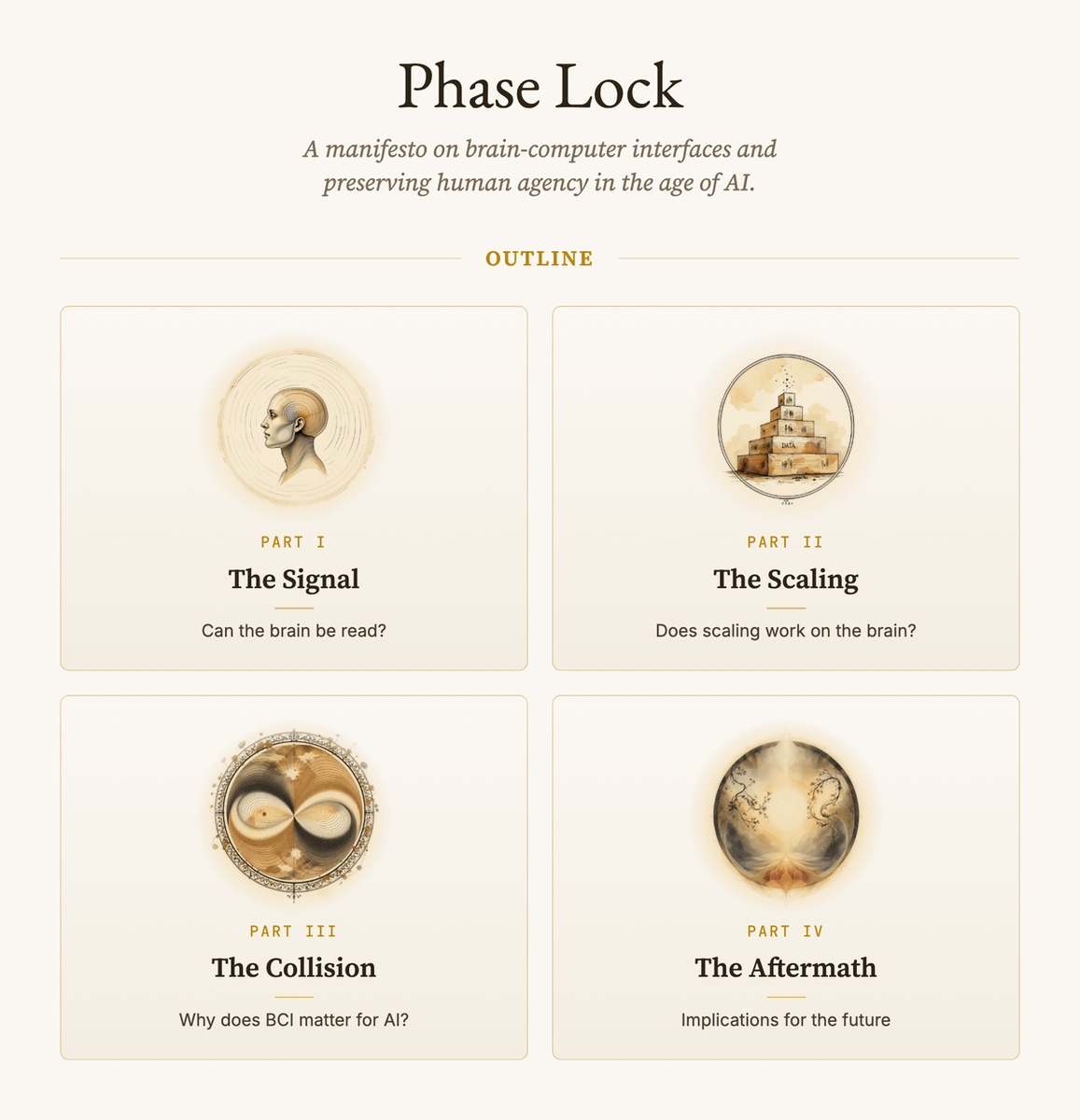
I spent 6 months writing Phase Lock: a manifesto on how brain computer interfaces can help align AI and preserve human agency.
If you only ever read one thing from me, read this.
I'm starting a podcast, "Confession," where I invite tech veterans to share their painful lessons.
We all connect through shared pain. Hear founders & CEOs like Satya Nadella (Microsoft), Dara Khosrowshahi (Uber), Luana Lopes Lara (Kalshi), and others share their stories and lessons learned.
Subscribe to Confession on...
✅ Spotify: https://t.co/ivOCa9wYK5
✅ Youtube: https://t.co/Ofo7boNWfg
✅ Apple: https://t.co/i8SFYF1CZC
@SatyaNadella@Dkhos@luanalopeslara
Today, we’re launching an ambitious new school called The Horowitz Andreessen Academy.
Based in San Francisco, The Academy serves the most promising young high school graduates.
We think this can be an elite institution that attracts top tier talent. One that prepares students for the future rather than remaining stuck in the past.
The #1 goal is to help students learn to build, which is the most important skill in the AI era. They'll learn primarily by pursuing their own projects, either individually or in groups. There are classes and guest lectures, too, from some truly amazing people who have built modern-day Silicon Valley.
The Academy is designed as a network, since that’s the reason students go to school in the first place. Core to that network are our 10 Founding Partners: Anduril, Anthropic, Coinbase, Google, Meta, NVIDIA, OpenAI, Palantir, Replit, and Stripe. The network includes over 50 hiring partners and over 200 speakers and mentors. To join as a hiring partner or faculty member, you can apply on our website.
We raised $42M in funding led by @a16z. I'll be CEO and @pmarca and @eriktorenberg will join me on the board.
Applications are open for our Founding Class Fellowship, which will be one year and tuition-free. Eventually, pending regulatory approval, we plan to offer a two-year program that charges tuition, similar in cost to an elite private university.
We're looking for the most unusually ambitious young builders on the planet. Come join us in San Francisco:
https://t.co/NfavmBy2ex
In 2025, scientists published the most detailed map of a mammal's brain ever made: one cubic millimetre of a mouse's visual cortex, 200,000 cells and half a billion connections, traced slice by slice under an electron microscope. We took 1,627 of those neurons and all 52,181 connections between them, and brought them back to life in a simulation using the same method scientists used to run an entire fly brain in a computer.
Then we gave it a stock portfolio.
Each stock's price is fed into the cells where signals normally enter the cortex. The decision comes out through the cells that, in a living mouse, send signals toward the spinal cord to move its body. Nobody tuned it and nobody trained it.
Here's what we found. The brain has opinions before it has ever seen a market. A rise in NVDA makes its decision cells fire almost five times harder than normal. A rise in SPY barely moves them, so this brain can never buy SPY, however high it goes. That isn't a strategy. It's where one mouse's neurons happened to grow.
The strangest result came when it made a decision. We expected the brain to light up. Instead, about 1,000 of its 1,627 neurons went quiet, and a small group took over and made the call. We checked it wasn't chance: two ordinary quiet minutes differ in only about 135 neurons. It looks like a brain focusing by switching everything else off.
this is the scary part about being able to point your favorite coding agent towards a connectome. methods that hill climb performance do not correspond to biologically meaningful results/artifacts. https://t.co/gUx4kRpCXK discusses this distinction well.
i know its all in very much good fun but i wanted to note that the fruit fly sims are not simulations! the connectome does give you wiring, but it doesn’t fully specify how the neurons and synapses behave.
these demos add assumed dynamics + engineered controls. if you scramble the connectome the fly still does the same thing, if you put in a different brain (ie worm connectome) it still does the same thing!!
If you are interested to read more about my connectomes are necessary but not sufficient to understand function of nervous system, please read this X-article. This is one of my fav topic to discuss being an experienced electrophysiologist :)
https://t.co/iVFStfvcSG
I feel like all future neurotech “health” companies should be forced to beat a baseline of “what if we put normal biosensors in these locations on the head?”
A few thoughts:
How to ground and what to reference?
Temporal lobe placement seems reasonable.
Multiple channels located in single device still highly correlated, maybe measuring different bio (not only neural) signals is the approach.
The Atlas 1.0 is our first instrument.
A first-of-its-kind brain wearable.
Built on six years of breakthroughs in nanotechnology, material science, and neural engineering.
We call her "the telescope": a tool to travel inward with curiosity and courage.