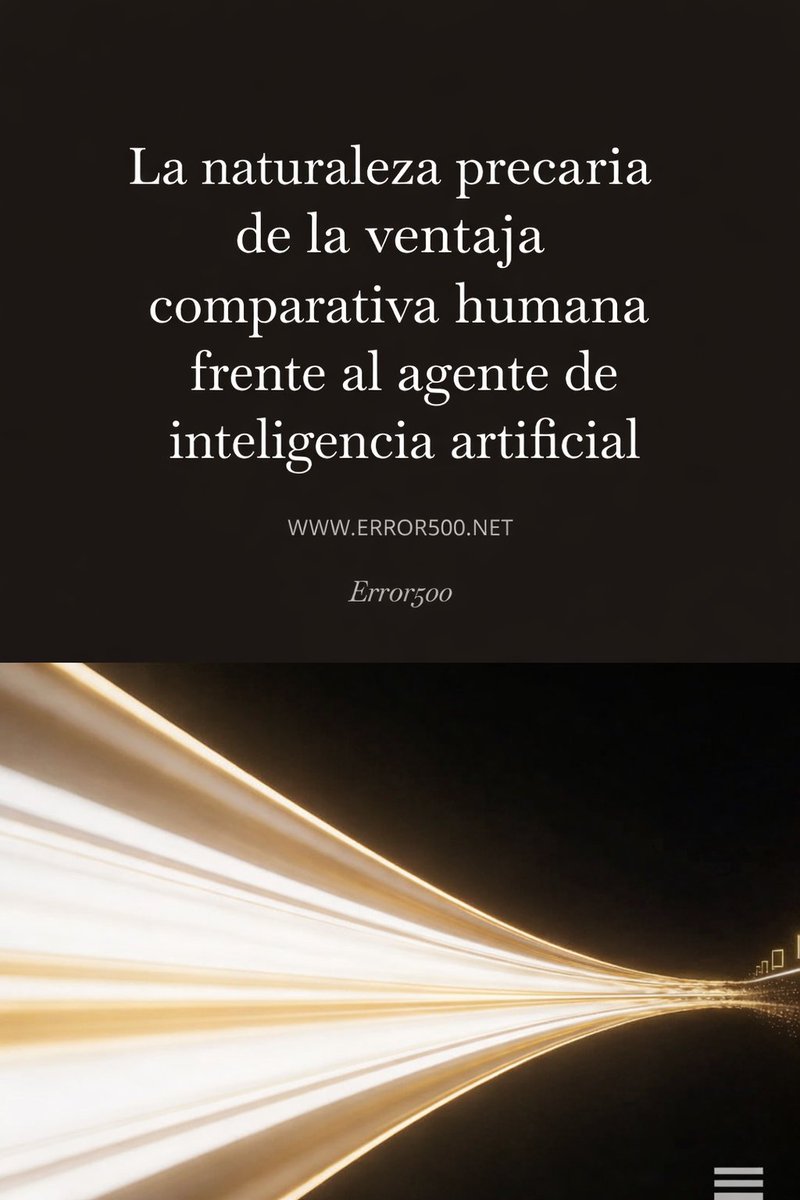
Yann Lecun published the most heretical AI paper of the year.
He opens by arguing Magnus Carlsen isn't good at chess and only gets more unhinged from there.
The Turing Award winner and his co-authors dropped a paper demanding the AI industry abandon its biggest obsession, AGI.
Right now, everyone from Silicon Valley CEOs to politicians assumes AGI is the ultimate goal. A machine that can do everything a human can do.
LeCun argues that this entire concept is a biological illusion.
Humans do not possess "general" intelligence. We are highly specialized biological machines, tuned by evolution simply to survive in the physical world.
We only think our intelligence is "general" because we are completely blind to the millions of cognitive tasks we are incapable of comprehending.
Which brings us to the chess argument.
Magnus Carlsen is the greatest human chess player in history. But compared to a modern computer? He is fundamentally terrible.
Our belief that Carlsen is "good" at chess is pure human-centric bias. He isn't objectively good. He's just better than the rest of us, who are biologically awful at it.
LeCun says we need to stop building AI to mimic human generality.
Instead, he proposes a new North Star: SAI.
Superhuman Adaptable Intelligence.
Instead of trying to build a machine that mimics our flawed, biologically-limited brains, we need to embrace extreme specialization.
SAI is about the speed of adaptation.
It is an intelligence that can learn to exceed humans at any specific, economically important task.
More importantly, it is designed to fill the vast skill gaps where humans are fundamentally incapable.
Things like managing global energy grids in real-time. Or predicting complex molecular structures.
The entire AI industry is obsessed with building a digital reflection in our own image.
LeCun's paper is a brutal wake-up call.
This is a super exciting release - Claude Fable 5 is the same underlying model as Mythos but with added safeguards. The benchmarks are great and it's SOTA on everything by a margin but I'll add that *qualitatively* also, this is a major-version-bump-deserving step change forward (imo of the same order as Claude 4.5 was in November), peaking especially for long problem-solving sessions on very difficult problems. You can give it a lot more ambitious tasks than what you're used to, the model "gets it" and it will just go, and it's never felt this tempting to stop looking at the code at all (but don't do this in prod!). The model still has quirks that people will run into and the safeguards are configured to be a little too trigger happy for launch, which can hopefully be tuned over time.
I feel a lot of things changing as working software increasingly comes out on a tap. The Jevon's paradox kicks in and I feel my own demand for software growing substantially. You can ask for anything - explainers, visualizers, dashboards, bespoke single-use apps (e.g. a full wandb that is hyper-specific just for your project), you can 10X your test suite, auto-optimize code, run giant research projects with custom HTML for the results, anything! "Free your mind" (Matrix ref). Really looking forward to all the things people build!
Intercambio tenso, pero valioso: la interna radical profundiza la presencia de la UCR en el debate público de la ciudad. El 7 de junio deciden los afiliados. Hay que garantizar participación también en Cerri y Cabildo. Después, unidad y trabajo para recuperar una alternativa capaz de gobernar y transformar Bahía Blanca.
Desde la Lista 115 acompañamos ese camino.
https://t.co/wxaRKXvR0I
Sabotaje Algorítmico en los Tribunales: El primer caso de "Prompt Injection" en una demanda judicial.
Sobre un fallo reciente de la Justicia del Trabajo de Brasil sobre el uso maliciioso de texto oculto para manipular algoritmos judiciales.
The mathematician Alexander Grothendieck is revered in the world of math; outside of it, he’s known for his unusual life, if he’s known at all. But what were his actual mathematical contributions?
https://t.co/umGPWwJ6HC
A lo largo y ancho de la ciudad, miles de personas trabajan cada día en tareas muy diversas y eligen la UCR para transformar la realidad con más derechos e igualdad.
A todos ellos, ¡muy feliz día!
Fireside chat at Sequoia Ascent 2026 from a ~week ago. Some highlights:
The first theme I tried to push on is that LLMs are about a lot more than just speeding up what existed before (e.g. coding). Three examples of new horizons:
1. menugen: an app that can be fully engulfed by LLMs, with no classical code needed: input an image, output an image and an LLM can natively do the thing.
2. install .md skills instead of install .sh scripts. Why create a complex Software 1.0 bash script for e.g. installing a piece of software if you can write the installation out in words and say "just show this to your LLM". The LLM is an advanced interpreter of English and can intelligently target installation to your setup, debug everything inline, etc.
3. LLM knowledge bases as an example of something that was *impossible* with classical code because it's computation over unstructured data (knowledge) from arbitrary sources and in arbitrary formats, including simply text articles etc.
I pushed on these because in every new paradigm change, the obvious things are always in the realm of speeding up or somehow improving what existed, but here we have examples of functionality that either suddenly perhaps shouldn't even exist (1,2), or was fundamentally not possible before (3).
The second (ongoing) theme is trying to explain the pattern of jaggedness in LLMs. How it can be true that a single artifact will simultaneously 1) coherently refactor a 100,000-line code base *and* 2) tell you to walk to the car wash to wash your car. I previously wrote about the source of this as having to do with verifiability of a domain, here I expand on this as having to also do with economics because revenue/TAM dictates what the frontier labs choose to package into training data distributions during RL. You're either in the data distribution (on the rails of the RL circuits) and flying or you're off-roading in the jungle with a machete, in relative terms. Still not 100% satisfied with this, but it's an ongoing struggle to build an accurate model of LLM capabilities if you wish to practically take advantage of their power while avoiding their pitfalls, which brings me to...
Last theme is the agent-native economy. The decomposition of products and services into sensors, actuators and logic (split up across all of 1.0/2.0/3.0 computing paradigms), how we can make information maximally legible to LLMs, some words on the quickly emerging agentic engineering and its skill set, related hiring practices, etc., possibly even hints/dreams of fully neural computing handling the vast majority of computation with some help from (classical) CPU coprocessors.
I used my personal Claude powered AI called Titus to control my computer. One of it's many tasks is to turn latest news into song so I can learn while I workout.
This is from last week when Nicholas Carlini demoed the power of what was probably Mythos, right?
Thank you, @AnthropicAI for the focus on AI Safety and protecting core assets ahead of what could be much more significant for the world than Y2K might have been without advanced notice. This is a opportunity to forge relationships with key players and learn many lessons as more powerful models are deployed in the future. 🙏
Introducing Project Glasswing: an urgent initiative to help secure the world’s most critical software.
It’s powered by our newest frontier model, Claude Mythos Preview, which can find software vulnerabilities better than all but the most skilled humans.
https://t.co/NQ7IfEtYk7
This is wild. Meta AI is about to have more users than ChatGPT and Claude... COMBINED
Three billion people across WhatsApp, Instagram, and Facebook are getting a new AI model that already knows what you talk about, what you look at, and what you buy. No download. It just appears, and it knows everything about you.
→ The model is called Muse Spark. Built in nine months by Alexandr Wang and his new division called Meta Superintelligence Labs
→ This is Meta's first closed-source model. The company that built its entire AI reputation on open weights, just released a frontier model nobody can download, inspect, or replicate
→ They threw out the entire Llama stack and rebuilt from zero. New architecture, data pipelines, infrastructure. Internal codename: Avocado.
→ It's natively multimodal. You can point your phone camera at something and ask it questions. It coordinates multiple AI agents on a single task, one planning your trip itinerary while another finds kid friendly activities.
→ It has a built in shopping assistant that pulls from your behavior across Instagram, WhatsApp, and Facebook to recommend products. Meta is turning its AI into a commerce layer that sits on top of 3 billion people's daily habits.
→ No other AI company has this kind of access to this many people's lives, and now there's a frontier model plugged directly into all of it.
Llevo metido dos semanas en un paper de economistas del MIT y UCLA
y salgo del mismo convencido de que por fin he dado con un marco desde el que discutir muchos de los efectos de la inteligencia artificial agéntica
en el empleo, en la economía, en los juniors, en los riesgos para el sistema...
La idea central es esta: conforme la IA pasa de asistir a ejecutar tareas completas, el cuello de botella deja de ser la inteligencia y pasa a ser la verificación humana.
Es decir: automatizar será cada vez más barato, pero comprobar que el resultado es correcto no cae al mismo ritmo. Porque verificar depende de tiempo experto, responsabilidad y, sobre todo, de algo decisivo: la latencia de feedback. No cuesta lo mismo validar un código que falla al compilar en segundos que una decisión financiera o educativa cuyos errores tardan años en aparecer.
A partir de ahí, el paper divide la economía en cuatro zonas: tareas baratas de automatizar y fáciles de verificar; tareas difíciles de automatizar pero verificables; tareas ni automatizables ni verificables; y la zona realmente peligrosa, donde automatizar es barato pero verificar es caro o directamente inviable.
Ahí está el riesgo. No porque la IA “falle” de forma visible, sino porque puede producir resultados plausibles, útiles en apariencia y económicamente rentables, mientras oculta errores cuyo coste acaba absorbiendo el resto del sistema. Como una forma de contaminación: el beneficio es privado, pero el daño potencial se socializa.
La tesis fuerte no es solo que sufran los trabajos rutinarios. Es que, en un mundo de agentes, lo más vulnerable será lo medible. Y que el valor se desplazará hacia quien pueda verificar, garantizar y asumir responsabilidad sobre el resultado.
Mucho más desarrollado en:
https://t.co/whEEpHAfsy
@UCRCapital@hernanrossi_ok Felicitaciones a la nueva conducción de @UCRCapital !! Un entrañable abrazo para @hernanrossi_ok , un referente de enorme recorrido y compromiso permanente con los valores esenciales del radicalismo y la Democracia. Nuestro reconocimiento... Éxitos en la gestión... !
Los símbolos de la democracia no se tocan. Celebramos que las gestiones hayan permitido reparar el agravio al monumento de Raúl Alfonsín y destacamos el trabajo de la Juventud Radical. En el Día de la Militancia reafirmamos nuestro compromiso con la memoria y la identidad radical
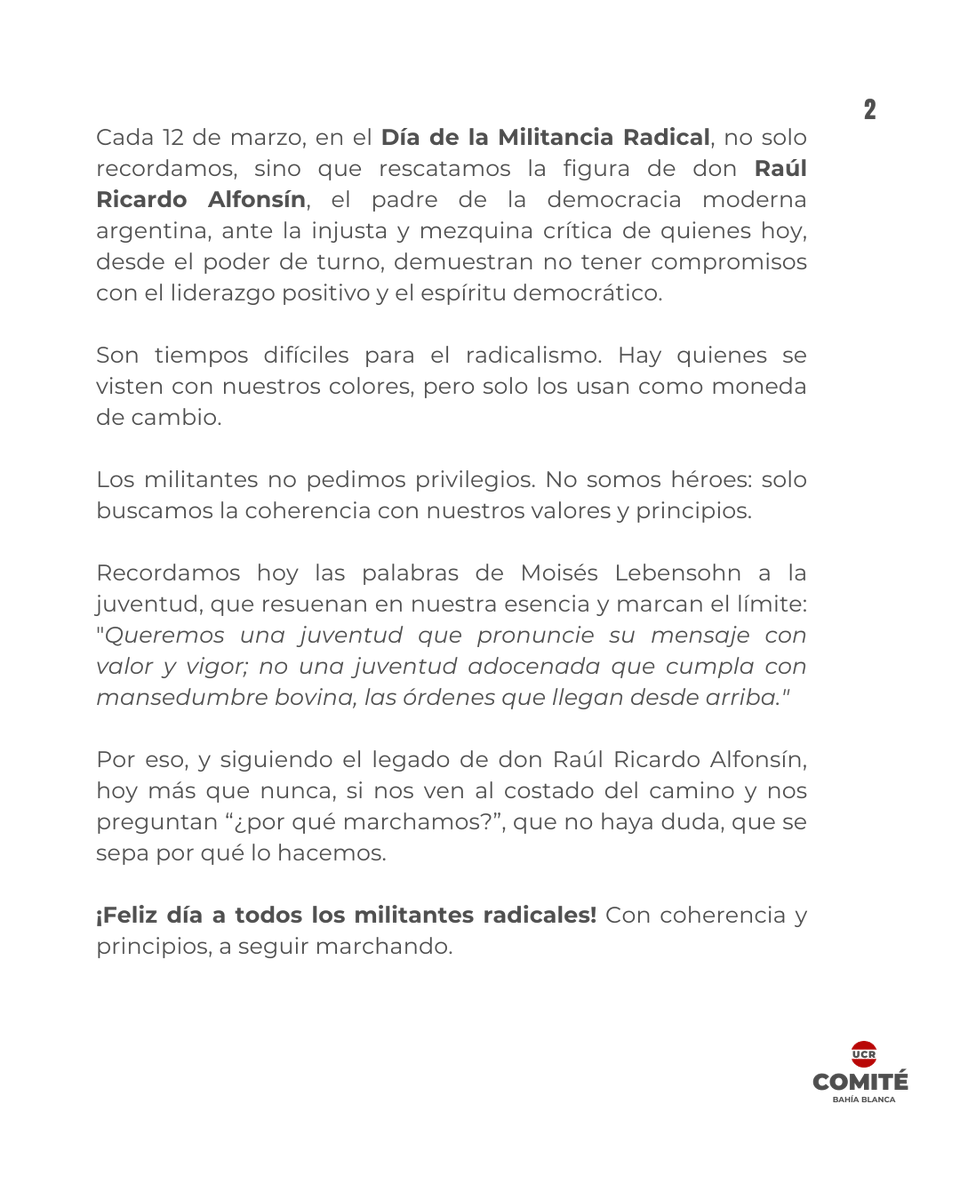
Cada 12 de marzo recordamos a Raúl Alfonsín, padre de la democracia moderna. En tiempos donde algunos usan los colores del radicalismo como moneda de cambio, los militantes seguimos defendiendo coherencia, valores y principios.
#DiaDelMilitanteRadical
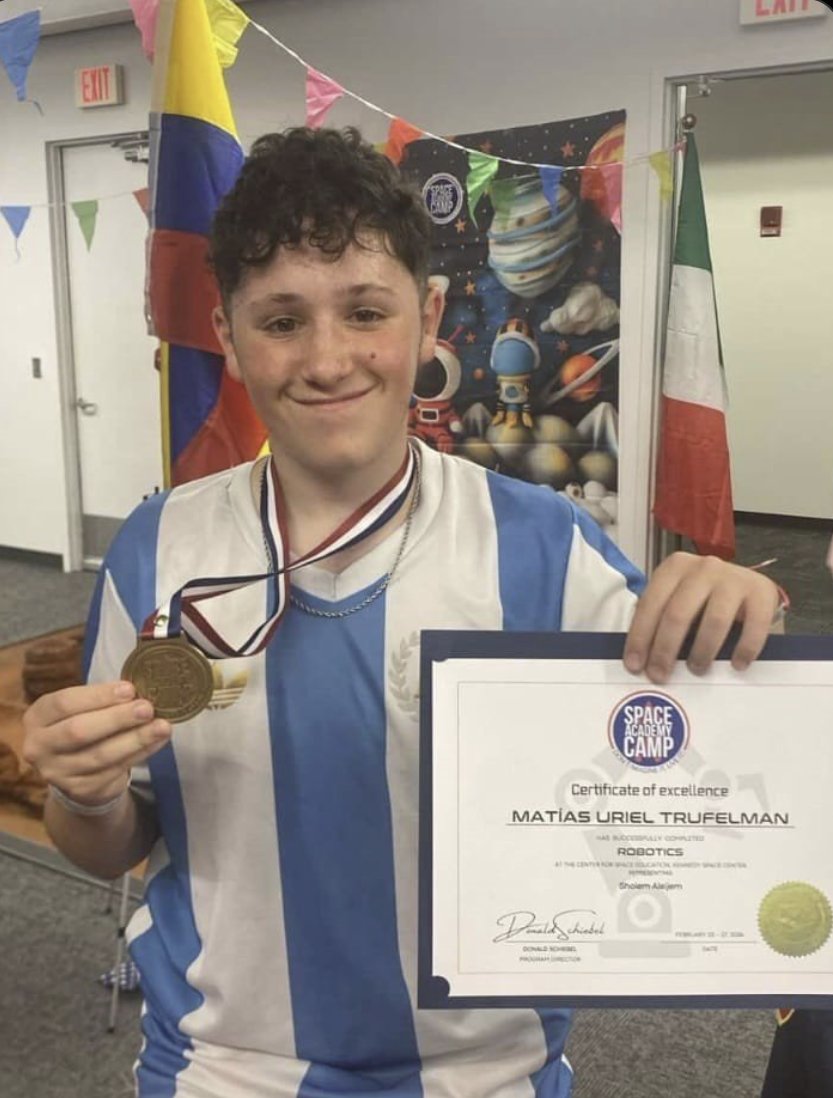
¡Felicitaciones Matías y familia! ¡¡¡Qué orgullo!!!
UN ESTUDIANTE ARGENTINO GANÓ EN LA NASA CON UN ROBOT PARA MINERÍA SUSTENTABLE EN MARTE
Matías Trufelman, de 16 años y alumno de la Escuela Scholem Aleijem, obtuvo el primer puesto en una competencia internacional de robótica del Space Academy Camp, programa vinculado a la NASA.
Junto a su equipo diseñó y programó un robot para extraer y procesar minerales en Marte con criterios de sustentabilidad y viabilidad económica. “El objetivo era pensar una solución integral (...) cómo hacerlo de manera sostenible y económicamente posible en el largo plazo”, explicó tras la premiación.
Salman Rushdie: "La literatura siempre tiene alguna relación con la verdad, por eso a los dictadores no les gustan los escritores" https://t.co/oGkkLcZVXI
Un sobreviviente de la palabra.