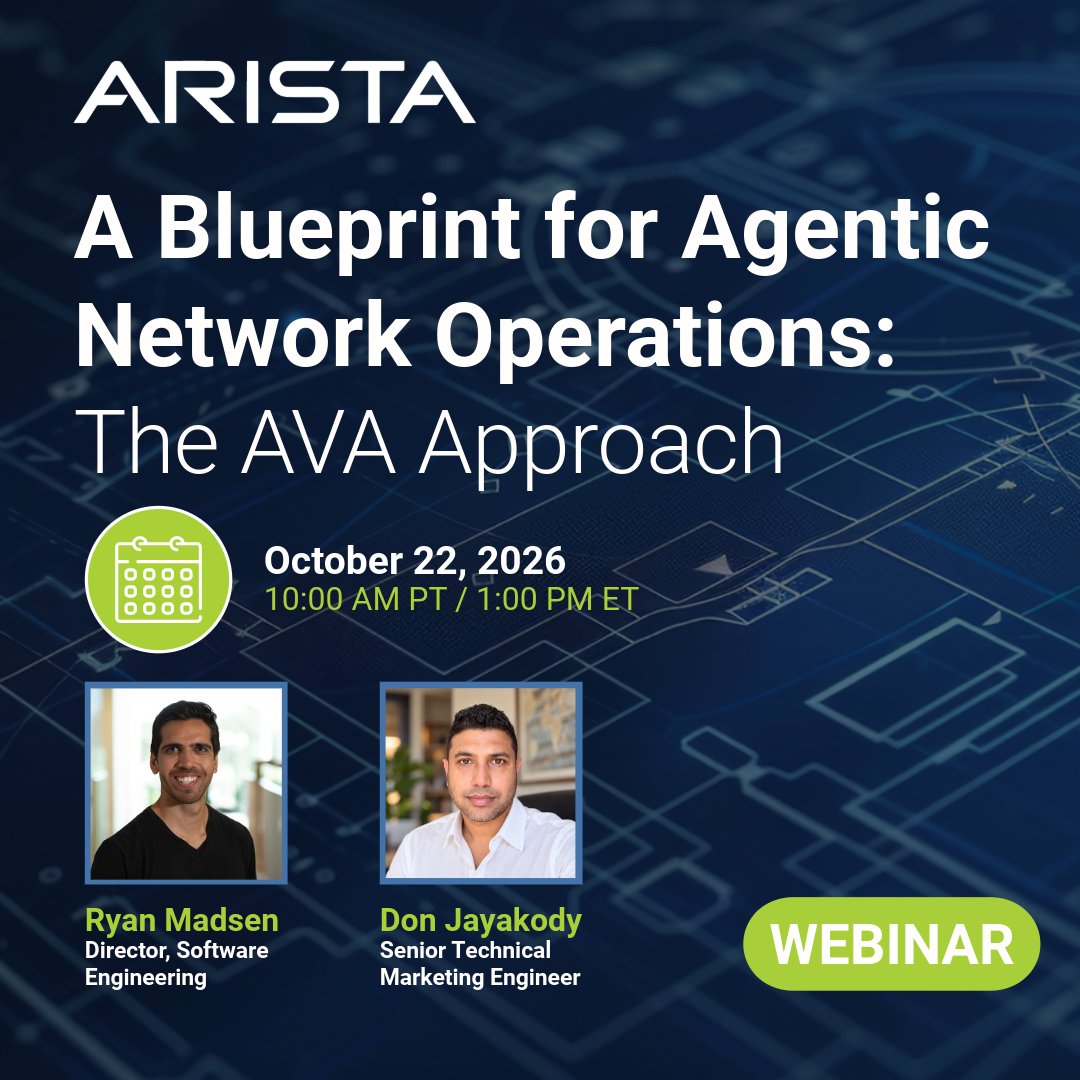
Learn what it takes to move from answering network questions to making informed decisions and taking action with agentic AI.
Join us for “A Blueprint for Agentic Network Operations: The AVA Approach” on October 22, 2026, at 10:00 AM PT / 1:00 PM ET.
Explore how AVA is designed to help network teams understand what’s happening, determine what to do next, and act with confidence.
Register: https://t.co/uAjlhkAVIz
#AristaNetworks #AgenticAI #NetworkOperations #NetworkAutomation
I'm Boris and I created Claude Code. I wanted to quickly share a few tips for using Claude Code, sourced directly from the Claude Code team. The way the team uses Claude is different than how I use it. Remember: there is no one right way to use Claude Code -- everyones' setup is different. You should experiment to see what works for you!
It’s crazy how much AI Agents are going to change the core premise of software.
Since the beginning of the industry, software has been something that enables people to do their work. We’ve spent decades building features that make people incrementally more productive when using the technology. Every feature has been in service of extracting a few percentage points of productivity improvement.
But no matter how many features get built, software before AI was ultimately still bound by how fast the human using the tool was able to do their work. Word processing or coding was always constrained by the upper limit of how fast you could type what you wanted. Contract software was constrained by how quickly you could review a document. Sales tools were limited by your ability to add, review, or interact with clients.
AI Agents flips this on its head. The new paradigm of software will soon be about AI Agents doing work for you, with humans used to plan, review and orchestration step in the process.
Think about the impact of this. Now, all of software is effectively unbounded by the speed at which humans work. Or, better yet, even their availability in the first place.
You can already see how this workflow is shaping up, mostly notably starting with AI coding. The new AI coding workflow often is to have an AI Agent generate some small or large chunk of code based on your prompt, and then you go through and review its work, often making a few changes and fixes in the process. In most cases this accelerates what you’re building meaningfully. Of course there still are plenty of bottlenecks elsewhere in the process, so you don’t capture all the productivity improvement, but you get a major jump. And these are just the early days.
We’re also starting to see similar output improvements in other areas of work. Deep research will take work that used to take a few hours or days for an analyst and compress it into minutes. AI Agents that review contracts or generate proposals equally compress this much time as well. The workflows are all the same: send a task to an AI Agent, review the output and incorporate it into your work.
The biggest impact is how we will need to think about and design software in the future. The tools that start to emerge (or that are reinvented) are no longer focused on how humans can become incrementally more productive in our work; instead, tools will be optimized for how we interact with AI Agents to make *them* orders of magnitude more productive and effective. This is about software the supports the planning, review, orchestration, and consumption of AI Agents’ work.
This is truly a new paradigm of software that’s emerging.
In 2009, Stanford business professor Tina Seelig split her class into groups and issued a challenge:
Each group had $5 and 2 hours to make the highest return on the money.
At the end, they'd give a short presentation on their strategy.
What happened next was fascinating:
A 26-year-old programmer built a $1 billion app in two years after following his girlfriend's advice.
This is the story of how a failed passion project turned into one of the most iconic apps of our time:
3 lines to always-always worry about when you are at a startup:
top-line / bottom-line / life-line
First two-everyone knows.
Life-line: make sure you always have enough runway left (raise $, cut spending, surviving to fight another day)
#startup
“Whatever the case, one thing we’re certain about is that generative AI changes the game.” - The business case of Generative AI👇:
https://t.co/KPixmwURD5
”In very early markets, the primary methods for generating qualified, interested customers are rich content, great products, and conversations direct from the company.”
“Human nature tends to favor the easiest course of action. There will always be a few who will climb the mountain. But most will follow the road ‘around’ the mountain. So don’t build businesses on top of the mountain, build it next to the road” - [Quoted from “Selling the Wheel”]
What seeds should I plant today? My partner @roelofbotha sent this quote around @sequoia:
"Don't judge each day by the harvest you reap but by the seeds that you plant.”
– Robert Louis Stevenson
@geethal1234 I may be completely wrong here, but the inclusion criteria looks that promising for SL:
“Chile qualifies for the SLL given its very strong economic fundamentals and institutional policy frameworks, a sustained track record of implementing very strong policies, and the author..”
@sanjiva Following recent blog on “Talent Vortexes” addresses this topic some what (though it’s not necessarily focus only on Musk).
https://t.co/jaWx4P8p8H
Reddit is a treasure trove of ideas, information, and insights.
You just need to know where to look.
A list of 20 interesting subreddits to get you started: