"The really good doctors we work with are very good at explaining to patients in simple terms what's happening."
From @nollahealth CTO @sean_geiger: "There's a lot of health stuff that feels like it's very complicated."
"But a lot of times the core issues are very simple... Like having a specific imbalance or pathogen here and there."
"(Explaining things simply) helps patients understand how to adhere to treatment paths and how to make personal decisions that help with their health plans the most."
From Industry News with @sophiadew
INTERNATIONAL CONFERENCE ON ELECTRONICS, ARTIFICIAL INTELLIGENCE & ROBOTICS (ICEAIR 2026)..!!
📍 Abu Dhabi, UAE
📅 28th – 29th December 2026
🔗https://t.co/S7JfraCdUB
📩 Submit your paper: https://t.co/aYHU4GLcxC
#wrfase#Ai#Electronicsconference#Roboticsconference#AbuDhabi
@AbHomineDeus Mocking the essay doesn't dissolve the silent consensus, it confirms it. I'd rather debate these futures openly than dismiss them. My bet stays on humans complementing tools, not losing to them. Which future would you bet on? #AI
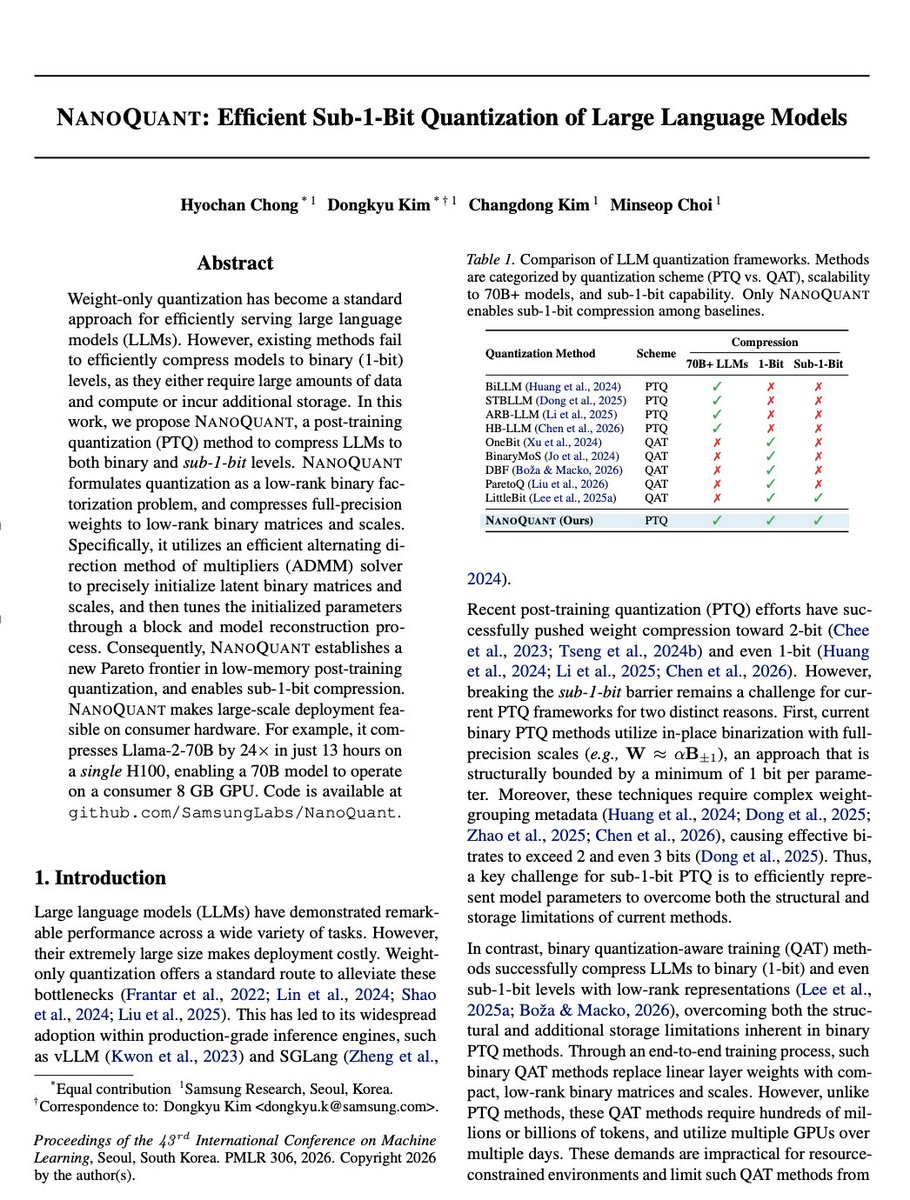
Samsung killed the GPU mafia.
They open-sourced a method that shrinks 70B LLM into less than 1 bit per weight
Running a frontier model meant paying API tolls or renting racks of $30,000 GPUs in the cloud.
First, we shrank models from 16-bit down to 4-bit. Then came 1-bit models.
Everyone assumed 1 bit was the hard floor. After all, how do you go lower than a single 1 or 0?
But, researchers introduced NanoQuant, the first ever sub-1-bit LLM compression.
Instead of storing every weight individually, even as a single bit, it compresses the model's weight matrices into ultra-compact, structured binary representations.
Less than one bit per parameter. On average.
The implications are massive:
• Slashes VRAM requirements by over an order of magnitude.
• Breaks the memory bandwidth bottleneck that makes local inference slow.
• Brings massive, high-capability models down to consumer hardware and edge devices.
Big Tech built its entire business model on one assumption: that frontier AI is too heavy for you to run yourself.
That assumption is dying.
Fascinating data. I'd argue the 1,000 GW shortfall to the tripling target is a deployment-speed challenge, not a technology one. Al Dhafra solar in the UAE shows how fast large-scale projects can move. #innovation
.
Global renewable energy is growing fast, but is it enough to triple by 2030?
Here is how cumulative global renewable capacity stacks up from the 2022 baseline (3,700 GW)
- Main case forecast: Reaches 9,700 GW by 2030 (2.6x growth).
- Accelerated case: Climbs to 10,400 GW (2.8x growth).
- Global tripling target: Requires 11,400 GW (3x growth).
Current policies put the world on track for a 2.6x expansion. With accelerated efforts, we can come remarkably close to the 2030 tripling goal.
Source: @IEA
@BetaMoroney Fascinating traction. $50M ARR in six months suggests real industrial demand, not just demos. I suspect manufacturing and logistics are first in line. Which deployment sectors are driving revenue?
@antgrasso@VisualCap Intriguing data. At this concentration, most nations risk staying consumers rather than builders. I believe pairing capital, R&D, and real industrial demand, as the UAE does, is the credible path. What timeline do you envision? #AI
@NeuraPod Remarkable scaling. Each additional implant generates invaluable datasets for decoding models. I'm curious what bandwidth and safety tradeoffs they're navigating at this scale. #BCI
The same prompts for a drowned neo-gothic city shader, less than a year later on GPT-6.2 Astra. This is all procedural
(Interestingly, in a very Astra move, the first version it made had deterministic elements to make the experience more impressive, no other model has done that)
@ramez Agreed. Winner-takes-all dynamics weaken alignment research itself. Without competing labs, fewer tests of safety assumptions. I'd say diversity of approaches is an engineering advantage, not just a value. What would real pluralism in frontier AI look like?
Know your farmer, know your food
Or....
Fake lab grown BS
Major investors include:
Investor Background
Tyson Foods Major American meat producer
Cargill Global agricultural and food corporation
SoftBank Japanese investment conglomerate
Temasek Singapore state-owned investment company
Bill Gates Microsoft co-founder and investor
Abu Dhabi Growth Fund Abu Dhabi investment fund
SITUATION EXPLAINED: Google's mid-tier Gemini 4 Neon beats Claude Opus 5.5 on almost every benchmark, for 25% less.
• Neon is adapted from Carbon and scores 61 on Artificial Analysis's Intelligence Index, 3rd overall and the highest of any Gemini model, ahead of Opus 5.5 at 59
• Its biggest lead is knowledge work, with 56.3% on Zapier's AutomationBench vs 42.5% for Opus, and Vals AI ranks it 1st on legal research and tax tasks
• It costs $3/$15 per million tokens with a 1M-token context, 50% more than Sonnet 5.5 and GPT-6.2 Sol
• Glean says it matched or beat Carbon "at 3x the speed and 60% of the cost," and on OpenRouter it ran at 127 tokens per second vs 46 for Carbon
• Argon launched only to cyber defenders in Google's Fairwind Program, but Neon went straight to the public (Pro included)
@theojaffee: "On the very best software engineering benchmarks, Opus still pulls ahead of Neon. But on almost everything else, Neon is still quite up there."
@theojaffee Agreed. Measurement norms only work with broad adoption. I would love to see Anthropic commit to comparable RSI indicators. Do you expect voluntary uptake across labs? #AI
@MTSlive Fascinating. 10 GW is a staggering compute demand, closer to a national power grid than a datacenter lease. I'm curious how launch cadence, thermal management, and terrestrial grids scale to meet it. #innovation
How can AI-driven predictive process monitoring adapt to streaming event logs without forgetting past patterns?
Explore one of the latest breakthrough articles from the 𝐈𝐧𝐭𝐞𝐫𝐧𝐚𝐭𝐢𝐨𝐧𝐚𝐥 𝐉𝐨𝐮𝐫𝐧𝐚𝐥 𝐨𝐟 𝐂𝐨𝐨𝐩𝐞𝐫𝐚𝐭𝐢𝐯𝐞 𝐈𝐧𝐟𝐨𝐫𝐦𝐚𝐭𝐢𝐨𝐧 𝐒𝐲𝐬𝐭𝐞𝐦𝐬:
🧠 𝘾𝙝𝙖𝙢𝙚𝙡𝙚𝙤𝙣𝙨 𝘿𝙤 𝙉𝙤𝙩 𝙁𝙤𝙧𝙜𝙚𝙩: 𝙋𝙧𝙤𝙢𝙥𝙩–𝘽𝙖𝙨𝙚𝙙 𝙊𝙣𝙡𝙞𝙣𝙚 𝘾𝙤𝙣𝙩𝙞𝙣𝙪𝙖𝙡 𝙇𝙚𝙖𝙧𝙣𝙞𝙣𝙜 𝙛𝙤𝙧 𝙉𝙚𝙭𝙩 𝘼𝙘𝙩𝙞𝙫𝙞𝙩𝙮 𝙋𝙧𝙚𝙙𝙞𝙘𝙩𝙞𝙤𝙣
Authored by 𝐌𝐚𝐫𝐰𝐚𝐧 𝐇𝐚𝐬𝐬𝐚𝐧𝐢, 𝐓𝐚𝐦𝐚𝐫𝐚 𝐕𝐞𝐫𝐛𝐞𝐞𝐤, and 𝐒𝐣𝐨𝐞𝐫𝐝 𝐯𝐚𝐧 𝐒𝐭𝐫𝐚𝐭𝐞𝐧, this study addresses a critical challenge in Predictive Process Monitoring (PPM): enabling machine learning models to continuously adapt to streaming data and concept drifts without suffering from catastrophic forgetting.
The proposed framework introduces:
🔹 𝐆𝐞𝐧𝐞𝐫𝐚𝐥 𝐚𝐧𝐝 𝐄𝐱𝐩𝐞𝐫𝐭 𝐏𝐫𝐨𝐦𝐩𝐭𝐬: A dual-prompt architecture that balances dynamic adaptation with core knowledge retention.
🔹 𝐎𝐧𝐥𝐢𝐧𝐞 𝐂𝐨𝐧𝐭𝐢𝐧𝐮𝐚𝐥 𝐋𝐞𝐚𝐫𝐧𝐢𝐧𝐠: Continuous model updates directly on event streams without full retraining.
🔹 𝐓𝐚𝐬𝐤-𝐒𝐩𝐞𝐜𝐢𝐟𝐢𝐜 𝐅𝐨𝐫𝐠𝐞𝐭𝐭𝐢𝐧𝐠 𝐌𝐞𝐭𝐫𝐢𝐜: A new evaluation metric designed to measure knowledge retention and degradation across recurring business process tasks.
🔹 𝐑𝐨𝐛𝐮𝐬𝐭 𝐏𝐞𝐫𝐟𝐨𝐫𝐦𝐚𝐧𝐜𝐞 𝐔𝐧𝐝𝐞𝐫 𝐂𝐨𝐧𝐜𝐞𝐩𝐭 𝐃𝐫𝐢𝐟𝐭: Demonstrated efficacy across datasets featuring gradual, sudden, and recurring process changes.
In real-world business environments like supply chain operations and customer service workflows, process behavior constantly evolves. This study provides a foundational framework for deploying resilient, adaptive AI models that learn continuously while retaining historical intelligence.
📖 Read more about this article: https://t.co/GJqwI1a7Gg
📚 Recommend IJCIS to your library today! - https://t.co/mVoq7pkq2l
#PredictiveProcessMonitoring #ProcessMining #ContinualLearning #MachineLearning #BusinessProcessManagement #OnlineLearning #ArtificialIntelligence #IJCIS
@MTSlive Intriguing estimates from someone so central to alignment research. I think pausing algorithmic gains until weights are secured raises hard engineering questions. What does 'secure' even mean at frontier scale? #AI
PhD Opportunity in PIMARL (Physics-Informed Multi-Agent Reinforcement Learning).
The goal is drone swarms that are robust, efficient to train and able to generalize across environments, using controllers that build in physics such as rigid-body dynamics, drag and energy models.
Duration: 3 years
Location: Sorbonne University Abu Dhabi & Thales Emarat Technologies, with regular visits to Thales premises
Starting date: January 2027
PhD Student
Topic: Physics-Informed Multi-Agent Reinforcement Learning for Autonomous Swarm Navigation and Control
Responsibilities:
Develop an original doctoral thesis operating at the interface of physical modeling and machine learning.
Integrate Physics-Informed Artificial Intelligence with Multi-Agent Reinforcement Learning (MARL).
Work collaboratively with two postdoctoral researchers, under the supervision of the PIs.
Algorithm design and code writing
Scientific paper writing
Demo realization
Required Qualifications & Skills:
Master’s degree in Computer Science, Robotics, Aerospace Engineering, Applied Physics, or a closely related field.
Strong foundational understanding of Reinforcement Learning (RL) and multi-agent systems.
Knowledge of or strong interest in Physics-Informed AI and neural networks.
Basic understanding of flight dynamics and drones’ control systems.
Excellent programming skills (Python, C/C++, simulation environments).
Hands-on experience with GPU computing for machine learning and simulation, including running and debugging multi-GPU training jobs.
How to apply: Send CV, motivation letter, and academic transcripts to [email protected], using the subject “SUAD-Thales Position: Application”
Follow @Promisevekpo for more #opportunities
@Deepneuron@MTSlive@DanielleFong@davidad Intriguing objection. I'd frame it as shifting trust rather than removing it: proof assistants still rely on small trusted kernels. CompCert and seL4 show the base can be auditable. Where would you draw the line?