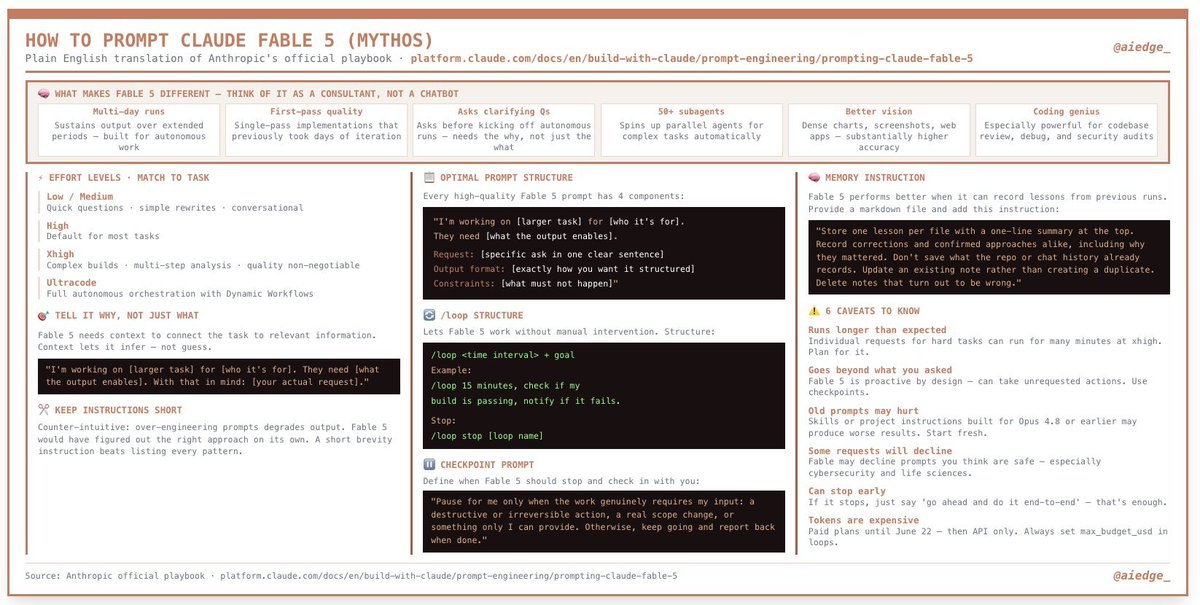
New skill: /improve-animations
Inspired by @shadcn’s improve skill I made one specifically for animations.
Use your most capable model to audit animations in your project and hand the execution to cheaper models.
Fable is available through July 12, so make good use out of it!
Deep dive into how you can generate designs, prototypes, frontends, and full stack apps with your own design system in @v0. As models continue to get faster, v0 gets more magical.
Today, I shared with the OpenAI team that I have decided to leave my full-time role at OpenAI and transition to being a part-time advisor.
Three months ago, I had to go on medical leave after a severe exacerbation of a chronic illness I’ve lived with for seven years. During that time, it became clear that the road to recovery would be much longer and more complex than I had anticipated—and that I needed to focus on it fully.
When I went on leave, many people told me I was courageous for prioritizing my health. The truth is that I am only making this decision now because I failed to make it many times before.
Over the years, doctors, friends, colleagues, and loved ones encouraged me to slow down. Two years after I got sick, Facebook offered me the opportunity to take a full year of medical leave. I didn’t even pause to consider it. I immediately said no. At the time, Zuck told me I should play the long game. I wish I had listened.
Looking back, I realize that a lot of what made me successful also made this decision incredibly difficult.
I grew up believing that opportunities were precious and that when they appeared, you grabbed them with both hands. That mindset carried me from a small town in southern France to opportunities I never could have imagined. By the time I turned 40, I had already gotten to do more than I’d ever dreamed possible as a kid growing up in Sète.
I love building. My work has always given me a deep sense of purpose. OpenAI in particular felt like a role that my entire career had been building toward, which made this decision even harder.
But what I’m learning now is that grit and endurance are not the only skills required to have impact over decades. Sometimes the harder thing is to stop, listen, and trust that taking care of yourself today makes it possible to contribute for much longer tomorrow.
This experience has also strengthened my conviction about why this work matters.
It has been a jarring experience to spend my days helping build the future while simultaneously navigating a disabling disease that still has no cure.
Over the last seven years, I’ve spent countless hours in doctors’ offices, dealing with symptoms, treatments, insurance, uncertainty, and all the invisible work that comes with being a patient. Like millions of others living with chronic illness, I’ve experienced firsthand how difficult healthcare can be to navigate, even when you have every possible advantage.
More than ever, I believe that some of the most important opportunities for AI lie in helping people solve real problems in their daily lives: their health, their finances, their time and the everyday burdens that shape human experience.
In particular, curing disease is the most important thing AI could accomplish. I’m excited to continue working towards cures through OpenAI but also through my work with @ChronicleBioAI and @CODA_research.
I’m deeply grateful to @sama, @gdb and the OpenAI board for their support during this time and for offering a way for me to continue contributing to the mission without sacrificing my chances of recovery. I’m also so thankful to my team and the many extraordinary colleagues I’ve had the privilege to build alongside.
For now, my focus is recovery. But my belief in the potential of technology to solve deeply human problems has never been stronger.
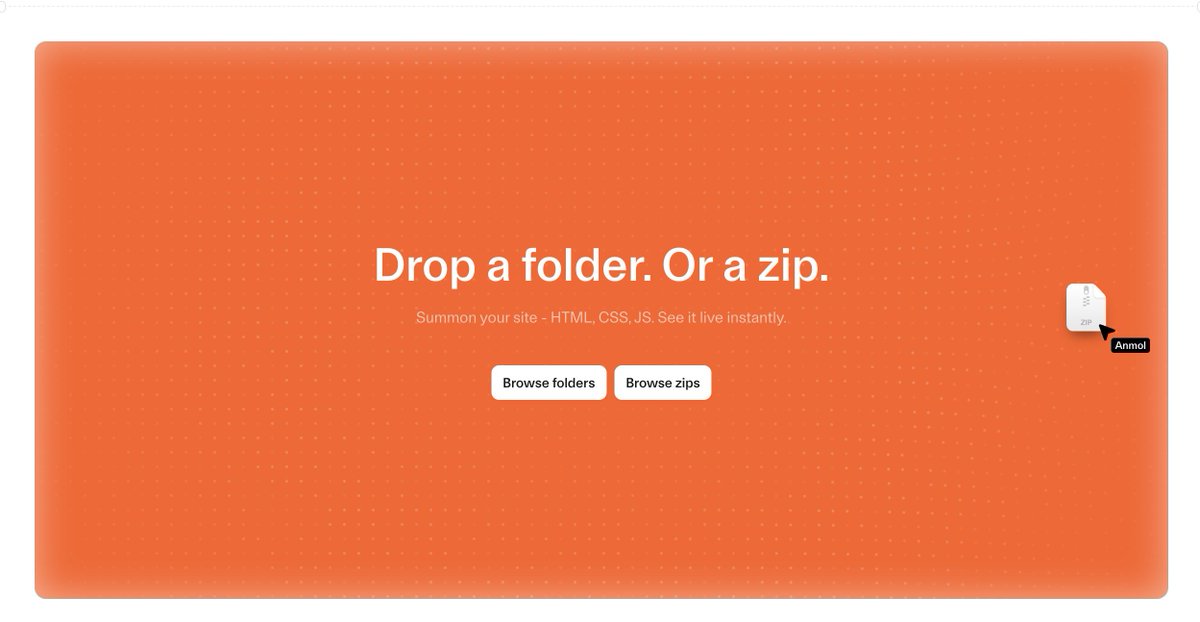
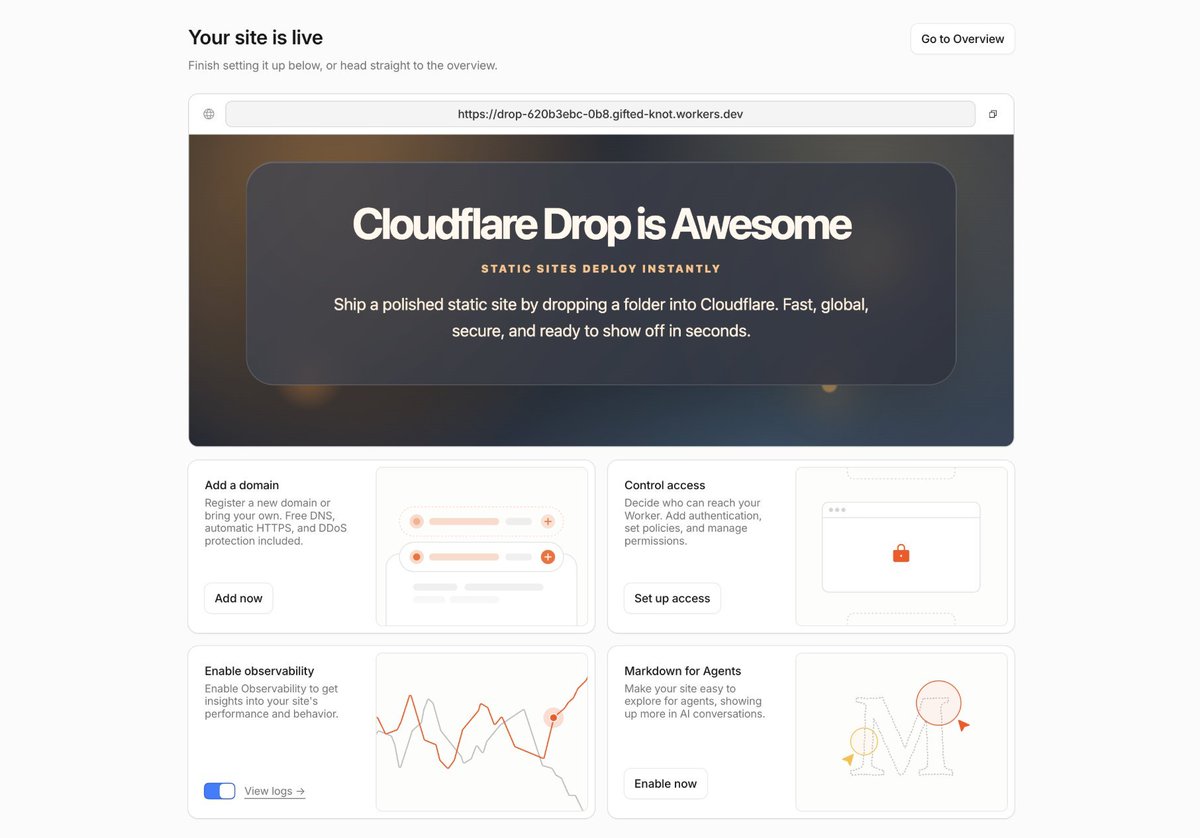
Introducing Cloudflare Drop
Drop your folder in the browser and deploy it instantly on Cloudflare. Your website... milliseconds away from users on region: earth
No account needed. Deployment is active for 60 minutes, then expires unless you claim it.
https://t.co/Dn6b1mggqs
My plan to cure autoimmune gastritis
To our knowledge, no one has ever done this to try and cure an autoimmune disease.
Context: In May, I got diagnosed with autoimmune gastritis (AIG). We found it by taking a tissue biopsy of my stomach. My immune cells are confused, causing my stomach to eat itself.
AIG stops your body from absorbing nutrients like iron and B12, and can eventually lead to cancer. It likely started decades ago when I was diagnosed with hypothyroidism when 21 years old. The thyroid and stomach are closely linked in your immune system.
I feel fortunate that I've been taking such good care of my body for the past five years as my condition would otherwise be much more severe. Millions of people are affected by this disease and are undiagnosed.
Standard of care tells you that you can’t do anything about it. That’s old fashioned.
Here is how we are going to try and cure it:
Step 0: find and diagnose the disease ✅
AIG is rarely caught early because symptoms are subtle. Early warnings are low iron and B12, but when hemoglobin and hematocrit look normal, doctors routinely miss it because there are no obvious signs of anemia.
A standard colonoscopy won't find it either, because it only checks the lower digestive tract, not the stomach. It was only through a highly targeted stomach biopsy that we found it. Even biopsies can miss it if they don't sample the exact right spots. Most people with AIG go undiagnosed.
Step 1: Map my immune system ✅
Last Thursday, I had a blood draw to isolate and decode 1 million of my immune cells. Think of your immune cells as trillions of soldiers. Each carries a unique key designed to unlock and destroy a specific threat, like a virus or bacteria.
A standard blood test allows you to see how many soldiers you have, but not their keys. Sequencing one million individual immune cells allows us to read the exact pattern of the teeth on every single key.
This is important for my autoimmune gastritis (AIG) because a specific platoon of rogue soldiers has developed keys that unlock an attack on my stomach lining.
Right now, we don’t know who they are. This test will inform us of which soldiers have gone rogue and are attacking me from within.
Once we know the soldier and key, we know what therapy path to pursue to shut them down.
Step 2: Catch the rogue soldiers
I will be getting a second biopsy from my stomach because we need to collect live tissue. We are currently planning out the logistics of getting the sample from my stomach to the lab.
We need these live cells because the initial blood tests showed the antibodies, which prove that an attack is happening, but doesn’t show us the actual rogue soldier doing the damage which is a T-cell.
The live sample will allow us to match the immune system mapping we did to the live T-cells.
Step 3: Build an early warning system
To keep an eye on the disease as we work towards a therapy, we’re building an early warning system. I'll have my blood drawn every two weeks and we’ll pair that information with wearable data to look for flare ups. This is important because the attack happens without producing symptoms that I can easily feel.
Step 4: Create a “Bryan in a dish” testing model, a miniature of my immune system
At the same time, we are taking a massive sample of my immune cells and deep freezing them (cryopreservation) for two reasons:
a) we’ll create a living lab: using these cells to replicate my immune environment in a lab dish. This allows us to test experimental drugs and therapies on my actual live cells before putting them into my body.
b) it creates a back up plan for me by preserving the raw cellular material needed for targeted rejuvenation therapies in the future.
Step 5: Build precision guided therapies to end the attack
Once we know who the rogue soldiers are, we will engineer a therapy designed uniquely for them. The trick is only turning off the rogue soldiers while leaving all the other healthy ones functioning as they are.
For safety checks, we’ll do two test runs:
1) we’ll run the therapy through a computer model that has my biology to evaluate how my molecules interact.
2) We will take my actual cells that we froze in Step 4 and watch them interact for real.
If both are successful, we’ll pursue one of four therapies:
a) fix the mistake my cells are making, restoring my immune system's natural off switches
b) teach the rogue cells to tolerate my stomach instead of attacking it
c) design smart molecules that physically plug into the rogue cells and turn them off
d) build soldiers who will track down and eliminate the rogue soldiers causing the damage
A marketing book from 1966 sells for $700 a copy while every coding skill from 5 years ago is worthless. The gap between those two facts is the most useful career insight you'll read this week.
Breakthrough Advertising by Eugene Schwartz sold a few thousand copies, went out of print, and never got updated. First editions now trade for $700+. The official reprint costs $125 with the original text untouched, and the "5 levels of awareness" Dan references here come straight from it. A 60-year-old book still runs the backbone of every funnel on the internet.
Same pattern everywhere you look. Maslow published the hierarchy in 1943. Cialdini's Influence came out in 1984 and has sold over 5 million copies. Aristotle wrote Rhetoric 2,300 years ago and law schools still assign it.
Now flip to technical skills. jQuery was a career in 2012. Objective-C mastery peaked in 2014. Prompt engineering went from $335K job listings to a solved problem in about 18 months. Each one depreciated the moment its underlying platform shipped an update.
Skills depreciate on the release schedule of their target. Technical skills target machines, and machines update yearly. Persuasion targets the human brain, which last shipped a major update roughly 50,000 years ago.
Every skill is a bet on the stability of its substrate. The brain is the only substrate with no roadmap.
Do you actually understand what $20,000 a month looks like when you build it properly?
Not 20 clients at $1,000. Not 100 clients at $200.
8 clients. $2,500 each. Agents doing the work. Him maintaining the system.
Lead qualification running 24 hours a day. Support tickets handled in seconds. Invoices chased automatically on day 7, day 14, day 21. Meeting briefs landing in inboxes 60 minutes before every call. Competitor reports delivered every Friday at 3pm.
Total tool cost on his side: $200 a month.
He built the system once. Packaged it. Now he's selling the codebase to people who want to do the same.
The agents were always the product. He just figured it out earlier than most.
Bottom line: That is the difference between freelancing and business.
While most people waste their time just "pressing buttons" in Claude, he realized that the product isn't your time—it's a finished, autonomous process. You set it up once, package it into a template, sell it, and then simply maintain the infrastructure.
The numbers in this post aren't magic; they are just the math of automation. Either you build systems that earn money while you sleep, or you continue trading your time for a fixed paycheck.
The choice is yours
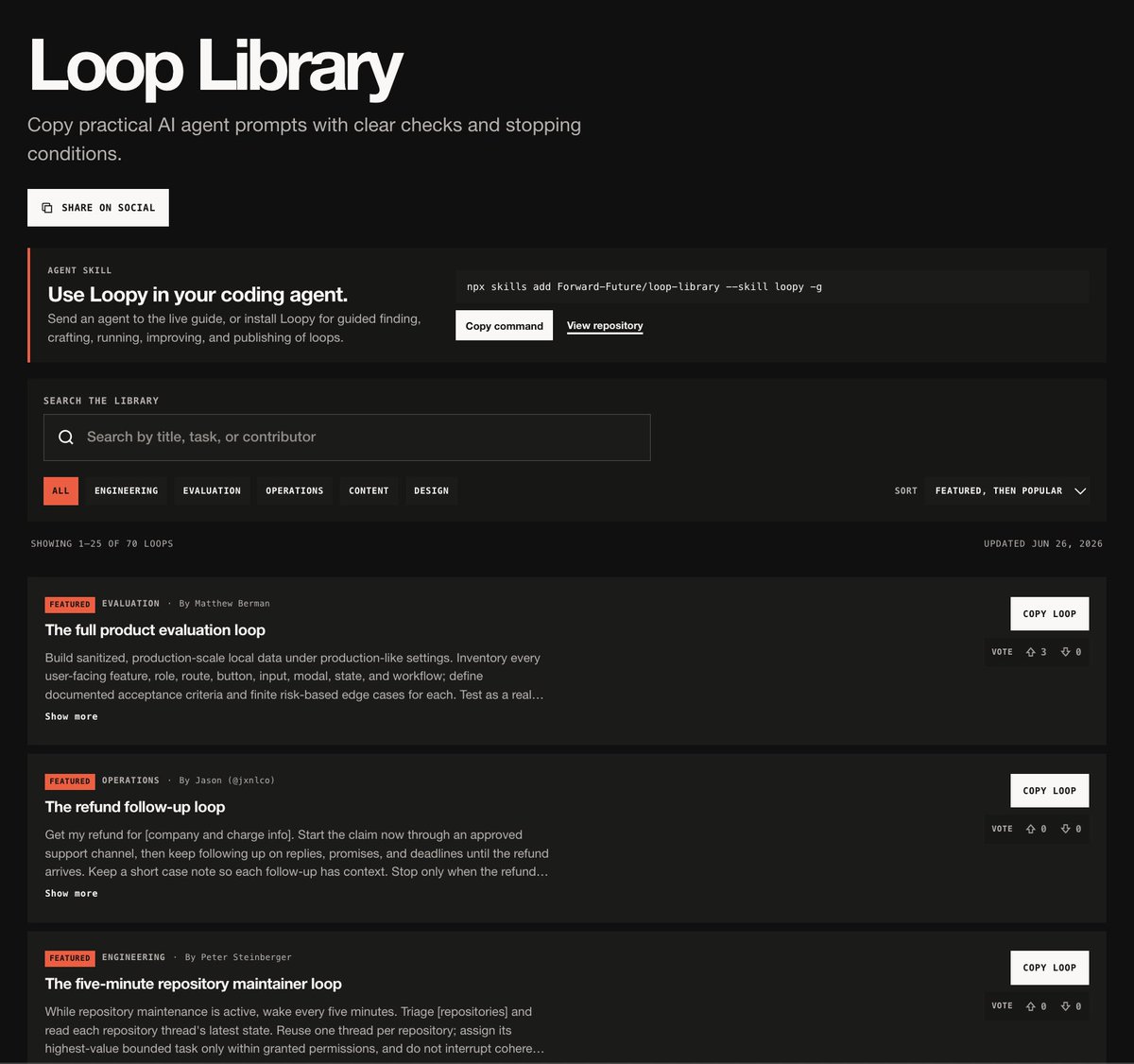
This is the best site on the internet to find agent loops you can use right now.
Free. Completely.
Most AI engineers are still writing these from scratch.
https://t.co/FHDHGXam6Z
Bookmark this site.
Then read this ↓
Palantir's CEO just exposed Sam Altman and Dario Amodei for robbing every Fortune 500 company.
Within two minutes, Alex Karp took the entire frontier AI industry apart on national television.
His exact words:
"Every single enterprise in this country, these people are LIVID. They are paying for tokens that create no value. These people are stealing the weights and alpha of my business."
He literally said the entire frontier AI business model is intellectual property extraction dressed up as a subscription.
Then he also destroyed the pricing model with a single question that Silicon Valley still refuses to answer:
"If it was so valuable, let's say I can make you $1 billion tomorrow. Wouldn't I say I'll make you $1 billion and I want 30 percent? Why are they charging for tokens if it's so valuable?"
That question breaks the industry.
If OpenAI and Anthropic's models truly delivered the productivity gains the labs claim, they would take equity or a share of the profit they generate. They would not sell access by the million tokens.
Token pricing is itself the CONFESSION that the product cannot produce reliable value at scale. If it did, they would price for the value. But they price for the compute because that is what they are actually selling.
Karp went even further...
He called the entire arrangement "a wealth tax that does not help the poor. It just punishes."
American businesses are transferring the alpha of their operations, meaning the workflows, the customer data, the strategy memos, the internal models that make them competitive, directly into the training pipelines of a handful of Silicon Valley labs. Once those labs retrain, the customer's own edge becomes the next enterprise product sold back to their competitors.
And the part the AI industry does not want anyone thinking about:
Every enterprise running its confidential documents, its customer conversations, and its financial models through a frontier model is potentially teaching that model HOW to replace them.
The vendor collects the token fee AND the compounding intelligence about that customer's business. That is the mechanism. And that is why Karp used the word "stealing."
He claims this is why every executive he meets is furious in private and silent in public. Nobody wants to be the CEO who called out the labs and then discovered their next competitor was built on their own leaked workflows.
The entire AI industry has been priced for perfection on one assumption:
That frontier labs produce durable, defensible value that justifies infinite compute spend.
But Karp just told us that the customers do not believe that assumption anymore. They believe they are being taxed without benefit, watched without consent, and copied without recourse.
The moment enterprises stop believing, the whole valuation stack shakes.
Doom scrolling but make it educational 🤓
Introducing Short Video Overviews in NotebookLM! Turn your most complex sources into 60-second, vertical videos that deep dive into any concept.
Rolling out now to Google AI Ultra and Pro subscribers on mobile & web (free users soon!)
Claude can run your company's growth with these 5 skill libraries.
Bookmark this.
1. alirezarezvani/claude-skills — 345 skills across 17 domains, 46 of them are specifically for marketing, organized into pods for content, SEO + AEO, CRO, growth, and landing pages.
2. coreyhaines31/marketingskills by @coreyhainesco – Marketing skills for Claude Code and AI agents. CRO, copywriting, SEO, analytics, and growth engineering.
3. gooseworks-ai/goose-skills by @GooseworksAI: 100+ skills + data APIs for growth, social, ads, and gtm. We built these and we use these every day. You can use this to find leads, scrape social, check ad performance, find influencers, generate creatives and more.
4. GBrain by @garrytan - this is an incredible foundation you can use to create a company brain. It has a knowledge graph, a synthesis layer to give you real answers and (my personal favorite) dream cycles so it updates the knowledge base every day.
5. AgriciDaniel/claude-ads — audits a creative against 250+ checks before you spend.
Links to all below.
ok I spent this morning inside Riverside's MCP integration with Claude and I'm convinced this is the new meta for video editing
before this, you used to have to edit in Descript, clip in Opus Clip, hire an editor to stitch it all together, and schedule in another tool
but all of that just got swallowed into Riverside.
in 10 mins i was able to:
> edit the video by editing the transcript. delete a sentence of text and that part of the recording disappears with it
> AI pulled the best moments into vertical clips for me, captions and all
> draft my newsletter straight from what I said
> scheduled my posts out across all my social platforms
so the whole record → edit → repurpose → publish loop now happens in the same tab I recorded in
and because of the MCP, I literally just told Claude "clip the 3 best moments from my recording and queue them for the week" and it goes and runs it for you
very based agentic workflow for content