Read my thoughts on 6G & Agentic AI, recapping seven stories highlighting key developments from the telco world around Agentic AI, IOWN, LTM, Multi-Agentic Systems, Autonomous Networks and more.
https://t.co/yBEiLp1r9C
#telecomblogs#6g#AgenticAI#autonomousnetworks
India is building its own S-400 class air defence system. 🇮🇳
Solar Industries has officially joined Project Kusha as a key development partner manufacturing the M2 booster.
And the scale of what is being built here is significant. 👇
• Three interceptor variants — M1 at 150 km, M2 at 250 km, M3 at 350 to 400 km
• All three share a common kill vehicle with different booster configurations
• Solar Industries contributing solid rocket motors and propellants for M2 booster
• Budget approved at Rs 21,700 crore
• Initial operational capability targeted between 2028 and 2030
• Integrates with IACCS alongside Akash, Barak-8 and S-400
• BEL and BDL also involved in prototype development
One missile system covering 150 km to 400 km with modular boosters is a very smart design.
India is not just replacing the S-400 import dependency.
It is building something it will fully own, upgrade and potentially export. 🇮🇳
Researchers from IIT Madras and IISc Bengaluru have solved a chemistry puzzle that remained unanswered for over 70 years.
As reported in The Indian Express, the team led by Prof. Sundargopal Ghosh and Stutee Mohapatra from the Department of Chemistry, IIT Madras, along with Prof. Eluvathingal Jemmis from IISc Bengaluru, has synthesised a carbon-free molecule that mimics the iconic ‘sandwich’ structure of ferrocene.
Using osmium and boron-based rings instead of carbon, the breakthrough marks the first stable carbon-free version of the molecule — something scientists worldwide had long attempted to achieve.
Published in the prestigious journal Science (https://t.co/zqkL1CSqz6), the discovery could open new pathways for designing advanced materials with unique chemical and structural properties.
Read more: https://t.co/DhPSJbAGJ9
@IndianExpress@iitmadras@iiscbangalore@amitabhsin
OpenTelemetry’s graduation shows what happens when the community aligns to solve real production pain points.
Chris Aniszczyk (@cra) and Mike Vizard dove into how OTel handles today’s massive data volumes, and why it’s foundational for tracing AI agents and token usage tomorrow.
Watch the interview from Open Source Summit: https://t.co/PcIcMYzwPy
Under the visionary leadership of Hon’ble Prime Minister Narendra Modi ji, the Government of India continues to strengthen Space Education, Research & Innovation across the nation.
India Space Lab invites students to join the Summer Internship & Technical Training Program 2026 featuring training in Drone Technology, Rocketry, CanSat & CubeSat, Remote Sensing, GIS & Disaster Management.
Last Date to Register: 10 June 2026
Online Internship | Certificate on Completion
https://t.co/X05Hy21AL0
Take your first step towards the future of Space Technology!
@indiaspacelab@DrSukantaBJP@jayantrld@IndiaDST@MinScTechGoI@isro@ISROSpaceflight@INSPACeIND@mygovindia@EBSB_Edumin@GoI_MeitY@YASMinistry@HRDMinistry
@DellOroGroup says 5G core network growth accelerated outside China in the first quarter of 2026 as EMEA and North America expanded, while operators increasingly pursue cloud-native architectures and broader 5G Standalone deployments. https://t.co/6x31ym6QUM
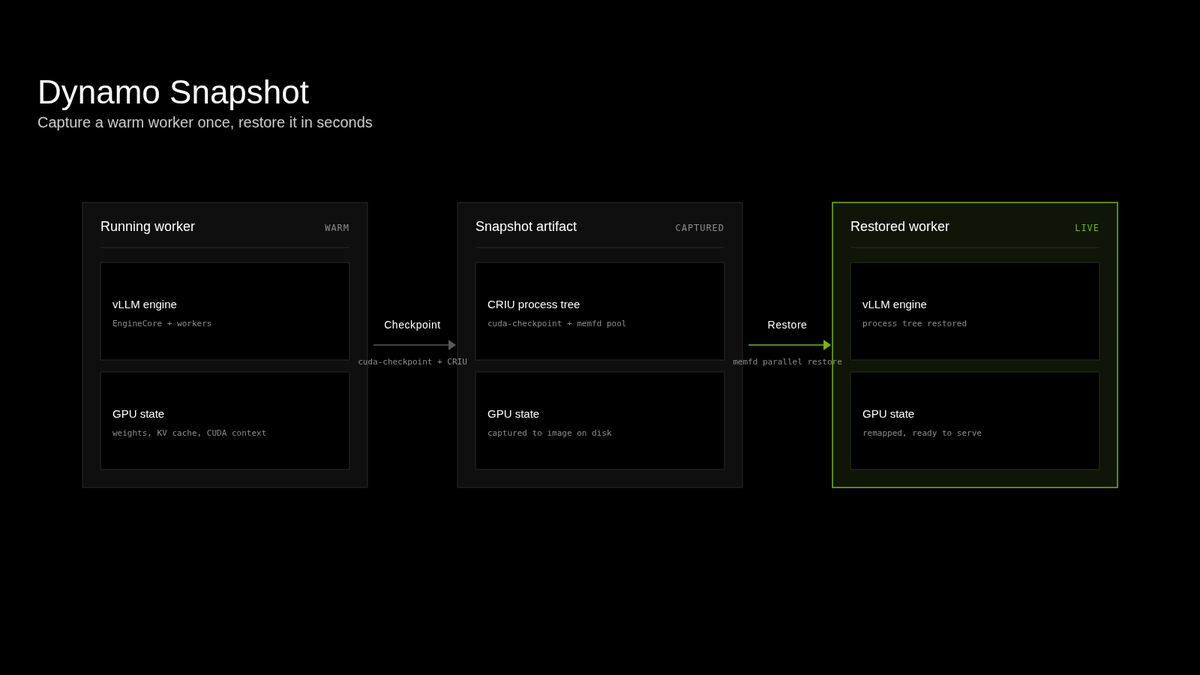
Introducing Dynamo Snapshot, our approach for fast startup for inference workloads on Kubernetes, which reduces startup time from minutes to under 5 seconds.
In production inference deployments demand fluctuates over time. Cold-starting inference workloads can take minutes, leaving idle GPUs that generate no tokens and serve no requests.
Snapshot leverages GMS to enable concurrent weight restoration over a high-speed interconnect, while using Linux native AIO and parallel memfd restoration to accelerate CRIU restore performance.
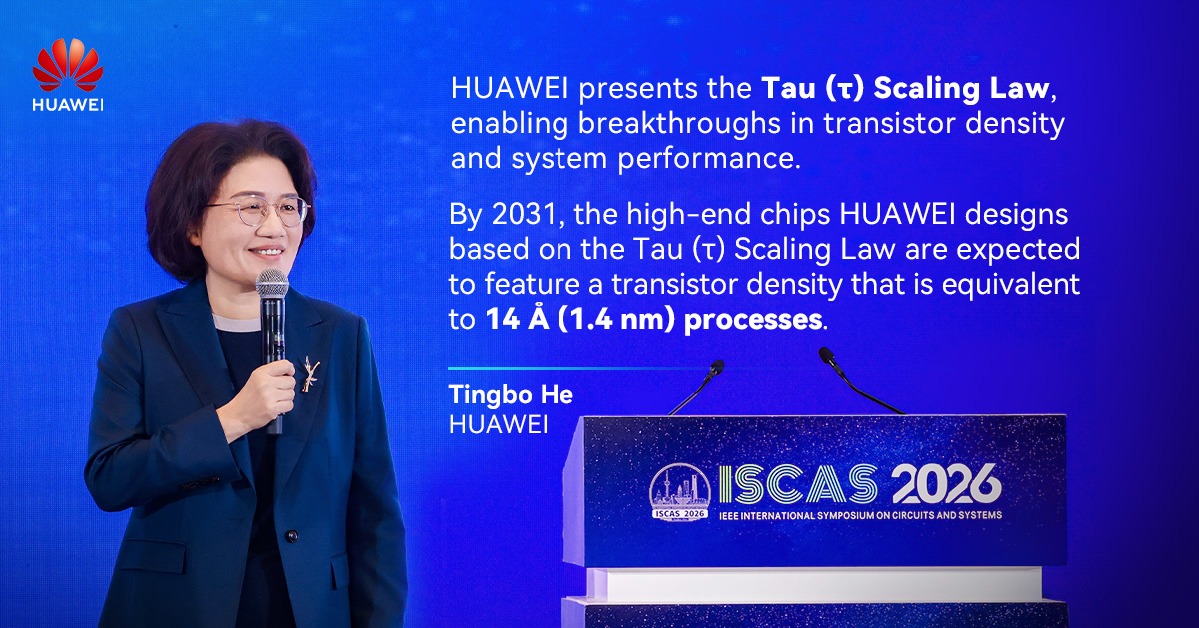
HUAWEI has presented the Tau (τ) Scaling Law, a new principle for guiding the future development of the semiconductor industry. By 2031, HUAWEI's high-end chips based on this law are expected to feature a transistor density that is equivalent to 14 Å (1.4 nm) processes.
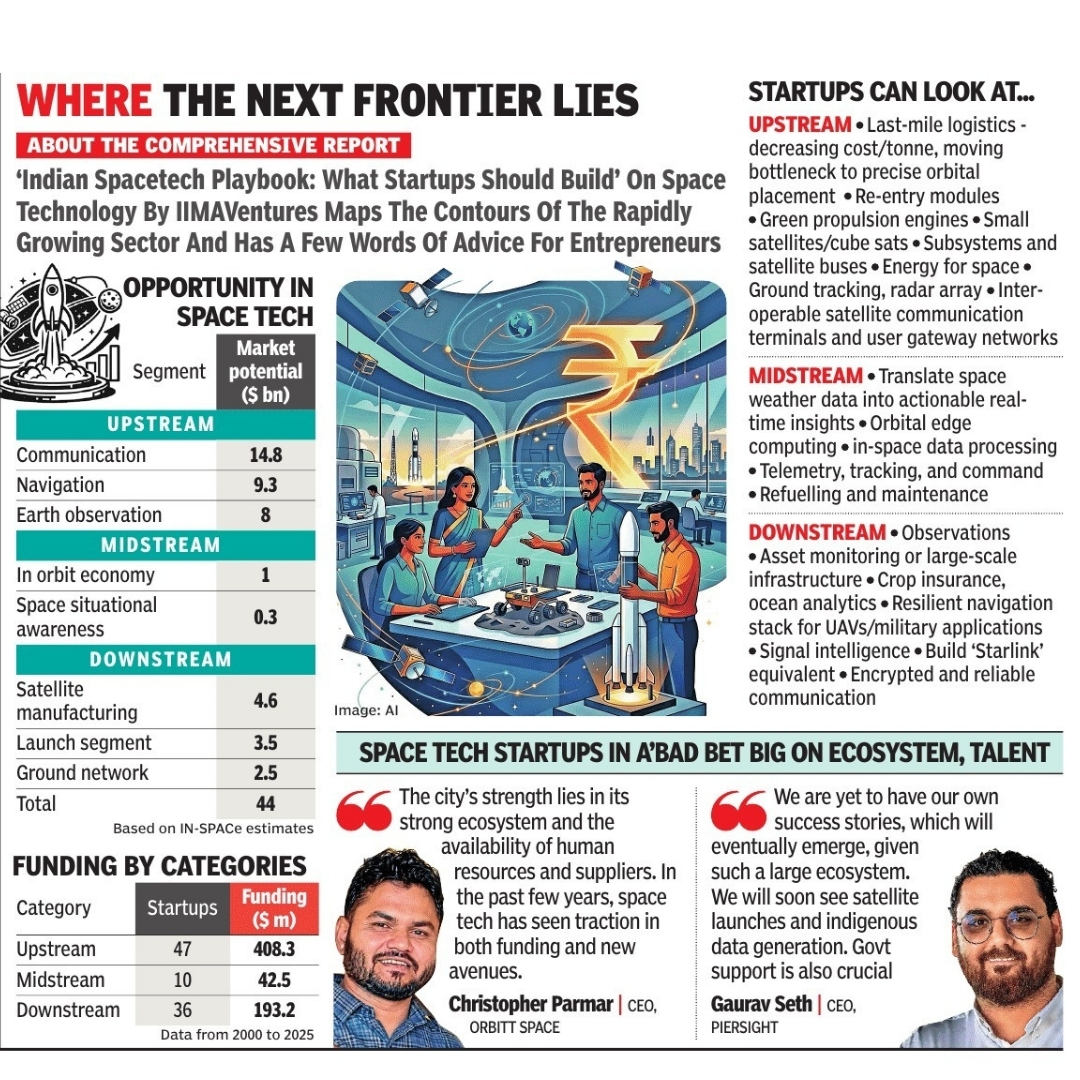
At IIMA Ventures, we’ve been early believers in India’s spacetech ecosystem, backing 11 spacetech startups at their early stages while the sector was still very early, technical, and too long-term to be considered investable.
Today, we announce @NeocambrianAI
The future of AI will be physical. But Physical AI has no internet scale dataset to learn from.
We’re building the data foundation of Physical AI - a high fidelity, pre training scale database of Human Action.
From India. For the world.
🗣️ "I can't help but notice that amid the hype surrounding #AI, chips, and data centers, the network rarely seems to get a mention."
Our Anne Lee explores how AI is driving the evolution of autonomous networks, drawing from her paper: https://t.co/byU0I4NyMg
Before #AI acceleration became a priority, #FPGAs changed computing by making hardware reprogrammable after manufacturing. Now an @IEEEorg Milestone, they enabled faster innovation in #networking, modern AI systems, and beyond. Learn more at @IEEESpectrum: https://t.co/6EGvCvmPK9
When are multi-agent systems necessary and how can we build them?
Single-agent systems are simple and incredibly powerful when equipped with the necessary tools for solving relevant tasks. Due to the complexity of orchestrating multiple agents, we should almost always start with a single-agent design and optimize this basic setup as much as possible—single agents are easier to evaluate and maintain.
We can expand the agent’s capabilities by incrementally adding more tools and conditional logic—in the form of prompt templates or modified instructions—to the system. For the agent to perform well, we should provide clear names, descriptions, and arguments for all tools, as well as detailed instructions that outline the expected actions and outcomes for a task.
When are multiple agents needed? Multi-agent systems distribute task execution across multiple specialized agents in a coordinated fashion. Multi-agent systems logically separate components of a difficult task, but they are also more complex. For this reason, we should expand to multi-agent systems only when necessary.
Common signs that using multiple agents may be helpful include:
- Instructions for the single-agent system are bloated, and the agent is struggling to follow instructions even with clear logic or templating.
- Tools are being selected incorrectly by the agent because there are too many available tools.
The reasoning capabilities of modern LLMs make it possible to select tools even from a large set. Issues arise when the set of available tools have overlapping purposes, making tool selection subjective. Splitting tools across distinct agents can be helpful in this case.
Types of multi-agent systems. There are many ways that one could design a multi-agent system, but two patterns arise frequently in practice:
- Manager setup: a central “manager” agent orchestrates specialized agents via tool calls, where each agent handles a specific task or domain.
- Decentralized setup: multiple agents operate as peers by handing off tasks to one another based on their respective specializations.
In the manager setup, task execution is controlled by a single, centralized agent. The manager agent acts as the “glue” for solving a task by developing a problem-solving strategy, delegating parts of the work to specialized agents, and deriving a final solution by synthesizing results.
Relation to sub-agents. The manager setup is related to the concept of a sub-agent. Instead of keeping all context in a single agent, we trigger a sub-agent to handle task components. Our main agent coordinates the high-level plan for solving a task while sub-agents perform technical tasks and return relevant context to the main agent. Sub-agents can help to improve system reliability by not overloading the main agent’s context.
Decentralized multi-agent systems have no centralized agent to orchestrate task execution. Instead, control is passed among multiple agents that operate as peers via tool / function calls. Such a setup works best when we do not need a central agent to synthesize results or interact with the user.
Concrete examples. The figure contains a few examples of each type of multi-agent setup:
- A multi-agent translation system could use a manager agent to identify the requested language pairs and route each pair to a specialized translation agent.
- We can use the decentralized setup to create an agentic support system that first uses an agent to triage the issue, then passes control to a specialized agent to solve that particular type of issue.
The hardest problem in AI agents may no longer be intelligence.
It’s coordination.
Multi-agent systems are failing 41–87% of the time —
mostly from coordination breakdowns, not model weakness.
which means:
the next infrastructure layer isn’t smarter models.
It could be systems that keep agents aligned, verified, and on track.
Sovereign gene-editing toolkit for cheaper crop innovation — not just using CRISPR, but pioneering a new AI-designed generation, bypassing costly Western patents— @icarindia ICAR-CRRI
Indian scientists used AI to create Plant-OpenCRISPR1 (POC1) — first AI-designed CRISPR system re-engineered to work in plants. Unlike traditional gene-editing tools which are borrowed from bacteria, POC1 proves AI can design custom genetic 'molecular scissors' from scratch, circumventing costly Western patents—domestic toolkit + affordable crop innovation.
Tech could enable precision-designed crops with higher yields, drought & disease resistance & better nutrition — without introducing foreign DNA/older GMOs
AI inference cost (which we pay in dollars) may rival our oil import bill and blow up our current account deficit. Great post on that below.
What is the solution? I believe that high developer productivity can be achieved without the high AI inference bill. We have to invent our way out of trouble. Stay tuned.