Moments in our investing careers like these are important to look back. I remember holding $RKLB through its merger and getting battered.
Yet space exploration was becoming possible and frontiers opening.
The space industry has developed incredible amounts in a mere 5 years.
Eating up some $RKLB here as it gets battered from ticker change ~-10% day hit. Space exploration and ride sharing able players will be the forefront’s in the vastly developing space industry. We are truly at a new age of becoming multi planet species. Very long on Rocket Labs.
NWS Flood Inundation Mapping (FIM) now covers nearly 100% of the U.S. population, expanded to include the East Coast, the Great Lakes region, the Rocky Mountains and the northern Plains. FIM visually displays the geographical extent of projected river flooding for more than 3.3 million river miles across the United States and its territories. https://t.co/t6hj7Xlvwp or https://t.co/cIbRn361Ex
Think Rocket Lab only operates in low Earth orbit? Think again.
When a spacecraft orbits the Moon, touches down on the lunar surface, or charts a course across deep space to Mars, there's a strong chance Rocket Lab technology helped it get there and deliver mission success.
Through our launch, spacecraft, solar power, separation systems, software, operations, and robotics solutions, we’re proud to support historic planetary exploration missions across the solar system. 🧵👇
Rocket Lab began as a small launch company. Today, our rockets, spacecraft, and components power hundreds of missions for science and exploration, national security, and commercial constellations.
Here's a tiny glimpse of how far we've evolved since Electron's first launch less than 10 years ago.
Rockets unlock space. Satellites do the work. We build and operate both.
Electron is vertical on Pad B at Launch Complex 1 ahead of today's 'Owl By The Dozen' mission for @synspective - our 96th Electron launch. T-2 hours to liftoff.
❄️LOX loading is about to begin
🌤️ Weather: 85% go
🚀 Range: Clear
⏱️ Liftoff: scheduled for 3:22pm NZ local time
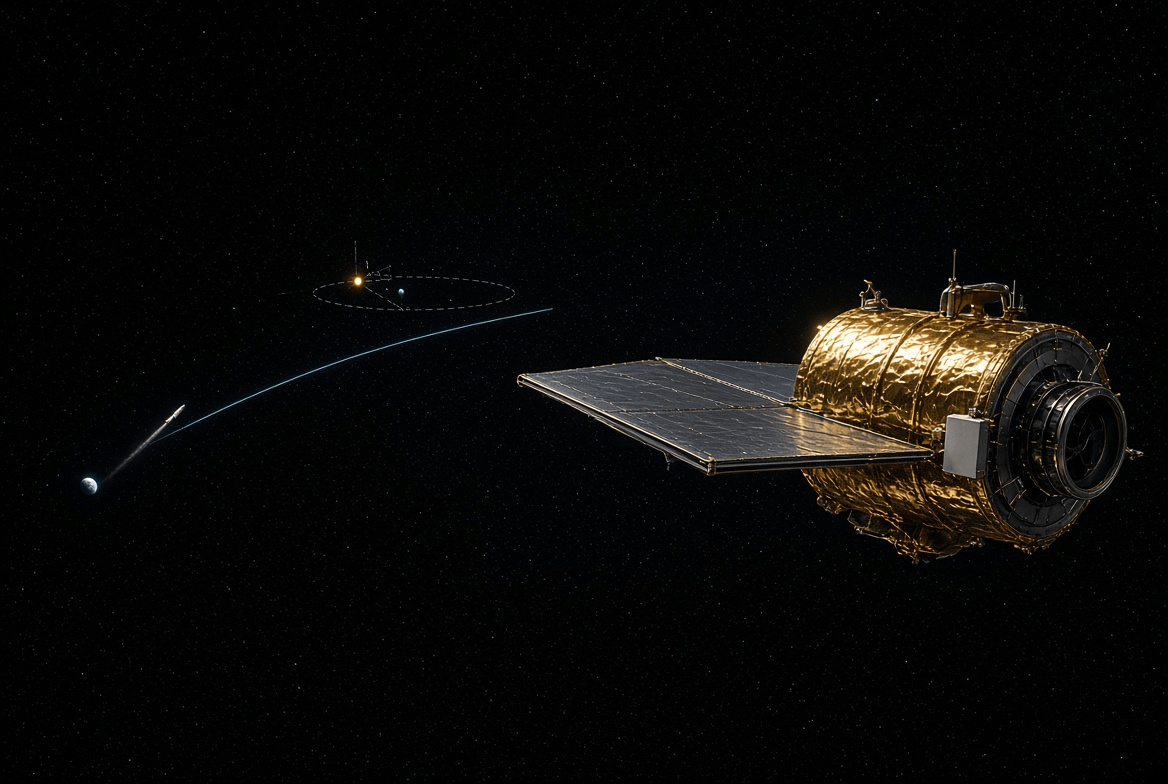
NASA launched the Nancy Grace Roman Space Telescope so cleanly that its fuel budget just doubled.Roman left Earth on a SpaceX Falcon Heavy on August 30, 2026, bound for the Sun–Earth L2 point about 1.6 million kilometers away. Mission planners had reserved up to 200 kilograms of fuel for the first big course correction. The telescope used about 18 kilograms. That leftover propellant, plus tanks that were filled to the brim because the observatory came in two tons under its mass limit, now adds up to at least 22 years of science operations instead of the original 5-plus-5-year plan.The spacecraft still has two more burns ahead: another correction this month and an insertion maneuver near L2 in early December. Both are expected to cost less fuel than budgeted. After that, the engines will fire about once every 28 days to hold station and dump angular momentum from six reaction wheels.Fuel is the clock that usually kills a telescope at L2. Roman was built with a back door: grab points, reflectors, and a refueling port that a future robotic tanker could reach. No such tanker exists yet. For now it does not need one.The observatory itself is healthy. All 18 infrared detectors on the wide-field camera have passed first checks, and the coronagraph is in test. That camera is about 300 megapixels and covers a patch of sky roughly 100 times larger than Hubble’s, at similar sharpness. Its job: dark energy, dark matter, galaxies, and exoplanets — for more than two decades, if the rest of the hardware holds.
BREAKING: @NASA has just published never before seen, high speed film camera views of the launch of SLS during Artemis 2
🎥 - 16mm High Speed Film (NASA)