You aren't trying to guess the exact day the market bottoms and you won't be able to. The point is to sell when you are euphoric, and start buying when you are scared. You want to be mostly right, you aren't trying to be perfect.
@Breakerxyz@BearOnWindows95@tonitrades_ The crazy part is your reply is categorized as spam on X but the AI slop isn’t. I wonder if X considers this comment as spam too.
@DeepValueBagger Adding on to point 2, what happens to the stock market when retail investors lose their jobs and start selling stocks to fund their lifestyles?
@stephspeaks8@venom1s@SophieTanno@CNN Hey @SophieTanno, you know that filming in public doesn’t require consent, right?
And btw, there are plenty of women filming men in public too without their consent. Are you going to write about that too?
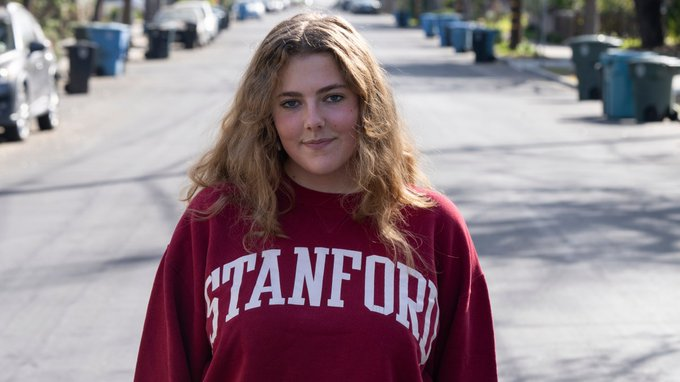
Nearly 40% of Stanford undergraduates claim they’re disabled. I’m one of them | Elsa Johnson, The Times
In 2023, one month into my freshman year at Stanford University, an upperclassman was showing me her dorm room — a prized single in one of the nicest buildings on campus. As she took me around her space, which included a private bathroom, a walk-in shower and a great view of Hoover Tower, she casually mentioned that she had lived in a single all four years she had attended Stanford.
I was surprised. Most people don’t get the privilege of a single room until they reach their senior year.
That’s when my friend gave me a tip: Stanford had granted her “a disability accommodation”.
She, of course, didn’t have a disability. She knew it. I knew it. But she had figured out early what most Stanford students eventually learn: the Office of Accessible Education will give students a single room, extra time on tests and even exemptions from academic requirements if they qualify as “disabled”.
Everyone was doing it. I could do it, too, if I just knew how to ask.
A recent article in The Atlantic reported that an increasing number of students at elite universities were claiming they had disabilities to get benefits or exemptions, which can also include copies of lecture notes, excused absences and access to private testing rooms. Those who suffer from “social anxiety” can even get out of participating in class discussions.
But the most common disability accommodation students ask for — and receive — is the best housing on campus.
At Stanford University in Palo Alto, California, where competition for the best dorm rooms is fierce, this practice is particularly rife. The Atlantic reported that 38 percent of undergraduates at my college were registered as having a disability — that’s 2,850 students out of a class of 7,500 — and 24 per cent of undergrads received academic or housing accommodations in the fall quarter.
At the Ivy League colleges Brown and Harvard, more than 20 per cent of undergrads are registered as disabled. Contrast these numbers with America’s community colleges, where only 3 to 4 per cent of students receive disability accommodations. Bizarrely, the schools that boast the most academically successful students are the ones with the largest number who claim disabilities — disabilities that you’d think would deter academic success.
The truth is, the system is there to be gamed, and most students feel that if you’re not gaming it, you’re putting yourself at a disadvantage.
That’s why I decided to claim my legitimate illness — endometriosis — as a disability at Stanford.
When I arrived on campus two and a half years ago, I would have assumed that special allowances were made for a small number of students who genuinely needed them. But I quickly discovered that wasn’t true. Some diagnoses are real and serious, of course, such as epilepsy, anaphylactic allergies, sleep apnea or severe physical disabilities.
But most students, in my experience, claim less severe ailments, such as ADHD or anxiety. And some “disabilities” are just downright silly. Students claim “night terrors”; others say they “get easily distracted” or they “can’t live with others”. I know a guy who was granted a single room because he needs to wear contacts at night. I’ve heard of a girl who got a single because she was gluten intolerant.
That’s why I felt justified in claiming endometriosis as a disability. It is a painful condition in which cells from the uterus grow outside the womb. I’m often doubled over in agony from the problem, for which there is no known cure, so I decided to ask for a single room in a campus dorm where I could endure those moments in private.
The application process was very easy. I registered my condition on the Stanford Office of Accessible Education website and made an appointment to meet an adviser later that week. The system is staffed largely by empathetic women who want to help students.
As I explained my diagnosis and symptoms over Zoom to one woman, she listened, nodded sympathetically, related my problems to her own life and asked a few basic questions. Within 30 minutes, I was registered as a student with a disability, entitled to more accommodations than I asked for.
In addition to a single housing assignment, I was granted extra absences from class, some late days on assignments and a 15-minute tardiness allowance for all of my classes. I was met with so little scepticism or questioning, I probably didn’t even need a doctor’s note to get these exemptions. Had I been pushier, I am sure I could have received almost any accommodation I asked for.
While I feel entitled to my single room, I would feel guilty about some of the perks I have — except that so many of my fellow students have gamed the system. Take Callie, a recent Stanford grad with ADHD and Asperger’s who agreed to be quoted under a pseudonym. Callie was diagnosed with her conditions in elementary school; in return, Stanford granted her a single room for all four years, plus extra time on tests — and a few more perks.
“In college, I haven’t had that many ‘in real life’ tests as opposed to take-home essays,” Callie told me. “When I did use the extra time, I felt guilty, because I probably didn’t deserve the accommodations, given the fact I got into Stanford and could compete at a high academic level. Extra time on tests — some students even get double time — seems unfair to me.”
But at Stanford, almost no one talks about the system with shame. Rather, we openly discuss, strategise and even joke about it. At a university of savvy optimisers, the feeling is that if you aren’t getting accommodations, you haven’t tried hard enough.
Another student told me that special “accommodations are so prevalent that they effectively only punish the honest”. Academic accommodations, they added, help “students get ahead … which puts a huge proportion of the class on an unfair playing ground”.
The gaming even extends to our meals. Stanford requires most undergraduates living on campus to purchase a meal plan, which costs $7,944 for the 2025-26 academic year. But students can get exempted if they claim a religious dietary restriction that the college kitchens cannot accommodate.
And so, some students I know claim to be devout members of the Jain faith, which rejects any food that may cause harm to all living creatures — including small insects and root vegetables. The students I know who claim to be Jain (but aren’t) spend their meal money at Whole Foods instead and enjoy freshly made salads and other yummy dishes, while the rest of us are stuck with college meals, like burgers made partly from “mushroom mix”.
Administrators seem powerless to reform the system and frankly don’t seem to care. How do you prove someone doesn’t have anxiety? How do you verify they don’t need extra time on a test? How do you challenge a religious dietary claim without risking a discrimination lawsuit?
I often think back to that conversation with my upperclassman friend. She wasn’t proud of gaming the system and she wasn’t ashamed either. She was simply rational. The university had created a set of incentives and she had simply responded to them.
That’s what strikes me most about the accommodation explosion at Stanford and similar schools. The students aren’t exactly cheating and if they are, can you blame them? Stanford has made gaming the system the logical choice. When accommodations mean the difference between a cramped triple and your own room, when extra test time can boost your grade point average, opting out feels like self-sabotage. Who would make their lives harder when the easiest option is just a 30-minute Zoom call away?
https://t.co/CflRHgha7E
@diogenes757@MurrayHillGuy1 You need to up your standards for what you consider good energy. 3 texts explaining why she’s flaking on you (whether real or not) is not it. That’s neutral at best. If she really wanted you, she’d meet you after the dinner.
@rachcorrine Well, thanks for sharing. Part of the problem is that women aren’t sharing the approaches that go well in detail. They only talk about the things men shouldn’t do but never about what men should do in detail. It’s always vague platitudes at best.
men have lost the momentum to talk to women or shoot their shot in public
we’ve created a culture where approaching someone in real life feels socially risky, non-consensual, or potentially punishable
so instead of learning confidence, timing, and respectful rejection, men opt out completely
they retreat to the safety of online dating
once there, they enter a massive humiliation ritual, where they jestermaxx for 5 moments of attention in a sea of 10,000 other men
they wait. then they pour money into whatever the apps promise will help
roses. super likes. boosts
all it does is drain their income, reduce their chances of finding the one, and create a kind of forced cuckification where whatever testosterone they had left is slowly siphoned out through micropayments
dating apps will contribute to the death of society and accelerate the population crisis
the pendulum has to swing back
@JohnDoeSt10 @Venus__On__Fire@therealjayber @SpectreDaygame Get a passport and use it. I’ve never met any femcels or demisexuals (whatever the fuck that means, no desire to look up snowflake terms) outside of the US. I fucked the most girls in my life last year.
Or stay in the US and enjoy the decline with the femcel cat ladies.
@clownworld2000@MurrayHillGuy1 Turns out there is a lot of overlap between midwit chicks on dating apps and HR recruiters. Often, they’re the same person.
@Griffith_Femto_@platinummolar Yikes, are you really shaming that strong empowered survivor for healing herself from her trauma with a throatpie from a stranger?
@therealjayber@wannafigh This same theme has been playing out everywhere in the West. Western women think they’re all survivors of their very own MeToo moment every time a guy hits on them.
Only solution is to let them rot in the west and use your passport to go to a country without these femcels.