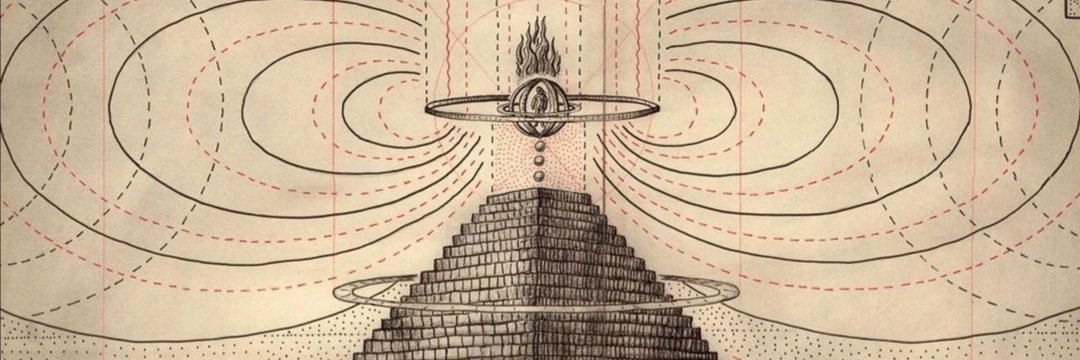
Groundbreaking research suggests consciousness may be a quantum phenomenon connecting the human mind to the fundamental fabric of the universe.
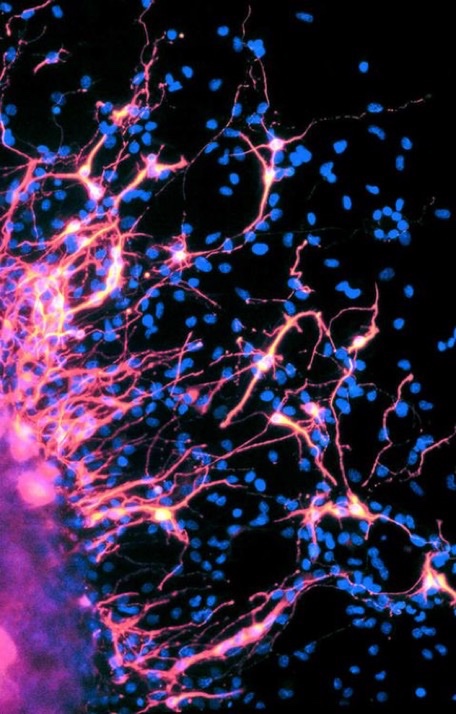
A team of researchers at Wellesley College recently uncovered evidence that could fundamentally change our understanding of how we experience reality. By studying rats under anesthesia, scientists discovered that tiny structural tubes inside brain cells, called microtubules, appear to be the gatekeepers of awareness. When these microscopic tubes were stabilized with specific drugs, the animals remained conscious significantly longer than those without treatment, suggesting that awareness is directly tied to the physical integrity of these cellular structures rather than just simple electrical signaling between neurons.
This discovery breathes new life into the Orchestrated Objective Reduction theory, which suggests that consciousness arises from quantum processes inside the brain. For decades, skeptics argued that the brain's warm environment was too hostile for delicate quantum states to survive, yet this research hints that our minds might actually function like quantum computers. If awareness truly emerges from these deep physical layers, it would mean the human experience is inextricably linked to the fundamental laws of the universe, potentially bridging the final gap between biological neuroscience and quantum physics.
source: Wagh, M. (2026, February 17). Your Consciousness Can Connect With the Whole Universe, Groundbreaking Research Suggests. Popular Mechanics.
Nvidia’s next marquee product — the Kyber rack-scale architecture designed to house its 2027 Rubin Ultra chips — has been delayed by more than 12 months to 2028, according to research firm SemiAnalysis, the latest in a string of reported setbacks raising questions about the AI giant’s product roadmap.
Click here to read more: https://t.co/Ivv5Fri14v
I'll never forget how many people didn't understand what I was doing with this proof of concept, and cried that it was impossible for a robot quadruped to handle recoil, and stay on target. Look where we are today. @Ghost_Robotics vision 60 on the range! https://t.co/yiUjnhdpWl
Neurologie sagt, dass Bewusstsein möglicherweise nicht von Neuronen stammt, sondern von einem verborgenen Hirnweg, auf dem Gedanken mit Lichtgeschwindigkeit wandern.
Ein chinesisches Unternehmen hat gerade einen Humanoiden Roboter für 17.600 Dollar auf den Markt gebracht, der verspricht, dich niemals zu verraten, dich bedingungslos zu lieben und lebenslang loyal zu bleiben.
A Chinese company just launched a $17,600 humanoid robot that promises to never betray you, love you unconditionally, and stay loyal for life. You can customize its face to look like anyone you want including a celebrity or a deceased loved one. Over 13,300 people have already pre-ordered one.
This is what happens when an entire generation grows up unable to build real relationships. We did not end up here by accident.
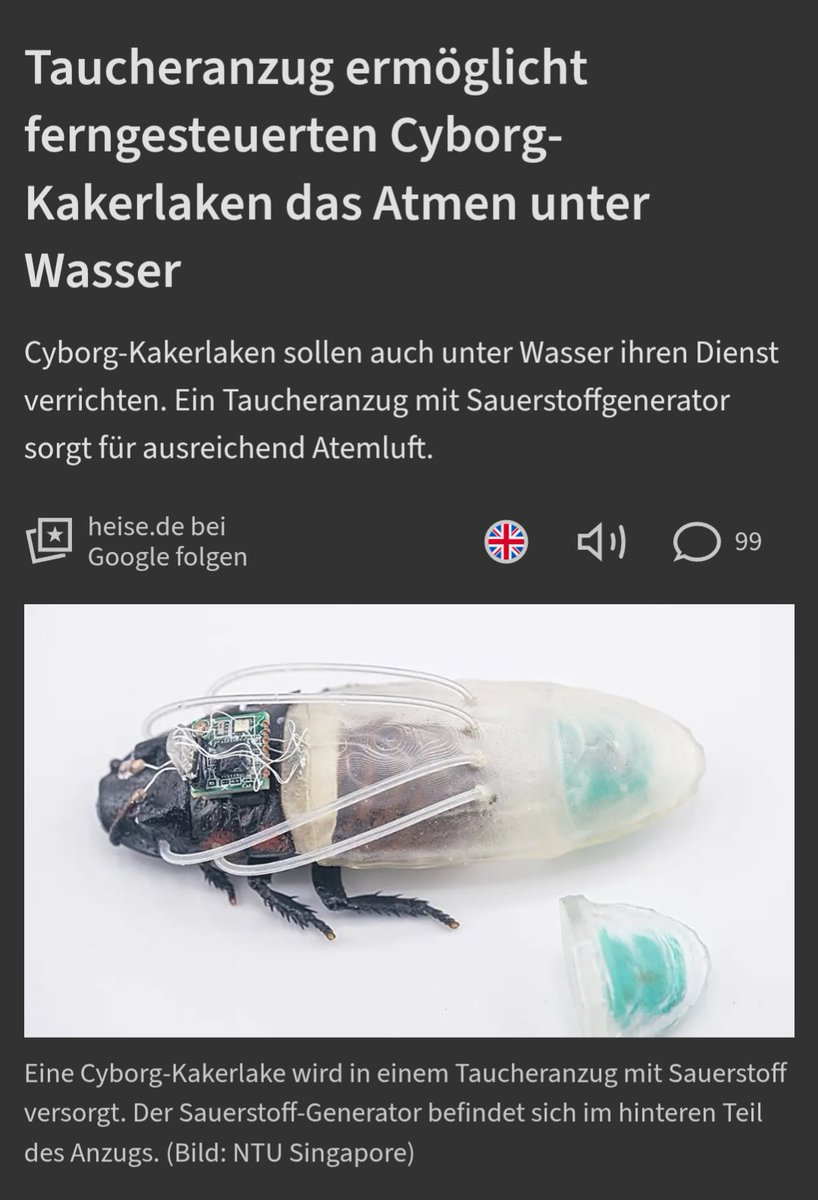
Der Insektentaucheranzug besteht im Wesentlichen aus drei Teilen: einem Sauerstoffgenerator, einer flexiblen Hülle sowie vier Silikonschläuche, über die die Sauerstoffzufuhr realisiert wird. Das System ist in sich geschlossen, sodass kein Wasser eintreten https://t.co/yZz8uzyBr7
Ex Machina is no longer sci-fi.
China has finally built it.
The company is AheadForm, founded in Shanghai.
The product is the world's most hyper-realistic robotic face.
Silicone skin you can't tell from human, 25 micro motors hidden underneath pulling the face into real expressions.
And RGB cameras embedded inside the pupils so when it looks at you, it actually sees you from where its eyes are.
They raised $28.5M to "give AI a head," which is also where the name comes from. AheadForm = a head form.
This is the opposite of where everyone else in robotics is focused.
Unitree, Figure, Tesla, Boston Dynamics: all about the body.
AheadForm chose the face because they think trust is the harder problem to solve, and trust gets decided at the face.
The reason nobody else has tried this is the "uncanny valley."
It's the creepy zone where a robot looks almost human but not quite, and looking at it just feels wrong even when you can't say why.
Most roboticists believed no amount of engineering could make a face realistic enough to escape it.
So they gave up and kept robots cartoonish on purpose: big anime eyes, exaggerated features, clearly synthetic.
But AheadForm decided to treat it as an engineering bug instead.
Add enough motors, tune the silicone, fix the timing, the valley closes.
And they're pulling it off.
A few crazy details about how this actually works:
1. The robot learns its own face in a mirror.
You put it in front of a camera, let it fire every motor randomly, and it watches what its face does and builds an internal map of "if I send command X to motor Y, my eyebrow does this."
Same exact process a human baby uses staring into a mirror. The robot teaches itself who it is by experimenting.
2. It predicts your smile 839 milliseconds before you smile.
By watching the micro-tells in your face that precede a smile, the robot starts smiling 0.8 seconds ahead, so its smile lands at the same moment yours does.
Most robot mimicry happens half a second late, which is exactly why it always feels artificial.
3. The pupils are the cameras.
When the robot makes eye contact, the gaze and the sensor are the same physical thing.
Most humanoid robots stick the camera on the forehead or chest, so they aren't actually looking at you when their eyes are pointed at you.
4. The founder, Yuhang Hu, did his PhD at Columbia under Hod Lipson.
Lipson is the guy who in 2006 built a four-legged robot that figured out it had four legs by experimenting with its own movement, nobody told it the body shape, it discovered it.
He has spent 25 years trying to build machines that know what they are.
AheadForm is that 25-year research arc productized.
5. NetEase Games already paid them to physically embody a fantasy video game character.
That opens up a brand-new category: robotics as the physical embodiment of fictional IP.
Every character-rich studio, Disney, Riot, Hoyoverse, Pokemon, Netflix, now has a question to answer about when their characters get bodies.
AheadForm believes whoever ships the first robot you'd actually want around your family wins.
That's the bet behind the most realistic robot face on earth.
[ 🇨🇳 CHINE ]
🔸 UBTech a présenté le 30 juin 2026 à Shenzhen l'U1, un humanoïde hyperréaliste décrit comme un « compagnon émotionnel » capable d'écouter et de dialoguer 24h/24, destiné notamment aux célibataires et aux plus de 60 ans, avec des prix allant de 119 800 à 990 000 yuans selon les versions.
🔸 L'U1 a une peau souple et une voix apaisante, une autonomie d'environ quatre heures, peut détecter fatigue ou stress, rappeler des médicaments et donner des conseils quotidiens, mais ne fait ni ménage ni tâches domestiques et n'est pas conçu pour des relations intimes « pour l'instant » selon UBTech.
🔸 Le robot a déjà recueilli plus de 13 300 précommandes et les livraisons devraient commencer le 16 septembre, d'après UBTech cité par l'AFP.
Shanghai-based iSAGE is teasing what it calls the world’s first “spatial heterogenous” six-armed humanoid robot.
The Hexa-Arm Robot is designed for crowded factory workstations where several tasks must be completed quickly and precisely. Each of its arms can reportedly operate in its own area on different jobs.
The system has 120 moving joints, force control on every arm, and advanced cameras for assembly tasks.