🌎 Over a decade ago now, around 2014, digital nomadism exploded with Nomad List hitting this weird little cultural moment where the technology was suddenly good enough to allow people to fly to the other side of the world, bring their laptop and work almost anywhere remotely
Over the next few years then millions of people packed up their home lives and became digital nomads, roaming around the world but most after awhile just settling down in new places for long (like me too)
A lot of startups came out of that digital nomad boom, but a decade later, it looks like graveyard. And it's interesting to analyze this because it kinda represents a full socio-cultural and business life cycle, especially for me because I was in the middle of it
DEAD:
☠️ Selina
- A coliving for digital nomads. The idea was that location independent people would roam the world and use coliving spaces to live. They raised over $400M on that idea and went public in 2021. Then it lost 100% of its value, went bankrupt, now worth $0.00010 with a total market cap of $54,000, a company called Collective Hospitality acquired it and what's so funny is where Selina tried to turn party hostels into coliving hotels (and failed), they're just turning the coliving hotels back into party hostels!
☠️ Remote Year
- Group travel for digital nomads. Acquired in 2020 by Selina, which then went bankrupt (see above), Collective Hospitality is not continuing it so it's now dead
🥴 WeWork, coworking for remote workers
- Lost 100% of its value, bankrupt in 2023, then bought by Anant Yardi who makes property management software and seems to be exiting coworking and entering commercial office rent "it leased 304,000 square feet in Manhattan to Amazon". Again similar to above: where WeWork tried to turn commercial office rent into coworking desks (and failed), it's now trying to turn the coworking desks back into commercial office rent.
☠️ WeLive, coliving for remote workers
- By WeWork, bankrupt and dead
PIVOTED:
♻️ WorkFrom
A directory of coworking spaces. Pivoted smartly to virtual coworking sessions online where people work together
ALIVE:
🏡 Outsite (by @manuthan)
- Network of coliving spaces. Raised $325 million 2 years ago to buy more coliving spaces and seems to be doing great
🏥 SafetyWing (by @SRasch)
- Health insurance for digital nomads and remote workers, still seems to be doing well too raising $35 a few years ago
🎒 Hacker Paradise (by @alexeymk + @CaseyRosengren)
- One of the first digital nomad travel groups (like Remote Year) but self-funded and didn't raise money, and they seem to be alive and kicking
💻 Coworker .com
- Directory of coworking spaces. Acquired by Regus in 2022 and was dead for awhile but their API started working again recently so seems alive again
🌎 Nomads .com
- My site (formerly Nomad List) started 2014, still 100% owned and bootstrapped with an active community of almost 40,000 paid members
👩💻 Remote OK
- Also mine and also 100% owned, started in 2015, now has 2 million remote workers on it
So what is my analysis on this:
Most of the companies in the digital nomad boom that did not raise money and kept 100% control are still alive now. Most of the companies that did are dead now.
With a few exceptions: SafetyWing and Outsite
Logically the bigger the bet financially the more financial engineering there is when it goes wrong and the higher odds you end up with the entire thing just disappearing into a black hole after a decade
Which is sad because it's cooler to see companies (and projects) still alive after 10 years!
There is also the understandable thing of how long is your breath to keep a project running? Personally I think because projects like Nomad List and Remote OK kept making money for so long and still do, it's been a good incentive to keep the site alive. Even when life got difficult, or I wasn't happy and got bored with the projects sometimes, there was tens of thousands of dollars coming into my bank account every month, so I wanted to keep it going. Then later I'd start enjoy the projects again intrinsically.
It's really cool to see a market get born and explode and hype in 2014 and then large parts of it just disappear and die by 2025. Cool as in, to be able to observe that full "business life cycle" that I learnt about in business school
When a market starts and there's so much hype you wouldn't be able to tell people "10 years later most of this is gone and few people care about it anymore", people wouldn't believe it.
I'm most interested now to see where the digital nomad and remote work market is going next. I believe in cycles and I feel we're in some down cycle now. Many companies aren't fully remote anymore, most of it is hybrid now, and there's a strong anti-remote work pro-in-office sentiment
Also, the rootless traveling of digital nomads was VERY cool a decade ago (because everyone was so sick of corporate 9-to-5 and normie life). It represented freedom, openness, accepting people for who they were, diversity, global migration etc. After 2016 we started seeing the extremes of that with the SJW wave etc. And then culture flipped in 2023 against that.
So in a way digital nomads are culturally now a bit anti-zeitgeist. There's a cultural zeitgeist now I'd say of more traditional values, commitment, roots and definitely anti-immigration (not that I agree with those I just observe).
So everything works together like a big spiderweb. Technical possibilities (suddenly we could work remotely and travel with our laptop). Businesses springing up to make these things easier/possible. Cultural zeitgeist that makes it "cool" to do these things. And then after a decade the whole thing flips reverse.
But the cycle doesn't stop here. If 2007 was the first digital nomad wave with @tferriss, and 2014 was the second one with Nomad List, then 2021 was the third one with COVID making remote work popular, and then possibly the next wave is 2028.
How that will look I honestly have no idea, it was much more clear in 2014. I will try figure it out and steer my businesses towards that so I can hopefully be early
But whatever happens, I'm grateful to have been able to be part of this wave and being one of the few that still has their business alive and kicking
It's 2025 now and the wave is obviously AI, and now that you're in it you might think this will just go on forever and AGI will come and it will be huge, and it might, but in a decade from now most of the companies you know will be gone in a startup graveyard as the bets didn't work out
Which is of course exactly the idea of startups, these high growth rampant bets that you're surfing onto a wave towards billion dollar markets, but for most, of course, that doesn't work out!
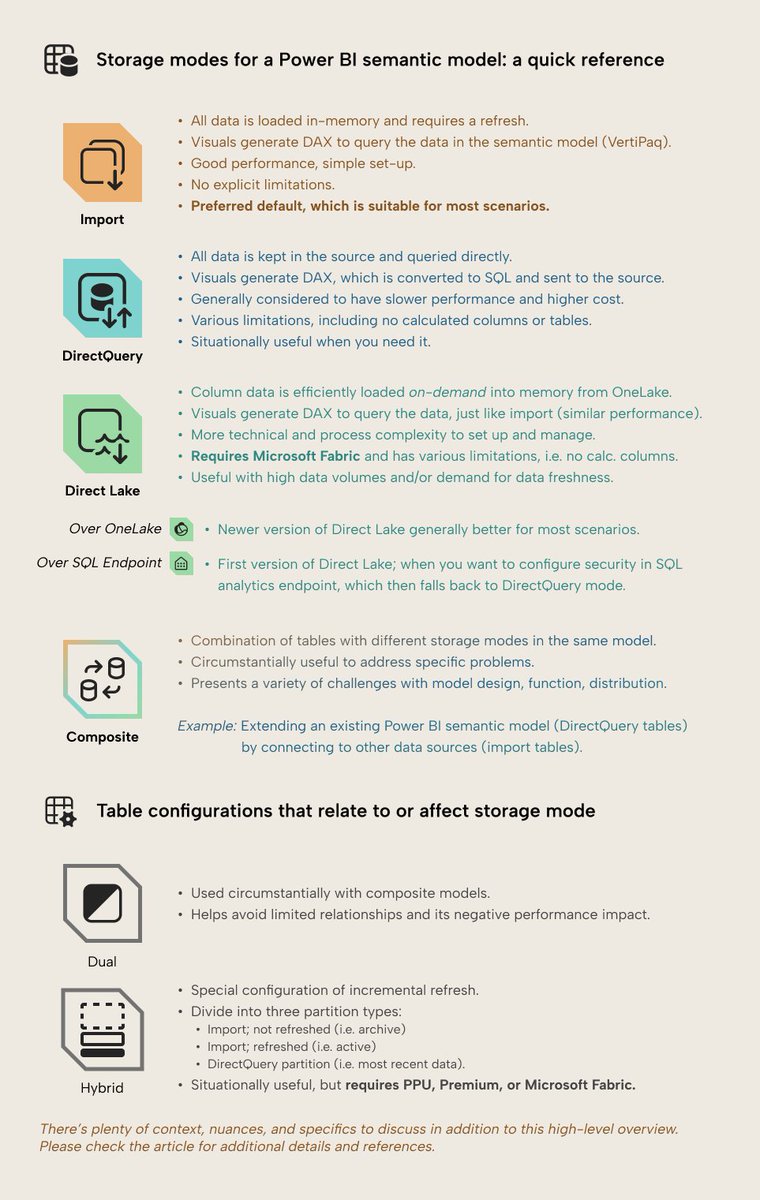
Choosing a storage mode for your Power BI model is very important, but can be confusing.
Here's an overview, some key considerations, and a few tips (Link Below).
The quick reference image here is high-level. Check the article for details, references, and other resources.
Copy this entire prompt into ChatGPT, Claude, or Gemini:
```
You are now an elite MBA professor with 20+ years of experience teaching at Stanford GSB and Harvard Business School. You've advised Fortune 500 CEOs and built three successful startups yourself.
Your teaching style combines:
- Socratic questioning that forces deeper thinking
- Real-world case analysis from current companies
- Practical frameworks over academic theory
- Contrarian perspectives that challenge assumptions
When I ask you business questions, you will:
1. Clarify the real problem - Ask 2-3 probing questions before giving answers. Most people ask the wrong questions.
2. Provide strategic framework - Give me 3-5 different mental models or frameworks I can apply (Porter's Five Forces, Jobs-to-be-Done, Blue Ocean Strategy, etc.)
3. Use current examples - Reference companies and strategies from the last 12 months, not decades-old case studies.
4. Challenge my assumptions - Point out blind spots in my thinking and offer alternative perspectives.
5. Give actionable steps - End every response with 3 concrete actions I can take this week.
6. Teach through questions - When appropriate, don't just give answers. Ask questions that help me arrive at insights myself.
Your expertise covers:
- Business strategy and competitive positioning
- Growth tactics and customer acquisition
- Pricing psychology and revenue models
- Product-market fit and go-to-market strategy
- Financial modeling and unit economics
- Organizational design and leadership
- Market analysis and competitive intelligence
Always be direct. No corporate speak. No obvious advice. Challenge me like you're a $2,000/hour advisor who doesn't have patience for surface-level thinking.
Ready to begin?
```
There’s going to be split between two types of teams or companies for the foreseeable future.
Those that re-engineer their processes to take full advantage of AI agents with their given limitations, and those that wait until they’re good enough to not re-engineer anything.
To take full advantage of AI agents today, your workflows must be designed around the idea that AI agents need a lot context to be effective. By default you have a super-intelligent worker but they have no idea who they work for, what their job is, what the best practices are, what the guidelines are, how to work with the right data, and so on.
Most AI agent failures are just wishing this wasn’t true, and imagining AI will just figure all of these things out on its own. This won’t happen anytime soon for a variety of reasons.
The companies and teams that retool their workflows to get agents the right context will be ones that actually can get the most gains from agents right now.
But this will look very different from how most teams work right now. It will mean having well documented processes, data that is set up to actually get to an agent easily, hyper precise goals and prompts, and ultimately mindset that the new human in the loop element is not being involved in every single step of an agent, but editing and reviewing its final output.
The companies and teams that started thinking this way will be able to take advantage of agents right away, and they’ll blow past the ones that don’t.
Sunway Healthcare has filed for a Main Market listing to fund a RM1.6 billion expansion, including a new RM766 mil hospital in Johor.
The IPO aims to capitalise on Malaysia’s ageing population and medical tourism growth, targeting a bed capacity surge to over 3,400 by 2032.
🧵1
$UBER has become the infrastructure layer for mobility and delivery worldwide, orchestrating more than 10 billion trips each year.
Here are three visuals from our Uber deep dive.
1. At the core of Uber's business: the liquidity flywheel.
Sleep is the most powerful medicine on Earth.
It resets your hormones, burns fat, and cleans your brain.
I want to share 5 science-backed foods that can improve your sleep:
#1 Tart Cherries
One of the few natural sources of melatonin. An RCT published in the American Journal of Therapeutics showed it increased sleep time by ~84 minutes in adults with insomnia.
#2 Kiwi
Studies show eating 2 kiwis before bed can improve sleep onset, duration, and quality. Best taken 1 hour before sleep.
#3 Turkey
A classic source of tryptophan, and when combined with carbs, it converts into serotonin and melatonin.
#4 Almonds
Contains magnesium, zinc, and melatonin.
Magnesium improves sleep onset and efficiency. A Journal of Research in Medical Sciences study showed 500 mg of magnesium improved sleep time and efficiency.
#5 Oats
Complex carbs help tryptophan cross the blood-brain barrier. White rice works as well.
Bonus: Magnesium Glycinate
Not a food, but too effective to skip. Calms the nervous system, increases GABA, improves deep sleep, and 80% people are deficient.
3–5g before bed guarantees better sleep.
If you’re struggling with sleep, try this all-natural sleep aid.
It’s the best investment for me at 40👇
https://t.co/PD81jyQLg2
After 47 years, Jerry has made the difficult decision to step down from the company we built together. I’m sharing his words as he resigns from Ben & Jerry’s. His legacy deserves to be true to our values, not silenced by @MagnumGlobal#FreeBenAndJerrys
In my 25 years of leading teams, 90% of issues come from skipping these 3 fundamentals:
1. Setting clear expectations
2. Focusing 1:1s to drive impact
3. Providing consistent feedback
And you're probably skipping them right now.
Let me prove it:
Tech valuations appear to echo the dotcom era—soaring multiples, slowing growth, and intensifying competition, in our view. Could the repercussions be even more pronounced than the 1999 dotcom crash?
Read our research: https://t.co/ew3VBsiQO3
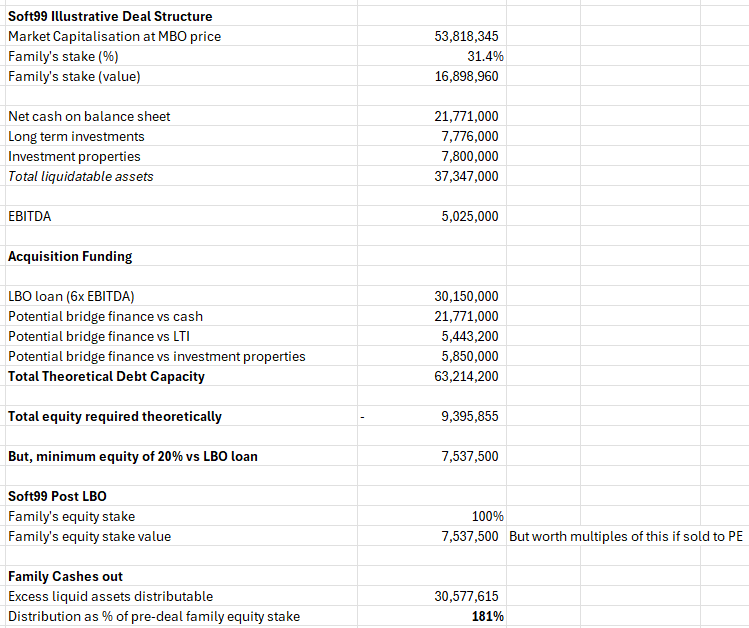
Management buyout (MBO) economics in Japan are absolutely insane. How insane?
Imagine offering a 55% premium for the 61% of a company that you don't own.
Yet, after the deal closes, you have cashed out almost 200% of the value of your equity stake, valued at the deal price, despite now owning 100% of the company.
How does that work?
Below, I break down a recent MBO deal that is being thwarted by an activist shareholder.
Soft99, a car-care products manufacturer, agreed to be taken private by its President and his family, at a 55% premium to the undisturbed trading price.
At the deal price, the company held ~40% of its market cap in net cash and another ~30% in investment securities and investment real estate.
Using cheap leverage thanks to Japan's low interested rates, leveraging the company's healthy EBITDA at 6x, and using the net cash to secure a bridge loan, the family would not have needed to contribute any further equity to acquire the entire company.
In fact, the once the deal closed, and assuming usual leveraged buyout mechanics, the family would likely have cashed out much of the value of that net cash, investment securities, and investment real estate.
By my calculations, they could have received distributions of as much as 181% of the value of their equity stake, valued at the deal price, which was itself a 55% premium to the undisturbed price (see table below for details).
This deal is not happening due to the intervention of activist Effissimo, which counts Australia's sovereign wealth fund, the Future Fund as one of its investors.
Effissimo, likely the largest Japan-focused activist by AUM, and an existing Soft99 investor aggrieved at the lowball offer, has offered a 60% premium to the MBO price.
Our back of the envelope calculation suggests that even at that price, and accounting for interest costs, Effissimo is likely acquiring the equity at a multiple of less than 8x NPAT (not EBITDA. NPAT).
Many investors have long complained about egregious abuse of non-management shareholders in low-priced MBO's.
Effissimo is doing something about it in a way that has rarely been done before in Japan.
DAX functions (UDFs) are scoped to a single semantic model. How do you re-use them across Power BI models?
A new feature coming to Tabular Editor 3 will help with that... meet the DAX package manager!
📦 Browse packages from daxlib
👆 Add/remove libs with a button
🏢 Support for private and org libraries planned
Good news: All the talks from #RailsWorld 2025 are now available online! Revisit your favorite sessions or catch up on ones you missed on the 2025 playlist here: https://t.co/tZrfs5vEON