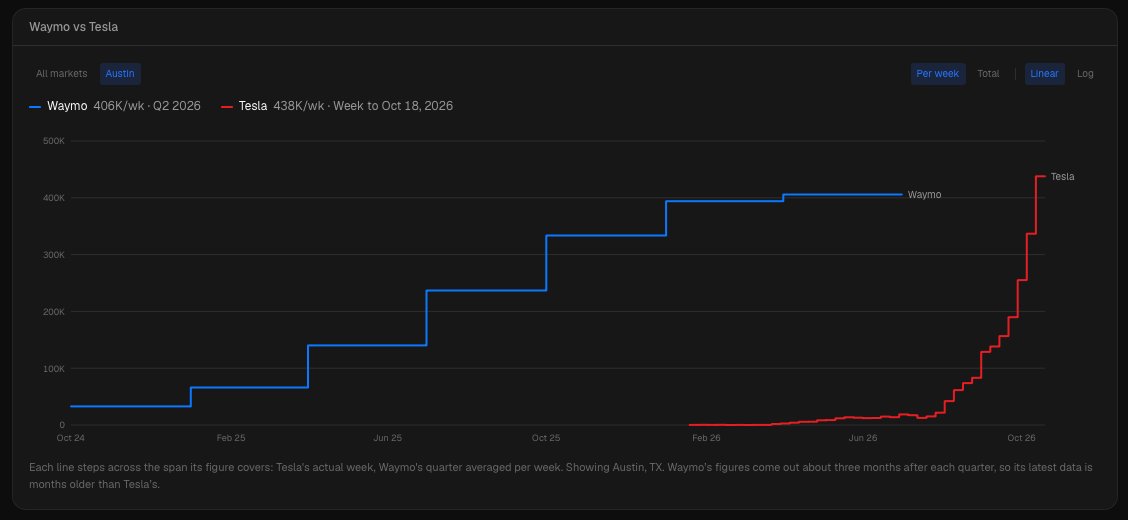
Tesla may have surpassed Waymo in Austin, TX, but the milestone isn't clear-cut 🧐
✏️ Waymo's weekly mileage is taken from Waymo’s Safety Impact hub, which lags by about a quarter
✏️ Waymo's weekly mileage growth seems to be getting flatter in Austin: ~333K/wk (Q4 ‘25) ➡️ ~393K (Q1 ‘26) ➡️ ~406K (Q2 ‘26)
✏️ Tesla is climbing as nearly ~30% growth per week
Conservatively, Tesla's Robotaxi miles can be 1.5x of Waymo's by December with linear growth; ~6-8x that of Waymo's flattening growth at Tesla's current pace 📈
We will see if Waymo's flattened growth continues and Teslas ~30% growth continues, but it's safe to say the battle is won in Austin 🤠
Chart from @RtaxiTracker
What a day for $TSLA! Here's what happened:
1. Robotaxi expanded 916% from ~25 sqm to 254 sqm in ONE day! This covers over 1 million people as it outpaces Waymo!
2. Cybercabs FLOOD Austin as Tesla adds 112 NEW vehicles under 48 hours!
3. FSD approved in Latvia marking the 10th EU country that approved the software!
4. Turo and Tesla have launched the first verified Tesla FSD (Supervised) rental experience in the US from 28 October, letting guests book API-verified FSD Teslas while hosts get free trials.
5. Barclays increases $TSLA PT to $470 from $370 due to a high likely of a merger with $SPCX and strong catalysts ahead included FSD & Robotaxi expansion, energy growth and record auto deliveries.
WHAT A DAY!
JUST IN: Tesla Robotaxi now covers more territory than Waymo in Austin, Houston, & Dallas, with its combined Texas service area nearly doubling Waymo's.
BREAKING: Microsoft, $MSFT, is offering buyouts to 60,000 workers as part of the company’s efforts to cut costs amid AI adoption, per Bloomberg.
Personnel on select teams in the US, Canada, India, and the UK at a vice president level and below will be eligible.
This reflects ~27% of Microsoft's total workforce.
If you've ever wondered why smart TVs are so cheap, this is why.
@log4j rooted his Samsung and found an always-on hot mic, automatic content recognition, geolocation, network mapping, ad targeting and user profiling, shared with Samsung's "400 partners".
A lot of it can be blocked in <15 min, wrote a basic guide below.
What your TV is doing
The main culprit is ACR (automatic content recognition). Your TV screenshots what's on screen, fingerprints it, and sends it home to build your ad profile. Samsung does it every 500ms, LG every 10ms [1].
What is insane: it happens on connected devices too.
Plug in your laptop, your console, your work machine, and your TV can fingerprint that via HDMI [1].
He also found that if your Samsung doesn't have a mic, it'll look for one from a connected soundbar or bluetooth device.
https://t.co/vNdTnIQ6KF
It's on by default, and you likely agreed to it on the setup screen you clicked through in 10 seconds.
Step 1: Turn off ACR
Samsung: Terms & Privacy → Viewing Information Services
LG: Live Plus
Vizio: Viewing Data
Roku: "Use info from TV inputs"
Sony/Google TV: Samba Interactive TV
Menus vary by model, but those are the names to look for. While you're in there, opt out of interest-based ads, reset your advertising ID, decline every optional privacy agreement, turn off voice recognition, and delete apps you never open.
Step 2: Give smart devices their own network
Put the TV, cameras, speakers and vacuum on your router's guest/IoT network. The logic is simple: these devices rarely get patched. If one gets compromised (getting drastically more frequent with AI), it shouldn't be able to see your other devices or home network.
Step 3: Block trackers for the whole house with DNS-level filtering
NextDNS (cloud-based) is easy and has a solid free plan. Pi-hole is a little bit more work if you prefer self hosting. For simplicity we'll focus on the former.
1. Sign up at https://t.co/IwhafVWVM8 (free tier is plenty)
2. Privacy tab: add a blocklist (OISD is a good bet) and turn on Native Tracking Protection for Samsung, LG, Roku, Amazon (see attached image)
3. Setup tab: copy your endpoint
4. Paste it into your router's DNS settings as DNS-over-HTTPS/TLS (or use the IPs + "Link IP" if your router only does plain DNS)
5. Bonus: block outbound port 53 except to your router. Some devices hardcode their own DNS to get around you
Then open the NextDNS logs and watch how often your TV phones home. It's eye-opening. If an app or update breaks, find the domain in the logs and allowlist it.
Why they do this
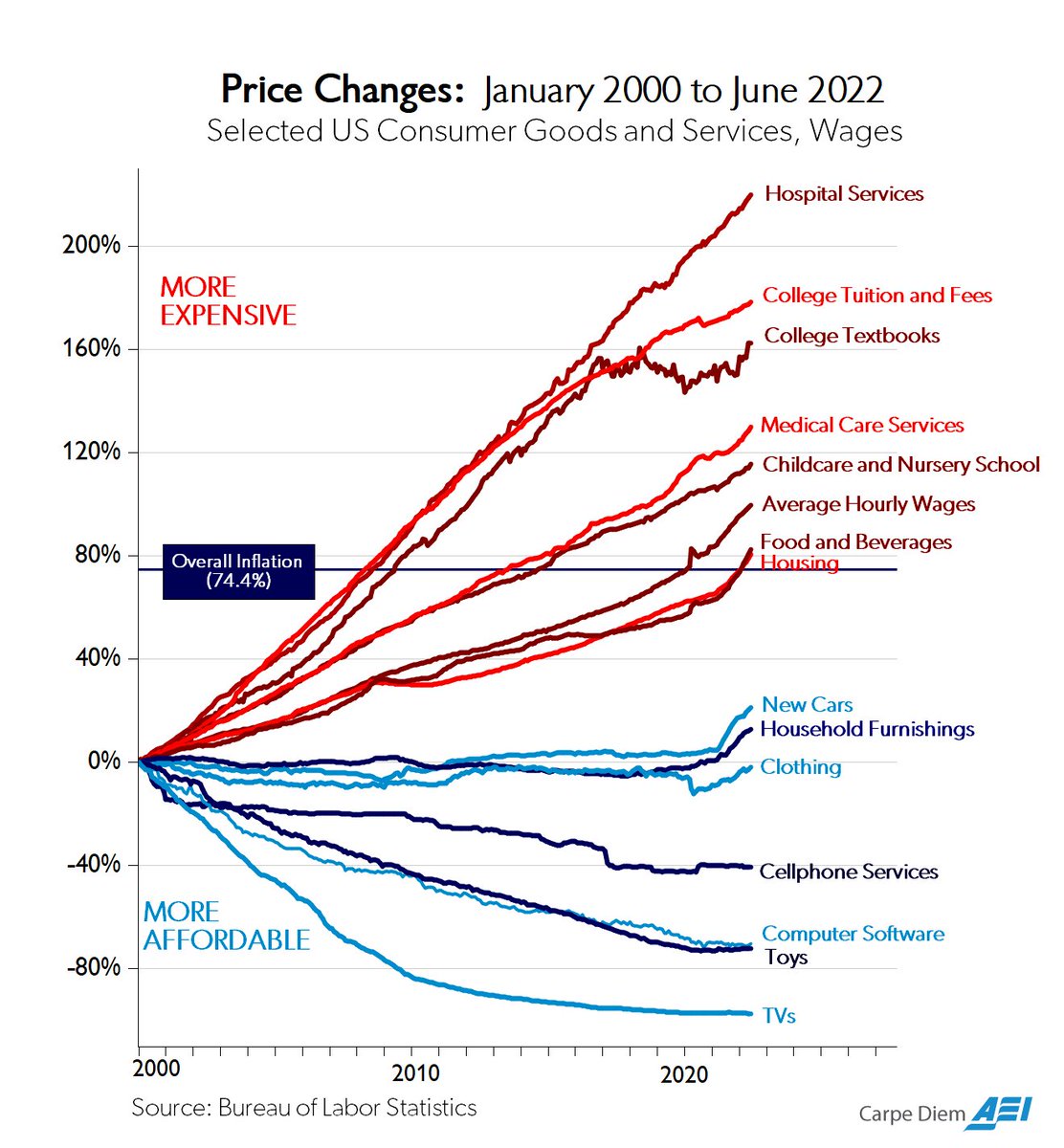
TV prices are down 97% since 2000 [2]. Most of that is better manufacturing and brutal competition. But once margins on the hardware hit zero, the cost moved to you.
In Q3 2024, Vizio lost $6.7M selling TVs and made $115.8M in gross profit from ads and viewing data [3]. They've said on earnings calls that they keep TV prices low to grow the audience they sell to advertisers. Walmart bought them in 2024.
This isn't a conspiracy theory either. Vizio paid $2.2M to the FTC in 2017 for tracking 11 million TVs without consent. Last December, Texas sued Samsung, LG, Sony, Hisense and TCL over ACR. Samsung and LG have since agreed to stop collecting that data without explicit consent [4].
TL;DR
1. ACR off
2. Ads + voice off
3. Smart devices on their own network
4. NextDNS filtering on the router
Sources:
[1] ACR study: https://t.co/S1IS8lXNbA
[2] Cost of US consumer goods: https://t.co/nclXELXcbd
[3] Vizio Q3 2024: https://t.co/CrVbwc9ZXk
[4] Texas v. Samsung: https://t.co/wFOUdeh1if
Samsung TVs look for microphones in your house via Bluetooth and then spy events like dogs barking or babies crying. They also spy what you do on YouTube and other apps.
Thanks abliterated DeepSeek.