Five years after starting @intros_ai, I’m thrilled to announce that we’ve been acquired by @BevyHQ.
We’re joining forces to push the boundaries of how AI connects, personalizes, and engages communities.
Nikhil’s always been one of the most thoughtful, kind people.
And he’s been thinking about Voice for as long as I can remember! Excited for you and your team Nikhil
Today, @vapi_ai is announcing a $50M Series B, led by @peakxvpartners. $72M total raised.
This funding round is a reality because of the engineering behind it: predictable latency, hard guardrails, observability at the call level, and clean escalation to humans.
Introducing Altara: the scientific intelligence platform for the physical world.
Today @evatuecke and I are excited to announce our $7M seed led by @GreylockVC, joined by @Neo, @BoxGroup, @Liquid2V, and angel investors including @JeffDean and leadership from OpenAI & AMD.
We’re already working with early customers in semiconductors, batteries, and advanced materials. More below.
@FarzaTV tried to build this recently with https://t.co/d98ItZs2Ig - couldn’t figure out so made it turn look videos into claude skills you could share
excited to give clicky a try
Excited to share a weekend side project called Second Mouse.
Second Mouse turns Loom videos into Claude Skills. Just drop a Loom link, and it will create a Claude Skill that shows you how to do what was in the Loom.
We’ve all seen Loom videos or screen recordings to learn something new. Usually we bring up the screen recording on one side of the screen, and try to follow along on the other side.
A second mouse that guides you through learning a new skill (more like a walkthrough or product tutorial) is much simpler.
If we want humanity to make faster progress, we need to make it easier to learn skills. Instead of looking for AI to replace people, we should look for ways AI can preserve and distribute what people know.
There’s a lot of ways knowledge transfer is changing. My favorite way knowledge moves is through communities (like those that run on @BevyHQ). In a fast-moving world, we need to encode what we know so it can make knowledge more accessible.
Let me know if you want to try out Second Mouse.
Note - this is just a fun weekend side project (so apologies if slow to reply) and you also need to have Claude browser extension (~$20 / month) to get the full experience. Check out my quick demo in comments if curious!
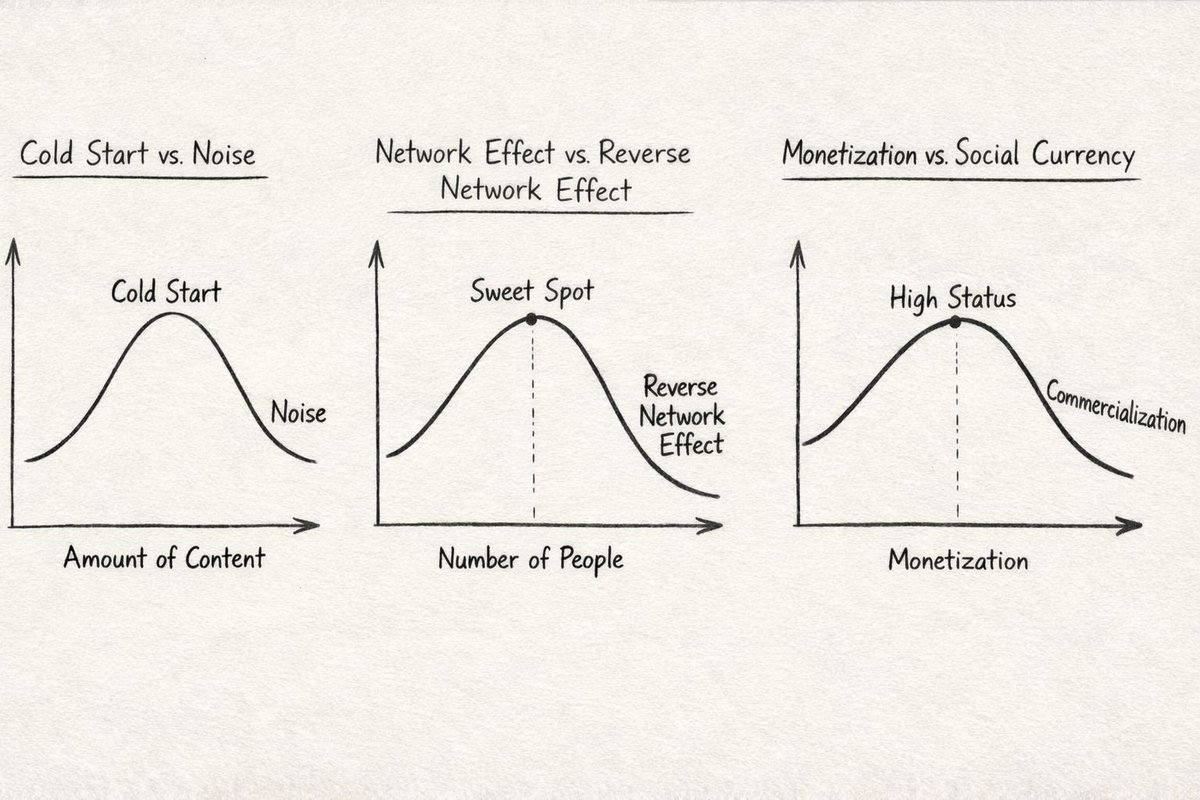
After 8 years building different types of communities, I’ve seen 3 “paradoxes” that every community runs into.
The first is the “Cold Start, Noise” paradox. The second is the “Network Effect, Reverse Network Effect”. And finally there’s “Monetization, Social Currency”.
I’ve seen variations of these concepts discussed across research, but haven’t seen them put together before.
Cold Start, Noise: The idea of a cold start was popularized by Reddit. The founders would pretend to be a bunch of different people in the forum, just to spark discussions. The issue is, once you solve the cold start problem, you immediately need to think about the noise problem - how to curate the content in a meaningful way.
Network Effect, Reverse Network Effect: Instead of focusing on content, this paradox relates to the people within a community. The more people in a community, the more value it holds. Although at some point, the bar for “who should be in this community” lowers, at which point the value of the network actually decreases. Every community has a sweet spot. One reason I started my last company was to help communities avoid reverse network effects, to keep high-value connection as their community scales.
Monetization, Social Currency: The more vetted the content and people are, the higher the social capital is associated with that group (ie. it’s seen as higher “status” to be an active member). The issue is, community builders are incentivized to grow the community - more budget, funding etc. So there’s this tension where on one side, members want a more trusted, intimate space. On the other, community organizers want scale.
By calling out some of the core scaling issues, my hope is that those building communities realize that every community faces these problems. Creating cohorts, segments, and more personalized experiences are a few ways I've seen folks counter these issues.
Reach out if you're thinking about similar stuff!
When the cost of code goes to zero, marketing is your only advantage.
Introducing Flint. It builds you a unique page for every ad, keyword, and customer.
We’re already doubling conversions for @Cognition and @Graphite. Sign up at @tryflint.
Speaking to a group of college students next week. Felt like a good excuse to experiment with Replit’s animation tool (released Friday) to visualize how professional growth trajectories differ across professions.
Start to finish, this took around an hour: roughly 20 minutes to write the concept out, 10 minutes to get a good first pass for the animation, and then 30 minutes of light editing and building a simple video scrubber.
Here’s the concept I wrote up, as well as the finished video!
Most professional growth happens on an S curve.
The reason growth is shaped like this is because there’s learning and understanding (university) followed by some upwards trajectory, and then your growth plateaus.
The S-curve differs for each profession or job.
The job in service work has a couple week ramp up time, followed by consistent, slow growth. The job of an investment banker has a much longer on ramp with education and technical knowledge, but faster upward trajectory and a higher ceiling. The job of a founder is slow initial growth, with potential to have rapid growth.
Another factor is risk of course - investment banking may not perform well enough and you need to start over and most companies fail.
The largest mistake I’ll see young people make here, and I was one of these people, is that they want to start the upward slope as early as possible, and they find themselves on the wrong graph.
Between ages 18-25 you have a chance to really define which graph you’re on.
Are you willing and able to delay the start of your upward trajectory so that in 5 or 10 years from now you’ll be at a higher place on your s-curve?
Or, do you want the easy fast win, but find yourself on the wrong graph?
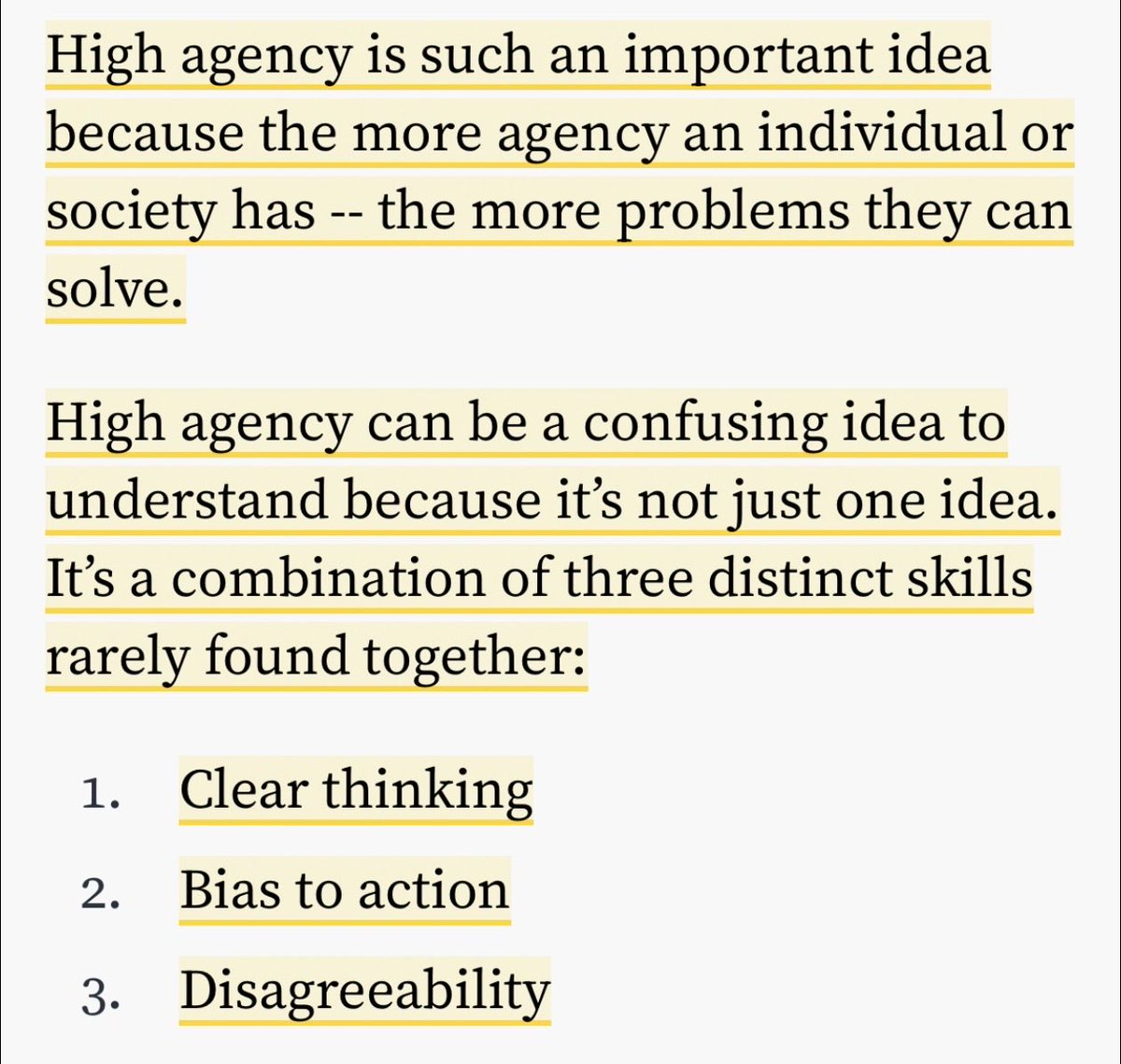
It’s hard to have agency if you don’t think of yourself as important.
If you believe you matter, then your actions carry weight. If your actions carry weight, you’re more likely to take them seriously.
There’s a cold start problem here. In the beginning, there’s often no visible proof that what you do matters. So you need a surplus of self-importance at the start, just enough to believe that your choices matter even if no one sees them yet.
@bencasnocha Ah got it. Well said, yeah I could see how those three are already over simplifying.
Self belief isn't something I really thought of as an essential part of agency before, but guess that sorta proves your point...
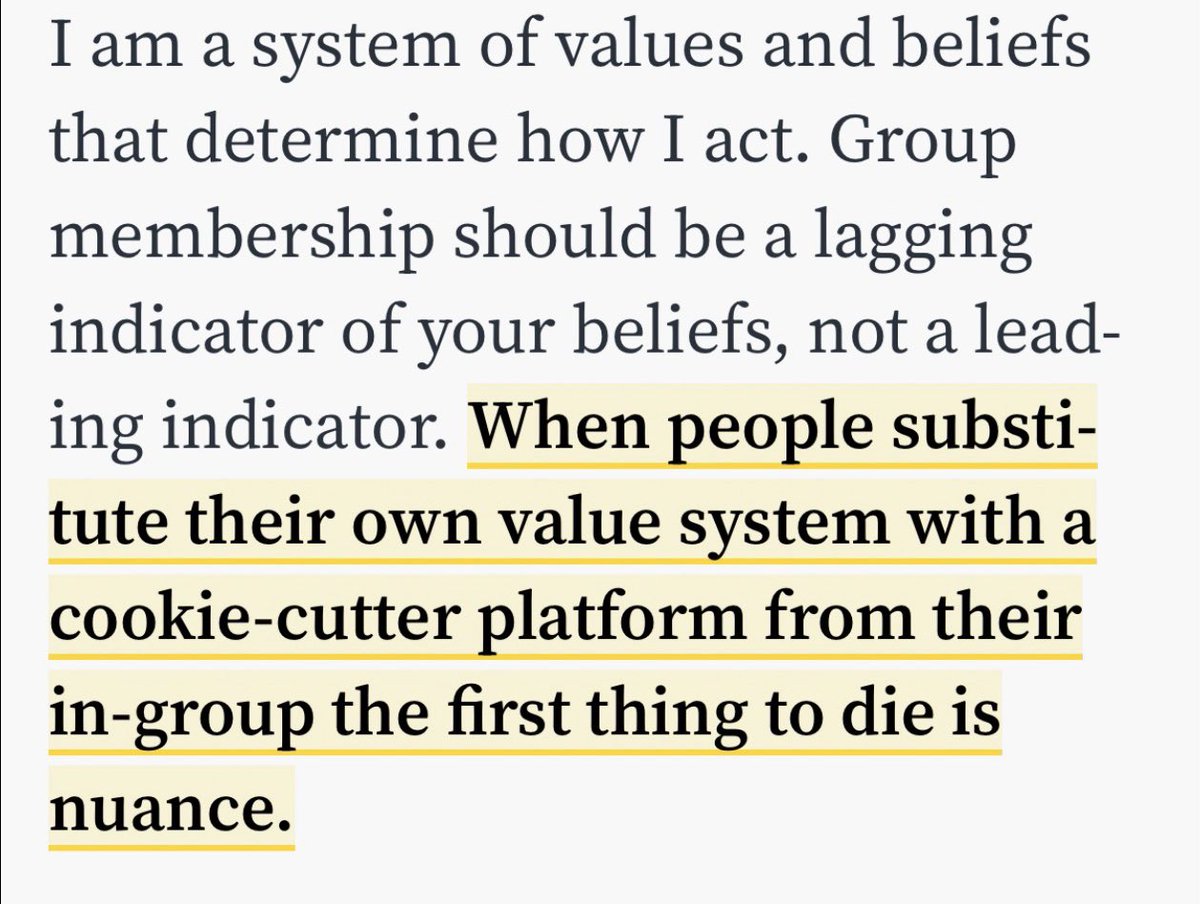
Best articulation I’ve seen why it’s important to choose your beliefs first, and groups second (not the other way around).
When group identity leads, nuance dies.
@kwharrison13