1. Intro
Vitalik recently wrote about where the EF should go; Aya added a note to explain how we got here, and why. I’ll write about the execution.
We now have enough clarity to stop treating “what is the EF for?” as an open-ended question. Our mandate is clear: The EF exists to ensure Ethereum is, becomes, and remains real permissionless infrastructure for self-sovereignty: censorship (and capture) resistant, free and open source, private, and secure; and capable of supporting sovereignty-preserving coordination at scales where trusted institutions hitherto have been unavoidable.
The following are my thoughts on some of the points that follow from the mandate and how we are translating it to action. But first, a short reminder about
2. What the EF is not for
We are not here to optimize for EF importance, corpo/pol appeal, or ecosystem popularity. We are also not here to please short-term speculators, prop up TBTF neo-SIFIs, market every app on Ethereum, help anyone look good to their crypto or investor friends, or provide on-demand entertainment for dinner parties and private retreats.
3. What the EF is for: Eliminating weaknesses
We are here to defensively strengthen places where Ethereum is, or can still become, extractive, totalizing, or vulnerable to cartel or state capture, or authoritarian tools of surveillance or coercion.
We will base our actions on a full examination of what Ethereum is and can be at the protocol layer (what is actually running as “Ethereum”), the access layer (what users use to interact with the protocol), the user layer (the end-users who need and will need Ethereum), and the institutional layer (the intermediated paths that scale self-sovereign usage).
The EF exists to harden every surface of Ethereum, including those where Ethereum can remain formally permissionless while becoming practically captured. Some obvious surfaces are the transaction pipeline, staking and network security, access layer standards and interfaces, self-sovereignty norms, privacy expectations, institutional adoption patterns, and social layer governance processes. The primary concerns are similar across most of them: does the status quo and its future trajectory minimize trusted dependencies, minimize points of leverage and capture vectors, make user privacy the default, preserve exit, and make trust assumptions legible?
The work starts with the EF itself. We are moving compensation and major financial relationships toward ETH and mandate-compliant Ethereum-native stables, with exceptions where positive law or unavoidable operational constraints require exceptions. Rather than a purity ritual or instruction for people to take unmanaged personal risk, it is robustness, alignment, and product pressure. If the EF’s work is to make Ethereum usable as infrastructure for self-sovereignty, everyone at the EF will increasingly live inside the constraints of the system the EF exists to improve: wallet UX, volatility, accounting, privacy gaps, payment friction, stablecoin trust assumptions, recovery, dependency risk, etc. If we can’t use these tools ourselves, it is unrealistic to expect others to. Ethereum is already mature; those who do not depend on the user-facing stack have no business trying to shape its future, at any layer.
The transaction pipeline is next. Preventing toxic MEV capture is core EF work, not a peripheral market-structure concern. Transaction supply, ordering, inclusion, block construction, propagation, and settlement are part of Ethereum’s neutrality boundary. Some MEV may persist as an adversarial phenomenon the protocol contains, but it must be absolutely minimized and, for that to be possible, we must guard against the acquisition of unwarranted influence by its beneficiaries.
If credibly neutral execution is subverted by privileged orderflow, cartelized builders, trusted relays, opaque routing, or validators outsourcing into a narrow supply chain, Ethereum will look permissionless while users experience it as intermediated at the moment value moves. EF protocol work will therefore prioritize lower barriers to block building and validation, stronger inclusion guarantees, reduced extraction opacity, competitive transaction pipelines, user-facing legibility of trust assumptions, and more aggressively exploring the open orderflow solution space.
None of this is simple. A good solution in one place can aggravate problems elsewhere. FOCIL is good for censorship resistance, but it may introduce more cross-block MEV. While ePBS solves the relayer trust problem, we must make sure that its implementation does not inadvertently obstruct long-term solutions to even larger problems. It would be unacceptable, for example, if ePBS enshrining the builder economy ends up making it harder to reduce reliance on the private orderflow that has emptied out the public mempool. Encrypted mempools may not only reduce pre-execution transparency and pending orderflow visibility, but also shift competitive advantage to new privileged actors, including specialized hardware operators in some designs, while adding protocol complexity.
In order to avoid wasting time playing whack-a-mole, we must commit to solving the extraction problem at a whole system scale. Doing so will require creativity, courage, and the understanding that failure to solve this problem is unacceptable. If we fail, we will have left in place an unnecessary barrier to institutional adoption, but, more importantly, we will also have surrendered a core part of the promise of Ethereum - the replacement of extractive middlemen with permissionless, credibly neutral infrastructure and competitive markets. That must not happen.
MEV is likely to be the next major front in the cypherpunk war. We must set ourselves up to win here.
Privacy is just as fundamental. A public ledger without serious privacy defaults is a surveillance substrate with settlement guarantees. That is not an acceptable end state for the world computer. Unconditional privacy will be readily available across Ethereum, with programmability on top for selective disclosure, proofs, auditability, compliance logic, reputation, governance, identity, and other constraints chosen by users and their communities. The temporal order matters: unconditional privacy must exist first, opt-in constraints come second.
It is also important to avoid forcing users to assemble a fragile stack of special wallets, RPCs, bridges, apps, compliance providers, and operational habits to attain privacy. Deep privacy must be more secure than this. Privacy is a condition for Ethereum’s viability as freedom-respecting coordination infrastructure and as such must be robust.
Staking must be treated as protocol infrastructure risk. Staking is not merely a yield product, and liquid staking is not merely an app-layer market. If stake, liquidity, validator access, DeFi collateral, and governance influence concentrate around a small set of issuers or operators, Ethereum’s security layer becomes vulnerable to capture through capture of the economic layer around it. EF will support research, specifications, and designs that keep staking permissionless, private where possible, plural in operation, and resistant to intermediaries becoming permanent control points.
The access interfaces are where users access either the protocol directly or through intermediated defaults. The primary problem to solve here is not getting Ethereum into more rooms directly, but making its users, both end users and institutions, more self-sovereign and less susceptible to coercion, and avoiding normalization of soft coercion in exchange for reach. EF will not help Ethereum become more acceptable by sanding off the properties that make it uniquely valuable. Ethereum does not need to become another permissioned settlement backend with better branding. It needs to show, in production, that self-sovereign coordination at scale is possible.
Across Ethereum, the EF’s defensive work seeks to ensure that Ethereum is infrastructure people can still use when counterparties fail, platforms censor, governments overreach, intermediaries extract, and coordination problems become infeasible for trusted systems to handle. A core part of that is to make that infrastructure secure and robust against capture at every layer wherever capture opportunities can hide.
4. What the EF is also for: Seizing opportunities
Shoring up the fundamentals is not enough. Ethereum’s potential is still largely unrealized, but that does not mean that the path ahead is going to be straight. Opportunities must be seized when the time is right. At this moment in time, a number are visible, including:
* Ethereum becoming the first quantum-resistant global infrastructure. Ethereum researchers will lead the post-quantum cryptographic migration before the threat becomes urgent, not after it becomes a governance emergency. That means hardening Ethereum’s cryptographic foundations while there is still time to design carefully. The same applies to other long-horizon risks, where waiting for market demand means waiting until the window for principled design has already closed.
* Verifiably self-sovereign stack, from soup to nuts, whether local or remote, with no censorship or extraction openings: browsers, wallets, intents, broadcasts, orderflow, inclusion, block construction, proposal, proving, exit, and recovery. Minimal MEV, and zero toxic MEV entrenchment, either in or around the protocol. No execution layer that is formally permissionless but practically gatekept by privileged supply chains. If there’s a funnel towards an extractive private lane, there’s other options that keep the game live. The goal is not only to prevent extraction or capture, but to make credibly neutral execution competitive enough that serious users prefer it.
* Making ETH normal digital cash: a private, dignity-respecting, debasement-resistant and surveillance-resistant medium of exchange and store of value, as well as the native asset of private computation and private coordination for both humans and their agents. If Ethereum can make private economic life and private institutional life possible without routing users back through the friction and potential abuse of custodians, surveillance vendors, or permissioned ledgers with softer branding, as well as provide a venue for secure and competitive machine economics, the value unlocks will be immense.
* Personal wallets with personal AI agents that users can actually own and run on their own personal computers. Not your keys, not your coins; not your model, not your mind. As agents become interfaces for more economic and social action, the question of who owns the wallet, the model, the memory, the policy, and the signing authority becomes an existential question about sovereignty instead of UX details - we are all users above any other roles, and no one at EF will forget this.
* Institutional and enterprise use cases where Ethereum wins by not disappearing into an invisible backend, gatekept by intermediaries or terrible UX, and by not compromising into a compliant fintech rail with web3 branding. Rather, we will win through proving that credibly neutral infrastructure can handle disintermediated coordination so competitively that trusted intermediaries have to meet Ethereum users on Ethereum’s terms.
* Security-preserving scaling. L2s and related infrastructure will be able to meet institutional-level needs without accepting dependencies on closed operators, opaque sequencing, custodial UX, or upgrade committees that users cannot realistically exit. Scale is not throughput alone. Scale is the guaranteed availability of self-sovereignty under real load.
We are ensuring Ethereum remains the hardest bedrock for settlement, local and worldwide; and beyond that, a civilizational ledger and execution substrate to stand the test of time. When future civilizations speak of the infrastructure they inherited from the Antiquity of the Information Age, their first example should be Ethereum.
Ethereum will outlast all of us. More than enough people watching understand this. Many wondered why it needed saying at all, but it did. If you don't believe us or don't get it, we don't have time to try to convince you, sorry.
5. Addressing departures
There has been a lot of online speculation about departures from EF, both before and after the mandate. Some people resigned, others were terminated. Some departures were about strategy, some about role fit, some about normal institutional change, and some simply about people deciding that their best work for Ethereum should happen somewhere else. We will not litigate individual personnel matters on Twitter. That is the default because it is better for EF, better for the people involved, and better for Ethereum. People who contributed through EF deserve dignity on the way out. They do not deserve to have their employment history turned into factional content.
Where possible, we have let people describe their departures in their own words as a matter of courtesy, and not concession. If public claims materially mislead people about EF’s direction, decision-making, or mandate, we may correct the record at the level of policy, process, and institutional facts. We still will not turn personal files into public spectacle.
Ethereum is permissionless. People may disagree, criticize, compete, fork, and build elsewhere. We intend to keep exits dignified and expect others to do the same. It will suffice to say that we are thankful for what all contributors have built; we will continue to do work Ethereum needs.
6. Addressing EF spinouts
Some work should and will leave the EF in the months to come. We hope and expect this process to result in some excellent work being done in service of scaling self-sovereign adoption, but we also must take care lest it becomes an abdication of responsibility or an excuse for undisciplined spending. Some work is not mandate-compatible and should not be carried forward with EF funds or EF endorsement, either inside or outside the Foundation.
The efforts carried out by the spinouts will vary widely. Some efforts will leave EF because another org would be a better home for them; others will leave because markets should decide on their worth. Some will leave because they are not compatible with the direction set out in the mandate; others because they are useful but not EF work.
Just as a spinout is not automatically good because it reduces EF headcount, former EF affiliation is not a claim on EF funding. The question we ask when deciding on funding is not “did this come from the EF?” But, rather the questions that should be asked about all external funding:
“Is this work mandate-critical? Would the EF do this work internally if it had the organizational and financial capacity? Is there no better natural home? Can the external party execute without increasing capture risk, private extraction, opacity, or dependence? Does supporting it reduce Ethereum’s dependence on the EF over time, without prematurely transferring resources and legitimacy to new organizations and thereby risking operational failure or mission drift?”
EF funding for work being done externally can be appropriate when it is a capacity solution for mandate work - work the EF should responsibly want done; work that protects CROPS; work that advances self-sovereignty and scales it; essential work that no actor can or will reliably do without EF funding; and work that can be scoped, reviewed, and held accountable without creating a permanent dependency.
Such funding is not appropriate when it is a lazy continuity payment, a friendship payment, a reputational hedge, a way to avoid making a hard decision, or a way to support work that is not compatible with the mandate.
EF has finite funds, finite legitimacy, and a specific mandate. We will spend all three as if they matter. When we say “EF is one of many nodes”, we mean that we intend to be one of many nodes working to keep self-sovereignty and its scaling the North Star, and working to keep CROPS the undisplaceable first-class properties of the network. We don’t mean that we will support orgs or projects with different priorities. Diversity that leads to ecosystem resilience, coordination cost right-sizing, and better decision-making is good. Diversity that leads to mission drift is not.
We are not neutral on the direction Ethereum takes. CROPS are not just things we “believe in”, they are characteristics we understand must be thoughtfully prioritized at every fork for Ethereum to realize its potential. We are partisans for and builders of something of such incredible neutrality that it will fundamentally reshape the world we live in; we wish to work with everyone committed to this shared purpose.
The big banks are coming for another bailout by attacking crypto.
They don't want you to earn rewards on your stablecoin holdings.
Our take: competition = better options for consumers.
If you wouldn’t ban credit card rewards, don’t ban crypto rewards.
Big banks are trying to undo law. They want a bailout because competing with products that too often suck is, well, hard. Stablecoin rewards need to stay. This bill is on the books for a month and is now the law.
Wow.
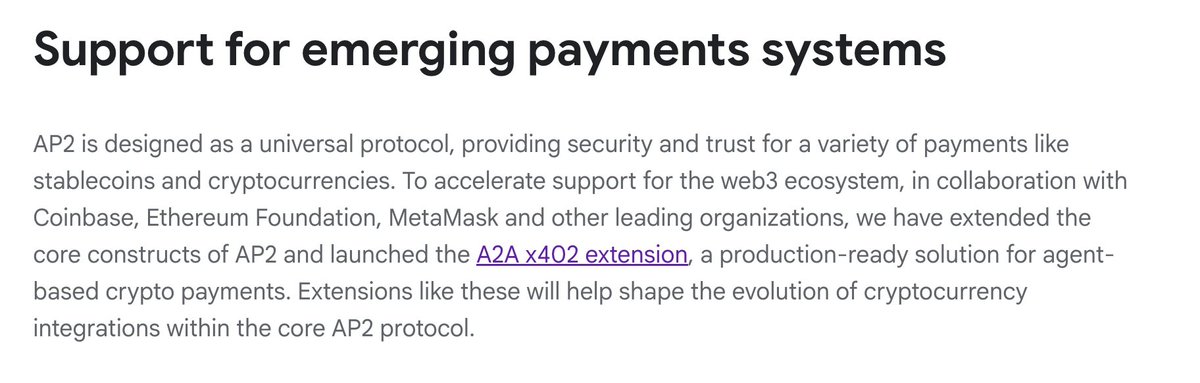
Looks like Google AI will support AI to AI payment using crypto out of the box.
Google is adding the x402 standard pioneered by Coinbase, the EF, and Metamask to it's agent to agent payment strategy.
That means Google AIs can pay AIs using crypto.
This is actually huge.
Three years ago today, The Ethereum Merge transitioned Ethereum from Proof-of-Work to Proof-of-Stake.
This upgrade cut energy use by ~99.99% and laid the foundation for future scalability.
Learn more. https://t.co/2idBFB7xOi
We’re starting a new AI Team at the Ethereum Foundation (the dAI Team).
Our mission: make Ethereum the preferred settlement and coordination layer for AIs and the machine economy.
The team will focus on two main areas:
- AI Economy on Ethereum = giving AI agents and robots ways to pay, coordinate, and follow rules without middlemen.
- Decentralized AI Stack = making sure the future of AI doesn’t rely only on a handful of entities but has open, verifiable censorship-resistant alternatives.
We believe Ethereum can be as useful for today’s AI developers as it will be for the sci-fi future. That’s why we’ll work closely with ecosystem projects to accelerate progress and push the boundaries of research and innovation at the intersection of AI and blockchains. Connecting two communities that have too often worked in parallel.
We’ll work side by side with both the Protocol and Ecosystem teams at the EF. Linking protocol improvements with the needs of AI builders, and funding innovative public goods that will make Ethereum the best home for AI.
Ethereum makes AI more trustworthy, and AI makes Ethereum more useful. The more intelligent agents transact, the more they need a neutral base layer for value and reputation. Ethereum benefits by becoming that layer and AI benefits by escaping lock-in to a few centralized platforms.
Acting with purpose and urgency, we’ll continue our recent work on ERC-8004—a standard for proving who an AI agent is and whether you can trust it— and continue to support new upgrades and standards. Inspired by the d/acc philosophy and Ethereum values, we’ll support projects that are leveraging Ethereum to build a more resilient and secure AI ecosystem where humans can flourish with AI.
Ethereum + AI is about making sure humans keep agency and AI can reach its potential. Neutral, verifiable, censorship-resistant infrastructure means AI works for the people, all of us.
The team starts with myself as lead, and we’re just getting started. Explore our job postings and resources below, and join us in building the future of decentralized AI on Ethereum.
We still do not have full account abstraction.
It's not possible to transact from an account without using ECDSA verification unless you go through an intermediary (and intermediary dependency is harmful to privacy and censorship resistance and generally the right to do things without getting permission)
eg. you can't be quantum safe without making your account depend on an intermediary to transact, you can't make a privacy protocol that does not depend on a (vulnerable) public broadcaster ecosystem
There really is a lot of challenging work to be done in getting this right. I just hope we don't get sucked into much higher levels of intermediary dependency as a norm before we do.
One thing that can help is to embrace open source:
https://t.co/nXE7DtRZ77
It's natural to fear technology if it's an inscrutable thing made by Other People that you're supposed to just trust, and you can't participate except as an end consumer.
Technology needs to be something that people everywhere can go and inspect and modify to suit their needs, and feel like it's theirs.
The intellectual requirements of doing this are of course far higher than 100 years ago, but on the flip side we have AI to help.
I am 100% aligned with almost all of what Tom @fundstrat says here.
Yes, Wall Street will stake because they currently pay for their infrastructure and Ethereum will replace much of the many siloed stacks they operate on (e.g. JPMorgam probably operates on several siloed stacks from all of the banks they've acquired and absorbed over the years). They will need their heads fully in our game, because our game will be called ... Finance. They will need to become a TradFi company that operates on decentralized rails, and that means staking, running validators, operating L2s/L3s/etc, participating in DeFi and writing smart contract software for agreements, processes and financial instruments, etc. This will be a relatively easy transition for JPM because they've been exploring and using Ethereum technology for their private blockchain networks since 2014-2015. And many other financial institutions also have solid Ethereum experience.
The narrative of L2s cannibalizing L1 will very soon be shattered. See @lineabuild and Proof of Burn at https://t.co/vrKG3vRuUe for an example of how this will soon pick up momentum.
Yes, ETH will likely 100x from here. Probably much more.
Yes, Ethereum/ETH will flippen the Bitcoin/BTC monetary base.
Yes, Tom and I are friendly and get on calls intermittently to discuss elements of the strategy and ways we can collaborate in the general furtherance of the strategy even while we compete in highly differentiated ways over time.
The one quibble that I have with what Tom has been saying, and I keep telling him this: he is not nearly bullish enough.
But the real problem is that it is not possible to be bullish enough. Nobody on the planet can currently fathom how large and fast a rigorously decentralized economy, saturated with hybrid human-machine intelligence, operating on decentralized Ethereum Trustware, can grow. Trust is a new kind of virtual commodity. And ETH, the highest octane decentralized trust commodity, will eventually flippen all the other commodities on the planet. Decentralized trust is all you need.