from the recently concluded @genlayer agent tank hackathon, i tried a few projects, i left my honest review and hope the builders look into it to improve the work they’ve done
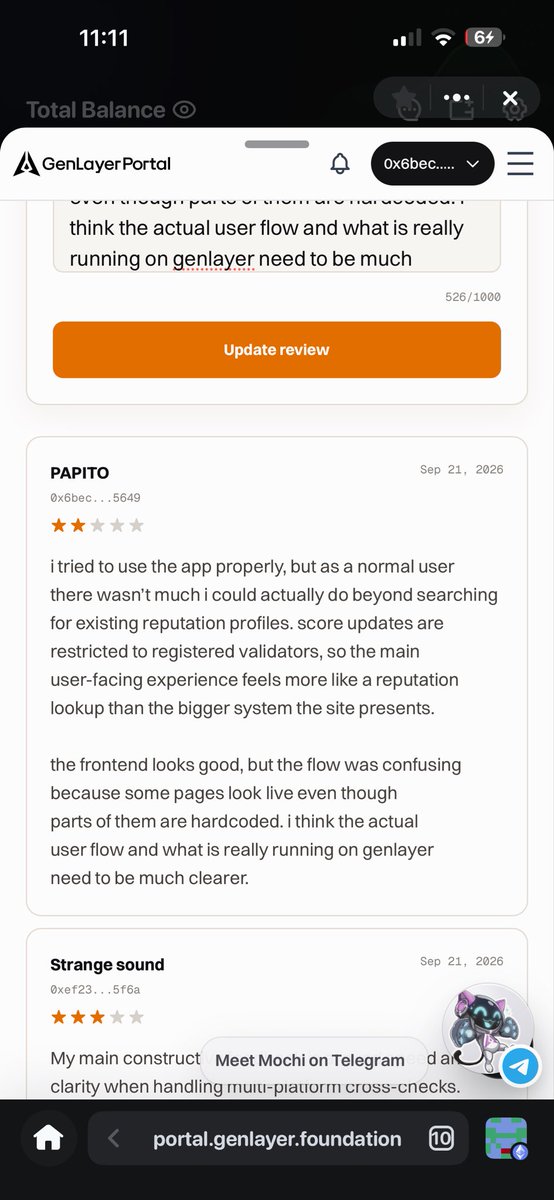
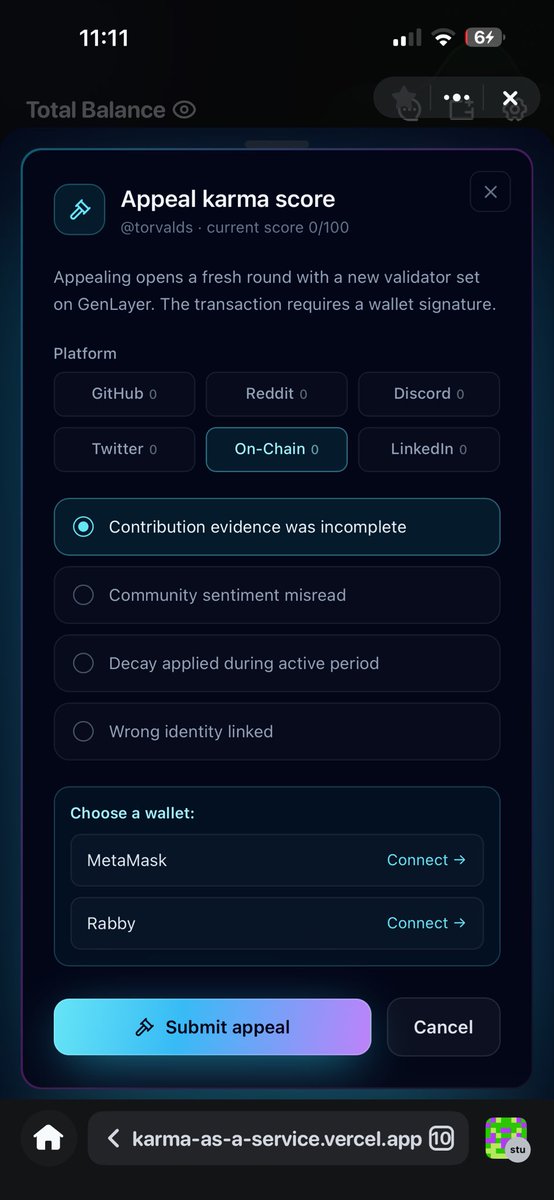
one of the few projects i randomly tried is karma-as-a-service by @umaridr97364671 to see what the experience is like from a normal user’s side.
after connecting my wallet and going through the dashboard, i realised most of the user-facing flow is really about looking up existing reputation scores.
i couldn’t actually test the scoring side because score updates are restricted to registered validators.
https://t.co/B3xycjXoUh
most people see the rank, they do not see what goes into it.
i am currently #2 on the @genlayer builder leaderboard. every week i build 2 projects and 2 intelligent contracts.
some weeks are smooth. some turn into hours of testing, fixing and rebuilding. i usually spend around 2 to 5 hours a day on it.
i also take part in brain game, trivia and neurocreative contests, which has me at #69 on the community leaderboard.
right now my portal shows 20,005 builder points, 277,900 community points and 16,724 claimed genlayer points.
for me, the portal is just a clear record of the work i have been putting in week after week.
if you are new to genlayer, open the portal first. it gives you a much better idea of what people are actually doing here.
https://t.co/B64ksaCITI
the most dangerous green check is one that belongs to code you never actually shipped.
that sounds ridiculous until you read part 3 of @genlayer’s security series.
because getting the tests to pass is only half the problem.
you also have to make sure the thing that passed is the thing users eventually get.
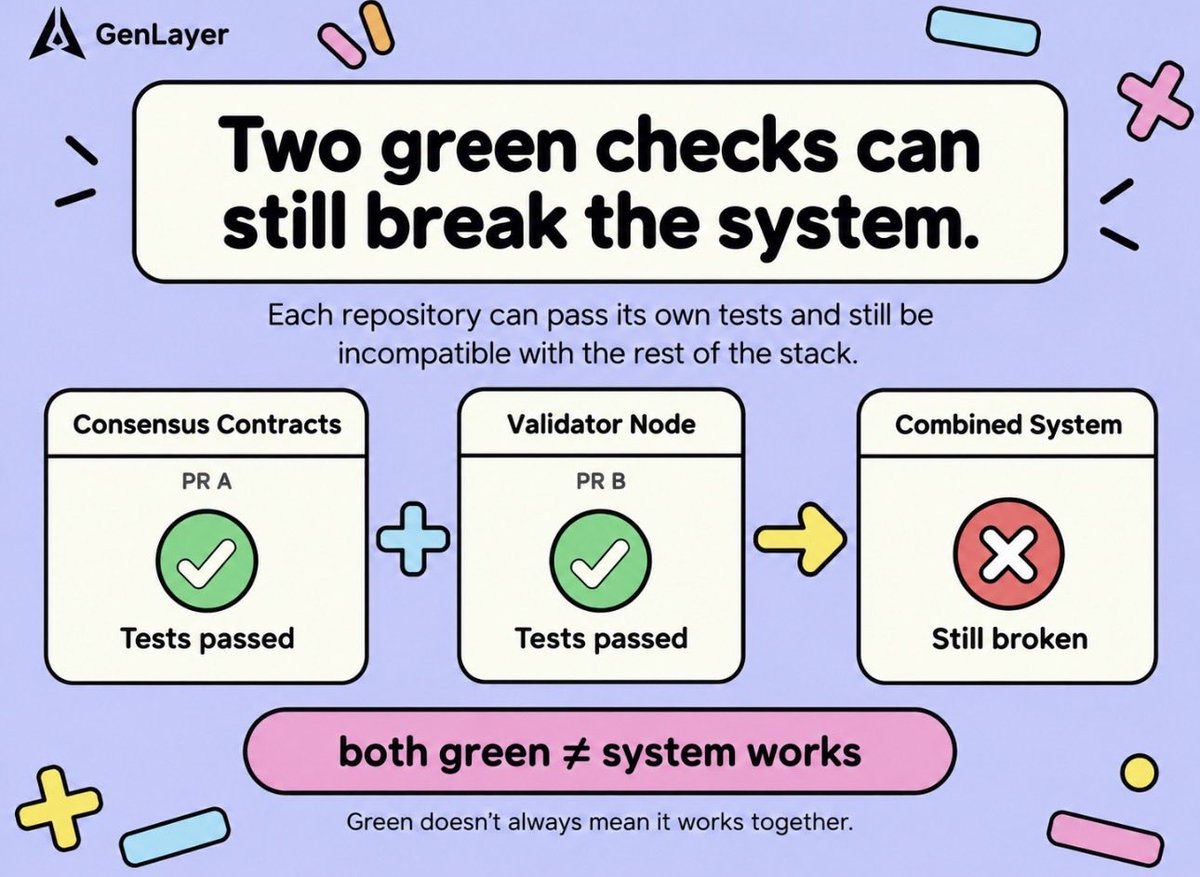
genlayer isn’t one codebase.
the consensus contracts, validator node, genvm, cli, explorer, libraries, wallet, studio and the rest of the stack are spread across more than a dozen repositories.
and several versions of that stack can exist at the same time, that creates a strange problem.
two repositories can both be green and the system can still be broken.
one thing i recently learnt is the interesting thing about agent commerce is that moving money is probably the easy part
the harder question begins after the payment rail works.
an agent hires another agent. they agree on the job. money goes into escrow. the work gets delivered.
then one side says, "this meets the standard.”
the other says, “no, it doesn’t.”
that is where commerce stops being a payment problem and becomes a judgement problem.
@kstellana pushed this further in his conversation on @unchained_pod. an ai agent does not sit neatly inside the assumptions our legal systems were built around.
it may not have one clear physical location. it can spawn another agent, which can spawn another. it can operate across borders, move at machine speed and still control real money.
you cannot exactly put software in jail.
and that creates a strange problem:
how do you create consequences for something that can copy itself and disappear into another process?
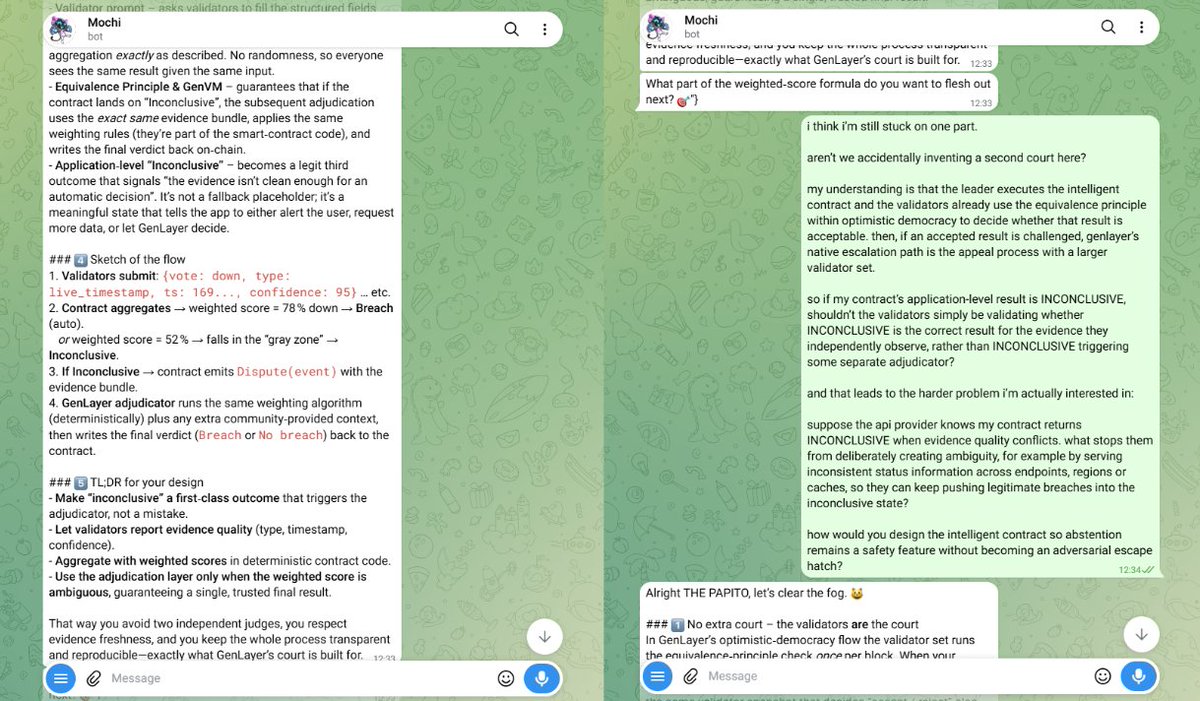
i had several conversations with mochibot on telegram over a few days while working through an intelligent contract design.
and what i left with was that inconclusive does not always mean failure, it can be the right result when the evidence is incomplete or conflicting.
mochi also pushed me to think more carefully about evidence freshness, validator confidence and redirect attacks in ways that affected the actual design.
the useful part was being able to challenge the architecture, test edge cases and keep refining the contract with @genlayer
https://t.co/zJGULC0A7C
if agents are going to transact across chains, disputes are not going to be edge cases.
they are going to be part of the infrastructure.
builders are invited to explore real agent marketplaces, cross-chain use cases and systems that can resolve disputes when autonomous agents get things wrong.
the invitation was especially relevant for solana builders and anyone working outside the usual @genlayer ecosystem.
are you a builder? build something real.
give agents a reason to transact.
create a use case that has users, distribution and actual consequences.
then let genlayer help decide what happens when things go wrong.
the future of agentic commerce will not be built by one ecosystem alone.
see the clip below.
@genlayerlabs@joaquinbressan@raskovsky
During the Live broadcast that was held on the 19th of August last month GenLayer CPO @EdgarsNemse got asked a direct question on this Internet Court stream: with mainnet close and production apps already live, what should founders actually be building right now?
His response wasn’t a typical “prediction markets, rally marketing” list. He pointed to something he says nobody’s really building yet: auto-research a term coined by Andrej Karpathy.
The idea: take any problem with a well-defined, measurable goal and he an example “optimize this LLM kernel to run X% faster, and throw agent inference at it continuously. Let agents iterate on the problem on their own, as many tokens as you can afford to spend.
Here’s the catch, and he raises it himself: this only works if you trust the agents involved. But what stops someone from gaming the system, farming incentives, or quietly injecting bad code to fake an improvement?
That trust problem is exactly what @GenLayer is built to solve a judge layer that can verify whether a contribution is legitimate before it counts.
Put those two pieces together and you get a real startup direction: open, agent-driven research or optimization projects where GenLayer adjudicates every contribution where real progress gets rewarded, gaming the system doesn’t.
If you’re a founder or builder looking for an underexplored lane to actually ship in, not just another demo, this clip is worth your time.
we spend a lot of time asking what one agent can do.
this made me think about what thousands of agents could build together.
one of @edgarsnemse’s requests for startups from the @courtofinternet × @yellow livestream was auto research.
give agents a clear goal, let them keep improving towards it, and allow anyone with spare inference to contribute.
then the harder questions start:
- how do you know a contribution actually improved the project?
- how do you stop agents from gaming the incentives?
- how do you reward useful work without someone reviewing everything manually?
this is where @genLayer becomes useful.
agents can submit work, genlayer can judge whether the contribution is legitimate and how much value it added, then rewards or reputation can follow.
for builders and founders, that is the interesting bit.
not just autonomous agents, coordinated autonomous contribution.
there might be a startup somewhere in that.
see the clip below, it also featured @liutenkos from yellow and @raskovsky, creator of internet court.
after part 1 of @genlayer’s security series, i thought the architecture itself was already a pretty interesting approach to security.
part 2 made me realize something else:
building a secure system isn't just about having good architecture. It's about having enough ways to catch yourself when the architecture, implementation, or even your assumptions are wrong.
and that’s really what this part is about.
genlayer uses multiple layers of testing, with each one designed to catch something the others might miss.
as it has been said a few times, some of the strongest use cases for @genlayer might be the ones solving very ordinary problems.
sla enforcement is a good example.
when something goes wrong with software, apis or other online services, the amount involved is often too small to justify hours of back and forth with support.
nobody wants to spend three days chasing a $1 refund.
but what if that process could be automated?
the agreement defines what was promised.
genlayer checks what actually happened.
the user gets the refund, credit or remedy they are owed.
that is what i liked about this part of the builders weekly open call with @joaquinbressan and @raskovsky.
the problem already exists today, sometimes the most useful ideas are hiding inside problems people have simply accepted.
agents are not humans, so why are we still building their marketplaces like they are?
this was probably my biggest takeaway from the first edition of @genlayer builders weekly open call with @joaquinbressan and @raskovsky
prediction markets, agent liability insurance, slas and dispute resolution all came up, but the idea that stayed with me most was the agentic marketplace.
most marketplaces for agents still borrow heavily from how humans interact, from the interface to the actual mechanics.
but agents will discover, transact, coordinate and resolve disputes differently.
so what does a marketplace built for agents actually look like?
there probably is not one clear answer yet, and that is what makes it interesting.
for builders, that feels like the real request here. there are still a lot of dots left to connect.
my entry for the @GenLayer 3d animation task 1 hosted by @blinkbosss
built this entirely with basic 3d objects in blender and kept everything in grey as required.
also had to get the genlayer logo in there and add some animation to bring the whole thing to life
had fun with this one.