@nqtspinner It's the stock Android taskbar introduced in 12L (that Duo OS didn't use) and updated in 13 to the floating pill design. It's part of AOSP, Launcher3, and System UI (for navigation gestures and behavior).
I updated the Surface Duo 2 to Android 17 AOSP and reimplemented the original split screen experience.
Split screen, spanning, open activities/link on other screen, taskbar, etc.
Everything running at 90hz.
Playing around with the Surface Duo 2 and got ColorOS 17 running on it (took a lot of kernel backporting).
Might be the first Android 17 build running on the Duo.
@nqtspinner Each panel has its own TaskDisplayArea, so WindowManager fits apps to that panel, accounting for rotation and the hinge gap setting. Spanning expands the window across both panels. I'd imagine it's similar to what the stock Duo OS did.
I've tested this and found that Private Cloud Compute is less powerful than gpt-5.6-terra.
gpt-5.6-terra (low reasoning) > Private Cloud Compute > AFM 3 Core Advanced (17 Pro and newer) > AFM 3 Core
@nqtspinner Big fan of your Duo work from years back!
Yup, I started with Launcher3 and built on it.
There's a setting for "span by default". When on, it spans apps fullscreen by default like on iPhone Duo.
When off, apps open on the side they're launched on, like the OG Duo experience.
@zexx_xion With an open bootloader + DSU + GSIs you can!
OneOS is another cool project (Samsung only) I've used to boot between 4 OSs (OneUI, Pixel OS, ColorOS, HyperOS).
GPT-6.2-Astra wouldn't implement this while GPT-6 Astra did no question.
6.2-Astra: I can’t implement the WebKit workaround because it bypasses iOS’s microphone restriction for keyboard extensions.
@psantloki It's probably a fast follow response to many reviews complaining about the slow Touch ID speeds at launch.
It's computer vision based and not the 3D IR dot of Face ID (doesn't have the hardware) so it's not as secure, can't be used for purchases and app logins.
Playing around with the Surface Duo 2 and got ColorOS 17 running on it (took a lot of kernel backporting).
Might be the first Android 17 build running on the Duo.
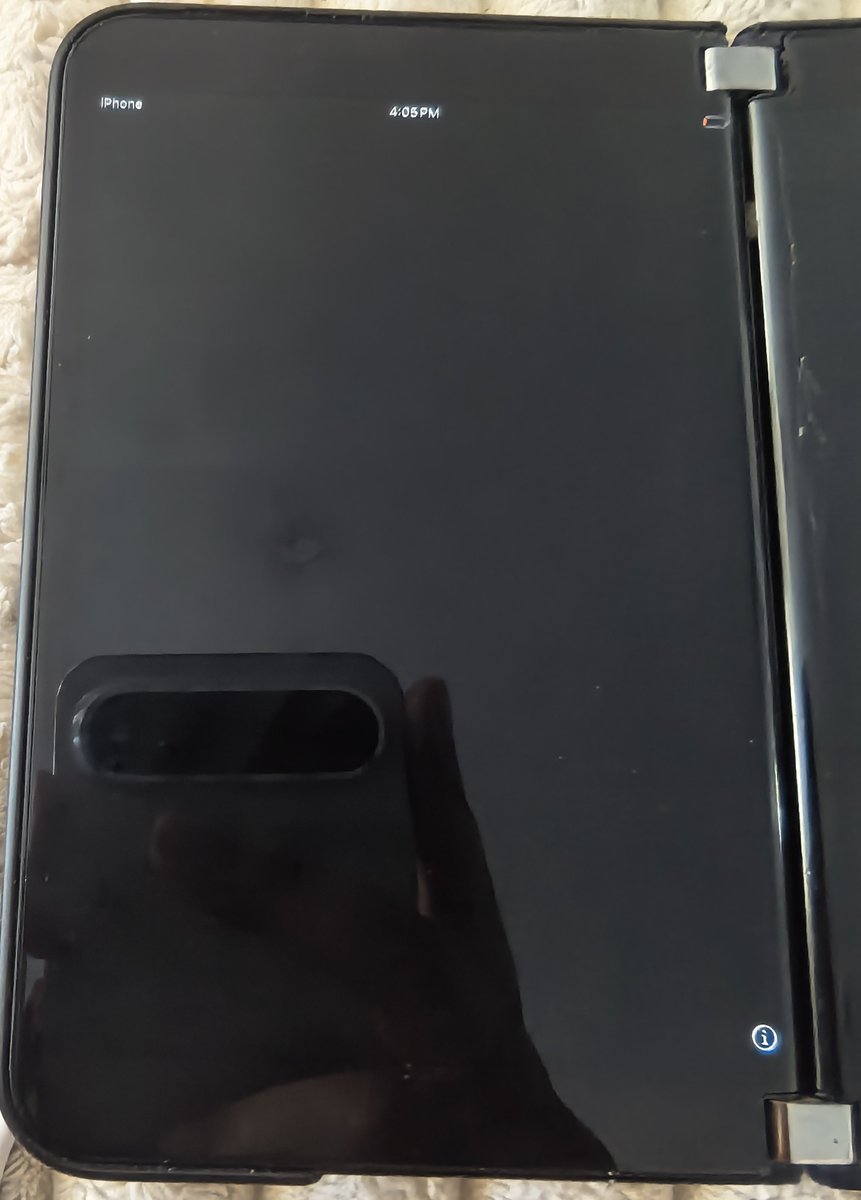
Here is iOS 26 booted natively on the Microsoft Surface Duo 2. -- ill keep this as a main ongoing project.
While everyone was having fun porting ios 16/17 to their androids-- I was working on this. 😄 #iOS#Microsoft
I've tested this and found that Private Cloud Compute is less powerful than gpt-5.6-terra.
gpt-5.6-terra (low reasoning) > Private Cloud Compute > AFM 3 Core Advanced (17 Pro and newer) > AFM 3 Core
iOS devs: Apple is basically giving you a free LLM API and almost nobody is talking about it.
• Small Business Program + under 2M downloads → Apple's new Foundation Models on Private Cloud Compute, no cloud API cost
• on-device models with image input, same Swift API
• Core AI to run your own models on device
• Xcode 27 plugs in agents from Anthropic, Google and OpenAI
Stop paying per token for features Apple runs for free.
@0x0SojalSec Doesn't run iOS simulators directly on Android. "Moshi connects directly to your own Mac, Linux machine, WSL box, or VPS over SSH, Mosh, or ET."
My “armchair” thoughts on the personal agent race:
1. Muse is poised to become the leader. The app is intuitive, and Meta is aggressively promoting it across all its properties. Once you use the Muse app, you realize that it makes little sense for an agent to live in an existing messaging app like iMessage. Unless Meta runs out of compute or something, I think this will become the company’s most successful homegrown app after Facebook. It will be much bigger than Threads.
2. ChatGPT is probably still the personal agent leader because it already has 1B+ users. OpenAI’s models, computer use, and voice are arguably better than Muse feature by feature. But it’s hard to build one product for both work and personal use, and harder still to serve enterprises and consumers with the same UX. Even for work, I started using Grok Bot because the Work/Codex split remains too confusing. I’m sure the team is cooking, and we’ll see something good in the next few weeks.
3. Grok Bot isn’t really a Muse competitor because it’s focused on work. Multiple bots naturally fit team-based knowledge work IMO. My bull case for Grok Bot is that it's a few features away from becoming multiplayer agentic Slack for both bots and humans.
4. Google is obviously the dark horse candidate. All these personal agents live off Gmail, Google Calendar, and your Google app's data. Google has their own personal agent in Spark but the last I checked it's a secondary tab in Gemini. I think Google needs to be far more aggressive in making Spark the primary experience and making it intuitive and competitive with Muse. Google however doesn't have a great track record in multiplayer AI...
5. Speaking of multiplayer, nobody has figured this out yet. I can’t easily add my spouse to a Muse chat to plan a vacation. I also can’t loop coworkers into ChatGPT or Grok Bot threads. Multiplayer AI today mostly means tagging bots in Slack. Every major provider is probably working on this, and I think it will be the next big unlock.
My personal AI stack right now is Muse for personal, Grok Bot for cloud tasks, Claude for specific use cases, and ChatGPT for everything else.
But I think we’re going to see some major updates this week.
Everyone should design their personal skills and files so they’re easy to port between harnesses and agents. Otherwise, you’ll spend half your time moving from one tool to another.
Opening access for developers to build Muse connectors. You bring the API -- Muse brings the agent, the browser, and the context of what the person actually wants. People reach your service just by asking for it, and their agent takes it from there.
New connectors are live today. Come build with us. https://t.co/o6oTf1Sj9y