Please be careful with CloudFlare configuration. I just had to fix a website who's traffic tanked for 2 weeks thanks to someone who turned on blocking all bots...
Posted the same on LinkedIn and got 600 likes and a heap of comments... a lot of people going through this
@taylorotwell@aarondfrancis Omg this is a game changer. The amount of times I’ve written this code for clients is insane, great idea to make it part of the core - can’t believe I never thought to do that. Does it have a way to verify s3 file hasn’t changed, or local expiry? Or do I need to change file name?
@gonedark@aarondfrancis It's a real shame, I've followed along from the start and as much as I love my AI tools & workflows, I love the Laravel community and the tools that have been built off the back of them, like yours. I hope you can work the business out
Laravel just shipped a first-party AI SDK and it's the cleanest AI integration I've seen in any framework.
One API for OpenAI, Anthropic, Gemini and 11 others. Fully testable. Feels like writing normal Laravel.
Here's everything I have learned so far: https://t.co/WEHRFRigpa
A few random notes from claude coding quite a bit last few weeks.
Coding workflow. Given the latest lift in LLM coding capability, like many others I rapidly went from about 80% manual+autocomplete coding and 20% agents in November to 80% agent coding and 20% edits+touchups in December. i.e. I really am mostly programming in English now, a bit sheepishly telling the LLM what code to write... in words. It hurts the ego a bit but the power to operate over software in large "code actions" is just too net useful, especially once you adapt to it, configure it, learn to use it, and wrap your head around what it can and cannot do. This is easily the biggest change to my basic coding workflow in ~2 decades of programming and it happened over the course of a few weeks. I'd expect something similar to be happening to well into double digit percent of engineers out there, while the awareness of it in the general population feels well into low single digit percent.
IDEs/agent swarms/fallability. Both the "no need for IDE anymore" hype and the "agent swarm" hype is imo too much for right now. The models definitely still make mistakes and if you have any code you actually care about I would watch them like a hawk, in a nice large IDE on the side. The mistakes have changed a lot - they are not simple syntax errors anymore, they are subtle conceptual errors that a slightly sloppy, hasty junior dev might do. The most common category is that the models make wrong assumptions on your behalf and just run along with them without checking. They also don't manage their confusion, they don't seek clarifications, they don't surface inconsistencies, they don't present tradeoffs, they don't push back when they should, and they are still a little too sycophantic. Things get better in plan mode, but there is some need for a lightweight inline plan mode. They also really like to overcomplicate code and APIs, they bloat abstractions, they don't clean up dead code after themselves, etc. They will implement an inefficient, bloated, brittle construction over 1000 lines of code and it's up to you to be like "umm couldn't you just do this instead?" and they will be like "of course!" and immediately cut it down to 100 lines. They still sometimes change/remove comments and code they don't like or don't sufficiently understand as side effects, even if it is orthogonal to the task at hand. All of this happens despite a few simple attempts to fix it via instructions in CLAUDE . md. Despite all these issues, it is still a net huge improvement and it's very difficult to imagine going back to manual coding. TLDR everyone has their developing flow, my current is a small few CC sessions on the left in ghostty windows/tabs and an IDE on the right for viewing the code + manual edits.
Tenacity. It's so interesting to watch an agent relentlessly work at something. They never get tired, they never get demoralized, they just keep going and trying things where a person would have given up long ago to fight another day. It's a "feel the AGI" moment to watch it struggle with something for a long time just to come out victorious 30 minutes later. You realize that stamina is a core bottleneck to work and that with LLMs in hand it has been dramatically increased.
Speedups. It's not clear how to measure the "speedup" of LLM assistance. Certainly I feel net way faster at what I was going to do, but the main effect is that I do a lot more than I was going to do because 1) I can code up all kinds of things that just wouldn't have been worth coding before and 2) I can approach code that I couldn't work on before because of knowledge/skill issue. So certainly it's speedup, but it's possibly a lot more an expansion.
Leverage. LLMs are exceptionally good at looping until they meet specific goals and this is where most of the "feel the AGI" magic is to be found. Don't tell it what to do, give it success criteria and watch it go. Get it to write tests first and then pass them. Put it in the loop with a browser MCP. Write the naive algorithm that is very likely correct first, then ask it to optimize it while preserving correctness. Change your approach from imperative to declarative to get the agents looping longer and gain leverage.
Fun. I didn't anticipate that with agents programming feels *more* fun because a lot of the fill in the blanks drudgery is removed and what remains is the creative part. I also feel less blocked/stuck (which is not fun) and I experience a lot more courage because there's almost always a way to work hand in hand with it to make some positive progress. I have seen the opposite sentiment from other people too; LLM coding will split up engineers based on those who primarily liked coding and those who primarily liked building.
Atrophy. I've already noticed that I am slowly starting to atrophy my ability to write code manually. Generation (writing code) and discrimination (reading code) are different capabilities in the brain. Largely due to all the little mostly syntactic details involved in programming, you can review code just fine even if you struggle to write it.
Slopacolypse. I am bracing for 2026 as the year of the slopacolypse across all of github, substack, arxiv, X/instagram, and generally all digital media. We're also going to see a lot more AI hype productivity theater (is that even possible?), on the side of actual, real improvements.
Questions. A few of the questions on my mind:
- What happens to the "10X engineer" - the ratio of productivity between the mean and the max engineer? It's quite possible that this grows *a lot*.
- Armed with LLMs, do generalists increasingly outperform specialists? LLMs are a lot better at fill in the blanks (the micro) than grand strategy (the macro).
- What does LLM coding feel like in the future? Is it like playing StarCraft? Playing Factorio? Playing music?
- How much of society is bottlenecked by digital knowledge work?
TLDR Where does this leave us? LLM agent capabilities (Claude & Codex especially) have crossed some kind of threshold of coherence around December 2025 and caused a phase shift in software engineering and closely related. The intelligence part suddenly feels quite a bit ahead of all the rest of it - integrations (tools, knowledge), the necessity for new organizational workflows, processes, diffusion more generally. 2026 is going to be a high energy year as the industry metabolizes the new capability.
Microservices is the software industry’s most successful confidence scam. It convinces small teams that they are “thinking big” while systematically destroying their ability to move at all. It flatters ambition by weaponizing insecurity: if you’re not running a constellation of services, are you even a real company? Never mind that this architecture was invented to cope with organizational dysfunction at planetary scale. Now it’s being prescribed to teams that still share a Slack channel and a lunch table.
Small teams run on shared context. That is their superpower. Everyone can reason end-to-end. Everyone can change anything. Microservices vaporize that advantage on contact. They replace shared understanding with distributed ignorance. No one owns the whole anymore. Everyone owns a shard. The system becomes something that merely happens to the team, rather than something the team actively understands. This isn’t sophistication. It’s abdication.
Then comes the operational farce. Each service demands its own pipeline, secrets, alerts, metrics, dashboards, permissions, backups, and rituals of appeasement. You don’t “deploy” anymore—you synchronize a fleet. One bug now requires a multi-service autopsy. A feature release becomes a coordination exercise across artificial borders you invented for no reason. You didn’t simplify your system. You shattered it and called the debris “architecture.”
Microservices also lock incompetence in amber. You are forced to define APIs before you understand your own business. Guesses become contracts. Bad ideas become permanent dependencies. Every early mistake metastasizes through the network. In a monolith, wrong thinking is corrected with a refactor. In microservices, wrong thinking becomes infrastructure. You don’t just regret it—you host it, version it, and monitor it.
The claim that monoliths don’t scale is one of the dumbest lies in modern engineering folklore. What doesn’t scale is chaos. What doesn’t scale is process cosplay. What doesn’t scale is pretending you’re Netflix while shipping a glorified CRUD app. Monoliths scale just fine when teams have discipline, tests, and restraint. But restraint isn’t fashionable, and boring doesn’t make conference talks.
Microservices for small teams is not a technical mistake—it is a philosophical failure. It announces, loudly, that the team does not trust itself to understand its own system. It replaces accountability with protocol and momentum with middleware. You don’t get “future proofing.” You get permanent drag. And by the time you finally earn the scale that might justify this circus, your speed, your clarity, and your product instincts will already be gone.
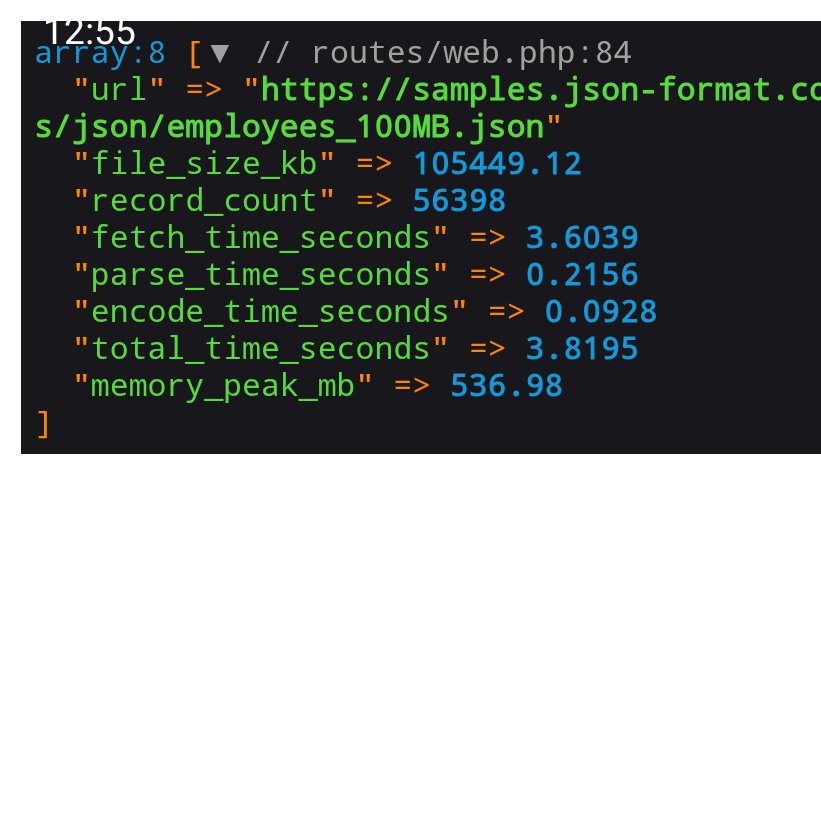
This is awesome! I wanted to benchmark @nativephp to see what we could accomplish here.
I pulled in 100MB of JSON data from a third party and ran json_decode on the contents. It took just over 3 seconds to retrieve the file.
But less than .22 seconds to parse it 💨
@jeffrey_way@aarondfrancis Yeah the wording here makes a difference, I use Claude code a fair bit for TALL stack dev with Laravel Boost but pair programming is where you have to draw the line as a dev. If you’re not leading the direction and reviewing it, then it’s vibe coding and it’ll be crap and messy.
@DCoulbourne@ZacksJerryRig Couldn't agree more @DCoulbourne! So well articulated. I build a lot of web applications around that budget and I'm pretty good at digging the details out of the customer and scoping to give an estimate, there's always unknowns and changes.
I've been migrating from Algolia to TypeSense with Laravel, Vue & InstantSearch.
I've written a guide as there were a few gotchas along the way + synonyms converter script: https://t.co/Otjr2o7I6k
Big thanks to @jbrooksuk for his advice on their migration with @laravelforge
@Kerollmops I can't use it without native support for promoting, pinning, and boosting specific documents. This is really where Algolia is ahead of the competition - unfortunately. Love the cloud UI and analytics though
@Kerollmops The main reason is my client was heavily tied to Algolia and loved it but pricing was getting too high, and Typesense had a direct InstantSearch adapter and much cheaper. Meilisearch looks really nice looks similar in terms of pricing to Algolia for 1m+ searches