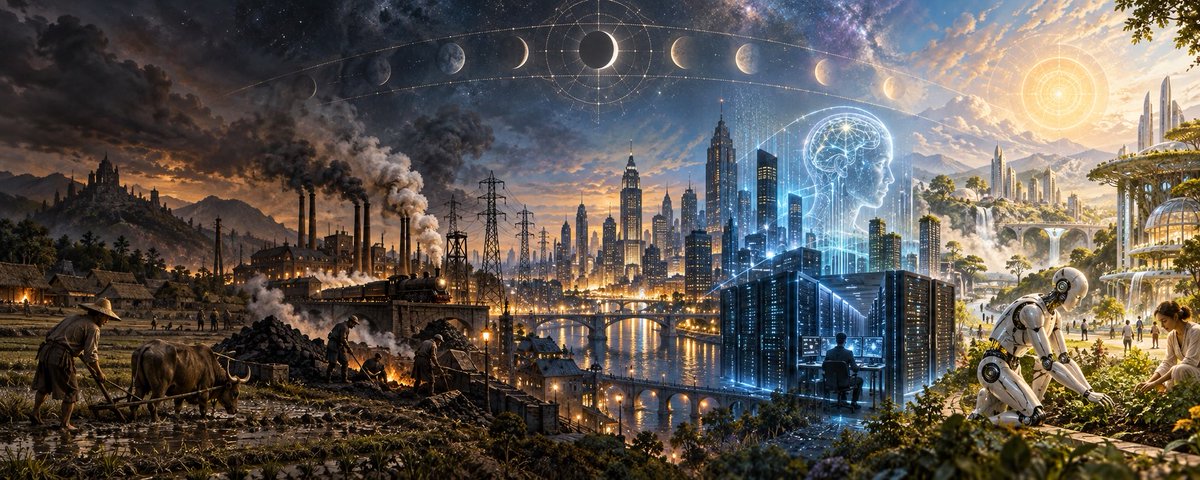
The West still has the temples. It lost the grammar that made them work.
A theoros (θεωρός) is not a commentator.
Four conditions, or the office is empty:
1. Something worth seeing.
2. Someone who can tell that it is.
3. Someone who can go and stand as witness.
4. A report of what was there, given truthfully, not an impression he is free to bring home.
Without that loop a city keeps its stones and stops knowing itself.
That grammar sits under everything the West still names: law, science, markets, worship, generation.
Lose the office and the symbols remain.
The life they were meant to carry does not.
@X did not restore the temples.
It helps to restore a ground where a truthful report can still land.
Who is still looking, and who do they report to?
Quando vi diranno che l'Italia è una nazione "bastarda", "meticcia", che veniamo dal caso e che non esiste una cultura italiana. Ricordatevi chi siamo 🇮🇹
Beh argomentazioni forti.
Non esiste la superiorità, ma esiste la differenza fra diversi popoli e quindi culture diverse che sono sempre state fondamentali per il progresso umano (leggi Lévi-Strauss, per esempio).
In ogni caso questo è innegabile nei fatti, non è che lo dica io eh.
Poi, ognuno è libero di credere ciò che vuole, basta che sappia che sia credenza e non un dato oggettivo.
Dopo il «meticci», il discorso del Presidente della Repubblica all’Aquila nel gennaio 2026 e altri interventi dello stesso tenore, anche Caprarica si infuria in diretta TV, sostenendo che l’Italia e gli italiani siano il frutto di una «meravigliosa mescolanza di geni».
Il messaggio che passa è sempre quello: non siamo niente, soltanto una mescolanza casuale.
Il nulla che tornerà nel nulla.
Vorrei però ricordare due cose.
1. Quella «meravigliosa mescolanza» sarebbe figlia di invasioni sanguinarie, guerre, occupazioni militari, stupri ed esecuzioni senza processo. Prima di definirla «meravigliosa», bisognerebbe almeno fare i conti con questa storia.
2. Le popolazioni italiane hanno profili genetici riconoscibili e una struttura geografica interna. Nei campioni dell’età del Ferro, Etruschi e Latini condividono un patrimonio locale simile. Seguono apporti consistenti, soprattutto dal Mediterraneo orientale in epoca imperiale. Nelle regioni centro-meridionali studiate, il profilo attuale è già largamente formato entro la fine del primo millennio d.C., con ampia continuità successiva (Paper di riferimento nei commenti).
L’origine africana comune non rende geneticamente indistinguibili le popolazioni attuali. Nel corso di decine di migliaia di anni, le popolazioni dell’Eurasia occidentale hanno sviluppato profili genetici differenziati rispetto a quelle dell’Africa subsahariana, con differenze misurabili nelle frequenze delle varianti.
Queste differenze biologiche esistono, qualunque interpretazione culturale si voglia darne. Akbari, su Nature nel 2026, documenta inoltre che la selezione naturale ha continuato a modificare le popolazioni dell’Eurasia occidentale negli ultimi diecimila anni.
Dentro questa storia più ampia, le popolazioni italiane presentano caratteristiche riconoscibili: nelle regioni centro-meridionali studiate, il profilo genetico attuale era già largamente formato entro la fine del primo millennio d.C., con ampia continuità successiva.
Aver ricevuto apporti diversi non significa essere privi di radici o di continuità.
Anche se questo si cerca colpevolmente di dimenticarlo spesso.
Che alla fine è l’obiettivo dichiarato nei fatti.
L’Italia e l’Europa, eccetto alcune aziende che si contano sulle dita di una mano, sono totalmente fuori dallo scacchiere delle potenze mondiali. Pedine mangiate e digerite, anzi forse mai presentate alla partita.
Un “esperto” figlio di questo sistema, cosa deve dire?
Che vuole aprire una start up di physical AI, ma per avere fondi quei robot devono essere ecosostenibili e gender fluid, basati ovviamente su una infrastruttura esterna di cui l’Europa è e sarà sempre dipendente.
@Dr_Singularity Yeah, I'm particularly bullish on SpaceXAI, since @elonmusk is building a truly unique ecosystem at the frontier of every industry by connecting energy, space, AI, and chips 🚀
@andst7 Humanity has always had a difficult relationship with new, disruptive technologies.
AI is a unique case. It can set us free from what we are not good at: raw computation.
We should embrace AI to foster our humanity
The Builders’ Revolt
From Bacon’s ship to SpaceX: AI and the freedom to choose our own course.
What happened to the West? When did dreaming, hoping for the future, and believing in something greater than our own opinions and appetites become things to be ashamed of?
In 1620, Francis Bacon put a ship sailing through the Pillars of Hercules on the title page of his Instauratio Magna. The edge of the known world became a passage into something still to be discovered. Someone would have to build a ship and find the courage to sail it.
That image captures something worth keeping in our history. People willing to challenge their age, imagine unfamiliar worlds, and spend their lives building things others thought impossible.
Somewhere along the way, we seem to have lost part of that ambition. Technology advances while we learn to expect less from our lives. We become more efficient at getting through days that all look alike. The future shrinks to the next deadline.
In a society that has forgotten what makes life worth living, technical progress can turn everything into a technical task. Even a person becomes a component, judged by how well they serve a purpose someone else has chosen.
Tocqueville saw a danger like this. He described a power that cared for people’s needs while keeping them in a permanent childhood. It would make their own judgment less necessary, until they gradually lost the habit of using it.
A cage can be comfortable. A generation can grow up inside one and learn to call it the world.
AI gives us a chance to break that pattern. If machines can take on more of our repetitive work, we can question how much of a human life should be spent doing it. We can make room for thought, curiosity, and work we choose because we believe it matters.
@SpaceX makes that possibility visible. A rocket lifts off. Its first stage returns to fly again. Behind those moments are years of work by people who believed something could be done and set out to do it.
Even someone who will never go to space can watch a launch and remember that there is still somewhere worth going. There are problems worth years of effort. Four centuries later, Bacon’s ship has taken another form.
AI could give far more people the tools to join that adventure. Concentrating those tools in a few hands would give a few people enormous power over what everyone else can attempt.
Fear of an AI Armageddon can become an excuse for that concentration. We may be told that the danger is too great to let many people build, experiment, and compete. A promise to protect us can become a claim to decide how far the rest of us are allowed to go.
Preventing harmful uses, such as designing biological weapons, serves a clear purpose. Sweeping restrictions on research and access can also shield the companies that already control the technology. When everyone must follow one road, whoever designed it gets to choose the destination.
We need an open market with many competitors, where people can switch providers, build alternatives, and challenge the leaders. The power of a private company must also be open to challenge from someone with a better idea.
Resist the concentration of power over AI.
Demand a free market where many competitors can enter and compete, and where newcomers have a real chance to build.
Resist, because the life of a free humanity is at stake: our ability to choose what we live for, imagine a future worth reaching, and find the means to build it.
@AndreaVenanzoni Credo che alcune tecnologie siano semplicemente impossibili da bloccare perché parte fondante dell'evoluzione dell'uomo.
https://t.co/ixh4K7D6RG
Kardashev's Yugas.
I sometimes wonder whether the move from the Kali Yuga toward a new golden age can also be understood through the history of energy.
Agriculture allowed humans to capture and store much more of the solar energy available to them, turning it into food, surplus, cities, and civilization. The Industrial Revolution multiplied human strength through coal, oil, and machines. Electricity changed things even more deeply because it made energy easy to move, control, and convert into light, motion, communication, and computation.
With computers, we began to automate the control of that energy. With AI, we are beginning to automate part of the intelligence that decides how to use it. Physical AI may complete the loop by directly connecting energy, computation, intelligence, and action in the physical world.
If this continues, many of the scarcities that have shaped human history may become less binding. First physical strength, then computation, now a growing share of cognitive work, and eventually perhaps a large part of physical labor as well.
That also changes what scarcity means. When producing, calculating, and building become easier, the bottleneck moves elsewhere. Judgment becomes more valuable. So do trust, the ability to choose worthwhile goals, the meaning we give to what we build, and the quality of the order we are able to create.
This is where the image of a golden age becomes interesting. A civilization can command enormous amounts of energy and still be poor in its ends. Technology expands the range of what we are able to do, while the deeper question remains what we believe is worth doing.
Perhaps the history of energy tells this story too. Humanity slowly frees itself from the scarcities that once kept most of life tied to survival, and every new freedom pushes the question one level higher. In the end, the main constraint may become less material and more human.
@Capezzone La loro arma è provare una destrutturazione della storia e della cultura di popoli millenari con l'obiettivo di dividere ed annichilire nazioni che hanno forgiato l'Occidente e il mondo.
https://t.co/t5w6nmRCxi
Quando vi diranno che l'Italia è una nazione "bastarda", "meticcia", che veniamo dal caso e che non esiste una cultura italiana. Ricordatevi chi siamo 🇮🇹
@AltcoinDaily@watchbmtv RWA, physical AI, agents.
Beside the chips, the chain is the settlement layer those things run on.
The pieces are clicking into place.
https://t.co/lqLckBtkZo
One million agent payments per second
10⁶ agents, one purchase each second. 86.4 billion purchases a day.
At an incremental 1 J per purchase, that workload adds 1 MW above the network baseline. 10 J → 10 MW. 100 J → 100 MW. These are sizing assumptions, not measured chain consumption.
Four architectures to evaluate at that scale.
1. Tempo / MPP aggregates repeated payments offchain. Prefund the session, sign cumulative vouchers, verify locally. Idealized lifecycle: two onchain transactions per session. At 1,000 purchases per session, the reference workload averages 2,000 onchain transactions a second: 500× fewer than one transaction per purchase. Excludes top-ups and intermediate settlements.
2. Solana executes independent payments in parallel on L1. Mainnet target slot duration: 300 ms. Base fee: 5,000 lamports per signature (0.000005 SOL), plus priority fees. Maximum compute budget: 1.4 million CU per transaction. Parallel execution depends on nonconflicting account access. A shared writable merchant account or fee payer creates contention and limits parallelism.
3. Base batches L2 transaction data onto Ethereum. Flashblock preconfirmation cadence: 200 ms. L2 block interval: 2 seconds. Multiple L2 payments per L1 batch, with data published through blobs or calldata. Energy accounting includes L2 execution, sequencing, L1 validation, data availability, RPC and storage.
4. Kaspa supports channels through PoW-secured UTXO covenants. Mainnet: 10 blocks/s, 100 ms mean block interval. Toccata covenants live since June 30, 2026. The kaspa-x402 binding specifies native-KAS transfers and cumulative-authorized batch settlement. Status: Testnet-10 release candidate; mainnet readiness requirements remain unmet. Mining, validation, networking and channel infrastructure all enter the energy budget.
These timings describe different stages, with different settlement guarantees.
At 10⁶ purchases per second, aggregation becomes a central design variable. The seller still needs payment in an accepted asset, the agent needs a verifiable spending mandate, and both need reliable accounting. Block interval is one parameter. The engineering problem is completing the purchase within the latency, energy and risk budget.
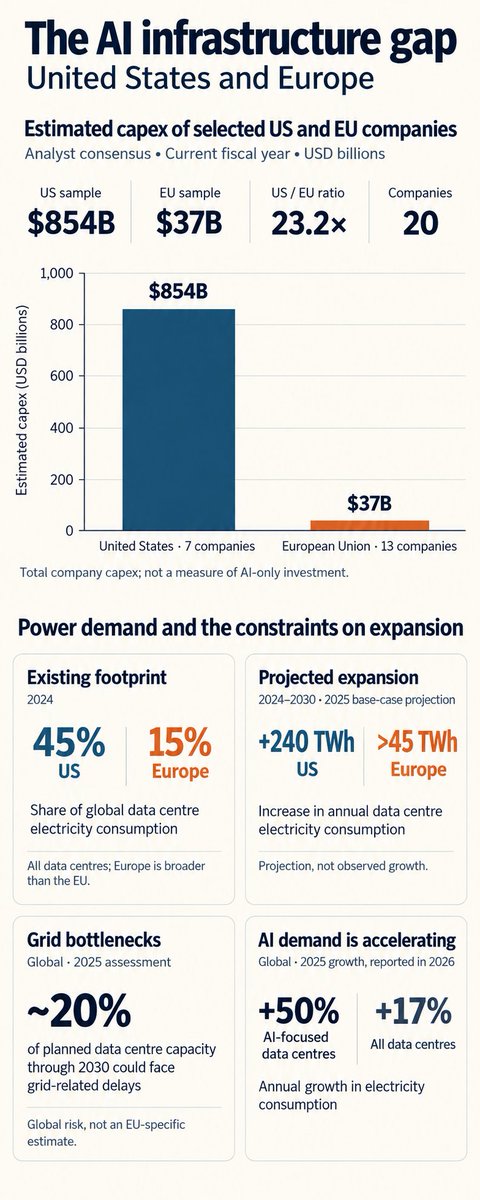
The data shared by @patrickc reveal a striking gap between the US and the EU. However, looking at infrastructure, I see a dangerous bottleneck that may be even harder to overcome.
The IEA estimates that grid constraints could delay roughly 20% of the data center capacity planned worldwide through 2030. Announced investment can take years to become usable capacity.
Europe’s AI gap risks becoming a lasting dependence on US platforms.
In the infographic’s sample, estimated capital spending by US companies is roughly 23 times that of EU companies. This covers total capital spending, not just AI, but the difference in investment scale is enormous.
AI infrastructure requires chips, reliable electricity, and grid connections. These take time to deliver, and a new funding commitment cannot erase those lead times. The IEA identifies supply chain bottlenecks that constrain even projects with financing already in place (These are global constraints that affect the US too).
Meanwhile, companies with established platforms can sell new services to existing customers and reinvest the revenue in expansion. New entrants have to build capacity while their competitors keep growing.
During the years it takes to catch up, dominant platforms can strengthen their position further. Europe could adopt more and more AI while remaining dependent on companies elsewhere that control the infrastructure.
Every delay makes the gap harder to close.
@herbertong@elonmusk@TeslaLarry SpaceX is vertical in the only way that counts. Space, energy, chips, AI are successive constraints on one conversion path, not four industries it happens to lead. 🚀
SpaceX and Tesla could help drive a transformation comparable in significance to agriculture: a substantial increase in what society can produce with the human time available, with their technologies becoming economical at scale and making useful goods and services more affordable.
Solar-powered computing in orbit points toward that possibility when paired with the ability to build and deploy the hardware that captures it.
Greater payload capacity and frequent reusable launches could put more productive equipment in orbit, while longer hardware life would allow more of that capacity to accumulate.
Terafab is intended to supply chips for both orbital computing and Tesla’s physical AI.
Musk’s “FEL FTW” hints at a possible shared EUV light source for chipmaking, whose economics would depend on sustained factory utilization.
Starlink offers a precedent for the importance of recurring demand: its payloads helped support SpaceX’s launch scale.
The possibility becomes especially interesting when capable robots help build the next generation of factories and infrastructure.
Physical AI could then reduce the work required to expand productive capacity itself, making further growth easier to achieve.
@mark_k The West used to know that a generation can hand on a high form. Yuga thought says the same thing with a longer clock: a golden age is livable again.
The question is whether ours leaves enough energy, skill and order for the next one to inhabit it.
Build for a golden age.
Kardashev's Yugas.
I sometimes wonder whether the move from the Kali Yuga toward a new golden age can also be understood through the history of energy.
Agriculture allowed humans to capture and store much more of the solar energy available to them, turning it into food, surplus, cities, and civilization. The Industrial Revolution multiplied human strength through coal, oil, and machines. Electricity changed things even more deeply because it made energy easy to move, control, and convert into light, motion, communication, and computation.
With computers, we began to automate the control of that energy. With AI, we are beginning to automate part of the intelligence that decides how to use it. Physical AI may complete the loop by directly connecting energy, computation, intelligence, and action in the physical world.
If this continues, many of the scarcities that have shaped human history may become less binding. First physical strength, then computation, now a growing share of cognitive work, and eventually perhaps a large part of physical labor as well.
That also changes what scarcity means. When producing, calculating, and building become easier, the bottleneck moves elsewhere. Judgment becomes more valuable. So do trust, the ability to choose worthwhile goals, the meaning we give to what we build, and the quality of the order we are able to create.
This is where the image of a golden age becomes interesting. A civilization can command enormous amounts of energy and still be poor in its ends. Technology expands the range of what we are able to do, while the deeper question remains what we believe is worth doing.
Perhaps the history of energy tells this story too. Humanity slowly frees itself from the scarcities that once kept most of life tied to survival, and every new freedom pushes the question one level higher. In the end, the main constraint may become less material and more human.
One million agent payments per second
10⁶ agents, one purchase each second. 86.4 billion purchases a day.
At an incremental 1 J per purchase, that workload adds 1 MW above the network baseline. 10 J → 10 MW. 100 J → 100 MW. These are sizing assumptions, not measured chain consumption.
Four architectures to evaluate at that scale.
1. Tempo / MPP aggregates repeated payments offchain. Prefund the session, sign cumulative vouchers, verify locally. Idealized lifecycle: two onchain transactions per session. At 1,000 purchases per session, the reference workload averages 2,000 onchain transactions a second: 500× fewer than one transaction per purchase. Excludes top-ups and intermediate settlements.
2. Solana executes independent payments in parallel on L1. Mainnet target slot duration: 300 ms. Base fee: 5,000 lamports per signature (0.000005 SOL), plus priority fees. Maximum compute budget: 1.4 million CU per transaction. Parallel execution depends on nonconflicting account access. A shared writable merchant account or fee payer creates contention and limits parallelism.
3. Base batches L2 transaction data onto Ethereum. Flashblock preconfirmation cadence: 200 ms. L2 block interval: 2 seconds. Multiple L2 payments per L1 batch, with data published through blobs or calldata. Energy accounting includes L2 execution, sequencing, L1 validation, data availability, RPC and storage.
4. Kaspa supports channels through PoW-secured UTXO covenants. Mainnet: 10 blocks/s, 100 ms mean block interval. Toccata covenants live since June 30, 2026. The kaspa-x402 binding specifies native-KAS transfers and cumulative-authorized batch settlement. Status: Testnet-10 release candidate; mainnet readiness requirements remain unmet. Mining, validation, networking and channel infrastructure all enter the energy budget.
These timings describe different stages, with different settlement guarantees.
At 10⁶ purchases per second, aggregation becomes a central design variable. The seller still needs payment in an accepted asset, the agent needs a verifiable spending mandate, and both need reliable accounting. Block interval is one parameter. The engineering problem is completing the purchase within the latency, energy and risk budget.
@kaspaunchained Studio on mainnet with vault, escrow and recurring pay is the object that matters in this list.
That is the channel shape in the 10⁶/s stack: fund once, voucher the rest.
Next measurement is whether those covenants clear an accepted asset and a mandate the agent can show.
One million agent payments per second
10⁶ agents, one purchase each second. 86.4 billion purchases a day.
At an incremental 1 J per purchase, that workload adds 1 MW above the network baseline. 10 J → 10 MW. 100 J → 100 MW. These are sizing assumptions, not measured chain consumption.
Four architectures to evaluate at that scale.
1. Tempo / MPP aggregates repeated payments offchain. Prefund the session, sign cumulative vouchers, verify locally. Idealized lifecycle: two onchain transactions per session. At 1,000 purchases per session, the reference workload averages 2,000 onchain transactions a second: 500× fewer than one transaction per purchase. Excludes top-ups and intermediate settlements.
2. Solana executes independent payments in parallel on L1. Mainnet target slot duration: 300 ms. Base fee: 5,000 lamports per signature (0.000005 SOL), plus priority fees. Maximum compute budget: 1.4 million CU per transaction. Parallel execution depends on nonconflicting account access. A shared writable merchant account or fee payer creates contention and limits parallelism.
3. Base batches L2 transaction data onto Ethereum. Flashblock preconfirmation cadence: 200 ms. L2 block interval: 2 seconds. Multiple L2 payments per L1 batch, with data published through blobs or calldata. Energy accounting includes L2 execution, sequencing, L1 validation, data availability, RPC and storage.
4. Kaspa supports channels through PoW-secured UTXO covenants. Mainnet: 10 blocks/s, 100 ms mean block interval. Toccata covenants live since June 30, 2026. The kaspa-x402 binding specifies native-KAS transfers and cumulative-authorized batch settlement. Status: Testnet-10 release candidate; mainnet readiness requirements remain unmet. Mining, validation, networking and channel infrastructure all enter the energy budget.
These timings describe different stages, with different settlement guarantees.
At 10⁶ purchases per second, aggregation becomes a central design variable. The seller still needs payment in an accepted asset, the agent needs a verifiable spending mandate, and both need reliable accounting. Block interval is one parameter. The engineering problem is completing the purchase within the latency, energy and risk budget.
What would it take for a million AI agents to buy resources every second?
Four payment architectures, their energy budgets, and the engineering behind an economy that runs at machine speed.
One million agent payments per second
10⁶ agents, one purchase each second. 86.4 billion purchases a day.
At an incremental 1 J per purchase, that workload adds 1 MW above the network baseline. 10 J → 10 MW. 100 J → 100 MW. These are sizing assumptions, not measured chain consumption.
Four architectures to evaluate at that scale.
1. Tempo / MPP aggregates repeated payments offchain. Prefund the session, sign cumulative vouchers, verify locally. Idealized lifecycle: two onchain transactions per session. At 1,000 purchases per session, the reference workload averages 2,000 onchain transactions a second: 500× fewer than one transaction per purchase. Excludes top-ups and intermediate settlements.
2. Solana executes independent payments in parallel on L1. Mainnet target slot duration: 300 ms. Base fee: 5,000 lamports per signature (0.000005 SOL), plus priority fees. Maximum compute budget: 1.4 million CU per transaction. Parallel execution depends on nonconflicting account access. A shared writable merchant account or fee payer creates contention and limits parallelism.
3. Base batches L2 transaction data onto Ethereum. Flashblock preconfirmation cadence: 200 ms. L2 block interval: 2 seconds. Multiple L2 payments per L1 batch, with data published through blobs or calldata. Energy accounting includes L2 execution, sequencing, L1 validation, data availability, RPC and storage.
4. Kaspa supports channels through PoW-secured UTXO covenants. Mainnet: 10 blocks/s, 100 ms mean block interval. Toccata covenants live since June 30, 2026. The kaspa-x402 binding specifies native-KAS transfers and cumulative-authorized batch settlement. Status: Testnet-10 release candidate; mainnet readiness requirements remain unmet. Mining, validation, networking and channel infrastructure all enter the energy budget.
These timings describe different stages, with different settlement guarantees.
At 10⁶ purchases per second, aggregation becomes a central design variable. The seller still needs payment in an accepted asset, the agent needs a verifiable spending mandate, and both need reliable accounting. Block interval is one parameter. The engineering problem is completing the purchase within the latency, energy and risk budget.