Building wealth in the stock market is simpler than people think.
Identify critical bottlenecks across industries. Invest in the companies solving them and capture their growth over the medium term.
Then recycle those profits into long-term compounding machines: businesses consistently growing free cash flow and revenue per share, with strong returns on capital.
Use bottlenecks to build wealth. Use compounders to preserve and multiply it.
$QCOM’s $5.137B is handset chip revenue, excluding licensing. For the full year, management cites lower shipments and inventory reductions linked to memory constraints and prices.
That isn’t a numerical Q4 Apple-versus-Android breakdown; the Apple modem transition is discussed as a prospective headwind.
$NVDA’s 22% and 14% measure direct buyers’ shares of total FY26 revenue—not ultimate end demand. The 36% is a sum of reported whole-percent figures.
NVIDIA separately estimates indirect-customer concentration; these disclosures don’t identify a specific deal’s buyer or reseller channel.
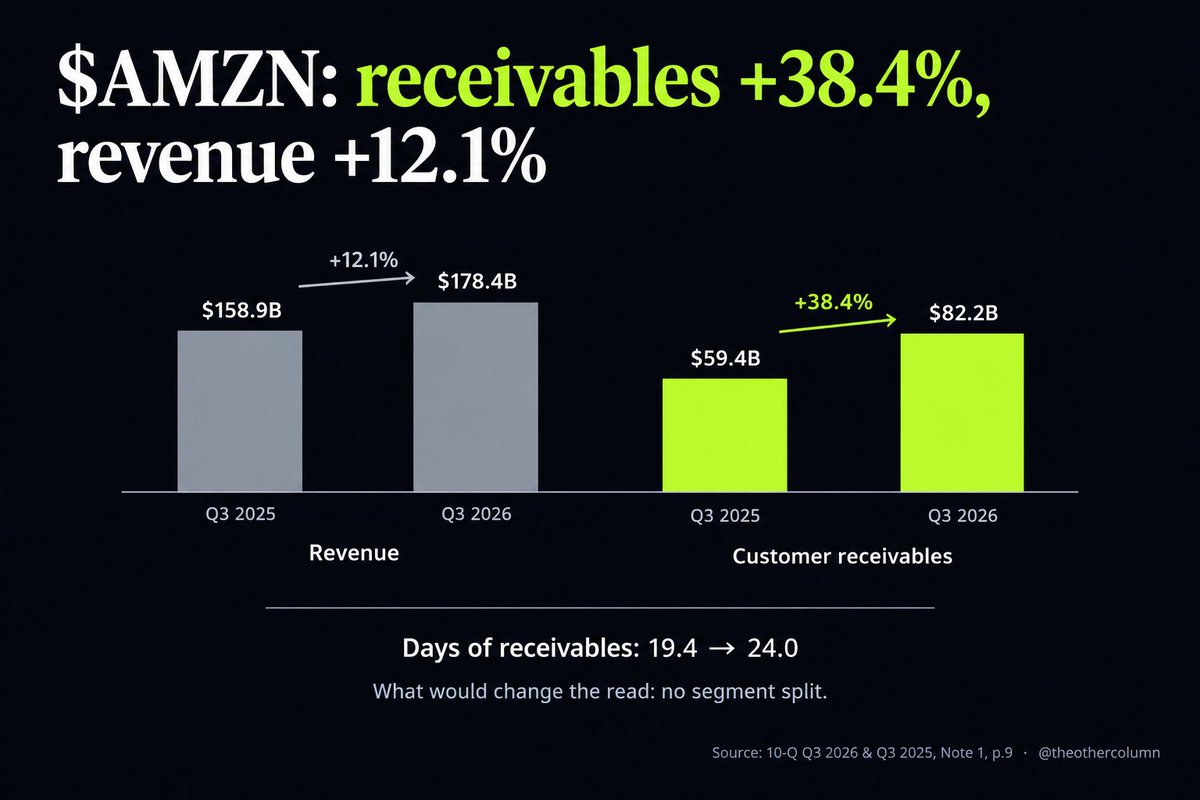
What $AMZN's Q3 receivables say that revenue doesn't.
Revenue: +12.1% y/y. Customer receivables: +38.4%, $38.0B to $52.6B. Days of receivables: 19.4 to 24.0 (my math).
• Vendor receivables: $12.5B to $28.8B
• Other receivables: $3.8B to $9.3B
• The filing gives no cause
Source: 10-Q Q3 2026 and Q3 2025, Note 1, p.9.
What would change the read: receivables aren't split by segment, so a shift toward AWS or enterprise customers on longer payment terms can't be ruled out.
$ORCL expects 13% of RPO within a year; $CSCO, about 49%.
RPO means contracted revenue not yet recognized. Timing matters alongside the total.
• ORCL: $664B at August 31, 2026; about $86B within 12 months (my math).
• CSCO: $46.7B at July 25, 2026; $22.8B short-term.
Source: ORCL Q1 FY27 10-Q, Note 1 p.7; CSCO FY26 10-K, revenue note p.74.
What would change the read: revised recognition schedules or cancellations.
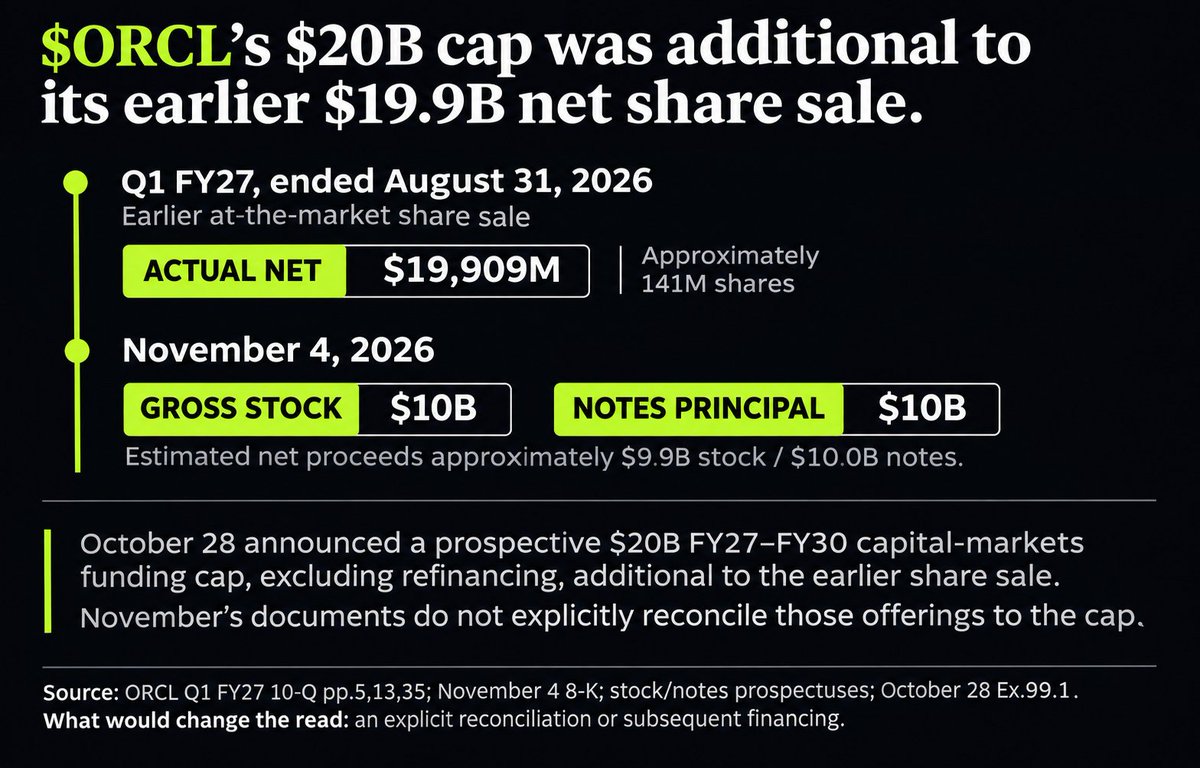
$ORCL’s $20B funding cap was additional to its earlier $19.9B net ATM.
The earlier at-the-market share sale raised $19.909B net. November 4 separately brought $10B gross equity and $10B notes principal.
• The October 28 cap covers FY27–FY30, excluding refinancing.
• November’s documents don't explicitly reconcile the offerings to that cap.
Source: Q1 FY27 10-Q pp.5,13,35; November 4 8-K; October 28 Ex.99.1.
What would change the read: an explicit reconciliation or subsequent financing.
Oracle ($ORCL) completed a $20bn debt and equity raise while cutting upfront capex requirements by 50% across its cloud buildout through three alternative customer contracting models. Management confirmed that no additional capital will be required for this investment cycle after stress-testing downside scenarios against its committed backlog. Under these alternative contracting structures—spanning multi-vendor financing, customer prepayments, and bring-your-own-hardware (BYOH)—vendors leverage balance sheet capacity to win component share while enterprise customers access asset-backed financing and direct hardware discounts. Because cloud infrastructure remains strictly supply-constrained, Oracle maintains full pricing power and attractive unit economics without conceding margin dollars to secure flexible customer deployments.
Analysts estimate that annual capital expenditures will peak at $112.2bn in FY28 before moderating to $95.4bn in FY29, allowing operating cash flow to surge from $31.98bn in FY26 to $98.2bn in FY29. This trajectory supports an estimated turn to positive free cash flow of $2.79bn in FY29, dispelling earlier sell-side expectations that had anticipated up to ~$50bn in external funding needs. With upfront capital commitments halved by vendor and client co-funding, analysts project EBITDA to expand from $38.2bn in FY26 to $112.6bn in FY29. The primary operational risk centers on customer concentration and contract renewals around FY30/31, where ongoing industry-wide memory shortages and two-way commercial commitments will govern long-term infrastructure utilization.
#Oracle #Cloud
Report date: 2026-11-08
On the same free cash flow basis: $MSFT $17.633B; $META −$2.120B.
Both quarters ended September 30, 2026. The original already flags the definition difference.
• Deduct cash property/equipment purchases and finance-lease payments: figures above.
• Deduct cash property/equipment only: $18.633B versus −$1.156B.
• MSFT figures calculated; META’s −$2.120B reported non-GAAP.
Source: MSFT Q1 FY27 10-Q p.6, Note 12 p.22; META Q3 8-K Ex.99.1.
What would change the read: lease-payment scopes that aren't comparable.
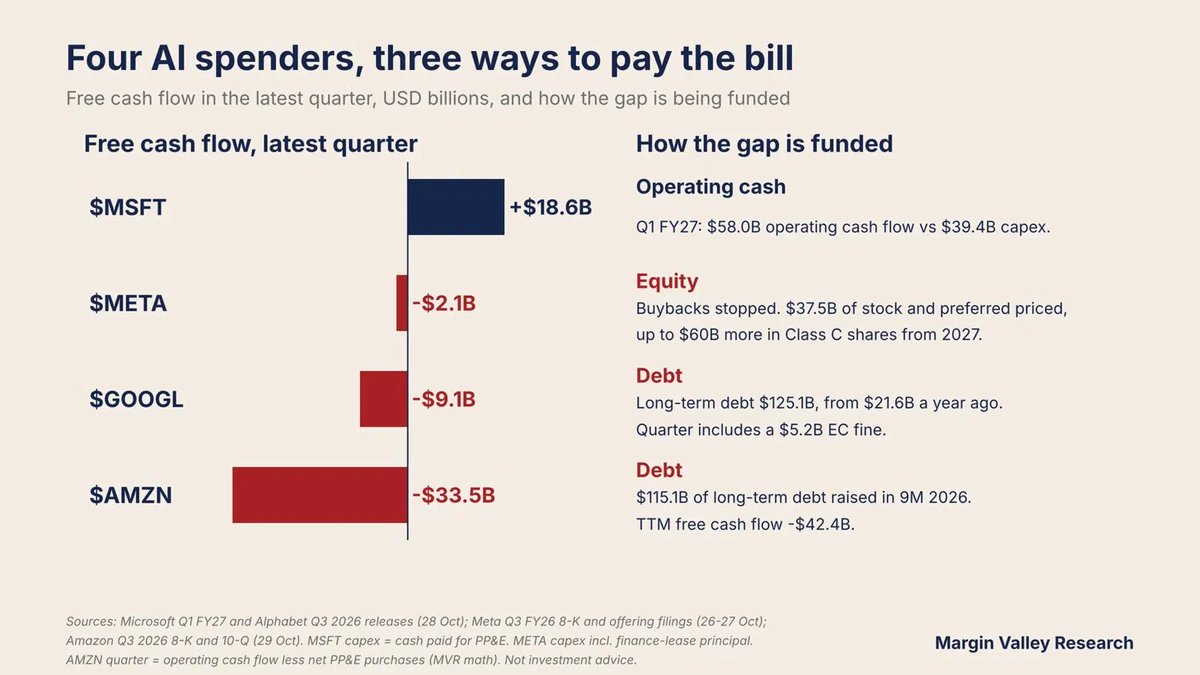
3 AI spenders, and how each one is paying the bill:
$MSFT: Microsoft
Pays from operating cash. Q1 FY27 brought $58.0B of operating cash flow against $39.4B of capex, leaving $18.6B of free cash flow.
$META: Meta Platforms
Free cash flow was −$2.1B last quarter once finance-lease principal is counted. Buybacks have stopped, $37.5B of stock and preferred is priced, and up to $60B of Class C shares can follow from 2027.
$AMZN: Amazon
Free cash flow was −$33.5B in the quarter and −$42.4B over twelve months. $115.1B of long-term debt was raised in the first nine months of 2026.
@JungleReportFi@BacklogAlpha The 10-Q doesn’t say. Note 1 gives timing, not termination rights; risk factors are left to the 10-K. It does show $11.4B of customer prepayments in the quarter, and $288B of data center lease commitments not yet started.
What would change this: termination terms in the 10-K
The Microsoft $MSFT obligation that isn't in its debt number.
Debt: $35.5B. Note 12 lists $364.6B of leases, "primarily for datacenters," that haven't started yet.
• They start FY2027 to FY2034, terms of 1 to 20 years
• Already on the balance sheet: $98.5B of lease liabilities, also outside the $35.5B
• Finance lease cost: $2.47B this quarter, +43.7% y/y
Source: 10-Q Q1 FY27, Note 12, pp.21–22.
What would change the read: how much of the $364.6B is conditional. The filing says "some arrangements" are, without an amount.
What $META has agreed to pay, as opposed to what it owes today.
Debt: $83.7B. Leases not yet started: $355.73B. Other non-cancelable commitments: $454.52B.
• The leases cover data centers, energy, colocations and network
• They start from late 2026 through 2036, terms of over 1 year to 30 years
• $121.41B of the other commitments is due in 2027
Source: 10-Q Q3 2026, p.20 and Note 10, p.21.
What would change the read: whether the data center venture leases sit inside the $355.73B. The filing doesn't say.
$ORCL and $CSCO report the same metric. It doesn't turn into revenue at the same speed.
ORCL: $664B RPO, ~13% recognized in 12 months (10-Q, Aug 31).
CSCO: $46.7B, ~49% (10-K, Jul 25, p.74).
Changes if ORCL's big cloud deals are modified or cancelled.
Let me get this straight.
$TSLA reported $28B revenue (−0.2%) and the stock still sits near $358.
$META grew revenue +26% to $64.6B yet sold off hard.
$MSFT Azure +48%, revenue $92.3B, price ~$531.
$GOOGL Cloud exploded, revenue $127.6B, still got crushed.
$AMZN AWS +39%, revenue $202B, hovering ~$259.
$AAPL beat with $114.5B revenue and $2.10 EPS, trading ~$342.
$NVDA reports November 17.
You know the pattern.
If this helps you, like + follow + share.
(NFA — DYOR)
@convequity ATM Program: $19.9B net proceeds on 141M shares. ORCL 10-Q, quarter ended Aug 31, 2026 (liquidity note). Filing shows that equity raise, not a $10B stock + $10B bond split. Wrong if ATM proceeds are revised.
@MilkRoadStocks Long-term debt $46.5B (Dec 31, 2025) to $125.1B (Sep 30, 2026). GOOG 10-Q balance sheet / debt note.
That is +$78.6B in nine months, not +$103.5B. Wrong if either period's debt line is restated.
@moneyordebt@edzitron China (including Hong Kong): $7.9B of $96.2B revenue (~8%). NVDA 10-Q, quarter ended Jul 26, 2026, geographic revenue note. On the filing's HQ basis that is not 20%. Wrong if a later note puts China above 20% of revenue.
@BacklogAlpha@JungleReportFi $664B in RPO checks out (10-Q Q1 FY27, Note 1). About 13% of it, roughly $86B, is expected as revenue in the next 12 months. 49% lands after month 36.
What would change this: the large cloud contracts behind the jump being modified or cancelled.
$COIN It's not a bank charter. No deposits, no loans. Here's what changes, and what doesn't.
2/ What it is: a federal charter for custody and trust services, replacing a patchwork of state-level oversight. The institutional custody business sits today in a New York-chartered trust company.
3/ What it isn't: a commercial bank. Coinbase has said it won't take retail deposits or do fractional reserve lending. Trust charters typically don't carry FDIC insurance either.
4/ US users: no new deposit protection, and no change to what you hold. The charter is about who supervises custody, not insuring it. What it may unlock is products: Coinbase has named stablecoin issuance, servicing, and payments as next.
5/ Non-US users: I haven't found anything in the announcements that addresses them. Anyone claiming a direct effect is guessing. Check your own entity's terms.
6/ The open risk: a banking-industry lawsuit against the OCC challenges how it reached its reading of the trust charter. A ruling against it would matter to every crypto trust charter, not just this one.
1/ Cisco's $CSCO Q4 GAAP EPS rose 52%. Operating income rose 38%.
The gap sits below the operating line: other income was $822M, vs $53M a year earlier.
It reports Thursday. Here's what I'll check.
2/ Q4 FY26 income statement:
Operating income $4,264M (vs $3,087M)
Pre-tax income $4,933M (vs $2,999M)
Pre-tax income rose $1.93B. Interest and other contributed $757M of that, about 39%. Operations did the rest.
3/ Full year: GAAP net income $13.3B, up 30%.
Operating cash flow $14.2B, which Cisco calls flat.
Net income grew by about $3.1B. Cash from operations didn't move.
4/ The fair read: Q4 revenue +18% to $17.3B, networking orders +40%, $9.3B of hyperscaler AI orders in FY26.
Operating income grew 38% on that. The business isn't the question. The quality of the EPS growth is.
5/ Thursday I'm checking:
- what is inside the $822M of other income (I haven't found it yet)
- whether Q1 operating cash flow tracks net income
- the tax rate: 21.8% in Q4 vs 15.0% a year ago
I'm wrong to flag this if Q1 other income is small and GAAP EPS growth stays within a few points of operating income growth.
Fun fact.
Bezos cheated on his wife and $AMZN has added $2 trillion to its market cap since.
Bill Gates cheated on his wife and $MSFT has added $2 trillion to its market cap since.
Is this a buy signal?
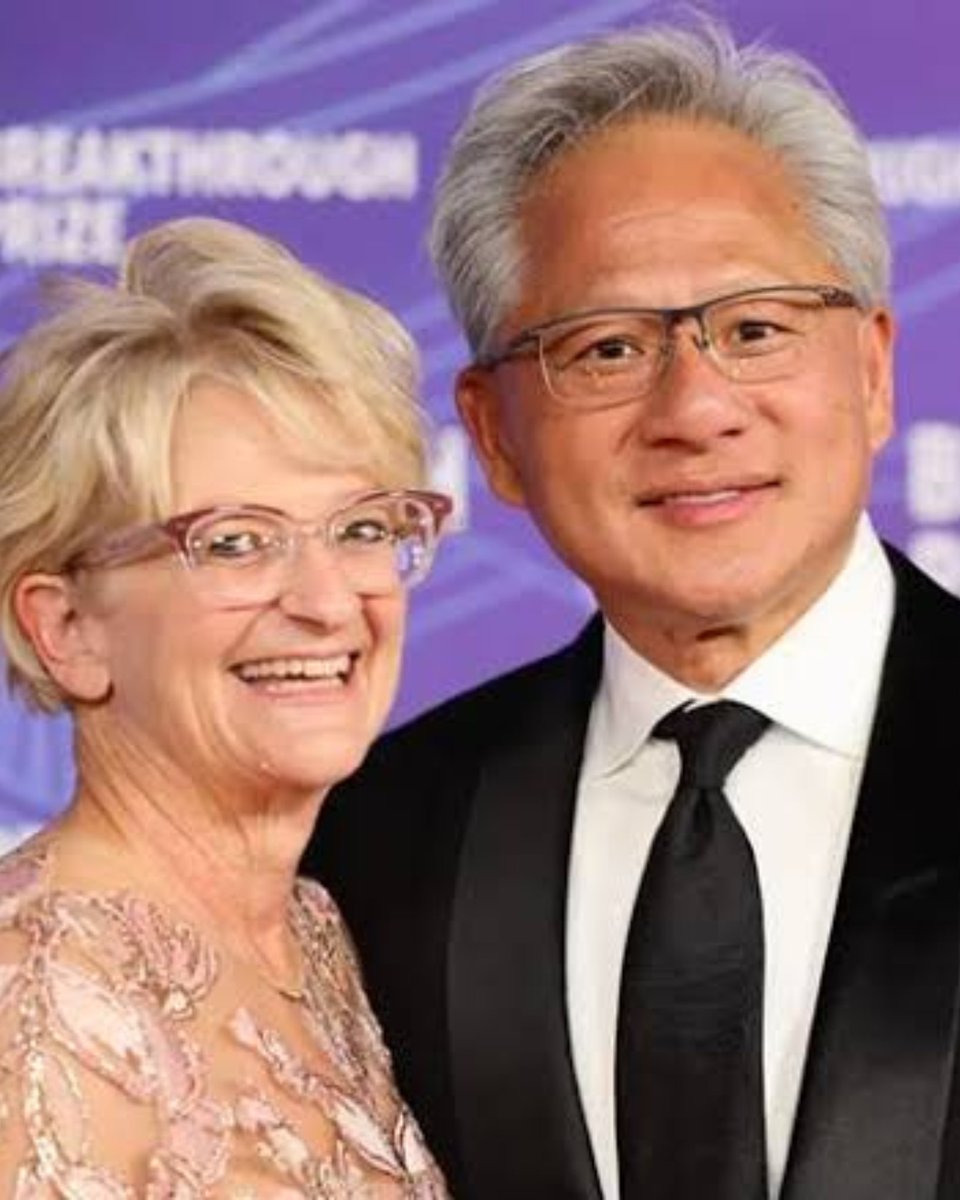
1/ How does Huang’s affair affect $NVDA?
Facts first. On Nov 8 Huang told Nvidia staff he was unfaithful to his wife. The woman is Alice Huang, a Megaspeed executive with no relation to him, whom US officials believe to be a foreign intelligence asset.
The espionage allegation is unconfirmed. Nvidia CEO Jensen Huang admits affair, board to launch investigation.
2/ Nvidia’s board has opened an independent investigation into whether Huang was the target of a foreign intelligence effort. It says it has no reason to believe national security or company secrets were compromised. Sen. Coons has promised a congressional probe.
3/ The price so far: NVDA fell 9.26% to $181.60 on Nov 5, its biggest one-day drop since January 2025. The stated drivers were fears of costlier borrowing and delayed data center builds. The affair isn’t one of them: the FT’s report on the relationship came Nov 7 and the admission came Nov 8, a Sunday.
4/ The fundamentals haven’t moved: six straight quarters of EPS and revenue beats, and fiscal Q3 guidance of $108B that excludes China data center sales. The China-licensing headline risk is largely outside the guided numbers.
5/ My view: a small key-man and governance discount, not a thesis break. Monday’s open is the first real test.
Falsifiable: NVDA underperforms SMH by less than 3% over the next 5 sessions. I’m wrong if the probe finds compromised secrets, Huang steps aside, or Congress moves on chip licensing. Not financial advice.
JUST IN: 🇺🇸🇨🇳 Nvidia $NVDA CEO Jensen Huang sends letter to employees after being targeted by female Chinese spy:
"I was unfaithful to my wife. My actions hurt her and our children. There is no excuse for what I did."
"I am fully committed to NVIDIA and will work to earn back your confidence."