The biggest lesson from the Graham Platner debacle is that both parties have been taken over by the biggest subhuman fucking losers to ever live because losers spend 80 hours a week online and have an infinite amount of time to spend on activism because they don't have friends or family and on the unlikely off-chance they have children they never see them because they aren't allowed within a thousand feet of a school or playground
This country will not return to greatness until slopulist, unemployable losers stop being allowed to think their opinions matter and get shoved back into lockers where they belong
Something good is happening at this World Cup.
The Scots turned up. The English turned up. The Norwegians turned up. They sang their songs, got stuck in, and the Americans loved them for it. Glasgow and Boston are getting twinned off the back of it.
For 30 years we’ve been told to view the US as some sort of Great Satan — all imperialism and orange-man clichés. Not everyone buys it of course, but enough do.
And then Europeans actually go, and find a place that feels familiar. Makes sense to them. A bit richer, a bit further ahead, but recognisably ours. Settled by Europeans, still deeply European in its bones.
There’s a gathering-of-the-clans feeling to it. Old neighbours discovering they still like the same songs, the same drink, the same daft humour, and genuinely enjoying each other’s company.
None of it’s a surprise, really. It’s just been buried under so much politics that we forgot we were allowed to enjoy it.
Good to be reminded.
I would have expected the market to start discerning between SaaS that is impacted by AI, SaaS that needs to evolve, and SaaS that benefits from AI. Analytical SaaS, Creative SaaS is in category 1, System or Record, Human workflow and Engagement and Productivity are in category 2 and Infrastructure SaaS and Cybersecurity are in 3. This constant paranoid reaction of the market will continue to create buying opportunities for the discerning.
Why will AI create more jobs in plenty of industries? It’s because we’re going to use AI to accelerate output in one area, and then eventually you run into a new bottleneck somewhere else in the process that still requires humans.
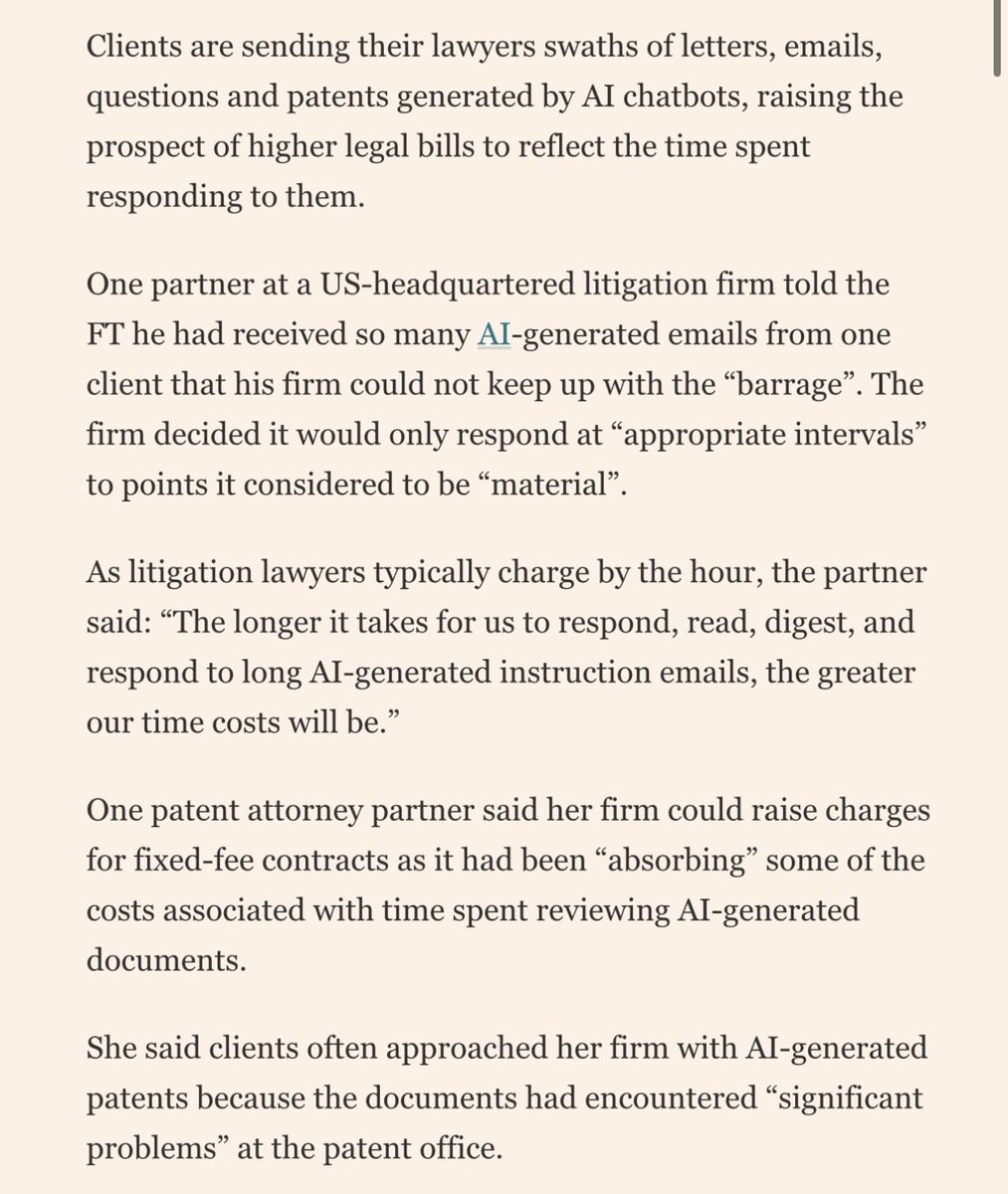
This example from the FT is an obvious one. More people asking legal questions from AI agents, which downstream eventually will mean there are more lawyers being pinged with questions. There are other drivers, too, like AI accelerating new business formation, more patent filings, new scientific research, and so on - all of which eventually land in the laps of lawyers and other regulatory functions.
But the analogy holds for plenty of other work. More code will mean more security risks, which means more security researchers. Automating patient referrals in healthcare just leads to a bottleneck of not having enough doctors. More customer outreach via AI leads to more sales conversations. You can list thousands of categories like this.
There’s a lot of areas where AI will lead to “efficiency” in the sense that we will automate something and then spend less in that area.
But the value proposition taps out at some point because the world isn’t static. Your competitor will use AI to build a better product, go out and meet with even more customers, deliver a better service, run better ad campaigns, and you eventually have to match them or die.
Philippe Laffont @plaffont made an excellent point during his keynote, which is easy to miss if you didn't listen to his presentation and only looked at the slides.
"This [chart] shows that when the market is expensive [based on P/E ratios], five-year forward returns are typically in the bottom quartile. However, there was one gigantic exception since 1950: the period from 1990 to 1998. The market was expensive then, but it saw great returns.
So, we asked, "What happened in the 90s?" In 1990, Dell Computer went up 1,000-fold in 10 years, an approximate 100% annual return, trouncing all other indices. It's those kinds of fast-growing stocks that make an expensive market "go cheap," because as companies and their earnings grow rapidly, the market eventually becomes cheaper over time.
Our view is that AI and the productivity gains we'll get from it will resemble the S-curve growth seen during the rise of the internet and the PC."
If you think people are angry about the Trump 2.0 shitshow now, just wait until average middle-class voters find out that they're going to have to pay higher prices for everything at the store during a self-induced recession that might cost them their jobs.
🥳TMT Breakout reached 1,000 Paying subs Today🥳
In celebration, we are giving away 3 Pro Tier subs ($1.5k each) to 3 people who quote or retweet this post.
We're also removing the paywall from our weekend post: Tactical Bounce? What Tech Stocks to Buy
https://t.co/DNOmCs6762
$MXL/$SIMO is now the funniest merger arb situation of the year.
The deal was viewed as broken by the arb community for a week now, due to Chinese regulatory problems (SAMR). Suddenly, without notice this AM however, it cleared SAMR, paving the way for the deal close.
(1/x)
We now have the three biggest doves of all time at the head of the Fed, Treasury Sec and the head of the President’s economic council. Take a guess how it goes from here
1/ In the second half of the 16th century, Britain plunged into an energy crisis. At the time, the primary source of energy driving the British economy was heat derived from the burning of wood, and Britain was literally running out of trees.




![TMTMoats's tweet photo. Philippe Laffont @plaffont made an excellent point during his keynote, which is easy to miss if you didn't listen to his presentation and only looked at the slides.
"This [chart] shows that when the market is expensive [based on P/E ratios], five-year forward returns are typically in the bottom quartile. However, there was one gigantic exception since 1950: the period from 1990 to 1998. The market was expensive then, but it saw great returns.
So, we asked, "What happened in the 90s?" In 1990, Dell Computer went up 1,000-fold in 10 years, an approximate 100% annual return, trouncing all other indices. It's those kinds of fast-growing stocks that make an expensive market "go cheap," because as companies and their earnings grow rapidly, the market eventually becomes cheaper over time.
Our view is that AI and the productivity gains we'll get from it will resemble the S-curve growth seen during the rise of the internet and the PC."](https://pbs.twimg.com/media/GuUBsxwWsAAKfyU.jpg)