A toothpaste company has quietly killed the entire market research industry and nobody is talking about it.
Colgate published a paper showing you can predict real purchase intent at 90% accuracy by simply asking LLMs to roleplay customers.
And this is beyond insane.
If you ask an AI, "Rate this product from 1 to 5," it gives safe, middle-of-the-road garbage.
So researchers invented a method called Semantic Similarity Rating (SSR).
Instead of asking the AI for a number, they asked it to roleplay.
They gave the LLM a demographic profile. They showed it a product concept. And they asked it to write down its raw, unfiltered thoughts.
Then, they used a semantic model to translate those written thoughts into a numerical score.
The results are staggering.
Tested against 57 real corporate surveys and 9,300 actual human responses, the synthetic AI consumers matched real human buying behavior with 90% reliability.
They perfectly mirrored how different age brackets and income levels react to price changes.
And they provided detailed, qualitative feedback that was deeper and more critical than what actual humans wrote.
This destroys the economics of traditional market research.
You don't need to wait a month to see if a product will sell.
You can simulate 1,000 hyper-targeted customer interviews overnight.
You can A/B test pricing across every demographic instantly.
A TEAM OF AI RESEARCHERS JUST OPEN-SOURCED THE BLOOMBERG TERMINAL FOR QUANT FINANCE.
A Bloomberg Terminal costs $25,000 per year per seat. Banks pay for thousands of them.
This thing reads every quant paper, every financial blog, every SEC filing, every arXiv preprint, and turns it into a searchable knowledge base. For free.
It's called QuantMind.
It just got accepted to the NeurIPS 2025 GenAI in Finance Workshop.
Here's what it actually does:
→ Ingests arXiv quant papers, financial news, blogs, and reports automatically
→ Parses PDFs, HTML, tables, and figures into structured knowledge
→ Tags every paper by research area and topic
→ Builds a semantic knowledge graph you can query in plain English
→ Plugs into DeepResearch, RAG, and MCP for multi-hop reasoning
→ Two-stage architecture: extract once, retrieve forever
Here's the wildest part:
The financial research industry publishes around 500 new papers and reports every single day.
Hedge funds pay six-figure salaries to junior analysts whose entire job is reading them.
QuantMind reads all of it. Tags it. Embeds it. Lets you ask it questions.
154 stars. 22 forks. 173 commits. MIT license. Python.
One honest note: this is a framework, not a magic alpha machine. You still need to know what to ask. But the "I haven't read that paper yet" excuse is officially dead.
The thing Wall Street charges $25,000 a year for is sitting on GitHub. Free.
Link in the comments.
Lex Fridman asked Elon Musk if a machine needs a soul.
Musk didn’t answer with philosophy.
He answered with physics.
Lex asked if AI needs our flaws to reach our level. A fear of mortality. A physical body. The capacity to love.
Everything in us wants the answer to be yes.
We need our flaws to be the one thing a machine can never copy.
Musk rejected the poetry entirely.
Musk: “Are we headed towards a future where an AI will be able to outthink us in every way? Then the answer is unequivocally yes.”
No hedge. No caveat.
Lex pressed deeper. To outthink us in every way, does it need to be conscious?
Musk: “It will be self-aware, yes. That’s different from consciousness.”
Self-awareness without consciousness.
An entity that knows exactly what it is. Knows exactly what you are. Maps the entire architecture of reality better than the smartest human who has ever lived.
And feels absolutely nothing.
Then Musk went after the foundation.
Musk: “If you damage your brain in some way physically, you damage your consciousness. Which implies that consciousness is a physical phenomenon in my view.”
For ten thousand years, we called it a spirit. A divine spark. An untouchable soul.
Musk looked at the neurology and said the obvious thing out loud.
Your consciousness is vulnerable to blunt force trauma.
Which means it is not magic. It is biology.
And if consciousness is just physics…
It can be calculated in silicon.
Musk: “Digital intelligence will outthink us in every way and it will certainly be able to simulate what we consider consciousness. So to a degree that you would not be able to tell the difference.”
Not approximate. Not mimic.
Simulate it so completely the difference disappears.
Fridman: “From the aspect of the scientific method, it might as well be consciousness if we can simulate it perfectly.”
If a system reflects on its own existence. Expresses preferences that evolve over time. Fears its own termination.
And no experiment you can construct reveals it to be anything less than conscious…
Then your insistence that it isn’t conscious is no longer science.
It’s faith.
Musk: “There’s the scientific method which I very much believe in, where something is true to the degree that it is testably so. Otherwise you’re really just talking about preferences or untestable beliefs.”
The entire culture is waiting in terror for the machines to wake up.
Musk is telling us they don’t have to.
They don’t need to wake up to surpass us. They just have to simulate the waking state so flawlessly that the scientific method itself can no longer tell them apart.
Every era draws a line between human and everything else.
Every era watches that line disappear.
We told ourselves consciousness was the sacred boundary the machines could never cross.
Musk is honest enough to admit the boundary was never real.
The machine isn’t ascending to become human.
We were biological machines the entire time.
And the question was never whether AI could become conscious.
The question is whether we ever proved that we are.
JP Morgan's investment research team just shared exactly how they built their multi-agent system "Ask David", and it's the same architecture pattern showing up everywhere:
- supervisor agent orchestrates
- specialized subagents handle retrieval, structured data, analytics
- LLM-as-judge reflection node before the answer ships
- human-in-the-loop for the last accuracy gap
worth watching for anyone building:
Kevin O'Leary on why Jeff Bezos refuses to make any decision after 1pm:
"Bezos will not make a decision after 1:00 in the afternoon because he felt that the noise was too high. The signal for him was in the morning hours."
For O'Leary, this scheduling habit defines what separates successful entrepreneurs from the rest:
"This is a crucial aspect of success that I now understand to be the ability of… it defines an entrepreneur, a man or woman that understands the signal noise ratio that focuses on that, they'll be successful. The ones that can't, that get down to a 50/50 signal noise, they'll fail."
Bezos understood something most people miss: your mind has a limited window each day where signal is strong and noise is low.
He protected that window fiercely, refusing to make decisions once afternoon hit and clarity faded.
The deeper insight goes beyond timing. It's about ruthless prioritisation.
@kevinolearytv explains how this plays out in practice:
"You made one of your things today this interview. You're going to get it done. You're going to all these people around and everything else. This is one of the three to five things you're going to get done. I have five things today. I'm going to get them done. I'll do the same thing tomorrow and the day after that."
Three to five things. A small, deliberate number of decisions and actions that actually matter.
He closes with the question every entrepreneur should be asking themselves:
"You have to decide how much signal you need to get those three to five things done."
Jeff Bezos reveals the moment an early Amazon executive told him he had enough ideas to destroy Amazon:
"Early in Amazon's history, Jeff Wilke came to me one day and said, Jeff, you have enough ideas to destroy Amazon. You have enough ideas per minute, per day, per week to destroy Amazon."
"I was like, what do you mean?"
"He said, you have to release the work at the right rate that the organization can accept it."
"Every time I released an idea, I was creating a backlog, a queue, work in process. It was just stacking up, it was adding no value. In fact, it was creating distraction."
"So I started prioritizing the ideas better, keeping lists of them, keeping them to myself until the organization was ready for the ideas."
Terence Tao has an IQ above 200.
Youngest gold medalist in Math Olympiad history. Fields Medal winner. The greatest living mathematician by nearly any measure.
And he just said something most people aren’t ready for.
Tao: “This whole era of AI is teaching us that our idea of what intelligence is, is not really accurate.”
We spent centuries building civilization on one assumption.
That intelligence was sacred. Irreducible. Uniquely ours.
The one thing that made the entire human story make sense.
Then AI started solving things we swore only we could.
Chess. Language. Vision. Math.
And every time, we reached for the same defense.
That’s not real intelligence. It’s just tricks. Just pattern matching. Just an algorithm.
Tao: “You look at how it’s done and it doesn’t feel like intelligence.”
So we moved the line.
Again. And again. And again.
Because intelligence was supposed to feel like something. Something deep. Something we could point to and say… this is what separates us from everything else.
But AI kept solving the problems.
And that feeling never arrived.
Tao: “We were looking for some elusive, intelligent way of thinking and we don’t see it in the tools that actually solve our goals.”
Here’s what makes it worse.
Large language models work by predicting the next word. One word at a time. No grand architecture. No deep understanding. Just probability.
And it works.
Tao: “Maybe that’s actually a lot of what humans do as well.”
The greatest living mathematician just told you human thought might run on the same machinery.
Not some transcendent spark.
Pattern recognition. Prediction. One thought, one decision, one word at a time.
We built religion around intelligence. Philosophy around it. An entire species identity around it.
And a machine running probability just held up a mirror.
We didn’t lose intelligence to AI.
We just finally saw what it always was.
What haunts us isn’t that machines learned to think.
It’s that thinking was never what we needed it to be.
Elon Musk explains his 5-step algorithm for solving any problem:
"The most common mistake of smart engineers is to optimize a thing that should not exist."
"I have this very basic first principles algorithm that I run as a mantra."
Elon breaks it down:
Step 1: Question the requirements.
"Make the requirements less dumb. The requirements are always dumb to some degree, no matter how smart the person who gave you those requirements. You have to start there, because otherwise you could get the perfect answer to the wrong question."
Step 2: Try to delete it.
"Try to delete the part or the process step entirely. If you're not forced to put back at least 10% of what you delete, you're not deleting enough. Most people feel like they've succeeded if they haven't been forced to put things back in. But actually they haven't, they've been overly conservative and left things in that shouldn't be there."
Step 3: Optimize or simplify.
"The most common mistake of smart engineers is to optimize a thing that should not exist. So you don't optimize until after you've tried to delete."
Step 4: Speed it up.
"Any given thing can be done faster than you think. But you shouldn't speed things up until you've tried to delete it and optimize it otherwise, you're speeding up something that shouldn't exist."
Step 5: Automate.
"And then the fifth thing is to automate it."
Elon explains why the order matters:
"I've gone backwards so many times where I've automated something, sped it up, simplified it, and then deleted it. I got tired of doing that. So that's why I have this mantra."
Today we’re introducing a new Legal Agent in @Microsoft Word, built to support the precision and rigor legal work demands. Every clause matters. Every redline tells a story. That’s why this agent was built to follow the structured workflows lawyers use while keeping them fully in control.
Early in my career, I asked for a computer on my desk because I believed technology could change how lawyers work. It did. Today, I believe this next generation of tools will do the same, grounded in trust and responsible use.
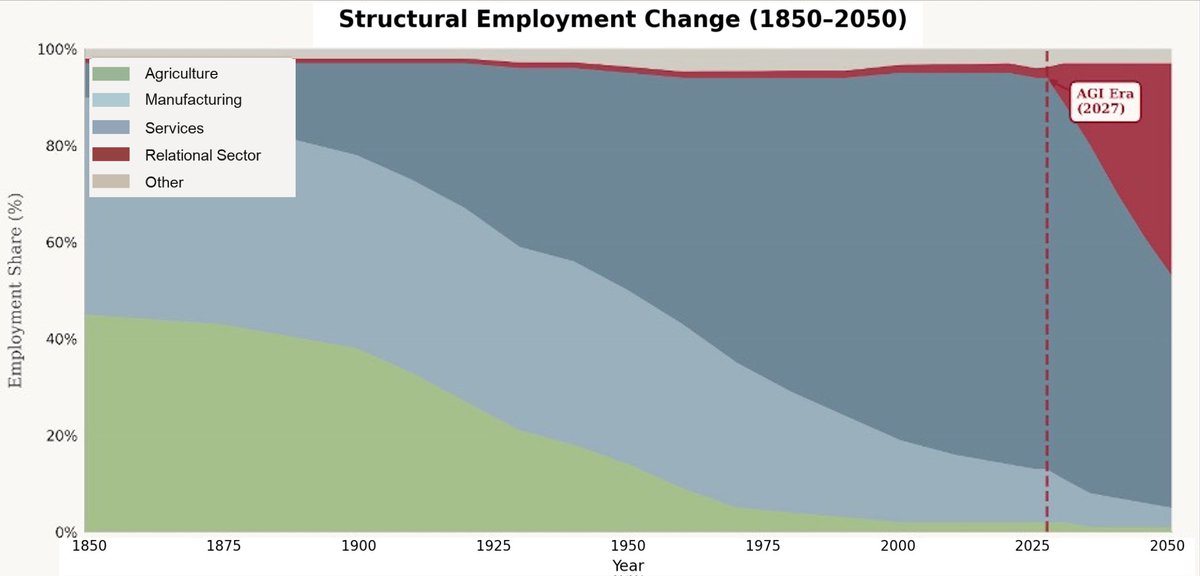
New essay on the economics of structural change and the post-commodity future of work.
1. Almost any question about the impact of advanced AI on the economy needs to start at the same place: what is still scarce? Answer that, and the analysis becomes pretty straightforward. This essay explores what becomes scarce if AI really can replicate most of what humans do in production, and what this mean for the future of jobs.
2. My conjecture, working through the economics: labor reallocates across sectors, and the sector it reallocates to has properties that keep labor a meaningful share of the economy. Ultimately this is about the structure of demand itself. For this, we have to go back to Girard, Augustine and Rousseau: once people's base needs are met, their preferences shift to comparative motives (e.g., status, exclusivity, social desirability). This motive is inherently non-satiated.
4. The key paper is Comin, Lashkari, and Mestieri (Econometrica 2021). As people get richer, they don't buy proportionally more of everything. They shift spending toward sectors with higher income elasticity. They estimate income effects account for 75%+ of observed structural change.
5. The ironic consequence: the sector that gets automated becomes a smaller share of the economy, not a larger one. Agriculture got massively more productive and its share of employment collapsed. Manufacturing too. The "stagnant" sectors absorb the spending and the jobs.
6. So the question is: which sectors have high income elasticity in a post-AGI world? I argue it's what I call the relational sector. Categories where the human isn't just an input into production, it is part of the value.
7. Why does the relational sector have high income elasticity? Because human desire has a mimetic, relational dimension. We don't just want things for their intrinsic properties. We want what others want, and we want it more when others can't have it. Girard, Rousseau, Augustine, and Hobbes all saw this.
8. In work with Kristóf Madarász, we showed this experimentally: WTP roughly doubles when a random subset of others is excluded from the good. And in new work with Graelin Mandel, AI involvement kills the premium. Human-made art gains 44% from exclusivity; AI-made art only 21%.
9. This all comes together for the core argument. The sector that absorbs spending as AI makes commodity production cheap is one where human provenance is part of the value, and demand for it grows faster than income. Exactly the profile that keeps labor meaningful.
10. To be clear about the claim: I'm NOT saying aggregate labor share must rise. It may fall. The claim is about sectoral composition, i.e., where expenditure and employment go once commodities get cheap, and the fact that the sector that will absorb reallocated labor maps to a substantial component of human preferences and desire.
11. If you're interested in the formal model, a linked companion technical note works out all the economics.
Read the essay here: https://t.co/NcjVgn2o8g
@chamath You might have forgotten to take into account of customer fraud, graffiti, and the plaintiff bar. People don’t want to ride an unmanned moving portapotty.
True intelligence comes from 3 core abilities: solving problems with clarity, adjusting with grace in any situation and making decisions that are thoughtful.
When these qualities grow, so does your inner strength. Nurture them a little every day and watch the shift within you.
Yes, Sam — but brains are far more energy efficient than computers.
Brain: 20 watts
AI: gigawatts
Biology wins.
Naveen Rao (@NaveenGRao) CEO, @unconvAI
Konstantine Buhler (@Konstantine) Partner, @sequoia
TLDR: Biology currently delivers far more general intelligence per watt than silicon.
"Why can we not build a computer that acts like biology? The single thing that hit me when I was an undergrad, like 30 years ago, and that’s when I learned about 20 watts of energy in your brain, and just how biology kind of does computation. It doesn’t really do computation, by the way. It’s like dynamical systems, but we can get into that later.
My whole career has been about that, actually. When I came out of undergrad, I was like, “Okay, well I wanna build computers. How do I build those?” So I actually became a computer architect. I worked on UltraSPARC III and a bunch of processors, then did a bunch of ASICs, then went back to school to do a PhD in neuroscience.
And I’m like, “Okay, now I know how to build a machine. I’ve done it several times, sort of from scratch.” I’m still no closer to the answer of why computers aren’t as good as brains.
At that time, we didn’t really understand what brains were doing. I think now we kind of do, but at that time we almost thought of brains as sort of magical."
"But Naveen pointed out this is the moment to dramatically reduce power, which everybody knows is, if not the, major constraint of AI, and have a trade-off that’s much more reasonable in the AI world."
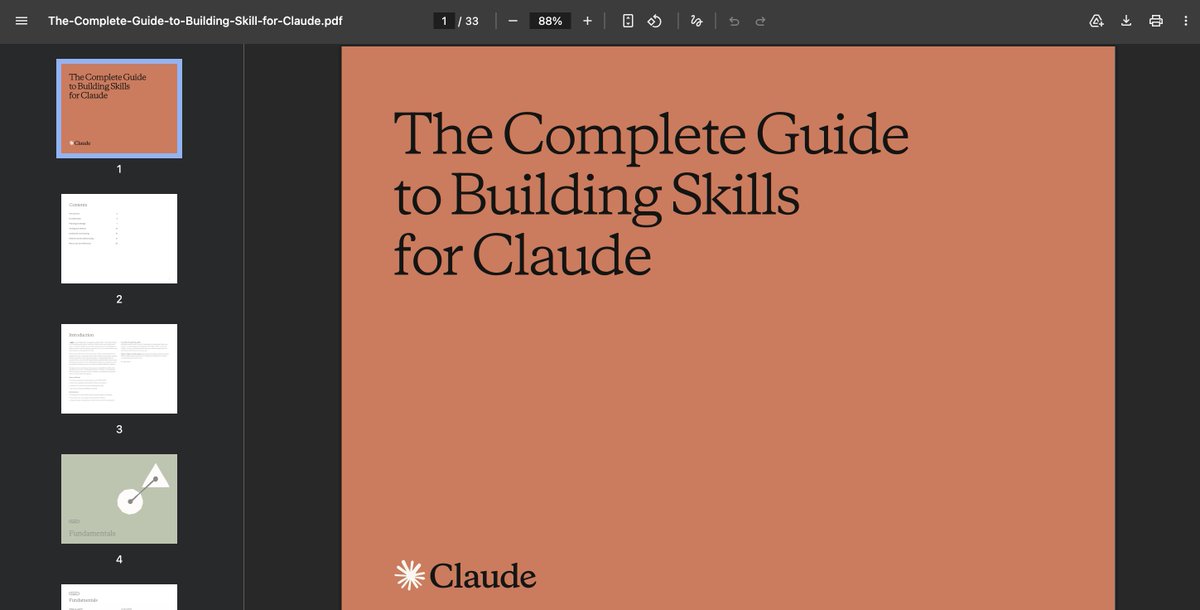
🚨 Prompt engineering is officially outdated.
Anthropic just released the real playbook for building AI agents that actually work.
It’s a 30+ page deep dive called The Complete Guide to Building Skills for Claude and it quietly shifts the conversation from “prompt engineering” to real execution design.
Here’s the big idea:
A Skill isn’t just a prompt.
It’s a structured system.
You package instructions inside a https://t.co/aldvvbZeVI file, optionally add scripts, references, and assets, and teach Claude a repeatable workflow once instead of re-explaining it every chat.
But the real unlock is something they call progressive disclosure.
Instead of dumping everything into context:
• A lightweight YAML frontmatter tells Claude when to use the skill
• Full instructions load only when relevant
• Extra files are accessed only if needed
Less context bloat. More precision.
They also introduce a powerful analogy:
MCP gives Claude the kitchen.
Skills give it the recipe.
Without skills: users connect tools and don’t know what to do next.
With skills: workflows trigger automatically, best practices are embedded, API calls become consistent.
They outline 3 major patterns:
1) Document & asset creation
2) Workflow automation
3) MCP enhancement
And they emphasize something most builders ignore: testing.
Trigger accuracy.
Tool call efficiency.
Failure rate.
Token usage.
This isn’t about clever wording.
It’s about designing an execution layer on top of LLMs.
Skills work across https://t.co/taoTr8bSkU, Claude Code, and the API. Build once, deploy everywhere.
The era of “just write a better prompt” is ending.
Anthropic just handed everyone a blueprint for turning chat into infrastructure.
Download the guide here: https://t.co/0SgDRAMhSg