My top @ASH_hematology#ASH26 abstracts for plasma cell disorders including myeloma and AL amyloidosis #mmsm@utswcancer
5⃣IEC-Enterocolitis after cilta-cel (US Myeloma Immunotherapy Consortium)
➡️Commercial cilta-cel, n=1,793 across 23 sites.
➡️Incidence: 3.0% (55 cases), rising each year from 1.8% (2022) to 3.9% (2025) as recognition improves. Median onset was day 96.
🛑No predictors. It was associated with higher odds of other toxicities( parkinsonism and cranial nerve palsy)
Important data given the safety signal. 56% of affected patients died, 29 of 31 without myeloma progression, and 12-mo non-relapse mortality was 51%
In tiefer Trauer nehmen wir Abschied von Herbert Blomstedt. Unser ehemaliger Gewandhauskapellmeister & Ehrendirigent ist heute, am 04.11.2026, im Alter von 99 Jahren in Göteborg verstorben. Wir verneigen uns in tiefer Dankbarkeit vor seinem Lebenswerk. Sie werden uns fehlen.
Anyone interested in cancer medicine needs to see the current front page of @NEJM
https://t.co/0cD1Skeabp
It's one historic advance after another after another on there right now
Extraordinary scene in the Atacama desert of South America.
Historically one of the world's driest locations has been completely transformed by heavy El Nino rain, leading to the proliferation of stunning flowers from long-dormant seeds.
Hi all,
The Lp(a) HORIZON trial has released topline data and, quite shockingly, missed its primary endpoint.
In other words, lowering Lp(a) in patients with prior MI, stroke or peripheral arterial disease, who were otherwise very well treated for LDL-C, blood pressure, diabetes and other risk factors, did not reduce the primary cardiovascular endpoint.
We obviously need to see the full data before making firm conclusions, and I don’t want to speculate too much without the details.
But this is a big enough result that it is worth summarizing what we know, what we don’t know, and what this may mean for our patients after 20+ years of trying to test the “Lp(a) hypothesis.”
What we know:
1-There are hundreds if not thousands of genetic, epidemiologic and Mendelian-randomization studies showing that elevated Lp(a) is associated with MI, stroke, peripheral arterial disease and aortic stenosis. That body of evidence is very strong.
2-However, much of those data come from community-based populations, often before the era of intensive LDL-C lowering and modern secondary prevention.
3-There has been much less information about how much residual risk Lp(a) carries in someone who has already had an event and is then treated very aggressively.
4-HORIZON may have had some of the best-treated patients of any recent cardiovascular outcomes trial.
Baseline LDL-C was about 65 mg/dL, a measured LDL-C contains the cholesterol carried on Lp(a), so in reality, 15-20 points lower.
5-In patients with very high Lp(a), if you correct LDL-C for Lp(a)-cholesterol, the actual LDL-C carried by LDL particles may have been closer to 45–50 mg/dL, perhaps even lower in some patients.
6-This raises a very basic question:
Can you still demonstrate a major incremental benefit from lowering another apoB-containing particle when the underlying LDL burden has already been driven this low?
What we don’t know:
1-What was the actual corrected LDL-C in these patients? I think it would be extremely informative to directly measure Lp(a)-C and calculate corrected LDL-C. This may tell us a lot about the biological setting in which pelacarsen was being tested.
2- What was the OxPL status? Our prior work has suggested that much of the pro-inflammatory biology associated with Lp(a) is related to its enrichment in oxidized phospholipids. Did OxPL fall? Did patients with higher OxPL derive more benefit? Was Lp(a) concentration actually identifying the patients with the most pathogenic particles?
3- Did we measure the right component of Lp(a) for trial inclusion? We generally measure molar particle concentration. But is molar concentration itself the main driver of risk, or is it partly a surrogate for what the particle carries? Cholesterol? Triglycerides? Oxidized phospholipids? Other proteins? Could two patients with the same Lp(a) concentration have very different Lp(a)-mediated risk? I think this question deserves much more attention.
3- Were the genetic data telling us exactly what we thought they were telling us? The genetic data are extremely compelling, but genetics reflect lifelong exposure. A clinical trial treats patients late in life, often after decades of arterial injury and after an event has already occurred. Those are not necessarily the same experiment. Could there also be some unrecognized biology linked to the LPA locus that we have not completely accounted for? That possibility should at least be considered.
3- Does very low LDL-C modify the Lp(a) risk relationship? Maybe Lp(a) is particularly important when LDL-C is higher, but its contribution becomes smaller once LDL-C is driven to very low levels. Again, we need the data.
4- Does aspirin or other antiplatelet therapy reduce part of the risk associated with Lp(a)? Lp(a) has potentially important prothrombotic effects. Almost everyone in a trial like HORIZON is receiving contemporary antiplatelet therapy. Could that blunt one component of the risk associated with Lp(a)?
5- Why are these patients still having events? This may be one of the most interesting questions of all. These are patients with LDL-C around 65 mg/dL, and perhaps corrected LDL-C substantially lower, yet cardiovascular events continue to occur. What is driving that residual risk? Inflammation? Thrombosis? Plaque burden that is already too advanced? Other lipoprotein characteristics? Something we are not measuring?
6- Do we need to re-examine some basic assumptions about atherosclerosis? We have spent decades focusing heavily on the quantity of circulating lipoproteins. But perhaps lipoproteins are relatively benign until they undergo biological modification in the artery wall. Oxidation may be one of those key modifications. For some patients, the answer may be to remove more particles from the circulation. For others, perhaps the better approach is to prevent their oxidation or block the downstream biological effects of oxidized lipids. The recent difficulties with anti-inflammatory approaches, including IL-6 inhibition, make these mechanistic questions even more interesting.
7- Was there something specific about pelacarsen, the degree or timing of Lp(a) lowering, advanced disease, trial duration, background therapy or patient selection that mitigated a potential benefit? We simply don’t know yet. That is why the detailed results will be so important.
What does this mean for patients today?
If you have already had an MI, stroke or PAD, the immediate lesson is very clear:
1- Get all of your established risk factors treated aggressively.
2- Get LDL-C/apoB very low.
3- Control blood pressure.
4- Control diabetes.
5- Don’t smoke.
6- Use appropriate antiplatelet and other guideline-directed therapies.
HORIZON shows us what modern secondary prevention should look like.
If you have elevated Lp(a) but have never had an event, the genetic and epidemiologic data still suggest increased lifetime risk.
Until the other 4 outcome trials read out, I would continue to treat every modifiable risk factor aggressively.
We should wait for those trials before drawing broad conclusions about the entire field.
I think the story of Lp(a) therapy is beginning, not ending.
We also need to show tremendous respect and gratitude to the patients who participated in HORIZON and to the investigators and companies that invested enormous resources to actually test the Lp(a) hypothesis, to the ultimate benefit to peole with elevated Lp(a) to best guide how to manage risk.
More to come as we go forward.
Here you can see how important phase III trials are. Preclinical rationale, early results - almost everything was in favor of pelacarsen. RIP.
https://t.co/BrYhyEaPg2
Profound sorry that my mentor, friend, and colleague, the legend Bob Kyle passed away. His contributions to patients, medicine, myeloma, @IMFmyeloma@MayoClinic myeloma group, and the institution are monumental. A role model who will be remembered for his integrity and commitment to patients. I owe my career to him. He leaves behind a legacy of experts at Mayo Clinic as well as world over who were influenced greatly by him.
See thread for links to a video an article on him that I wrote for @MayoProceedings
Post your memories below.
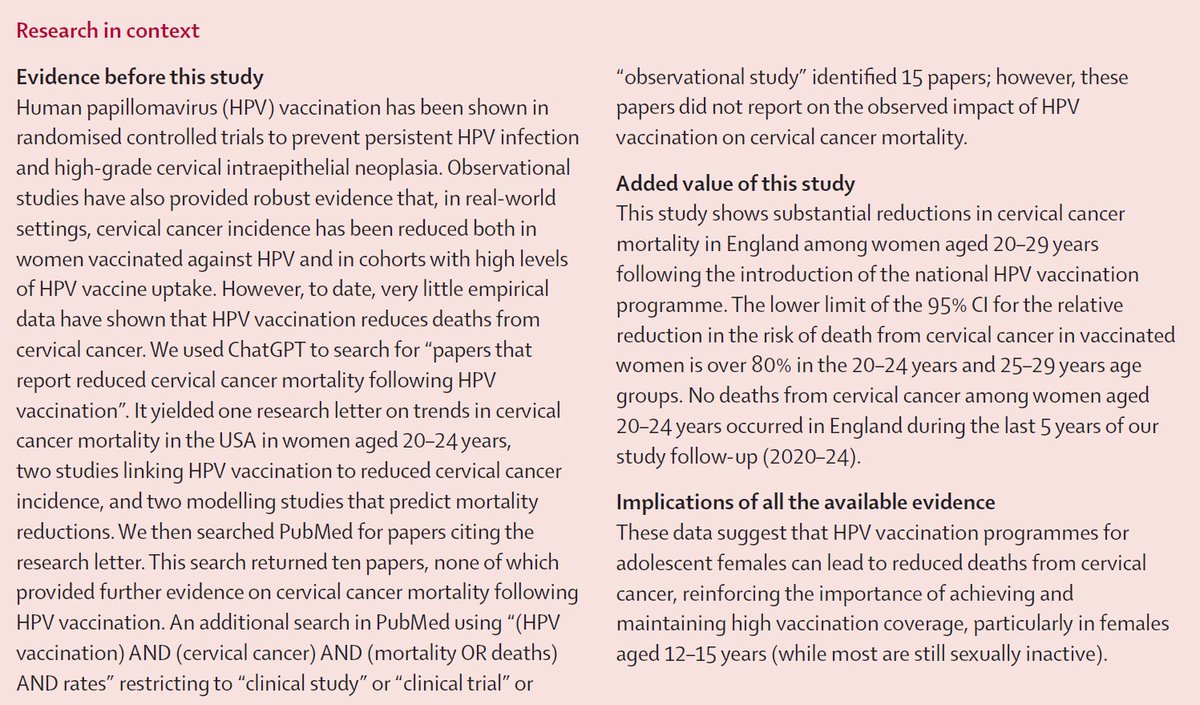
ICYMI - HPV vaccination linked to drastic reduction in cervical cancer deaths for young women in England, finds observational study in The Lancet.
Explore the research: https://t.co/ON1BIUCQo8
MajesTEC-4 was the most fascinating study reported at EHA 2026 for me.
Not because 100% MRD negativity (10⁻⁵) was achieved.
What truly caught my attention was the magnitude and speed of CR/sCR conversion.
After ASCT, CR/sCR rates were approximately 25-40%.
Within 6-12 months of Tec-based maintenance, CR/sCR approached 100%.
That is breathtaking.
MASTER, CASSIOPEIA, and PERSEUS established an extraordinarily high bar. MajesTEC-4 is now challenging those landmark studies despite being an early run-in cohort of ~90 patients.
The deeper question is not whether teclistamab is active.
We already know it is.
The question is why it appears so active in the post-ASCT setting.
Where do the effector T cells come from?
Are they predominantly reinfused with the autograft?
Do the classic Mayo observations linking early lymphocyte recovery to superior outcomes offer a clue?
Perhaps ASCT is doing more than cytoreduction.
Perhaps maintenance is doing more than maintaining.
Step by step.
Trial by trial.
Not only are responses becoming deeper.
More patients are achieving them, and they are achieving them faster.
#EHA26 #MultipleMyeloma #ASCT #MRD #Myeloma
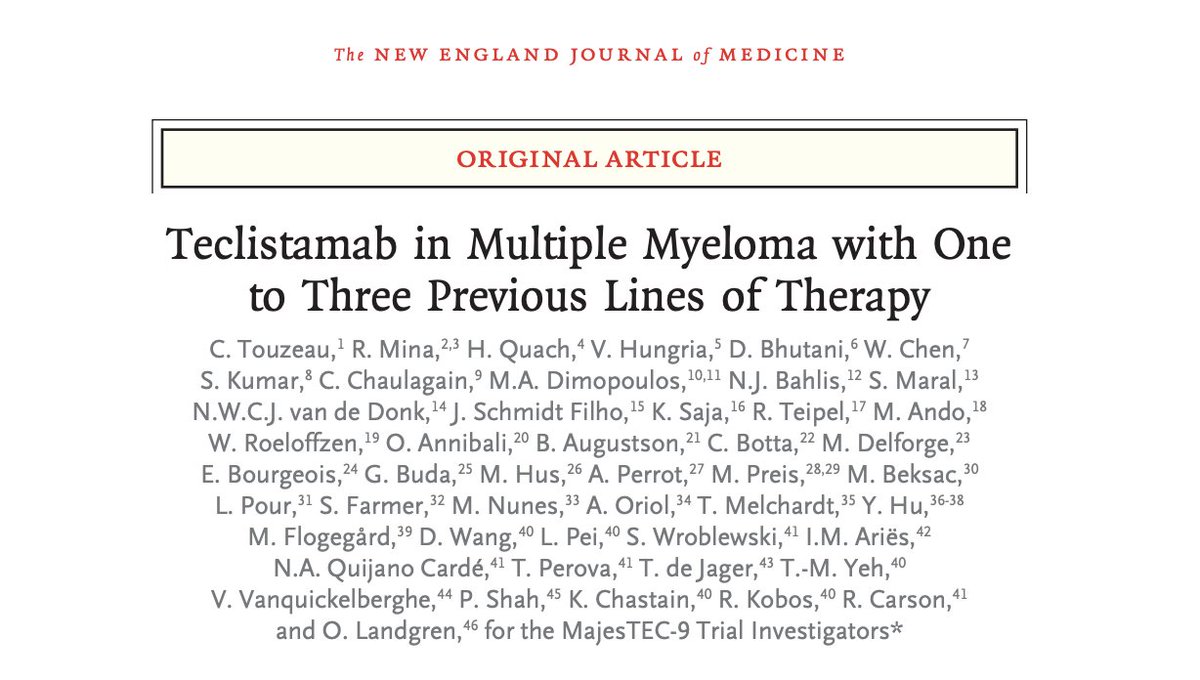
#ASCO26@ASCO MajesTEC-9 @NEJM#mmsm
Teclistamab monotherapy vs PVd/Kd in RRMM with 1-3 prior lines (all lenalidomide + anti-CD38 exposed)
➡️Median follow-up: 17 months
➡️sCR 54% vs 9%
➡️18-mo PFS 70% vs 27% (HR 0.29)
➡️18-mo OS 79% vs 69% (HR 0.60)
➡️190/291 (~2/3) still on drug at cutoff
🛑Grade 3/4 infections in 42%.
https://t.co/475mG020cf
Exciting times
🧵
Why do pts progress on epcoritamab? EPCORE NHL-1 paired biopsies
61% of progressors lost CD20: MS4A1 mut (58%) or transcriptional silencing (17%).
39% kept CD20 but lost intratumoral CD3+ T cells.
Antigen escape or T-cell failure: map the mechanism, choose the next tx. #EHA2026
#News for #Investors and #Media: The U.S. FDA has granted accelerated approval for our foundational BCL2 inhibitor in relapsed/refractory mantle cell lymphoma �� the first and only in R/R #MCL.
Full announcement: https://t.co/rr45qXXnzP
#Oncology #BeOneOnnovator
Updated mSMART guidelines for relapsed myeloma. This is a major revision. https://t.co/9SVglZ15Ce
1) First relapse: Options are BCMA CART, Tec-Dara, BCMA bispecific, or standard triplet. How to choose?
See below.