Proud supervisor moment: Jung-Hoon Jung, a PhD student in my group, received the 1st Prize Poster Award in Topic 8 (Interdisciplinary and complex systems) in StatPhys29. There were 114 posters in Topic 8 and he is the only Korean awardee in the all 9 topics (in total 946 posters)
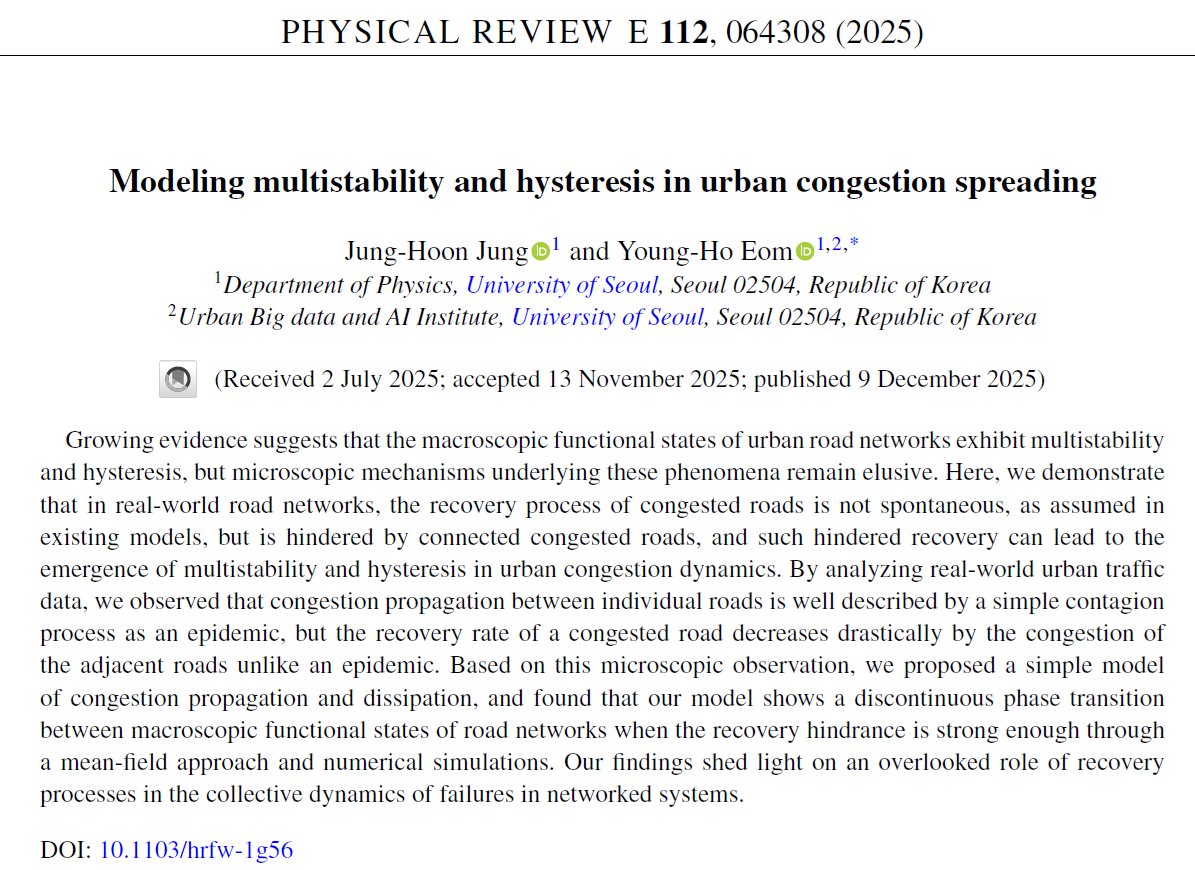
How does local congestion spread and dissipate in real-world urban road networks? How do macroscopic functional states of road networks emerge from such microscopic congestion propagation and dissipation? Check out our new preprint https://t.co/sFz00coCXy
CNRS tenure track on "Dynamics and collective decisions" at the interface between statistical physics and social sciences. One of the potential hosting laboratories is the Centre de Physique Théorique in Marseille.
https://t.co/AK0Ox8rhEn
Still a few spots available to attend Charting Complexity, a conference dedicated to exploring the power of Complex Systems Science (London 10-12 of June). Program: https://t.co/Er3WTdraDo. If you like to attend, express your interest here: https://t.co/opdRTlif7k
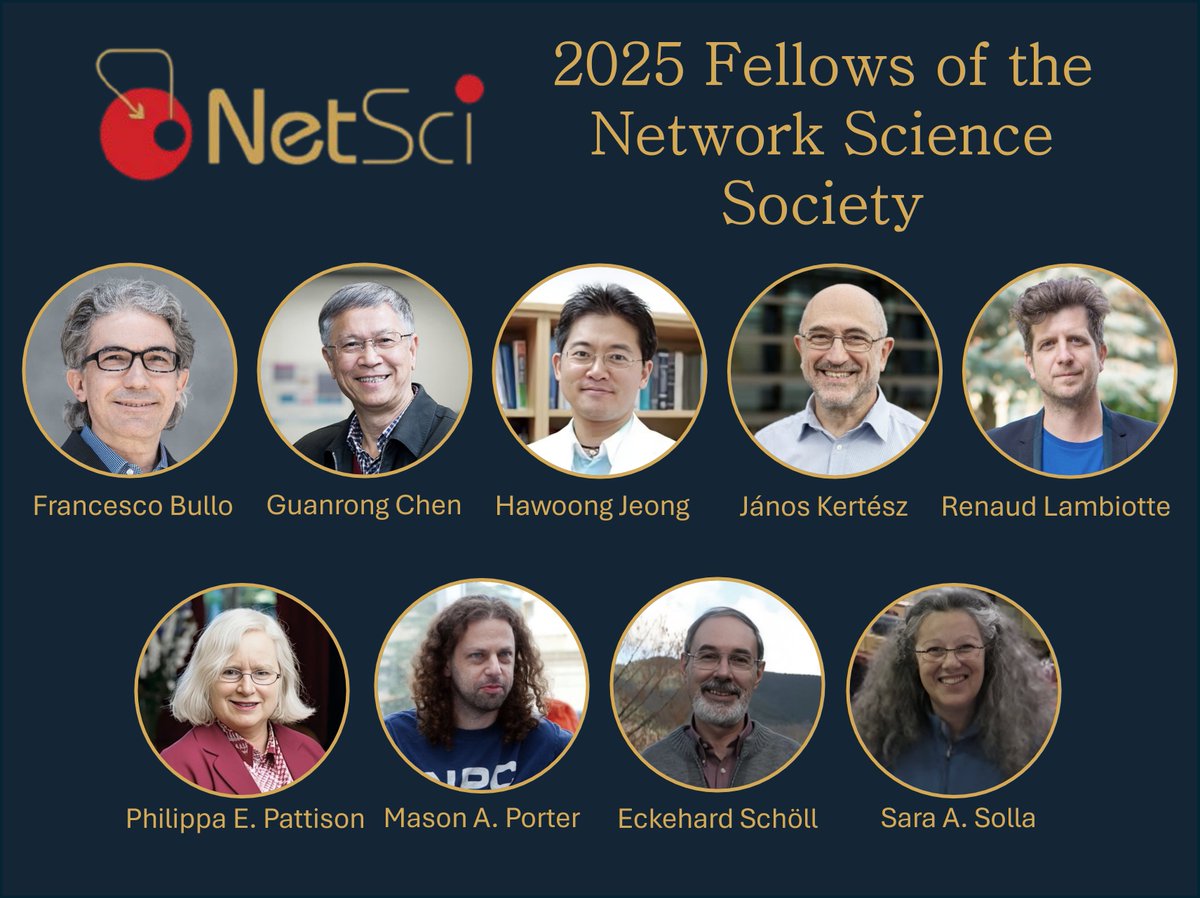
The Network Science Society has a new class of Fellows! Congratulations to the 2025 awardees:
Francesco Bullo
Guanrong Chen
Hawoong Jeong
János Kertész
Renaud Lambiotte
Philippa E. Pattison
Mason A. Porter
Eckehard Schöll
Sara A. Solla
*Permanent* position in Applied Mathematics at City. We are - of course - particularly interested in profiles in Computational Social Science, Network Science, Data Science, and related fields. The application deadline is June 1st.
https://t.co/qbJlphoVqj
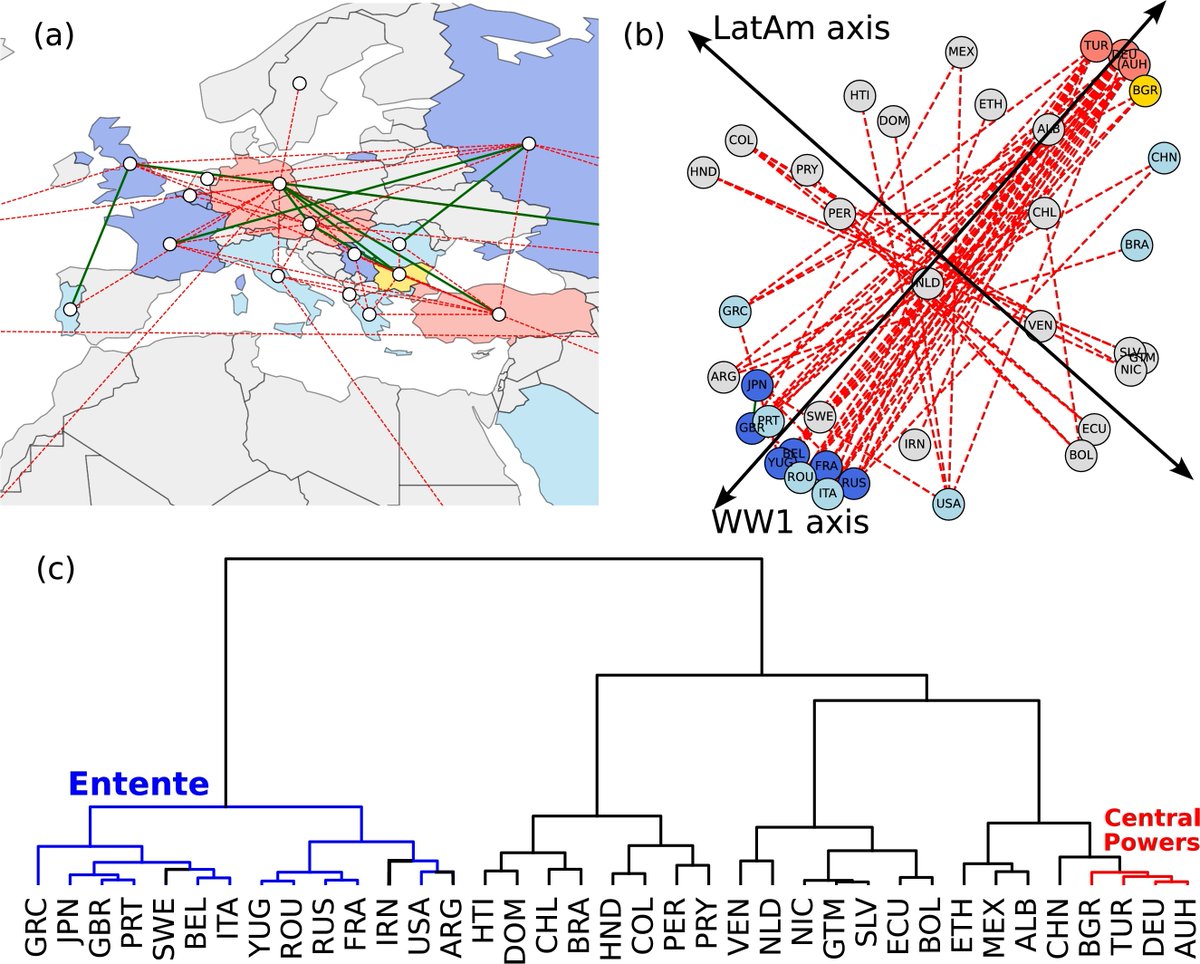
In this new paper: https://t.co/9m9aAOTWRd we developed a theory for using signed graph communicability as an effective way to analyze social and biological data. Joint with @FernandoDazDaz6. Please, spread the news!
Open postdoc position at @dnds_ceu in Vienna in the Computational Human Dynamics Lab of @MartonKarsai on inequalities in 15-minutes cities in collaboration with https://t.co/zAH3oqsMaj. Check it out here: https://t.co/LgP2kwiLSn
@postdoc@CompSysSoc@IC2S2@netscisociety@ceu
COMPLEX NETWORKS, a Satellite to STATPHYS29
Venice 21-23 July 2025
https://t.co/2yFSfo4DOD
Deadline: March 31 2025
Further info at https://t.co/BTa2V4t0HM
You can send your contribution to [email protected].
#Hiring#JobOpening
We seek a dynamic & personable individual with postdoctoral experience in statistical physics, nonequilibrium, nonlinear, and complex systems, to join our close-knit team of editors running the world’s premier physics Letters journal.
https://t.co/aYtYGKYQvg
New work in @NatureComms 🚀! Instead of black-box deep learning with 100's of parameters, what if we use large-scale data to discover simple, interpretable models that accurately describe human mobility? It works: accuracy + insights for urban planning & beyond!
And here we go! First position on my ERC grant is officially open. Fully funded 3.5 years PhD position at @NUnetsi London working with me and the @NPLab_
on modeling and reconstructing higher-order systems. Application deadline: 16th February 2025. https://t.co/HuzgquFa4B
This years NetSci is hosting Satellite Symposium "CPIN: Critical Phenomena In Networks". This symposium topic are critical phenomena in networks. Deadline for extended abstract submissions is 15 February. Please see satellite page for more details: https://t.co/56enZGmnmF
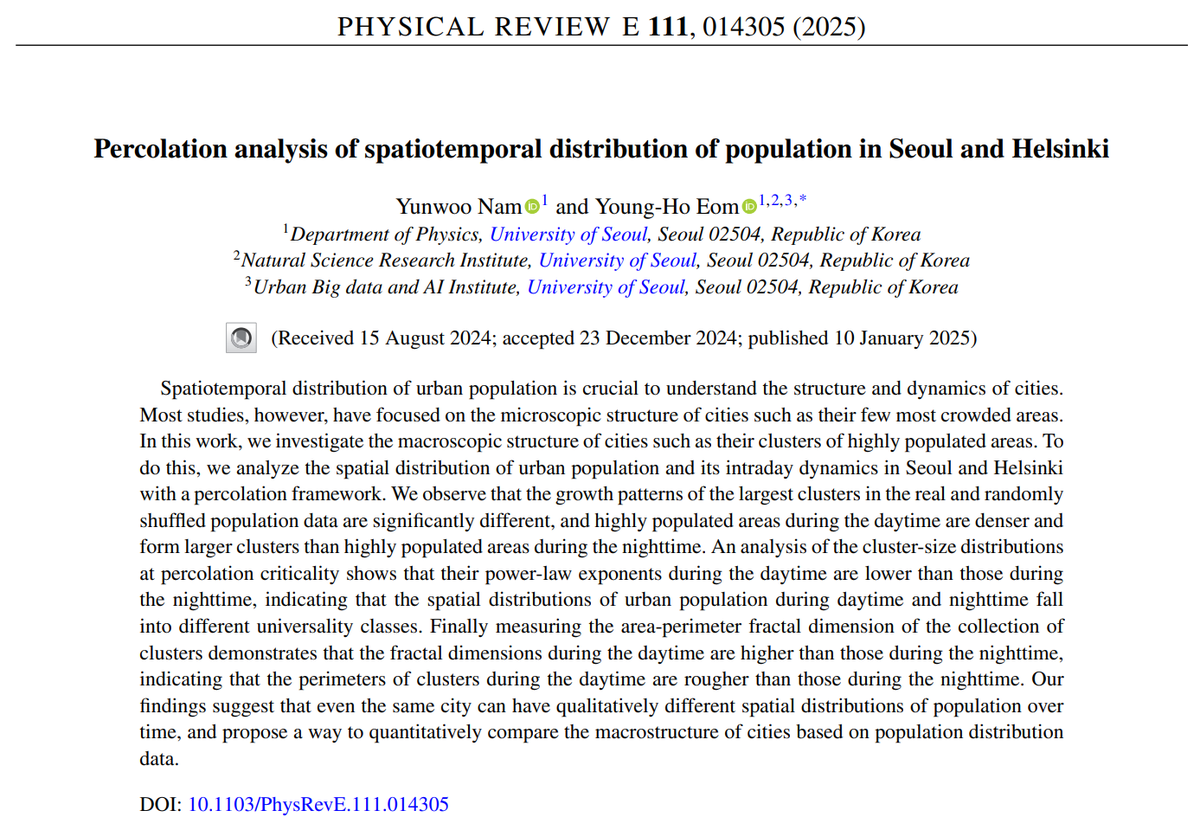
Our new paper on the intraday dynamics of urban macrostructure is finally published in Phys. Rev. E: Percolation analysis of spatiotemporal distribution of population in Seoul and Helsinki (2025)
https://t.co/1A7NHKVzxw
[New preprint!] What are the qualitative differences in the spatial distribution of urban population between daytime and nighttime? We address this question with a percolation analysis of real-time population distribution data from Seoul and Helsinki. https://t.co/9wFTJaoYCc
🔊 New paper in @NatureHumBehav! Using large-scale mobility data, we find how businesses, amenities, and other urban places depend on each other. It reveals connections that aren’t always visible but have substantial economic impacts.







![thinking_22's tweet photo. [New preprint!] What are the qualitative differences in the spatial distribution of urban population between daytime and nighttime? We address this question with a percolation analysis of real-time population distribution data from Seoul and Helsinki. https://t.co/9wFTJaoYCc https://t.co/J6VsoiAQTZ](https://pbs.twimg.com/media/GVVVm3faUAA-UZ2.png)





