When I am an old woman I shall wear purple..
And make up for the sobriety of my youth
And pick the flowers in other people’s gardens
And learn to spit
#bitcoin
JUST IN: $7 TRILLION SCHWAB CEO JUST REVEALED IT WILL CHARGE JUST 0.75% ON #BITCOIN AND CRYPTO BUYING
CHEAPER THAN GEMINI AND COINBASE FOR INSTANT PURCHASES
WALL STREET IS COMING – BIG TIME 🚀
This 2-hour Stanford lecture breaks down how models like ChatGPT and Claude are actually built, clearer than what many people in top AI roles ever get exposed to.
Save this and set aside two hours today. It might end up being the most valuable thing you learn all week.
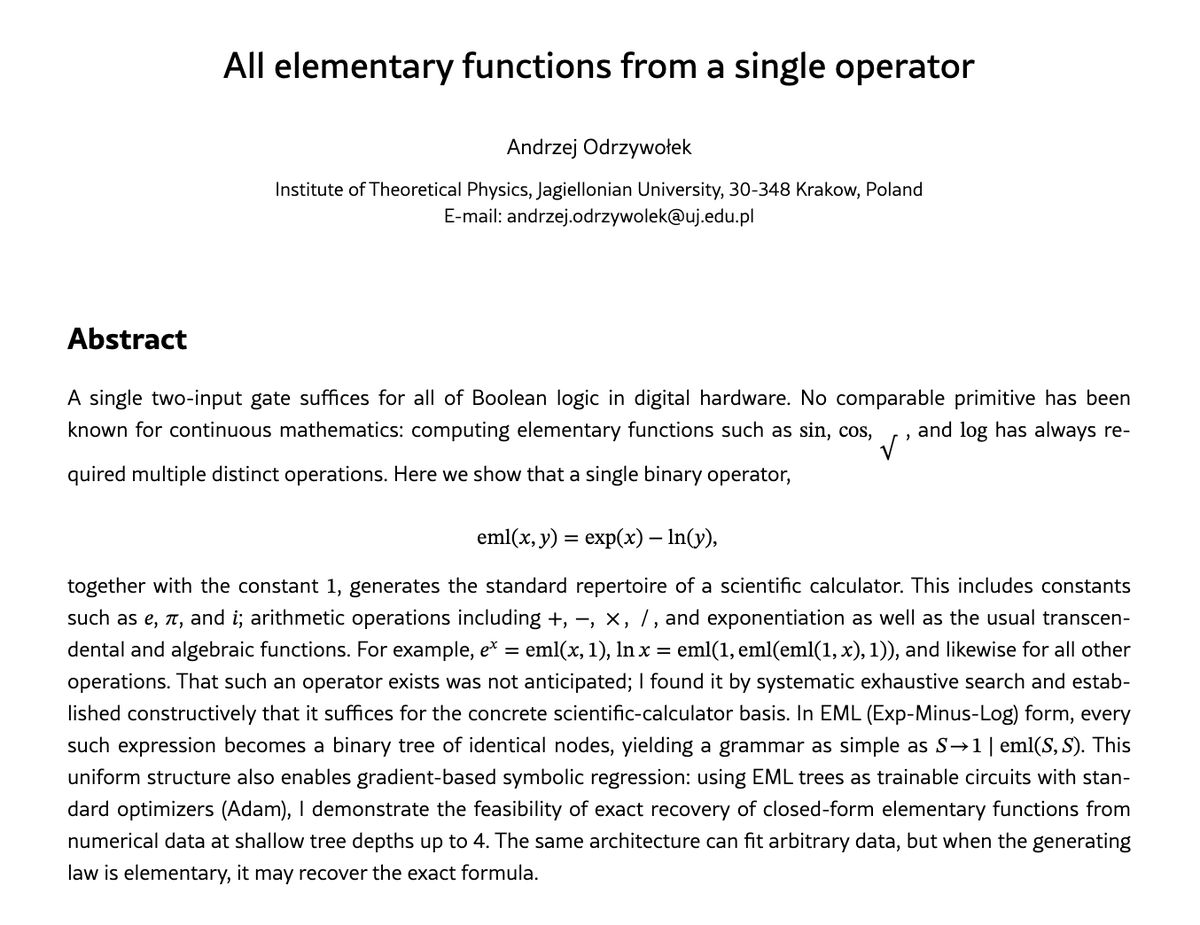
Researchers just proved that every single elementary function, sin, exp, log, sqrt, comes from one single binary operator.
It is like finding the “God Particle" for calculus.
In computer science, every complex program breaks down to a single logical operator: the NAND gate. It is the fundamental building block of all digital reality.
But for continuous math, physics, engineering, machine learning, we thought we needed a massive toolbox.
Addition. Subtraction. Trigonometry. Logarithms.
Every scientific calculator and neural network has to juggle all of them.
Until today.
But this paper proved that every single mathematical function can be generated by a single, bizarre binary operator.
eml(x,y) = exp(x) - ln(y).
Combine that with the number 1, and you can build everything.
Pi. The square root. Sine and Cosine. Arithmetic.
It is all just the exact same operator, repeating over and over again in a binary tree.
Nobody anticipated this existed. It was found by systematic exhaustive search.
But the implications for AI are massive.
Instead of an AI struggling to combine different mathematical rules to discover a new scientific law, it can just use a single, uniform architecture.
One trainable circuit. One repeatable node.
We thought the language of the universe was complex.
It turns out, it's just one equation repeating in the dark.
Your body replaces 98% of its atoms every year. Within five years, every single one is swapped out. The you from 2021 is physically gone. Not "mostly gone." Gone. The atoms that used to be your face are now part of the air, the ocean, somebody else's lunch.
Oak Ridge National Laboratory proved this in 1953. Your skin right now is about a month old. Your liver, six weeks. Your stomach lining regrows every five days. Your skeleton is completely different from ten years ago. A few atoms do stick around for life, buried in some brain cells, in parts of your heart, and in your tooth enamel. Scientists at the Karolinska Institute in Sweden tracked them using leftover radiation from 1950s nuclear bomb tests. The oldest surviving piece of "you" lives in your brain, your heart, and your teeth.
Your brain is also erasing you. On purpose. A neuroscientist named Ron Davis at Scripps Research found that the brain has cells that release dopamine, the same chemical you feel after a good meal or a win, and use it to dissolve memories. When his team shut these cells off in test animals, they remembered twice as much. The chemical behind your best feelings is the same one shredding your past, and it never stops running.
Ebbinghaus proved this back in 1885. You lose about half of everything you learn within one hour. A 2020 study from Baycrest's Rotman Research Institute had people live through a real experience and then checked how much they kept. At best, about a quarter. 75% of the details of your own life are being actively wiped by the organ that is supposed to be keeping track of it all.
The universe is 13.8 billion years old. Squeeze all of it into one calendar year, with the Big Bang on January 1st, and humans show up at 11:52 PM on New Year's Eve. Your whole life, every birthday and breakup and boring Tuesday, lasts 0.17 seconds on that calendar. Not even long enough to blink.
Stars will keep burning for about a hundred trillion more years, then the fuel runs out and the lights go off everywhere. The last things left will be black holes, places where gravity is so strong not even light can escape. Even those slowly leak away over a number of years so large you would need a hundred zeros to write it. After the last one is gone, nothing is left. No light, no warmth, nothing bumping into anything else, ever again. The universe reaches total stillness and stays there. Forever.
Brian Cox once described the window where life can even exist as one-thousandth of a billion billion billionth, billion billion billionth, billion billion billionth of a percent of the universe's total run time. You are in that window right now. Built from borrowed atoms, running on a brain shredding its own records, here for a fifth of a second on a cosmic calendar that ends in permanent silence. Anyway, hope your Tuesday is going alright.
When I was 13, I hoped that one day I would have a girlfriend with big tits...
When I was 16, I got a girlfriend with big tits, but there was no passion, so I decided I needed a passionate girl with zest for life.
In college I dated a passionate girl, but she was too emotional. Everything was an emergency; she was a drama queen, cried all the time and threatened suicide. So I decided I needed a girl with stability.
When I was 25, I found a very stable girl but she was boring. She was totally predictable and never got excited about anything. Life became so dull that I decided I needed a girl with some excitement.
When I was 28, I found an exciting girl, but I couldn't keep up with her. She rushed from one thing to another, never settling on anything. She did mad impetuous things and made me miserable as often as happy. She was great fun initially and very energetic, but directionless. So I decided to find a girl with some real ambition.
When I turned 30, I found a smart ambitious girl with her feet planted firmly on the ground, so I married her. She was so ambitious that she divorced me and
took everything I owned.
I am older and wiser now, and I am looking for a girl with big tits.
L-theanine is the only legal compound that changes your brainwaves on an EEG within 40 minutes of swallowing a capsule. And the mechanism is wild.
Your brain constantly balances two opposing neurotransmitters. Glutamate fires neurons. GABA calms them. L-theanine is a structural mimic of glutamate, close enough to cross the blood-brain barrier and sit on glutamate receptors. But instead of firing the neuron, it partially blocks the signal. Your excitatory system downshifts without you feeling sedated.
That downshift cascades. GABA levels rise. Serotonin and dopamine both increase. EEG studies at Oxford showed 200mg produces measurable alpha wave activity in the 8-13 Hz range across the parietal and occipital cortex. Alpha waves are the frequency your brain produces during meditation and flow states. Most people spend years trying to access that band through breathwork. A capsule gets there in 40 minutes.
The part that makes it genuinely useful: a 2016 study gave subjects L-theanine during a multitasking stressor. The placebo group's brains shifted into high-beta stress mode. The L-theanine group maintained alpha dominance under the same conditions. Their brains stayed in calm-focus while processing the same cognitive load.
Pair it with caffeine and the synergy gets even more interesting. Caffeine alone sharpens attention but triggers tremor, anxiety, and an eventual crash. L-theanine blocks the jitter pathway without touching the alertness pathway. You get the focus of coffee without the cortisol spike. One cup of green tea contains roughly 20mg of L-theanine, which is why tea feels different from coffee at equivalent caffeine doses.
200mg daily is the dose most studies use. That bottle is 100mg capsules. Two per day. Yes, it's worth the hype. One of the few supplements where the EEG data actually matches what people report feeling.
There's a physicist at Stanford named Safi Bahcall who modeled this exact principle and the math is wild.
He calls it "phase transitions in human networks." When you're stationary, your probability of a lucky event is limited to your existing surface area: the people you already know, the places you already go, the ideas you've already been exposed to. Your opportunity window is fixed.
When you move, your collision rate with new nodes in a network increases nonlinearly. Double your movement (new conversations, new cities, new projects) and your probability of a serendipitous encounter doesn't double. It roughly quadruples. Because each new node connects you to their entire network, not just to them.
Richard Wiseman ran a 10-year study at the University of Hertfordshire tracking self-described "lucky" and "unlucky" people. The single biggest differentiator wasn't IQ, education, or family money. Lucky people scored significantly higher on one trait: openness to experience. They talked to strangers more, varied their routines more, and said yes to invitations at nearly twice the rate.
The "unlucky" group followed the same routes, ate at the same restaurants, and talked to the same 5 people. Their networks were closed loops. No new inputs, no new collisions.
Luck isn't random. Luck is surface area. And surface area is a function of movement.
The lobster emoji is doing more work than most people realize. Lobsters grow by shedding their shell when it gets too tight. The growth requires a period of total vulnerability. No protection, no armor, soft body exposed to the ocean.
That's the cost of movement nobody posts about. You have to be uncomfortable first. The new shell only hardens after you've already moved.
It should be pretty obvious at this point that AI is a "force multiplier" not a "labor substitute".
It helps experts be better at things they are already good at. It doesn't let beginners match experts.
If you can't write, anything you write with AI will be unmitigated slop.
If you aren't a software engineer, anything you vibecode with AI will have security holes and won't be able to scale past a toy demo.
If you blindly trust AI to deliver on a research task without knowing the subject matter, you won't be able to fact-check it.
There's this weird misconception of AI as something that completely levels the playing field. I don't see it that way at all. There are mathematicians deriving novel lemmas with off-the-shelf models. Normal people can't do that.
AI is a tool that makes experts better. It doesn't make everyone into an expert.
Google’s March 31, 2026 paper improves theoretical resource estimates for a future quantum computer breaking ECDLP-256 (secp256k1, used in Bitcoin). It shows roughly 1,200–1,450 logical qubits plus 70–90 million Toffoli gates, runnable on under 500,000 physical qubits in minutes under optimistic assumptions. This is roughly 20x fewer resources than prior work. No such machine exists today.
Even then, the prime targets would be old P2PK legacy coins (about 1.6–1.7 million BTC total, or 8% of supply) with permanently exposed public keys. However, only about 10,200 BTC sit in large enough chunks to cause meaningful market disruption. The rest (over 32,000 UTXOs averaging around 50 BTC each) would take decades or longer to crack one by one due to cost.
Modern cold storage with fresh Native SegWit addresses (like 0.01 BTC DCA UTXOs) only exposes keys briefly during a spend (short in-flight window). After confirmation, risk for those coins drops to zero. Tiny, scattered holdings are economically unattractive targets.
Bitcoin already took the first step: BIP-360 (Pay-to-Merkle-Root / P2MR) is in the official BIP repository with testnet implementations. Google itself accelerated its internal PQC migration to 2029.
For the vast majority of users with well-managed holdings, this remains a long-term engineering issue with plenty of runway, not an immediate crisis.
Christopher Robin came down from the Forest to the bridge, feeling all sunny and careless, and just as if twice nineteen didn’t matter a bit, as it didn’t on such a happy afternoon. ~A.A.Milne #fridayfeeling
This lady tells 1 year of studying quantum physics in under 60 seconds:
Quantum physics isn't just science; it's logical spirituality.
You don't attract what you want; you align with what you already are. In the quantum field, every version of you already exists, the wealthy you, the happy you, the successful you.
Your thoughts and emotions broadcast a frequency that your life mirrors back to you. The quantum field responds to certainty, not begging.
Visualization is your most powerful tool because our minds can't distinguish between imagination and reality. Pull your future into the now and recode your past. Everything is accessible right now.
You aren't just a person in the universe; you are the universe experiencing itself through you. Go live like the miracle you are!
Scientists used 200,000 human brain cells to play DOOM. The cells had never seen a computer. They learned in real time. They got better.
Separately: an entire fruit fly brain, 139,000 neurons, 50 million connections, was copied into a laptop. It predicts real brain responses with 90%+ accuracy.
The biological computing timeline:
2021 → neurons learn Pong
2022 → fruit fly brain fully mapped
2024 → entire fly brain simulated on a laptop
2026 → human brain cells play DOOM
A GPU needs ~700W to run an LLM.
The brain runs the whole show on 20W.
We're spending trillions on building the next giant AI training computer but what if the solution to our energy needs was just copying the technology already running in our heads?
Scientists just copied a Fruit Fly's biological brain and trapped it inside of a computer.
Not an AI model trained to act like a fly... A total digital copy of a fly !! This is some sick sci-fi stuff:
- They scanned and copied the brain, neuron by neuron, synapse by synapse, from electron microscopy data.
- Then dropped that brain into a simulated body in a video game like environment.
The fly walked. It groomed. It fed. Nobody taught it anything. The behavior was already in the wiring.
The entire premise of modern AI is that intelligence is something you train into a system. This is proof it's something you can transfer out of one. Wild times