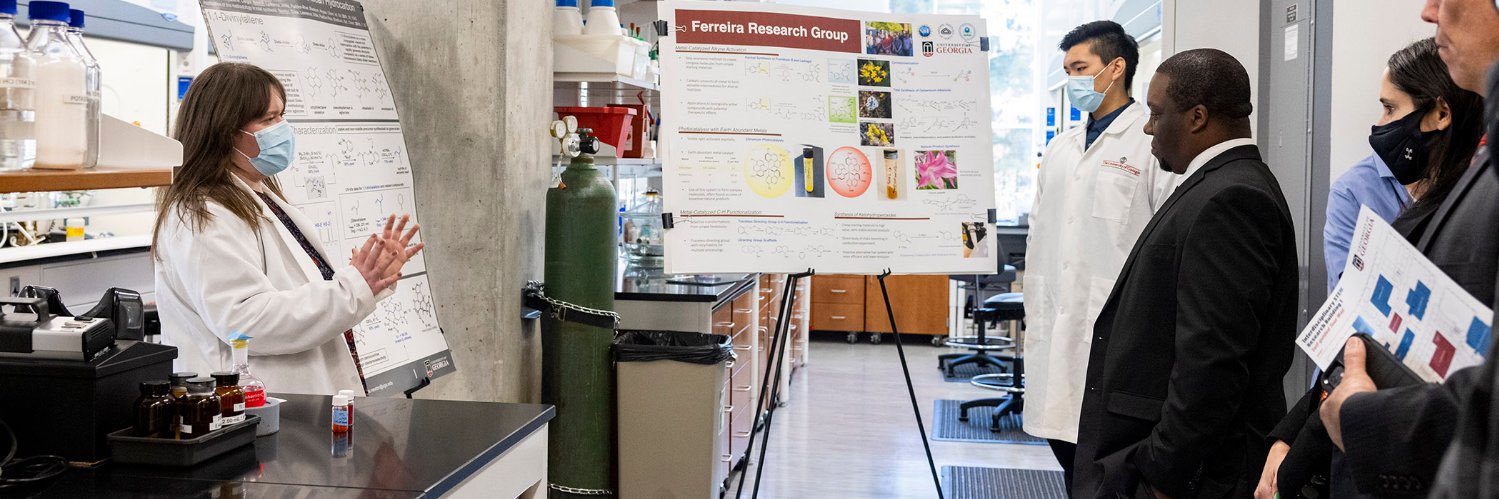
It’s official—I’m a PhD! Countless hours in the lab, late nights, and way too much caffeine have paid off. Big thanks to my advisor, Eric M. Ferreira, and everyone who cheered me on. Next stop: sunny Santa Barbara for my postdoc adventure!
De novo design of ligand binding proteins using large language models alone
1 Off-the-shelf LLMs (ChatGPT, Claude, Gemini) were used as the only “design engine” to create de novo proteins that bind Zn2+/Cu2+ or the PFAS pollutant perfluorooctanoic acid (PFOA), without providing 3D coordinates or running energy-based optimization during generation.
2 A key deliverable wasn’t just sequences: the LLMs also produced explicit, human-readable rationales (heptad-repeat patterning, helix packing, loop architecture, metal coordination preferences, and ligand-binding logic), positioning LLM output as both designs and an interpretable design hypothesis.
3 Metal-binding campaign: with an ~800-word prompt, the models were asked to design ~60-aa helix-turn-helix monomers that homodimerize into a 4-helix bundle, placing two metal sites and keeping N/C termini within ~15 Å, while avoiding copying known sequences/motifs.
4 Across 80 total sequences (10 designs per metal × 4 LLM variants), BLASTp and PDB similarity searches found no close matches, suggesting novelty; different LLMs explored distinct sequence “styles” (e.g., Gemini more repetitive/charged, Claude more diverse/asymmetric, ChatGPT-base higher N/S/T).
5 Structures were assessed post hoc using AlphaFold3 and Chai-1; predicted confidence was generally low-to-moderate (far below typical design cutoffs), yet many sequences still adopted the intended helix-turn-helix / bundle-like topology, showing that fold-level constraints can emerge from text-only reasoning.
6 Experimental validation for metal binders: 12 candidates were selected; 6 expressed and purified; 3 showed helical CD spectra and dimer-like SEC behavior. Zn2+ selectively stabilized these proteins vs Cu2+ in thermal denaturation, consistent with cognate binding.
7 One design (LMBP-11) had Zn2+ binding validated by ITC with an apparent KD ~30 µM. Notably, successful binders often deviated from the prompt (e.g., using His/Asp/Asp rather than His-only first-shell ligands), highlighting gaps between LLM-stated rationale, generated sequences, and realized 3D geometry.
8 PFOA campaign: initial prompt (<200 words, including PFOA SMILES) requested a 5-helix bundle with a hydrophobic cavity for the fluorous tail and charged loop residues for the carboxylate head, binding two PFOA molecules. First-round pentamer designs expressed and folded, but showed minimal PFOA-induced 19F NMR changes.
9 Iteration mattered: guided by α-helical barrel principles (Woolfson lab) and an expanded repeat pattern, a second round produced 6-helix bundles with higher predicted confidence and more consistent ligand placement. 2/8 tested hexamer designs (LPB-hex-175, LPB-hex-186) caused strong 19F NMR line broadening/peak-area reduction for key PFOA resonances at sub-stoichiometric protein, consistent with binding.
10 Comparison to structure-based redesign: ProteinMPNN/LigandMPNN redesigns on LLM-generated backbones yielded higher-confidence predicted models and very different sequences, implying LLMs can generate feasible but suboptimal sequences and may sample a distinct, rule-driven region of sequence space.
📜Paper: https://t.co/ISoDOTvuNy
#ProteinDesign #LLM #ComputationalBiology #DeNovoProteinDesign #Metalloproteins #PFAS #PFOA #Bioremediation #AlphaFold3 #ProteinMPNN
Missing the TOC graphics since ACS moved to Silverchair? Wei Huang (@WeiHuangixk2) in our group built a Tampermonkey userscript that restores them, plus inline abstracts, a multi-column grid, and 1-click Zotero saves. Works on any ACS Publications listing:
https://t.co/LCmpQoYoCq
GRAD STUDENTS and POSTDOCS: If you're studying natural products please apply to the 2025 Natural Products and Bioactive Compounds Gordon Research Seminar! This is a unique event for exceptional researchers studying natural product synthesis, biosynthesis, and their biology.
Congrats to the Newton Lab on their latest JACS paper! It’s been a pleasure attending our joint meetings and seeing this project come to life. Excited to see it published!
https://t.co/2GF9cgMW8M
It’s official—I’m a PhD! Countless hours in the lab, late nights, and way too much caffeine have paid off. Big thanks to my advisor, Eric M. Ferreira, and everyone who cheered me on. Next stop: sunny Santa Barbara for my postdoc adventure!
Reminder: Virtual Symposium is tomorrow anuary 15, 2025 @ 12 noon ET feat. Yang Yang @yang2biocat (UC Santa Barbara) & Julian West @pushingarrows (Rice University)
Watch for free:
YouTube: https://t.co/J4z4SqAVu2
Zoom: https://t.co/dMUWFfroSe
Thank you to @BeyondCCHF
Ever had a radical reaction not work when it ‘should’?
Mismatched *radical polarity* may be the issue. We often only look at BDE & redox (thermodynamics), but forget polarity (kinetics).
Jake, Andrew, & I are excited to share this new resource to help!
https://t.co/A90WdSyIZm
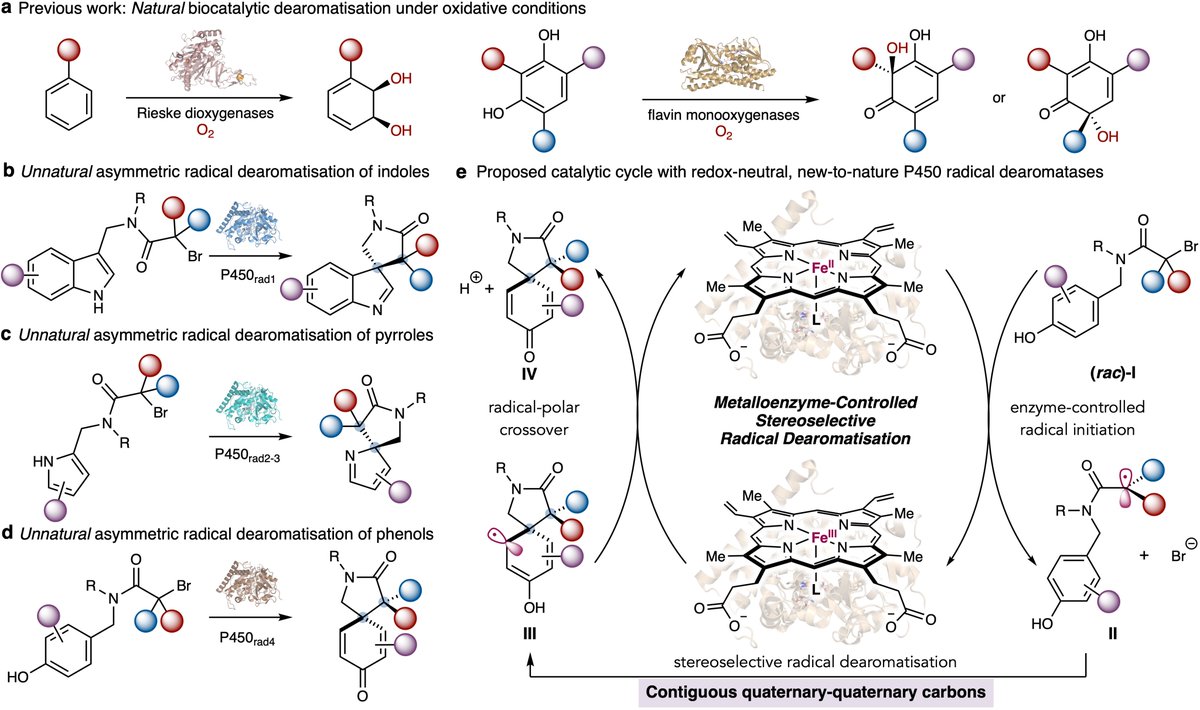
https://t.co/TsYAVZ8wty Pleased to share our latest work in @Nature. This paper wraps up our research at @ICIQchem , and I’m grateful for their incredible support! Looking forward to continuing the journey with the @MelchiorreGroup@Unibo !
We evolved P450 radical dearomatases (P450rad) with new enzyme functions not known in nature. With engineered P450rad enzymes, a series of indoles, pyrroles and phenols underwent asymmetric radical dearomatization in a stereoselective fashion
Congrats to the team led by Maolin who developed an exciting new-to-nature enzymatic process to selectively incorporate fluorine motifs into functional molecules (https://t.co/fJjeewHlqn).
#TotalSynthesis of (−)-Rauvomine B via a Strain-Promoted Intramolecular Cyclopropanation by Jake M. Aquilina, @ankush_chem, Gabriel N. Morais, Shuming Chen, and Myles W. Smith at @UTSWMedCenter in @J_A_C_S https://t.co/u0wblFPFKP
Check out our latest work on the stereoselective synthesis of pyridyl-cyclopropanes via enzymatic activation of pyridotriazoles just published in @J_A_C_S ! Congrats to @Satyajit_chem Yining Wang and rest of team @UTDallasChemBio@FollowStevens! https://t.co/l1TRIgSG1P
What an honor to be chosen for the Priestley Medal. #Enzymes are the best chemists, of course, but the Priestley medalists are no slouches...and include many of my colleagues @CaltechCCE. Thank you!
MEDICINAL CHEMISTS: Looking to increase your Fsp3? Synthesize in 3D just as you have been doing in 2D for eons by combining biocatalytic C–H oxidation and radical retrosynthesis (enabled by electrocatalysis). Appearing today in @ChemRxiv : https://t.co/HdWKuwseWy . A fantastic collaboration with @hanzyduzit@YuKawamata