Excited to announce our recent results studying Ultra Diffuse Galaxies with JWST (https://t.co/TuRUTXQls0)! We looked for low stellar density galaxies (LDGs) in the El Gordo cluster at z=0.87, and find some interesting differences between those galaxies and local UDGs.
Shout out to everyone on the PEARLS team who helped make this possible, including ASU grad student Alex Pigarelli, who masterfully did all the SED fitting in the paper, and ASU undergrad Jake Summers who is responsible for much of the PEARLS data reduction!
Excited to announce our recent results studying Ultra Diffuse Galaxies with JWST (https://t.co/TuRUTXQls0)! We looked for low stellar density galaxies (LDGs) in the El Gordo cluster at z=0.87, and find some interesting differences between those galaxies and local UDGs.
These last two plots in particular suggest that LDGs at higher redshift tend to be predominantly recently accreted objects. I am excited to see how we can use these (as well as more JWST measurements) to better understand how low surface brightness galaxies form and evolve!
The "PEARLS" project is the subject of a recent study published in Astronomical Journal by a team of researchers, including @ASU Prof Rogier Windhorst using images of the earliest galaxies to see very distant objects. @ASUTheCollege@NASAWebb
https://t.co/42olUWaGDg
Using @NASAWebb’s new images and data @ASU Regents Professor Rogier Windhorst & team were able to trace the light that was emitted by the bright white elliptical galaxy, allowing astronomers to identify the effects of interstellar dust in the spiral galaxy.https://t.co/ke1941x0q7
@AstroLevy If you have the wcs info, you can use the astropy wcs package to easily go from (ra,dec) to pixels, then do some interpolating (I would use numpy mgrid) to get it in integer pixels
@kairyssdal bigger on the sky cancel each other out). So as you fly in a spaceship from here to there, small details will get accentuated and you would see many more stars, but the whole nebula will seem more tenuous as it grows to fill the whole sky.
Writing tips
- good writing takes practice
- read what you've written out loud
- plan
- style & voice come in time
- all writing starts off messy
- writing is thinking, give it time
- don't apologise for the first draft
- write
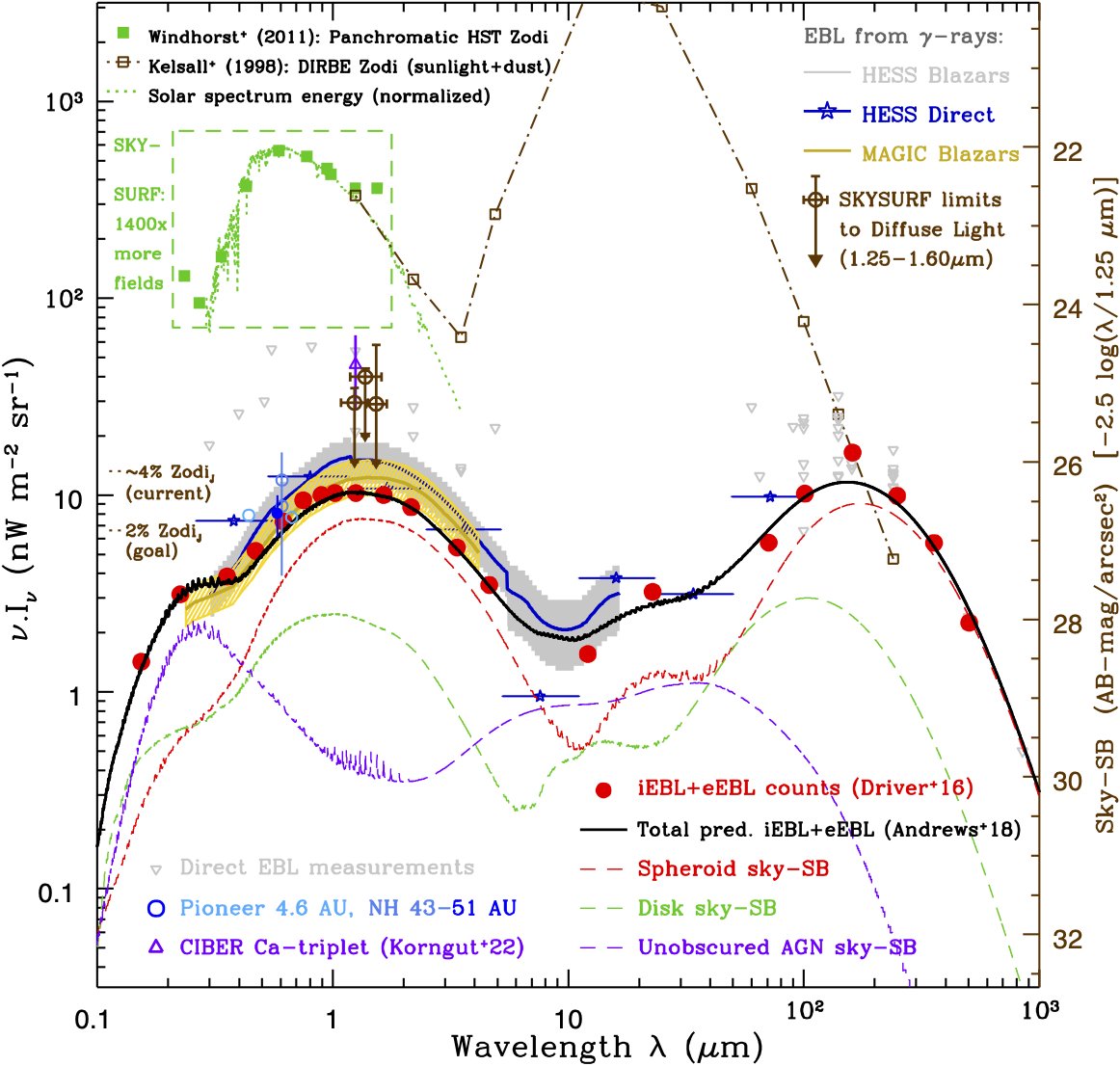
SKYSURF is the largest archival HST program to date, aiming to analyze over 250000 HST images. What are we doing; why do we need to analyze these images? Let’s step back and just look at the night sky. One of the most basic astronomical questions we can ask is:
I am excited to announce that the first results of the SKYSURF project have landed on the arxiv! https://t.co/DA723mDQv0 and https://t.co/yjsoT9MJ8m.
Headline results: we put limits on the amount of diffuse EBL of 29, 40, and 29 nW/m2/sr at 1.25, 1.4, and 1.6 microns.
These are upper limits because they depend on the exact foreground models used. In particular, at this point, we cannot distinguish truly extragalactic emission from a closer (i.e. solar system) isotropic component. We are working on ways to distinguish these scenarios though!
Darby Kramer, and Scott Tompkins. Undergrads Zak Goisman, Andi Swirbul, Hanga Andras-Letanovszky, and Daniel Henningsen have been doing awesome work also! Stay tuned!
SKYSURF is the largest archival HST program to date, aiming to analyze over 250000 HST images. What are we doing; why do we need to analyze these images? Let’s step back and just look at the night sky. One of the most basic astronomical questions we can ask is:
This is the biggest project I have worked on, and I am truly blessed to have the opportunity to work on this project with a large group of great people! In particular, I am looking forward to the great work of PhD students Rosalia O’Brien, Delondrae Carter, Sarah Caddy,