@USEmbassyAddis Nothing new that's what corrupted officials do . it clearly shows how greedy the individual is . I heard that the regime in Ethiopia requested that the US govt to extend it's Ambassador's tour .
I think the regime has a plan to keep using him .
"September 13, 2026 (Tigray Mass Media Agency) The genocidal regime of Abiy Ahmed has carried out a drone strike on Meskote Brhan Primary School in Korem, Southern Tigray, according to Korem city administration."
@EU_Commission@EUCouncil@hrw@UNGeneva@amnesty@IntlCrimCourt
News: #Addis_Standard to receive 2026 Democracy Award for independent journalism as #US marks 250th anniversary
The National Endowment for Democracy (#NED) has named Addis Standard trilingual publication among the recipients of its 2026 Democracy Awards, recognizing individuals and organizations from #Ethiopia, #Burma, #Syria, #Russia, and #Cuba for what it described as their courage and leadership in advancing democratic freedoms.
“The yearning for freedom that launched our nation 250 years ago remains one of the most powerful forces in the world today,” said Board Chairman Peter Roskam. “
“This year’s honorees embody the courage and persistence required to defend those rights in their own communities. Their work reminds us that America’s commitment to liberty is strongest when we stand with those carrying that promise forward.”
https://t.co/WoiUowU5W4
U.S. Diplomatic Performance in Ethiopia and Emerging Regional Risks
The United States' engagement in Ethiopia since the outbreak of the Tigray War exemplifies a strategic failure, characterized by a notable gap between declared American objectives and actual outcomes. Washington entered the Tigray crisis with clear goals: to avert mass atrocities, stabilize Ethiopia as a regional anchor, and contain the conflict’s expansion across the Red Sea-Horn of Africa. Nevertheless, despite having early access to substantial evidence of atrocities, including internal evaluations by the U.S. State Department and other agencies as early as May 2021, the United States refrained from issuing a genocide determination. This reluctance diminished its influence at a crucial juncture and conveyed to all parties that U.S. red lines were flexible. In policy terms, this constitutes a strategic failure: the inability to synchronize tools, timing, and political resolve with the magnitude of the crisis.
The U.S. role as a guarantor of the 2022 Pretoria Cessation of Hostilities Agreement further exemplifies a diplomatic failure. Although the agreement formally ended active hostilities, its core provisions remain unimplemented. Tigray continues to be encircled by Ethiopian federal forces and militias, with significant portions of its territory still under occupation. Furthermore, essential services, including banking, fuel, and budget, remain restricted. Millions of Tigrayans are either internally displaced or have been compelled to seek refuge in Sudan. As a guarantor, the United States possessed both the responsibility and the diplomatic capacity to ensure compliance, yet it has not fulfilled this role. Consequently, the peace agreement that exists predominantly on paper, with minimal practical impact on the humanitarian or security realities in Tigray and the region and the surrounding region.
At the national level, Ethiopia is experiencing systemic instability that directly contradicts U.S. objectives. The Ethiopian federal government is actively engaged in armed conflicts across multiple regions, including Amhara, Oromia, Gambella, and Afar, while simultaneously facing economic collapse, governance breakdown, and widespread public distrust. Despite U.S. policy efforts to support the Ethiopian federal government with the aim of preserving national unity, this strategy has not resulted in stability. Instead, Ethiopia’s internal fragmentation has intensified, and the government’s capacity for effective governance has diminished. This discrepancy between U.S. intentions and actual outcomes constitutes a clear failure in foreign policy failure.
In the regional context, Ethiopia has become a driver of instability rather than a stabilizing force. Its involvement in Sudan, particularly its alignment with the Rapid Support Forces (RSF), its confrontational posture towards Eritrea, and the escalating tensions with Somalia over maritime access, have collectively deteriorating the security environment in the Red Sea-Horn of Africa. These developments compromise U.S. regional priorities, including Red Sea security, counterterrorism cooperation, and safeguarding critical maritime corridors. The inability of U.S. diplomacy to restrain Ethiopia’s increasingly assertive regional behavior reflects a broader erosion of American influence.
The challenges are exacerbated by the growing credibility gap. Washington’s simultaneous support for the Ethiopian federal government and the imposition of visa sanctions on Tigrayan leaders have strained its trust with various constituencies. The Ethiopian government perceives U.S. pressure as inconsistent and politically motivated, while Tigrayans perceive U.S. actions as punitive and misaligned with the realities of their humanitarian crisis. This dual loss of trust constrains the U.S.'s capacity to influence outcomes, mediate disputes, or enforce agreements. 1/2
@SecRubio@SenateForeign@SenatorShaheen@SenatorCardin
Pretense Over: Ethiopia Admits Fuel Blockade on Tigray
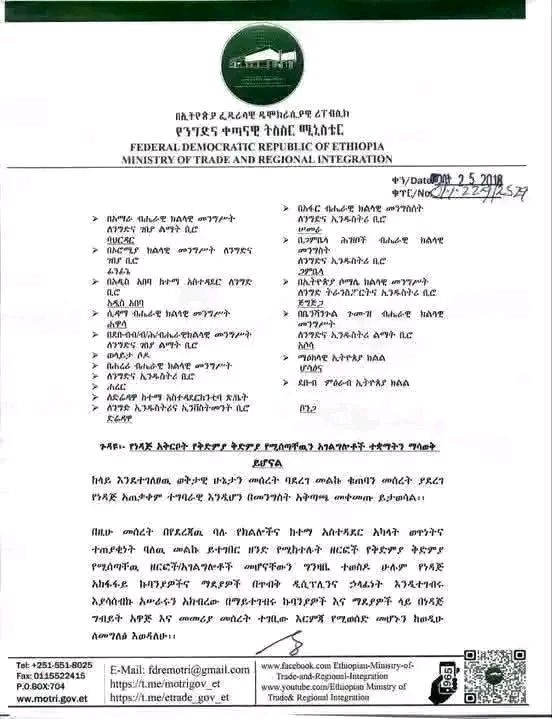
Ethiopia has issued a nationwide directive urging all regions and admins to prioritize fuel use. Notably, the letter excludes #Tigray—where the federal govt halted fuel deliveries months before the current global oil crisis.
Ethiopia’s Blockade Strangling Tigray’s Business Sector
#Ethiopia is continuing its genocide by non‑lethal means, inc restricting credit, halting all fuel deliveries and obstructing post-war reconstruction—measures that have left #Tigray’s business sector struggling to recover.
Why Tigray’s Industrial Heart Has Failed to Restart
Three years after the Pretoria Agreement, the expected ‘peace dividend’ has vanished. Trapped between a liquidity crisis and political deadlock, #Tigray’s economy is not just stalling—it’s disintegrating.https://t.co/Dfsjhjjo3B
Is War Brewing In the Horn of Africa?
As Ethiopia redeploys its entire army along its borders, #Tigray authorities accuse the federal gov’t of breaching the Pretoria Agreement. At the same time, #Ethiopia accuses #Eritrea of pivoting to mobilize and fund armed groups in #Amhara.
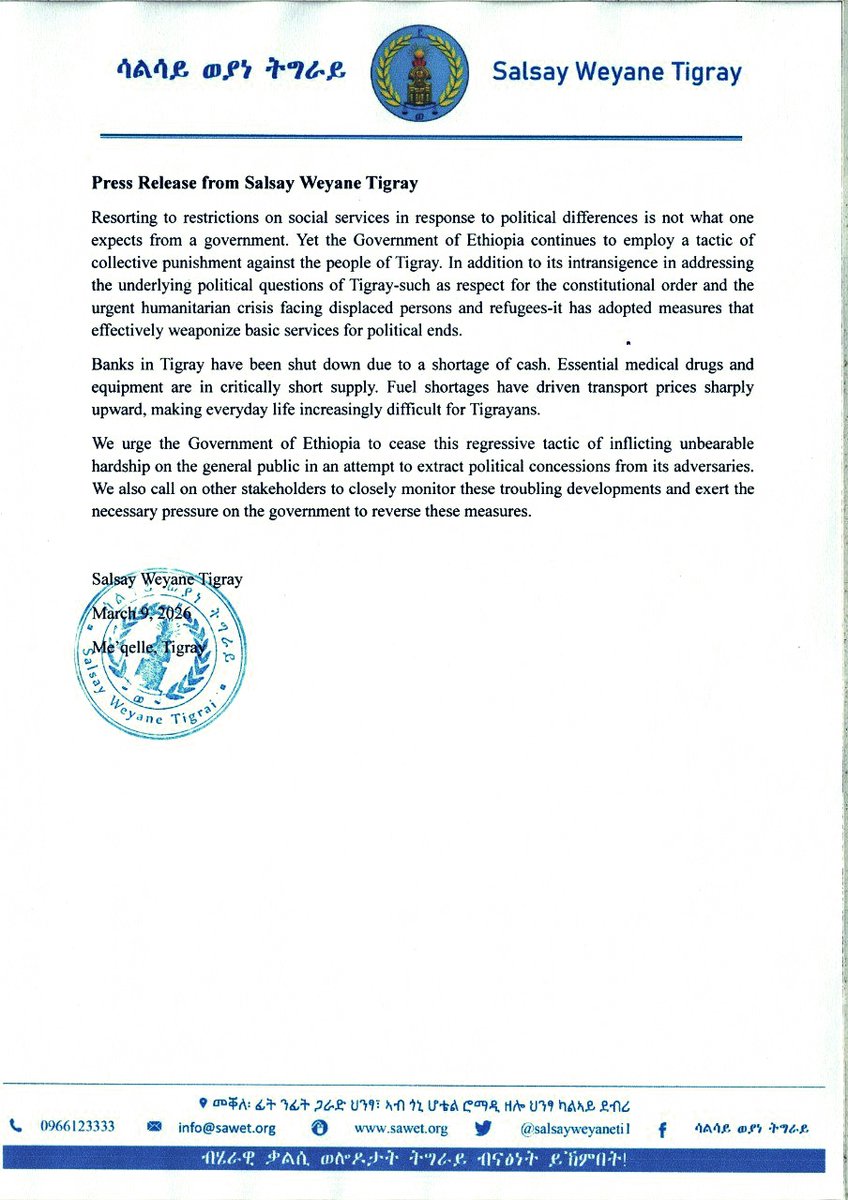
Tigray: Collective Punishment Used as Political Leverage
“#Ethiopia continues to employ a tactic of collective punishment against the people of #Tigray, regressive tactic of inflicting unbearable hardship on the general public in an attempt to extract political concessions.”
Ethiopia is massing troops near Tigray amid PM Ahmed’s push to regain access to the Red Sea.
The last conflict in this region killed a stunning 600,000 people.
PM ABIY AHMED = DANGEROUS = INCOMPETENT = CORRUPT.
The cycle of aggression against Tigray always ends the same way for the aggressor. The ENDF might have short memories, but the battlefield remembers the Derg era and the 2022 reality. If history is any guide, the outcome is already written. #TDF#Tigray#NoMoreWar#TPLF
The Ethiopian federal government's withholding of Tigray's budget violates principles of constitutional equity and fiscal federalism, as well as commitments in the Pretoria Cessation of Hostilities Agreement for postwar recovery. This action undermines children's right to education, hinders progress toward Sustainable Development Goal 4, erodes postwar recovery gains, and jeopardizes stability in Tigray and the region.
We urgently call on international partners to provide emergency financial support and exert diplomatic advocacy to ensure the Ethiopian federal government releases Tigray's allocated budget.
@UNICEF@UNICEFETHIOPIA@RepGregoryMeeks@Secrubio@Repbrianmast@Houseforeign@Senateforeign@SenatorRisch@SenatorShaheen@SenateDEM@SenateGOP@Ymahmoudali







![TeklehaymanotG's tweet photo. "[Solomon] Bogale’s posts called for persecution and violence against Tigrayans by “cleansing” them from Ethiopia." https://t.co/39YkyHMpXq](https://pbs.twimg.com/media/HDN2inkXsAEuJZL.png)