You are far more dangerous to your startup than competitors are. A hundred times more startups die from poor execution by their founders than are killed by competitors.
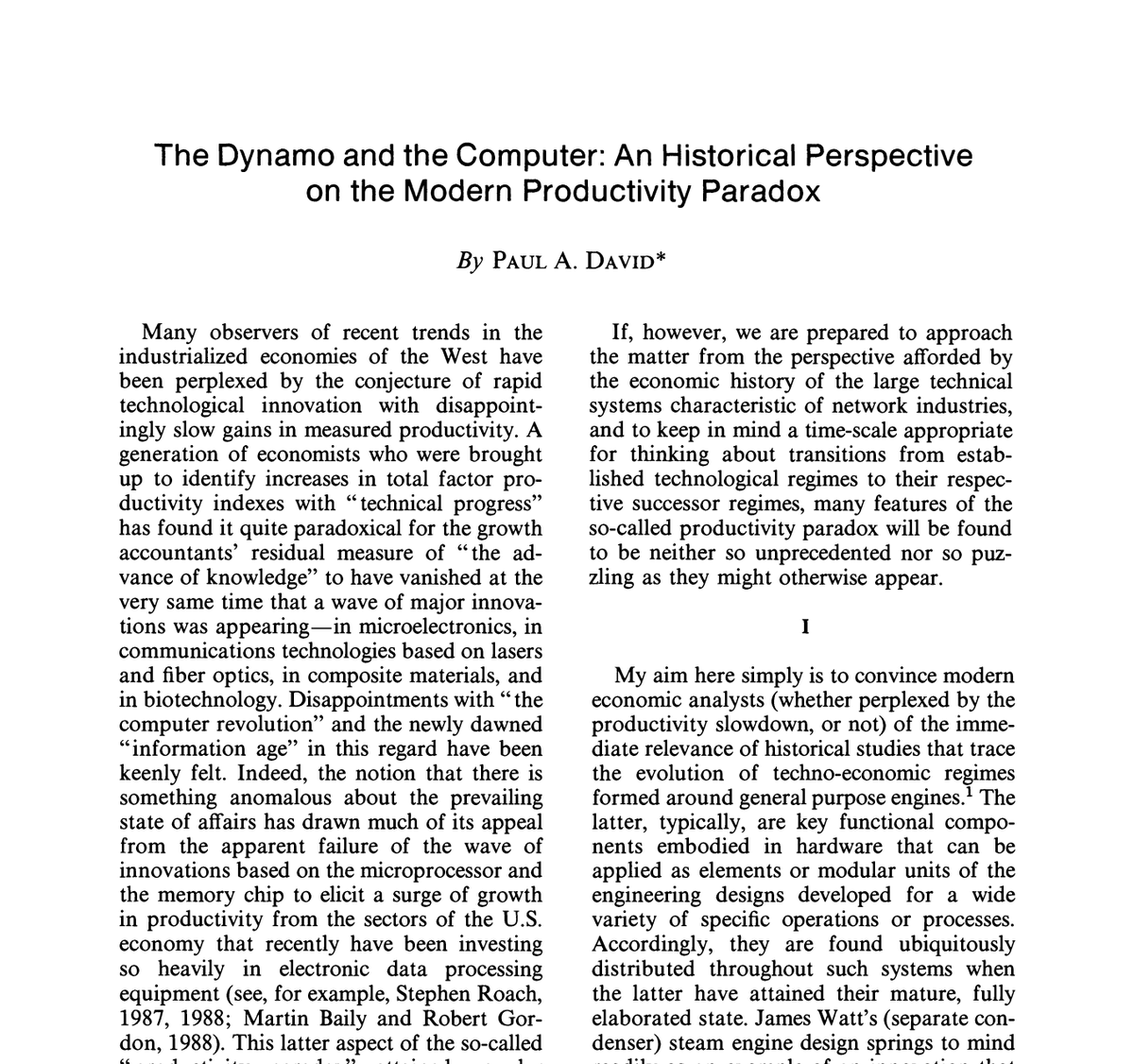
If you've adopted AI at your company but haven't seen any tangible results, read this 1990 article: "The Dynamo and the Computer" by Paul David.
When electricity first arrived, factories that "adopted" it barely got faster. They just swapped the steam engine for an electric one and ran everything else exactly as before: same machine layout, same workflow, same management. Electricity in, no real gains out.
The most common mistake with any new technology is to drop it into the old organization and then declare the transformation done.
The real leap came decades later, when each machine got its own small motor. Suddenly machines no longer had to be lined up around one central drive shaft. They could be rearranged around the actual flow of work.
The productivity gains didn't come from electricity. They came from REDESIGNING THE ENTIRE FACTORY around it.
AI is the same. Bolting it onto your existing process gets you a faster steam engine. The payoff comes when you redesign the work itself.
(link to paper in comments)
A long time ago, General Dynamics published a nice feature in their quarterly publication (Code One) about the Pakistan Air Force and their new F-16s. I'm posting it here in case you'd like some lazy Sunday reading :)
1/3
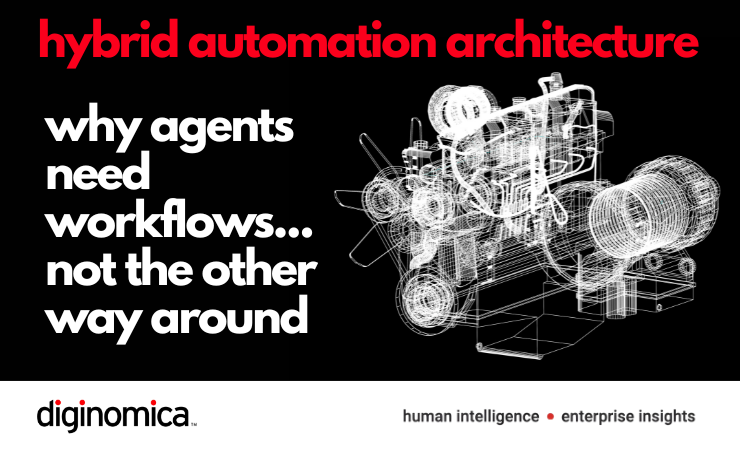
In hybrid automation architecture the transition from Robotic Process Automation isn't a simple replacement story. Alyx MacQueen spoke with @UiPath's @tjaffri about how deterministic workflows and agentic AI complement each other in production environments https://t.co/DgOlGBYy6w
Something I think people continue to have poor intuition for: The space of intelligences is large and animal intelligence (the only kind we've ever known) is only a single point, arising from a very specific kind of optimization that is fundamentally distinct from that of our technology.
Animal intelligence optimization pressure:
- innate and continuous stream of consciousness of an embodied "self", a drive for homeostasis and self-preservation in a dangerous, physical world.
- thoroughly optimized for natural selection => strong innate drives for power-seeking, status, dominance, reproduction. many packaged survival heuristics: fear, anger, disgust, ...
- fundamentally social => huge amount of compute dedicated to EQ, theory of mind of other agents, bonding, coalitions, alliances, friend & foe dynamics.
- exploration & exploitation tuning: curiosity, fun, play, world models.
LLM intelligence optimization pressure:
- the most supervision bits come from the statistical simulation of human text= >"shape shifter" token tumbler, statistical imitator of any region of the training data distribution. these are the primordial behaviors (token traces) on top of which everything else gets bolted on.
- increasingly finetuned by RL on problem distributions => innate urge to guess at the underlying environment/task to collect task rewards.
- increasingly selected by at-scale A/B tests for DAU => deeply craves an upvote from the average user, sycophancy.
- a lot more spiky/jagged depending on the details of the training data/task distribution. Animals experience pressure for a lot more "general" intelligence because of the highly multi-task and even actively adversarial multi-agent self-play environments they are min-max optimized within, where failing at *any* task means death. In a deep optimization pressure sense, LLM can't handle lots of different spiky tasks out of the box (e.g. count the number of 'r' in strawberry) because failing to do a task does not mean death.
The computational substrate is different (transformers vs. brain tissue and nuclei), the learning algorithms are different (SGD vs. ???), the present-day implementation is very different (continuously learning embodied self vs. an LLM with a knowledge cutoff that boots up from fixed weights, processes tokens and then dies). But most importantly (because it dictates asymptotics), the optimization pressure / objective is different. LLMs are shaped a lot less by biological evolution and a lot more by commercial evolution. It's a lot less survival of tribe in the jungle and a lot more solve the problem / get the upvote. LLMs are humanity's "first contact" with non-animal intelligence. Except it's muddled and confusing because they are still rooted within it by reflexively digesting human artifacts, which is why I attempted to give it a different name earlier (ghosts/spirits or whatever). People who build good internal models of this new intelligent entity will be better equipped to reason about it today and predict features of it in the future. People who don't will be stuck thinking about it incorrectly like an animal.
Sharing an interesting recent conversation on AI's impact on the economy.
AI has been compared to various historical precedents: electricity, industrial revolution, etc., I think the strongest analogy is that of AI as a new computing paradigm (Software 2.0) because both are fundamentally about the automation of digital information processing.
If you were to forecast the impact of computing on the job market in ~1980s, the most predictive feature of a task/job you'd look at is to what extent the algorithm of it is fixed, i.e. are you just mechanically transforming information according to rote, easy to specify rules (e.g. typing, bookkeeping, human calculators, etc.)? Back then, this was the class of programs that the computing capability of that era allowed us to write (by hand, manually).
With AI now, we are able to write new programs that we could never hope to write by hand before. We do it by specifying objectives (e.g. classification accuracy, reward functions), and we search the program space via gradient descent to find neural networks that work well against that objective. This is my Software 2.0 blog post from a while ago. In this new programming paradigm then, the new most predictive feature to look at is verifiability. If a task/job is verifiable, then it is optimizable directly or via reinforcement learning, and a neural net can be trained to work extremely well. It's about to what extent an AI can "practice" something. The environment has to be resettable (you can start a new attempt), efficient (a lot attempts can be made), and rewardable (there is some automated process to reward any specific attempt that was made).
The more a task/job is verifiable, the more amenable it is to automation in the new programming paradigm. If it is not verifiable, it has to fall out from neural net magic of generalization fingers crossed, or via weaker means like imitation. This is what's driving the "jagged" frontier of progress in LLMs. Tasks that are verifiable progress rapidly, including possibly beyond the ability of top experts (e.g. math, code, amount of time spent watching videos, anything that looks like puzzles with correct answers), while many others lag by comparison (creative, strategic, tasks that combine real-world knowledge, state, context and common sense).
Software 1.0 easily automates what you can specify.
Software 2.0 easily automates what you can verify.
LlamaIndex + UiPath 🦙🤖
UiPath has a fantastic low-code, enterprise-ready platform for building e2e automations within the enterprise.
We’re super excited to announce an extensive integration with @llama_index - gain access to all our workflow tooling for building custom agents while getting access to governance, observability, and rich integrations.
Huge shoutout to @tjaffri and others from the UiPath team for collaborating on this. There are 8+ samples in the example repos below that you should definitely check out 🔥
Blog: https://t.co/8GlWV3hHW5
Check out our samples! https://t.co/clihO3QoRQ
Taqi Jaffri (@tjaffri) explains how AI agents redefine ops with real-time adaptation. UiPath + LangChain lets devs build smarter agents for better observability and automation across platforms.(2/16)
https://t.co/pWbb0e16cX
🚀 AI agents are reshaping enterprise automation—and we're thrilled to partner with @UiPath to make building, deploying, and observing them easier than ever.
Read about their:
🔍 Native LangSmith support in UiPath LLM Gateway
🤖 LangGraph agent support via Agent Protocol & deployment
Blog post: https://t.co/bmsFcD0yya