Spatial genomics has existed for many years, but it has often been limited by complex imaging systems, specialized equipment, and $$$.
With IRISeq, we wanted to simplify this to a simple PCR rxn. https://t.co/jmS3N6PRu2
@SeeFisch Its not clear to me if this is the correct strategy if the etiology of ascites is purely right sided HF and not cirrhosis.
Also, the 2.5:1 ratio of mra:loop diuretic is totally made up afaik. Titrating to optimal lytes/volume status as opposed to fixd ratio is likely superior
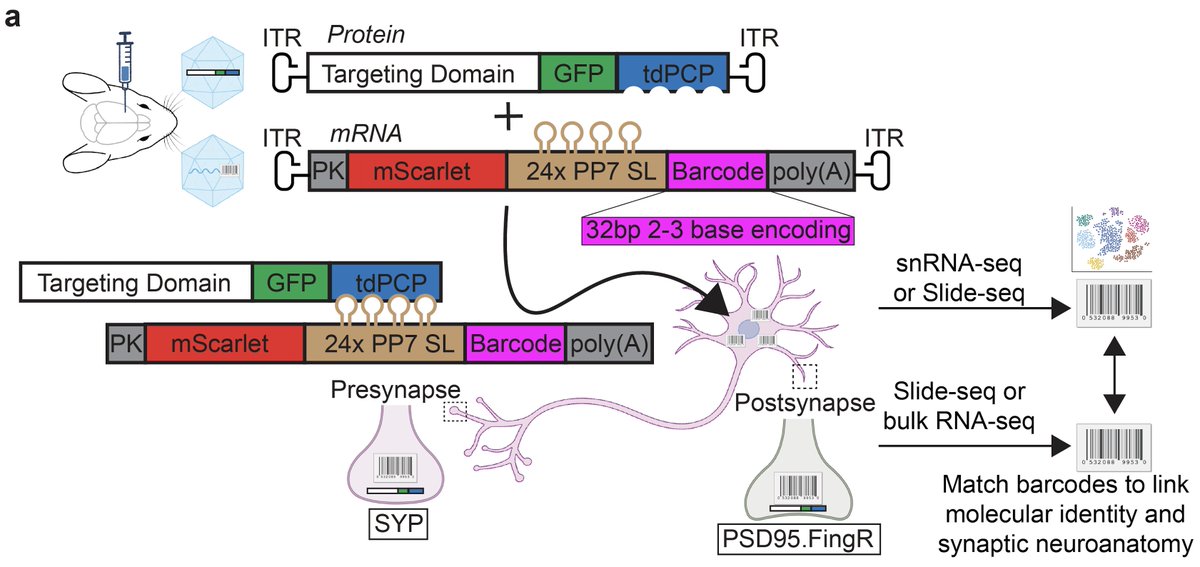
2/8 Introducing Synapse-seq: our AAV-based tool for mapping brainwide presynaptic projections or postsynaptic distributions of molecularly-defined neurons, via protein-guided RNA barcoding & single-cell/spatial readouts: https://t.co/OFvb8uxvAn
We are thrilled to have the following superstars join our fellowship program in July 2026. Congratulations to Erik, Wes, Tushar, Brian, May and Shawna, and congratulations to the MGH GI Division for recruiting such talent. Welcome to the family!
Excited to share new work from our team! Cognitive Behavioral Stress Management (CBSM) has been effective at reducing stress, and enhancing downstream neuroendocrine functioning, among women with breast cancer. But- this work has been in predominately high SES samples. @NGoelMD
Excited to share our preprint, describing a method for heritability partitioning with GWAS sumstats that significantly improves upon S-LDSC
Led by the fantastic Hui Li, and co-supervised by @XihongLin#ASHG24 poster 4089F
https://t.co/RHE6Es1Joi
How do genetic perturbations change cells? How are these effects shaped by cell type and dosage? How do we best extract insight from modern massive perturbation atlases? Im pleased to share a new preprint where we develop a suite of statistical approaches to these Qs (link below)
How do genetic perturbations change cells? How are these effects shaped by cell type and dosage? How do we best extract insight from modern massive perturbation atlases? Im pleased to share a new preprint where we develop a suite of statistical approaches to these Qs (link below)
Could not be more delighted to present our work investigating how over 220,000 complex and molecular trait-associated genetic variants affect transcriptional regulation using massively parallel reporter assays!
https://t.co/1eoN4OxAvd
See below for a 🧵. 1/n
@LNuzhna What exactly is a “human aging dz”? Is cancer a human aging dz in that most cancer incidence rates are an exponential function of age? If so, I cant imagine diffuse mets are an act of bodily compensation
@CalebLareau@tsion_abay@MerilTakizawa @ChaligneRonan @Satpathology Nice re: quality! Unclear, whether they had RNA (we didn't do any staining on top of just a standard electron micro prep). Likely some organelles that glommed onto the nucleus, maybe rRNA? It may not be a huge issue if you're using the same protocol to compare btwn conditions
@CalebLareau@tsion_abay@MerilTakizawa @ChaligneRonan @Satpathology Cool stuff!! How does the quality of the data compare between the sorted/unsorted? Also, curious if you ever did some EM on the gated v ungated, we did a quick single replicate for our DA neurons w the TF enrichment and found, by eye, there was some extranuc material riding along
@tangming2005 Curious what the alignment quality is for those mt- and rps/rpl reads. In brain data i sparingly trust these populations.
Obvi would require stains or flow data to make me really believe it!
Thrilled to have matched at @MGHMedicine in the Stanbury PSTP! Thanks to all my mentors, family, and friends for the support and love.
Thank you to all the patients who have taught me so much so far and the ones that I will learn from on my next journey!
Doctorin’ soon! 🩺🫡