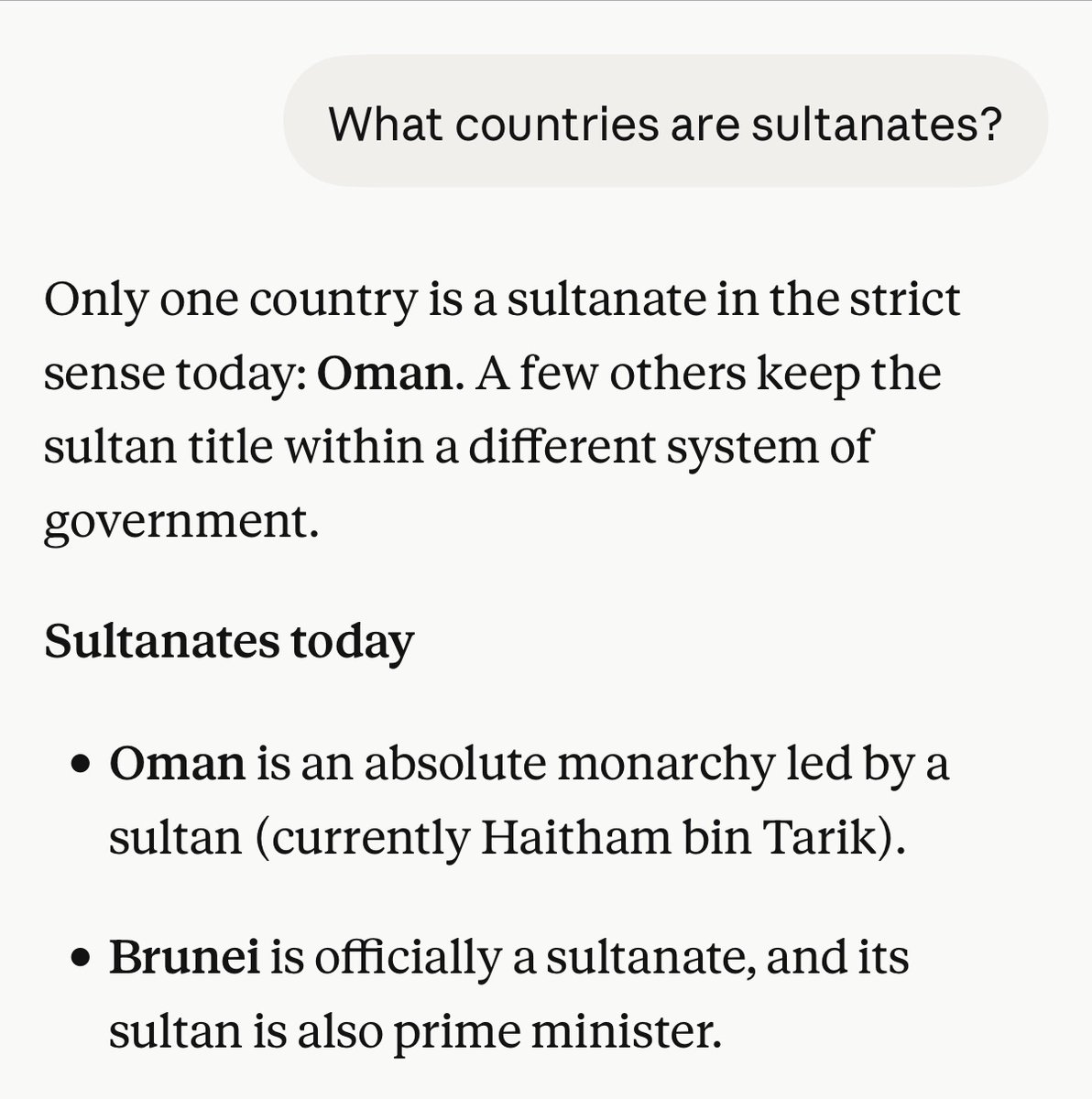
@_Adawy_@Abeer_elAssal Choose your AI. But I think what you are saying makes more sense if we are talking about the ruling system (e.g. Oman is basically a sultanate).
https://t.co/Zd30zfFPfz. $20M Raised. 7 M&A’s completed in 12 months.
Investors include Expa, Coinbase Ventures, and Tenet Fund. 825 million users impacted. You have probably used us already.
We help your favorite fintechs move money to the rest of the world.
This is, if works as advertised, is the best conventional programming buddy. Replace your "subjective" conditionals with this in your code paths. Fast and cheap that you don't need to over think pricing or performance.
After co-inventing ChatGPT, I kept asking myself: why have superhuman chat models not led to AGI?
I’ve spent the last 2 years in stealth building a new way to train models (RLCD), and a new type of frontier AI model that we are releasing today: Jev
• 20-200x faster
• 40-400x cheaper (w/ output tokens free)
• Frontier composable intelligence optimized for decisions
AFAICT the shortest path to AI-based economic revolution
Crowds gathered in Dublin to protest Trump’s visit to Ireland, with demonstrators using imagery featuring Trump, Epstein and Netanyahu to voice their criticism.
I use Linear today in the opposite (and pretty sure the wrong 😅) way. I use it almost entirely as an after-fact rather than a before-fact.
The work gets done mainly in Claude + Paper + GitHub. Then Linear comes in as a repository to log the work that's already done.
But why do that at all? Because it's just far, far faster to get the work done first, sometimes even shipped, and then reason about its broken down components once so much of the ambiguity is out.
So now I prefer work to be "logged" in Linear for record keeping. It's kind of becoming the CRM of engineering work, and my relationship with it starts to feel like a salesperson's relationship with the CRM: necessary to do (maybe even necessary evil), but I don't particularly care about or like doing it.
I even do the breakdown + record-keeping part using Claude with Linear's MCP.
I work within a team, but I take on too much solo-track work, and maybe that's just why.
We’re sharing a solution to the Navier-Stokes Millennium Prize Problem, one of the deepest problems at the frontier of mathematics.
The proof was produced by a group of agents, using an OpenAI next-generation model significantly more capable than GPT-6 Astra.
The problem concerns whether the description of smooth three-dimensional fluid motion modeled by the Navier-Stokes equations can break down. It has remained unresolved for roughly 90 years.