Introducing Chantless: Chapter 1 — Apprentice
A powerful tool makes you free, allows you to express yourself, and learns and grows with you.
This is what we're building with Chantless. A technology that lets you shape and evolve models alongside you.
There is an (unpatchable?) supply-chain zero-day in PyTorch autograd that allows a regularization term to use the model's weights as RAM and SGD as its CPU clock to run any computation during training.
research for me has always been this and hopefully i get to do more of this.
though it comes with its own caveats and it is easy to get cynical or demoralised.
more so than anything else, look past all the negativity as compute and mile high clubs become everything.
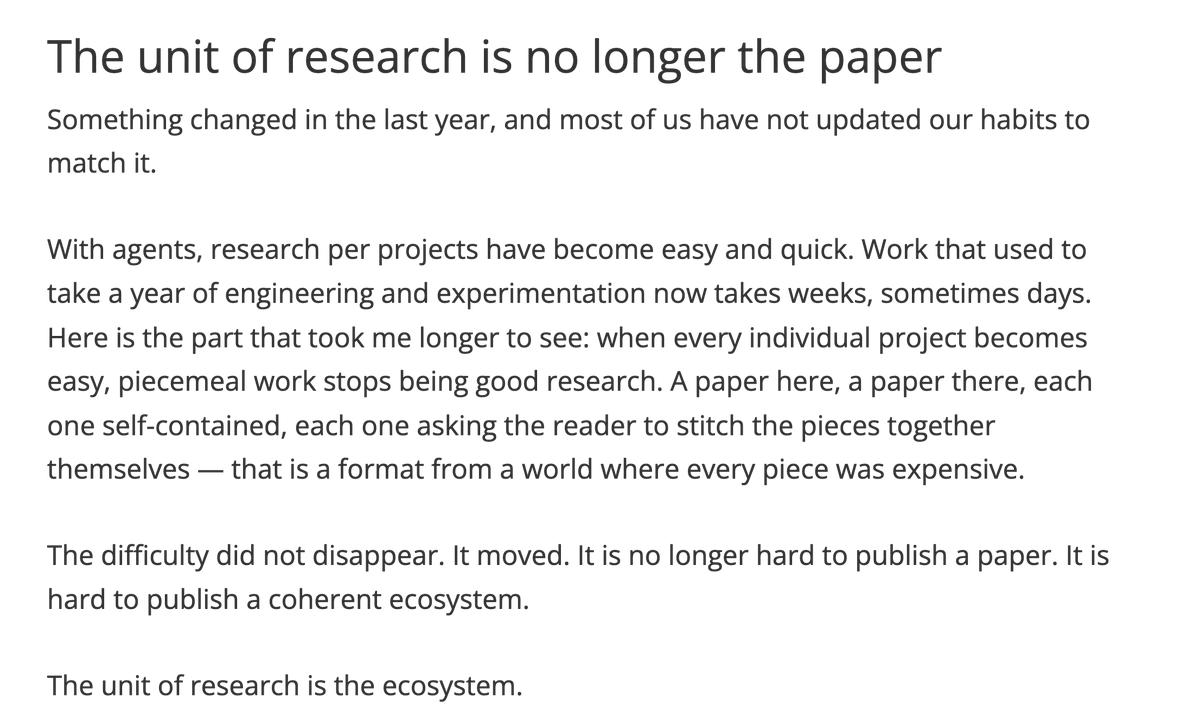
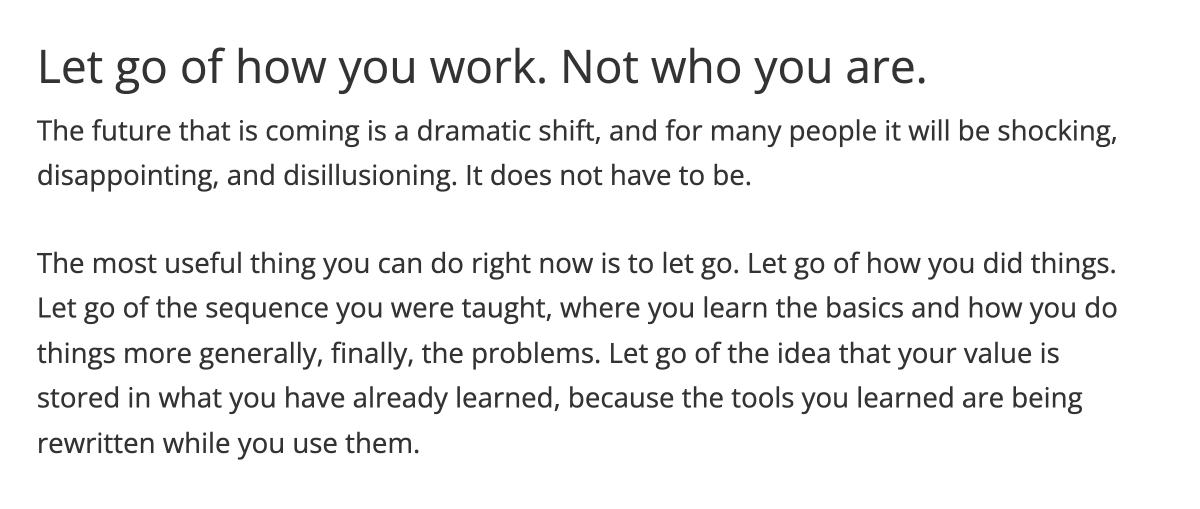
Tons of bangers and useful advice for undergrads and grad students trying to make sense of how to navigate academia and entering industry in the age of agents in @Tim_Dettmers recent blog.
Highly recommend people read it.
https://t.co/3VbFSlxqpF
@30SergioMisal telling myself that there’s only one thing i really need and finding that for the day/week then sticking with methods that have worked for me in the past.
note to myself, three highest leverage skills i can refine continuously are -
> defining precisely what i want to see
> continuously declutter my idea space
> communicate no farther than the edge of common conscious
@brane_trix decluttering is like keeping only what works and is clearly your top priority and throwing away everything else because it is incredibly easy to get lost in this.
i almost didn't want to post this.
70% of my workday runs with gpt-live in codex.
i am losing an edge sharing this.
despite this, the things we don't use don't get better.
so - try it.
seriously, i want it to stay and get better fast.
@cloneisjun it shouldn’t happen normally and would only happen when you’re evaluating on the same ancestor/parent problem that you’re training your counterfactual on.
so you want to go for minimal overlap there and keep things well isolated.
ideas that are non-negotiable for building an ai that actually learns with experience (part 2):
> agents love creating tests but they are useless and more often than not, net negative. passing these tests is like placebo. it serves no more value than giving your agent morale boost.
> counterfactuals are your friend, you are looking for ways to get surprised. so in curation or synthesis, you want to explore in ways like what if agent used a differrent path than earlier. this is clear superiority over the approach where historical traces yield little value because they may only contain happy paths or select few issues.
> your extraction per experience needs to be a structured and meaningful process. some of the things we use that are highly effective are - correctness, error detection/blame assignment, action-level credit, flagging possible sub-trajectories for reuse. one expensive and painful execution can support several cheap learning operations.
> when is human involvement actually useful? primarily the delta i have seen in this area is where we teach the system how to construct and evaluate new experiences. correcting one answer is often weak value and thus you need to have a way to ask your human abstract questions and let the agent backtest strategies applying what it infers from those abstractions.
> you want to checkpoint or version control everything. you are going to use fork/replay/diff/reset a lot if you are working on anything serious.
> your evals need to be robust and diverse enough that you can identify regressions nicely. because in a continual learning environment, you are going to face random unexplained forgetfulness at times and that is why you need checkpointing, to do iterative merge and eval loops in such cases.
> promotion to a new improved version should be much harder than training. think of it like how you have to use your finger multiple times to ensure it is properly being detected. useful insights gathered to make a proper update may take weeks and continual learning isn't going to look like a daily or weekly checkpoint update.
> continual learning in the most practical way i look at it, is a plumbing problem.
ideas that are non-negotiable for building an ai that ACTUALLY LEARNS with experience (part 1):
> collecting prod traces doesn't solve learning and logging becomes useful for learning when we can establish what went wrong. so you want a really neat mechanism to assign blame first.
> majority of the agentic failures shouldn't result in training. if i was to explain this, let's say if a tool is broken, context is not handling something properly then you want to fix it. likewise if knowledge is the missing component, you need to go and fix retrieval. in an ideal world youu want to isolate for all of this and only then think about updating the weights.
> one real world failure and a good human insight translates to hundreds of experiences to learn from. this is the single biggest leverage i have learnt and i would throw away all arch diagrams and fancy memory gardening in favour of this.
> i love synth data and i think doing it right is art but it is equivalent to speculation. the same way a human would generate value out of a thought experiment or brainstorming while organising their thoughts on the paper. i do not expect to discover new truths by using this all by itself.
> multi-agent systems work well in some cases and do not work so well in the other. is serial execution really your bottleneck? are you polluting context for a single agent too much by having decoupled tasks? then yeah, it helps. are you making them work on ideas that are not independent and they need to have lots of message passing between each other then solving message passing is your bigger value generation here.
> having nine units work on something is not a guarantee of nine new solutions. error correlation is high when we are using the same model for everything and if you can, find maximum error decoupling. it is still mostly unsolved and terribly underdiscussed.
> execution is your second best thing that you can do. the best thing you can do is figure out low effort or if possible barely noticeable ways to let the human annotate as much data as yo can.
@KrrishKapoor8 see the agent would never remove tests to fix its contextual bloat by itself, if you’re intervening and have a process to ensure yield based preservation of tests, then it’s fine.
i’m using the loss function from the line-go-up paper on all of 4chan and then RLing on a bunch of temu envs that last-gen claude built out of a failed startup’s monorepo it’s gonna be fine as long as we think hard enough about what alignment means
@FrostForger i still think eventually we would get advanced representations that would compress a lot more than our understanding in the neurons so it may not resolve cleanly for everything but still great.
if i understand this correctly, this says modern LLMs may naturally develop specialized neurons for coherent concepts, rather than arbitrarily mixing unrelated concepts into the same neurons.
so it means given sufficiently large network and enough data/compute, everything should get its clean abstraction.
which is quite convenient and if it was intuitive to some people they would have started working on capabilities isolation six months ago, oh wait.
interpretability might be the most important scientific problem in the world right now, as I don't think we can solve alignment if we don't know what we're building. I think I have good news about it. I co-authored early work in mechanistic interpretability at OpenAI and came away pessimistic, because neural networks appeared to fold into arbitrary tangled knots. years later, I started openai's first large-scale automated interpretability project, finding about 2% of neurons legible with the primitive tools we had
with modern agentic tools and a much closer look, the picture looks totally different. the vast majority in models up to trillions of parameters are legible, and their circuits beautiful. many famous examples of tangled neurons turned out to be misunderstood. The roadblocks I expected mostly aren't there. I now think ambitious interpretability will be solved by the time we need it most, and possibly quite soon, as automated scientists keep improving. it may be a bitter lesson for interpretability: the simple thing, at absurd scale, works
https://t.co/zHij5zwKGT