Some pretty huge news on the writing front: Announcing today that we’ve sold the rights to Artificial Wisdom and sequel in a two book global deal with Del Rey USA (Penguin Random House). Unbelievably excited about what we have in store!
https://t.co/OlTnI11Izf
I’d definitely say my Pod 2 (2022) from @eightsleep was one of the best gadgets I ever bought, especially for summer. Sadly one side of the bed stopped heating last winter, and now neither side cools anymore. So today, it comes off. Thank you for your service 🫡
Great story! I’m super curious whether you still see the same value in a .com so many years after Notion’s brand has become ubiquitous. How should startup founders in 2026 think strategically about domains when most named .coms come at a steep price (in your case, incredibly valuable equity).
Plans released for a $16 billion mile-long ship capable of carrying 80,000 people.
The 'Freedom Ship' would be home to about 50,000 people, with space for 10,000 tourists and 20,000 crew members.
"The Freedom Ship is envisioned as a permanently mobile city at sea designed for long-term residence rather than short-term travel," the company says.
The ship would be about 8 times the size of the current largest ship in the world, the Royal Caribbean’s Icon of the Seas.
The plans include a 15,000-seat stadium, schools, colleges, shops, clubs, a water park, a music hall, museums, parks, and more.
The ship, which would run on nuclear, would be too large to dock and would remain in international waters.
Freedom Cruise International says it would go around the world every two to three years.
Insane.
NEW: Apple readies iOS 27 service that will let users split bills for dinners, events by taking a photo of a receipt and assigning items to friends. This will be part of Apple Wallet and Cash, taking on Venmo and Splitwise. https://t.co/uSCQiLvGUI
Today Instagram had this massive exploit where hackers were just stealing rare handles left and right. Hundreds of accounts gone.
People losing handles they’ve owned since 2010, some worth hundreds of thousands.
I own a few rare ones so I was actually stressed watching this happen in real time, which I haven’t been in years.
Obama White House account got hit.
These aren’t some random new accounts, these are verified, locked down accounts and they still got compromised.
The thing is the exploit is so simple it’s almost funny. Attacker goes to Forgot Password, says their account is hacked, turns on a VPN to match the target’s location (which now you can find on the about section of the page).
Instagram’s AI support flow asks them to verify with a selfie.
They grab a photo from the target’s profile, run it through an AI video generator to make an animation of the person’s face moving around, upload that to Meta’s AI as proof.
And Meta’s AI just accepts it because it can’t tell the difference between a real selfie and an AI-generated video of someone’s face
.
Once verified they change the email to theirs. Password reset link goes to their email. They own it now. 2FA gets bypassed somehow in the process but honestly I don’t know exactly how, just that it did.
Point is even locked down accounts went down.
Then you try to recover your account and you’re talking to a chatbot that has zero ability to help.
You can’t escalate to a human. You’re just stuck. Your asset is gone and there’s no one to call.
The whole thing just highlighted how stupid it is to automate account security without any human in the loop.
One AI fooling another AI while there’s literally no person anywhere to catch it.
Meta took hours to even acknowledge it while accounts were getting stolen every minute.
Now thankfully it’s patched but I don’t think it will be the last one. Stay safe!
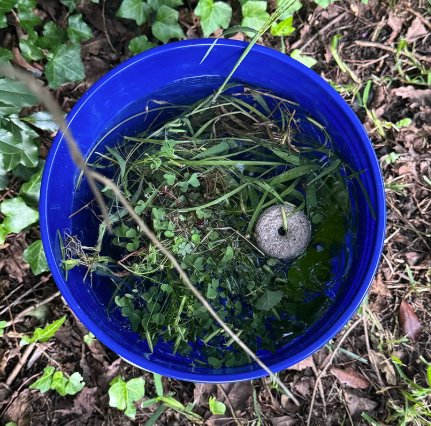
You can crash your yard's mosquito population without spraying a single chemical with a Mosquito Bucket of Doom.
Fill a 5-gallon bucket about two-thirds with water. Drop in a handful of grass clippings, leaves, or hay. Let it sit for a day, then drop in a Bti dunk (also called Bacillus thuringiensis israelensis, sold at any hardware store as "mosquito dunks," about $10 for six).
Mosquitoes are powerfully attracted to fermenting water and will lay their eggs in your bucket. Bti is a naturally occurring soil bacterium that produces a toxin that kills mosquito, blackfly, and fungus gnat larvae only.
This method doesn't harm bees, butterflies, fireflies, fish, frogs, birds, pets, or people. BTI dunks are EPA-approved for organic use and safe in animal water troughs and birdbaths.
One dunk lasts about 30 days. Top off the water as it evaporates. Cover with 1/2-in Mesh Hardware Cloth to prevent animals from getting trapped and put the bucket somewhere shady where pets and kids won't get into it.
The bucket becomes a mosquito magnet and a dead end. Compare that to fogging the entire yard with pyrethroids, which kills every insect in it, including the predators that eat mosquitoes.
Doug Tallamy's Homegrown National Park has been running the "Mosquito Bucket Challenge" since 2021. The more buckets in a neighborhood, the bigger the dent. One bucket per yard is a great start.
With everything we are hearing right now about ticks this seems like good information to share.
“Here’s what I’ve learned after more ticks than I care to count.
First, whatever your uncle told you, forget it. No matches. No nail polish. No Vaseline. No soap on a cotton ball. All of those do the same terrible thing, they stress the tick out, and a stressed tick empties its gut back into the bite before letting go. Which, if you think about what that actually means for a second, is literally how Lyme and the rest get transmitted so you’re not speeding up its exit. You’re making it throw up into you.
Fine-tipped tweezers. Grip right where the mouthparts enter the skin, not the body, the head. Pull straight up, steady, no twisting, no jerking. It’ll feel like it’s resisting because it is, the mouthparts are barbed. Just keep the pressure on and it lets go in a few seconds. If a piece breaks off in the skin, leave it alone. Your body pushes splinters out. Digging around with a needle does more damage then the fragment ever would.
Clean it with alcohol or soap. Wash your hands.
Now here’s the part most people skip: don’t flush the tick.
Tape it to an index card. Clear packing tape right over the body, write the date and where on your body it was, and stick the card in a drawer. If you come down with anything weird in the next 30 days, rash, fever, joint pain, that flu-that-isn’t-flu feeling, that tick goes with you to the doctor. Some labs will test the tick itself, which is faster and often more reliable than waiting for antibodies to show up in your own blood. A dated tick taped to a card is one of the most useful things you can hand a doctor who’s trying to figure out what’s wrong with you.
The other thing worth saying out loud: if the tick was engorged when you pulled it, and you can’t swear it was off your body within 24 hours, call your doctor that same day. Don’t wait for a rash. Fewer than three out of four Lyme cases even produce the classic bullseye. A single preventive dose of doxycycline within 72 hours of a deer tick bite cuts the Lyme odds way down, and most docs in tick country will write that prescription without giving you a hard time, especially if you walk in with the tick taped to a card and a clear timeline.”
The 2010s were about liberating our reliance on local files. We moved our data to the cloud and gave our DVD collections and CDs to the charity shops. Kindle sales went up and hardbacks declined.
The next decade is going to see a shift back. Local context is better for personal AI. The big tech companies have lost our trust as gatekeepers of our data and the risk of being locked out of your own work (or having something innocuous being reported to the police by algorithms) is a dealbreaker. Paper books rule again and customers are seeking open course e-readers. Music and media are going to be harder but I can see signs of shifts.
We rely on digital now, it’s too important to our lives to risk this kind of thing happening 👇
A dad took a photo of a rash on his sick toddler so the doctor could see it over video. It saved to Google Photos by itself. Two days later Google had wiped his email and phone number and reported him to the police for child abuse.
The police looked into it and cleared him completely. Google still would not give his account back. That same year another dad in a different state went through the exact same thing, and the New York Times wrote about both of them in 2022.
The manga artist in this post fell into the same machine. Anything you save to Google Drive or Google Photos gets scanned and turned into a kind of digital fingerprint, a short code that stands in for your file. Google compares that code against a huge list of files it has already banned, like pirated movies or known abuse photos. The newer software does not even wait for a match. It looks at a picture it has never seen and makes its own guess about whether you broke a rule.
When the software flags you, the damage does not stop at one file. Your Google login is also your YouTube, your photos, sometimes your phone service, and the button you click to log into dozens of other websites. One flagged upload can lock you out of all of it at once, which is how the artist lost things that had nothing to do with Drive.
This post asks how long Google has been doing this, and the numbers answer it. In a single six-month stretch, Google reported more than a million files to the national center that tracks child-abuse material and shut down about 270,000 accounts. Some of those people did nothing wrong, like the two dads.
Getting back in is nearly impossible. A law from 1996 gives tech companies broad legal cover for decisions like this, and the fine print you agreed to lets Google shut your account whenever it likes. The dad the police cleared never got his back, even after officers confirmed he had done nothing wrong.
Anything you upload to Google can be scanned by software with the power to shut down your whole online life on its own, before a single person ever reviews the decision. The manga artist is just the latest to find that out.
This is the greatest video I’ve ever seen. No notes. The lifeless clanker carcass just laying there. No crowd reaction, anything. Just Billie Jean. Until its lifeless shell is shamefully dragged off. Purely amazing.
Not sure who to personally thank for a finished copy of the paperback of Artificial Wisdom by Thomas Weaver published 4 June, one of last year’s top reads and a perfect beach read, pre order now @tom_weaver@TransworldBooks
Every plant on Earth runs on stolen technology. A cell swallowed a bacterium 1.6 billion years ago and kept it alive. That's where chloroplasts come from.
Could we replay it? Put photosynthetic machinery back into animal cells, on purpose?
In 1969, Margit Nass asked: what if we did it again, on purpose? She put spinach chloroplasts into mouse cells. They survived five days. She published it in Science. One author.
Then the field walked away. Fifty years of nothing.
This week, scientists at @NUSingapore put spinach chloroplasts into mouse eyes as eye drops. The corneal cells absorbed them and started photosynthesizing. Dry eye damage reversed in five days. Beat Restasis.
Evolution's oldest trick just became a therapy.
🚨 Revealed 🚨the shortlist for Audiobook of the Year.
Voted for by you, the readers, the winner will be announced this June 18th at the Capital Crime Fingerprint Awards!
Vote now: https://t.co/KNU9L0WJZt
@lisajewelluk@tom_weaver@blacklionking73@SarahPinborough