1/ Are stimulus checks effective in stimulating the economy during recessions?
In my JMP, I find the answer is NO.
Why? Heightened unemployment risk lowers the marginal propensity to consume (MPC). 🧵👇
#EconTwitter#Econjobmarket
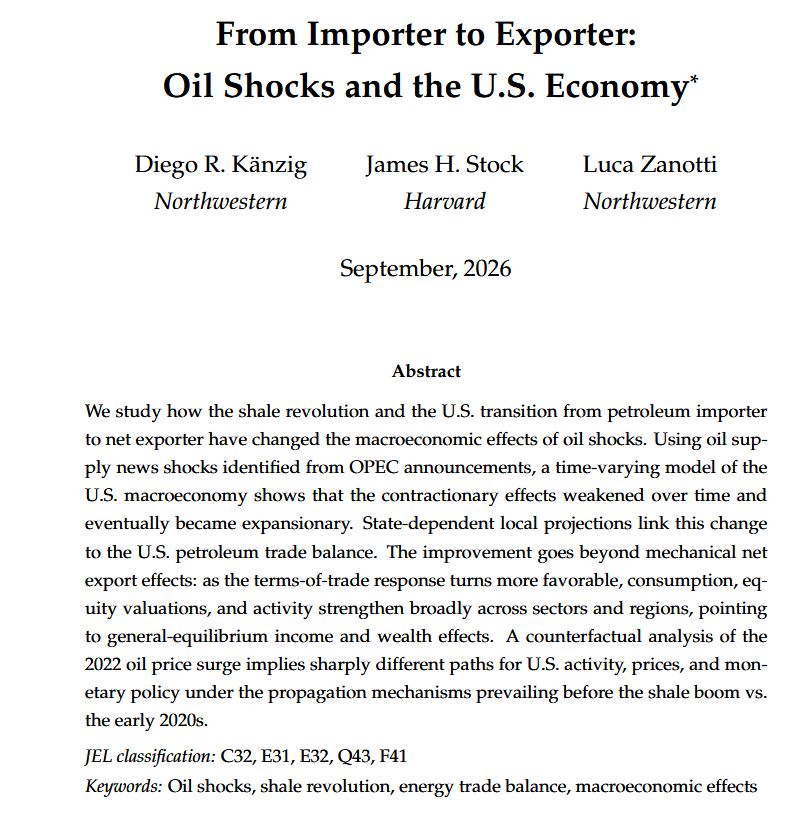
Very excited to share our new paper with Jim Stock and @LucaZanotti8:
“From Importer to Exporter: Oil Shocks and the U.S. Economy”
I’ll present it today at the Fall 2026 BPEA conference @BrookingsEcon.
Paper: https://t.co/o2c0TAbjK5
Livestream: https://t.co/7zoVNxmsCC
Thread below👇
@maxgoedl@StephanoLAC@BachmannRudi Being able to verify all logical steps doesn't necessarily mean understanding a proof. The latter requires knowing the intuition behind the proof strategy. For big problems like NS, it's also critical to understand why a proof strategy doesn't work. AI proof won't tell you that
A lot of people are missing Terence Tao’s point and thinking “mathematicians are upset that AI is better than them.” That’s not what he’s saying, and some people are forgetting that Tao is one of the most AI-pilled mathematicians out there.
His point is that when people work on discovering something, along the way they invent new concepts. Those concepts later become useful far beyond the original goal, and enables further inventions. Finding a solution does matter, but the intermediate idea is often what makes the field richer, because other people can share it and build the next thing from it.
In tech, we can use the analogy of collaborative software. We started with algorithms for merging changes in a Word document, and evolved that to concepts about versions, diffs, and merges, and later to real-time collaboration tools like Git, Google Docs, and Figma. Humans built upon these concepts and developed more powerful solutions.
Terence’s worry is that a machine automating a solution robs the field of the value of developing the intermediate discoveries in the pursuit of larger discoveries.
When automating a solution, the intermediate discoveries and invention of concepts can be buried or completely hidden in the black box. We don’t learn from them to build the next thing; it’s like we never made the invention of collaborative document editing and thus could not have the conceptual understanding to invent the next version – and since it’s hidden, we also don’t socialize them to allow other people to invent, too, a core tenet of collective discovery.
So then, in both code and math, this leads to the atrophy of development of concepts in the field.
In other words: pure ‘solution extraction’ that hides the process of discovery can leave the field with a checked-off theorem but little new insight or new questions to pursue. And it might prevent us from understanding a field deeper.
I am seeing, first-hand, that atrophying of skills in software development. We push buttons and get solutions. There is much less incentive to develop new concepts and human skill. The bet most software companies are making is that LLMs are so effective in writing code that you’re still shipping overwhelmingly more value even with human skill atrophy, and it’s the right bet IMO.
However, much of the software industry is built upon building things, not necessarily novel invention and research. In such an environment, you can say that you accept some atrophying of conceptual invention and human skill for more output.
On the other hand, sectors like math and pure sciences that are focused on invention and insight might be the hardest hit by this.
Practical/applied sciences might fall somewhere in the middle. An Alzheimer’s cure, room-temperature semiconductor, or highly effective carbon capture solution are far too valuable to sandbag and say only humans can do that to develop concepts in the ‘proper’ way. The outcome matters too much to treat the preservation of concept invention as the highest goal. Even there, though, hidden intermediates can slow the next breakthrough if nobody can see how the first one actually worked.
So the question is not “is AI allowed to solve hard problems?” It is “in this field (math, science, tech, etc.), is the answer itself the main point, or are the concepts and abstractions we use to get there also the thing we need to maintain?”
In pure math, there’s an argument that the intermediates are often more useful than the solution, and atrophy in concept development is highly detrimental to the field. Solving Navier–Stokes, contrary to what some people claim, has little practical application, and pure math might be one of those fields where just finding a solution isn’t the entire point, and can actually be contrary to the field, which is what Tao is worried about.
How can we use macro and micro data jointly to discipline HANK models? Florian Huber, Gary Koop, and I address this in “Beyond Aggregate VARs: A Bayesian Benchmark for HANK Models”.
https://t.co/tZdrmE3WF3
@cmatthes_econ Second this. HA models make predictions about cross-sectional dynamics, and we could use this information when testing and estimating these models. @YadSelvakumar and I develop a simple structural estimation framework for doing so. https://t.co/zMhxopIMqQ
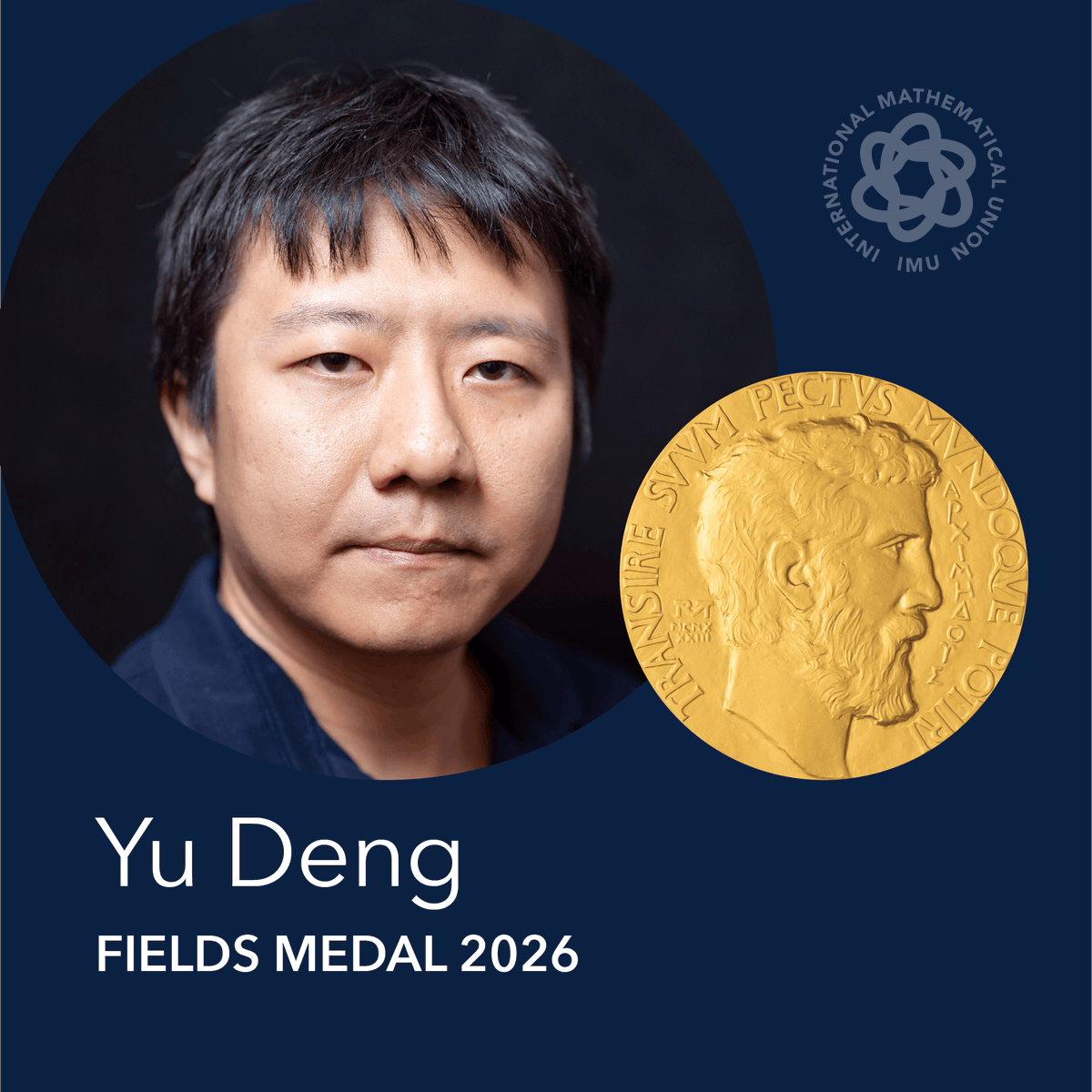
During today's #ICM2026 opening ceremonies, the IMU announced the 2026 Fields Medals recipients:
@UChicago's Yu Deng, @stonybrooku's John Pardon, @UofT's Jacob Tsimerman, and Hong Wang of @nyuniversity and @Institut_IHES.
Read more: https://t.co/oJARAI8I8j
We have a new version of our paper on panel local projections with macro shocks!
📄What do panel LPs estimate? How to calculate robust standard errors?
📄Matlab and R packages
📄Empirics: We revisit the role of financial frictions in shaping the transmission of monetary policy
Konnichiwa! WAMS will be in Tokyo, Nov 20-22
Keynotes:
Yan Bai
Refet Gürkaynak
Apply by end August for
Workshop of the Australasian Macroeconomics Society
https://t.co/PHnGFgM3HS
The Fed just announced the leaders of the new task forces that Kevin Warsh spoke about in his first press conference: https://t.co/spHxllBOMS
It's an impressive list, including Raghu Rajan, Jeremy Stein, Chad Jones, Kevin Murphy, Greg Mankiw and Tom Sargent(!)
New paper: "How Does Monetary and Fiscal Policy Affect the Economy in the Face of Large Shocks?" (with @KenMiyahara ) Paper: https://t.co/76PmxQm9He
Two model features are important for understanding the effects of policy in the COVID era: heterogeneous households + state-dependent pricing.
How would the US economy have evolved under different fiscal and monetary responses? 🧵
🚨📢 - We're currently organizing the 3rd Annual e61 Micro for Macro Workshop in Sydney (Dec 14-15). We have a fantastic set of speakers confirmed and we'd love to consider your best work as we put the rest of the program together. Call for papers below. Deadline July 17!
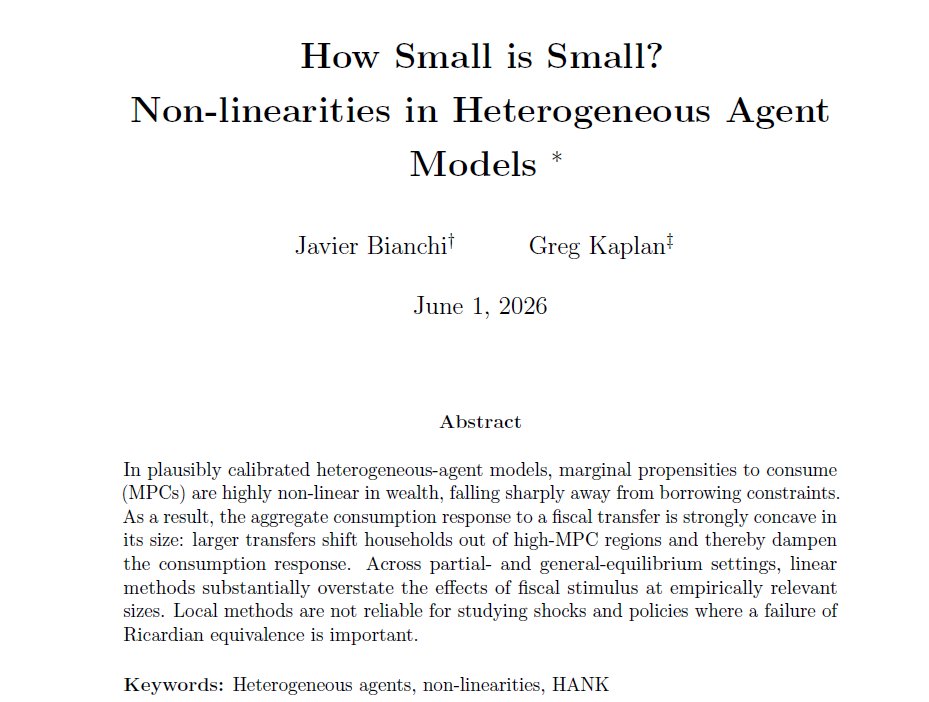
📢 New paper w/ @GregWKaplan 🧵1/10
How small is “small” for local-linear methods to deliver reliable answers in heterogeneous-agent models of fiscal stimulus?
Our answer: very small.
This is a subtle but thought-provoking paper that I think everyone should read. Ordinarily, we assume some way that firms compete, whether on prices or quantities. What happens if the choice of competition is itself chosen? Monetary policy might fail us when we need it most. 1/
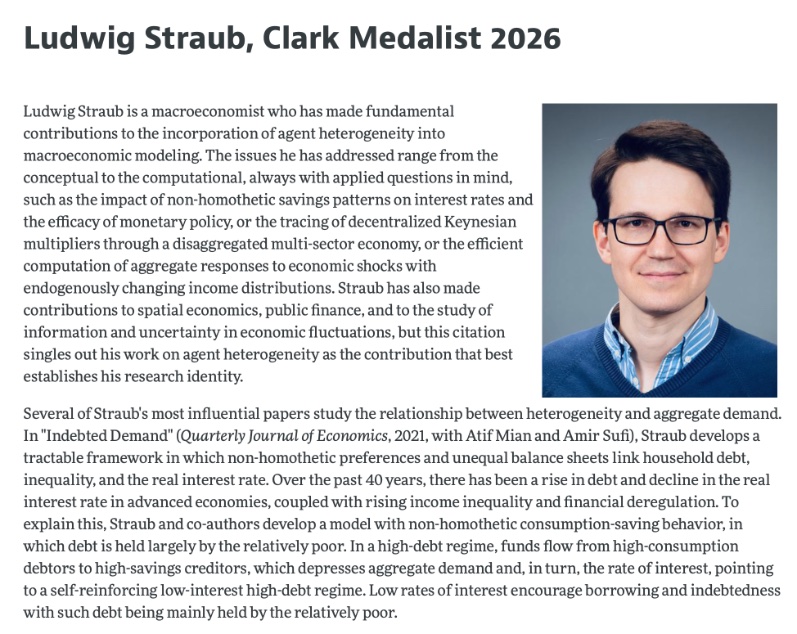
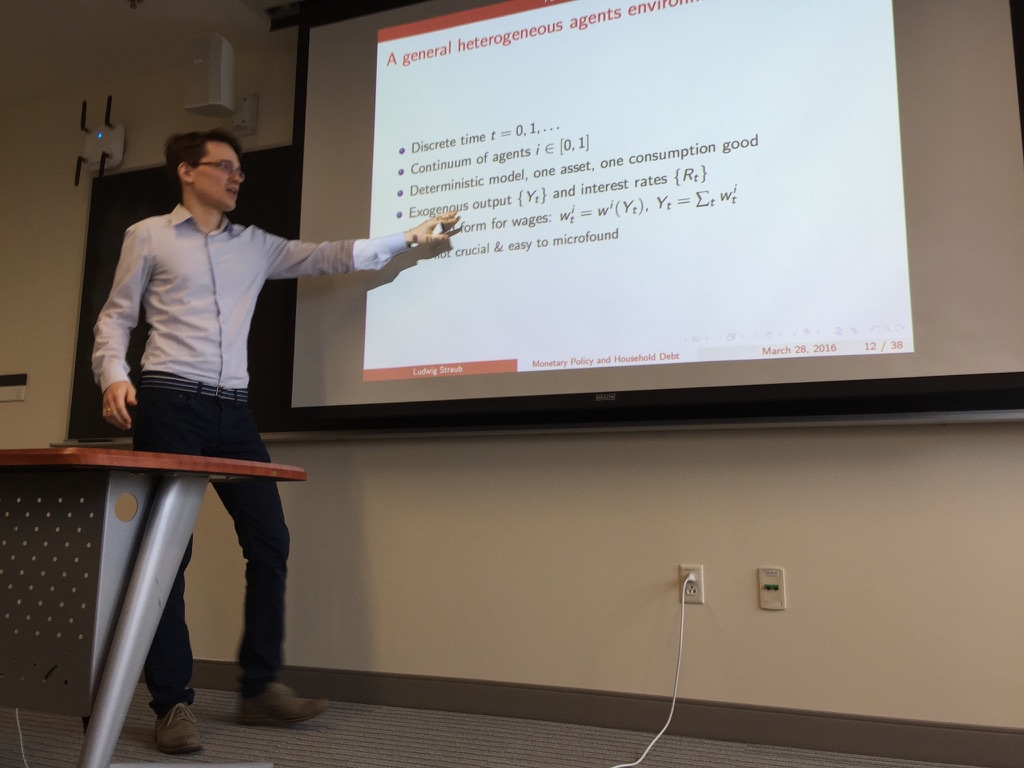
Congratulations to Ludwig! Extremely well deserved. Very happy for him and a testament to all his great coauthors. Here he is as a 3rd or 4th year student presenting in our macro student lunch at MIT.
Let me tell you a bit about John's work (the part that is most closely related to my own research), because it is the way I can best memorialize him, and I think he would want to be memorialized by his peers.
🚀 Draft chapters my forthcoming MIT Press book:
𝗛𝗲𝘁𝗲𝗿𝗼𝗴𝗲𝗻𝗲𝗼𝘂𝘀 𝗔𝗴𝗲𝗻𝘁 𝗠𝗮𝗰𝗿𝗼𝗲𝗰𝗼𝗻𝗼𝗺𝗶𝗰𝘀: A Tractable New Keynesian Framework
A modern, analytical roadmap to TANK & HANK models for researchers, students and policy institutions
https://t.co/La1oqEmGEY
👇
💻 If you’re serious about computation in economics, you eventually need to get serious about hardware. And that includes FPGAs 🔌.
⚙️ Field-programmable gate arrays (FPGAs) allow users to configure programmable logic blocks to execute specific algorithms, avoiding the “one-size-fits-all” limits of standard CPUs.
In economics, we deal with very heavy computation:
• Hundreds of millions of observations
• Large-scale ML model training
• Dynamic programming with dozens of state variables
(among many others).
Even with state-of-the-art algorithms and high-performance programming languages like C++, runtimes can stretch into weeks.
Economists have therefore turned to more advanced hardware, including large-scale parallelization and GPU acceleration. I’ve published on both.
But FPGAs? Still underused—despite being far more accessible today, thanks to cheaper hardware and new high-level synthesis (HLS) compilers.
🔬 Together with @ChBhagath, André DeHon, and @AlePeri83, we explored how FPGAs can accelerate macroeconomic models.
We programmed an FPGA to solve heterogeneous agent models with incomplete markets and aggregate uncertainty—a standard but intensely demanding macro problem.
🚀 Result: a single FPGA performs on par with 69 CPU cores on a conventional cluster.
Why? Because FPGAs unlock:
• Instruction pipelining
• Data-level parallelism
• Precision tuning
These gains are not theoretical. You can now access FPGAs easily via Amazon Web Services. The implications for economics are significant.
Check this link:
https://t.co/798LDDsKgJ
for:
📄 Paper.
📂 Replication code.
📘 Tutorial PDF.
FPGAs are no longer exotic. They are useful, affordable, and within reach. Economists should take note.
Very excited to be organising with Gabriela Nodari at Economic Research
@RBAInfo
and
@SedlacekPe
the RBA Quantitative Macroeconomics Workshop. It will be held in Sydney on 11-12 December 2025.
Submit a draft of your paper to https://t.co/d5FXjg9yFL by Friday 8 August 2025.